Question 20May/Jun 20269706/111 mark
Which statements are correct?

Show answer
BCorrect answer
Cambridge 9706, Paper 1 & 2. 1,558 questions, 2020 to 2026.
Pages reproduced from the original Cambridge question papers and mark schemes. Tables, ruled accounts and answer templates are cropped images, not retyped — shown on a white card so they stay readable in dark mode. Paper 2 questions with parts in more than one topic are filed whole under every topic they touch; parts outside the chosen topics are dimmed. Click any image to enlarge it. Mark schemes are hidden until you choose to reveal them.
Accounting information for stakeholders: ratio analysis of profitability, liquidity and efficiency, and interpreting the results.
113 past paper questions on this topic since 2020, across 13 exam sessions.
| Year | Paper 1 | Paper 2 | Total | Chart |
|---|---|---|---|---|
| 2026 | 12 | 3 | 15 | |
| 2025 | 19 | 3 | 22 | |
| 2024 | 14 | 4 | 18 | |
| 2023 | 19 | 3 | 22 | |
| 2022 | 21 | 1 | 22 | |
| 2021 | 7 | 2 | 9 | |
| 2020 | 4 | 1 | 5 |
The whole topic on one page, with answers and mark schemes. Printing this page prints just this list.
Which statements are correct?
BCorrect answer
A company provided the following information at the end of the year on 31 December:

What is the return on capital employed (ROCE)?

CCorrect answer
The following information is available for a business.

What is the purchases figure for the year?

DCorrect answer
John is a sole trader. His business provided the following balances at the end of a financial year.
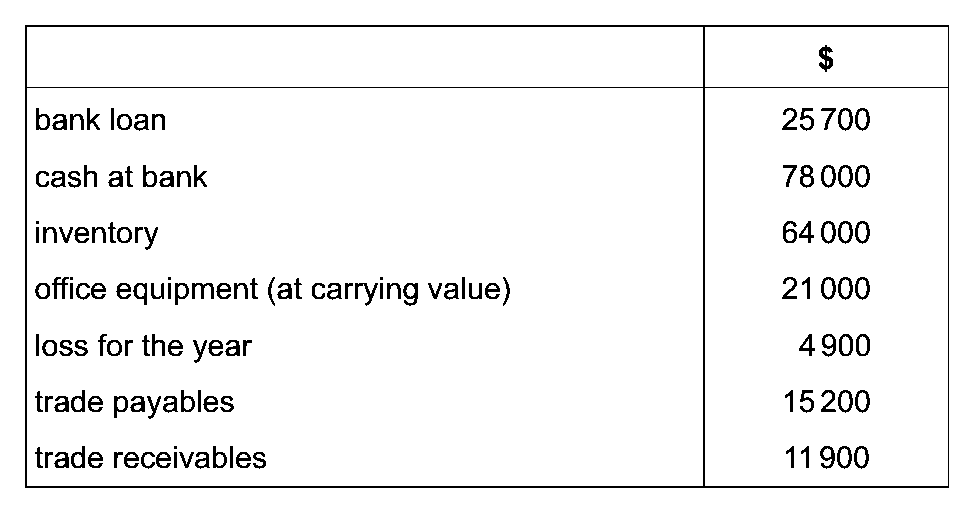
What was the capital balance at the beginning of the financial year?

CCorrect answer
Which statements about users of accounting information are correct?

CCorrect answer
How is non-current asset turnover calculated? total net book value of non-current assets

total net book value of non-current assets total cost of non-current assets

BCorrect answer
Which statements are correct?

BCorrect answer
A company provided the following information at the end of the year on 31 December:

What is the return on capital employed (ROCE)?

CCorrect answer
The following information is available for a business.

What is the purchases figure for the year?

DCorrect answer
Which ratio can be calculated to measure the profitability of a business?
CCorrect answer
A business provided the following information for the year.
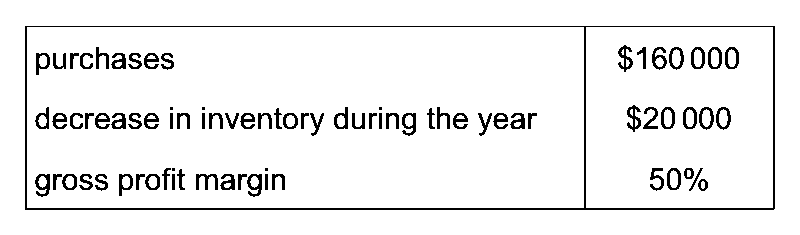
What was the gross profit?

DCorrect answer
A manufacturing business makes product X. Each unit of product X requires:

The factory overhead applied is $5 per direct labour hour. The required profit margin of the business is 20%. What is the price to be charged for one unit of product X?

DCorrect answer
Which stakeholders would focus mainly on the liquidity of a business?

DCorrect answer
A company’s financial statements show the following information.
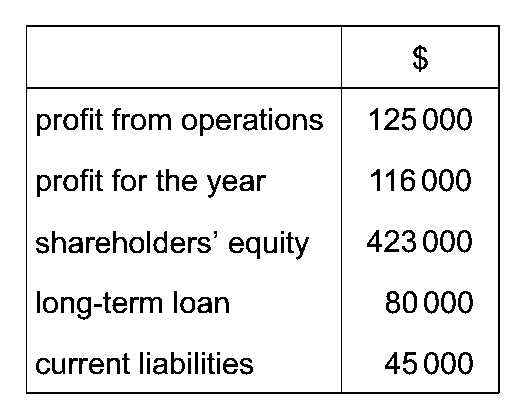
What is the return on capital employed?

DCorrect answer
The owner of a business has provided the following information.

What is the business’s revenue?

BCorrect answer
Who are the internal users of financial information?

BCorrect answer
A trader calculates his trade receivables turnover as 89 days. What was the denominator (bottom figure) in his calculation? A credit purchases B credit sales C trade payables D trade receivables

BCorrect answer
The following details have been extracted from the financial statements of a limited company.
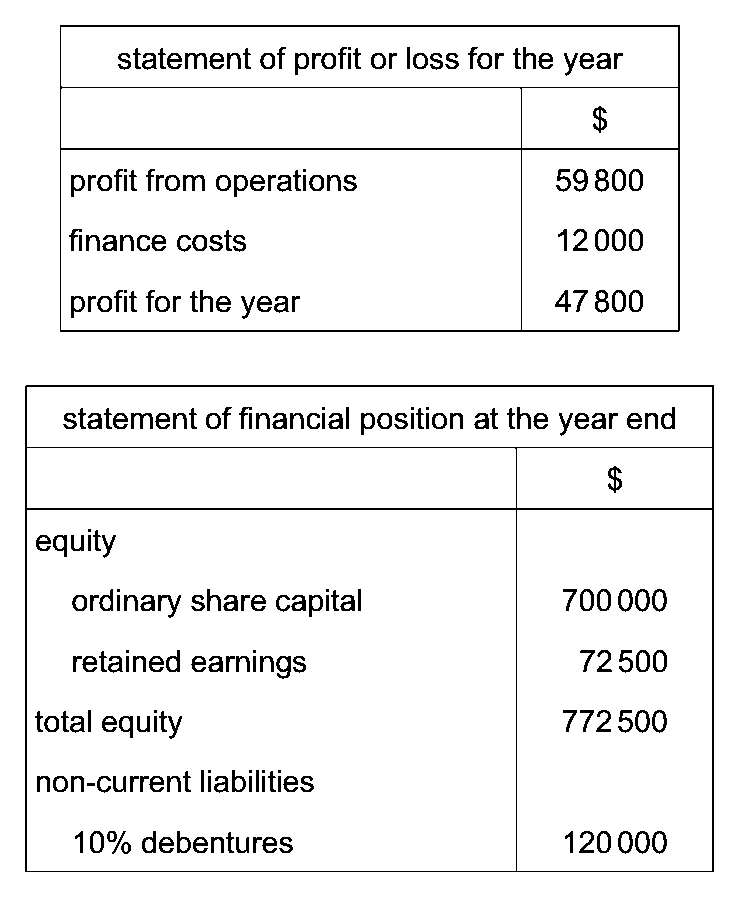
What was the return on capital employed?

CCorrect answer
Arya sells one type of product at a unit price of $100 and with a credit period of one month. Customers’ purchases in excess of 80 units are allowed a discount of 5%. Roy purchased 100 units but returned 10 units two weeks later. How should Arya record the sales returns?

CCorrect answer
A trader calculates his rate of inventory turnover as eight times a year. What was the numerator (top figure) in his calculation? A average inventory B closing inventory C cost of sales D credit purchases
CCorrect answer
A business has the following balances at the end of a financial period.

What is the closing balance on the owner’s capital account at the end of the financial period?

BCorrect answer
Which statements about ratios are correct?

ACorrect answer
A limited company achieved a return on capital employed of 5% for the previous financial year. The following additional information is available.

What was the profit for the year of the company?

BCorrect answer
A company had the following balances at 31 December.

The current ratio is 2.5:1. What was the value of trade payables at 31 December?

BCorrect answer
The table shows year-end information for a company.

What is the return on capital employed (ROCE)?

DCorrect answer
A manufacturing business provides the following budgeted annual information.

Fixed overheads are absorbed on the basis of direct labour hours. A job requires direct materials costing $480 and needs 30 labour hours. The business wishes to make a profit margin of 25% for this job. What is the price to be quoted for this job?

BCorrect answer
A business has the following balances at the end of a financial period.

What is the closing balance on the owner’s capital account at the end of the financial period?

BCorrect answer
Which statements about ratios are correct?

ACorrect answer
A limited company achieved a return on capital employed of 5% for the previous financial year. The following additional information is available.

What was the profit for the year of the company?

BCorrect answer
What is not a limitation of accounting information?
ACorrect answer
The accounting year of a company ends on 31 December. At the end of Year 1, the company was financed by equity of $850000 and there were no long-term borrowings. At the beginning of Year 2, a 6% debenture of $150000 was issued. Profit for the year for Year 2 was $58000 and dividends of $20000 were paid. What was the return on capital employed for Year 2?

CCorrect answer
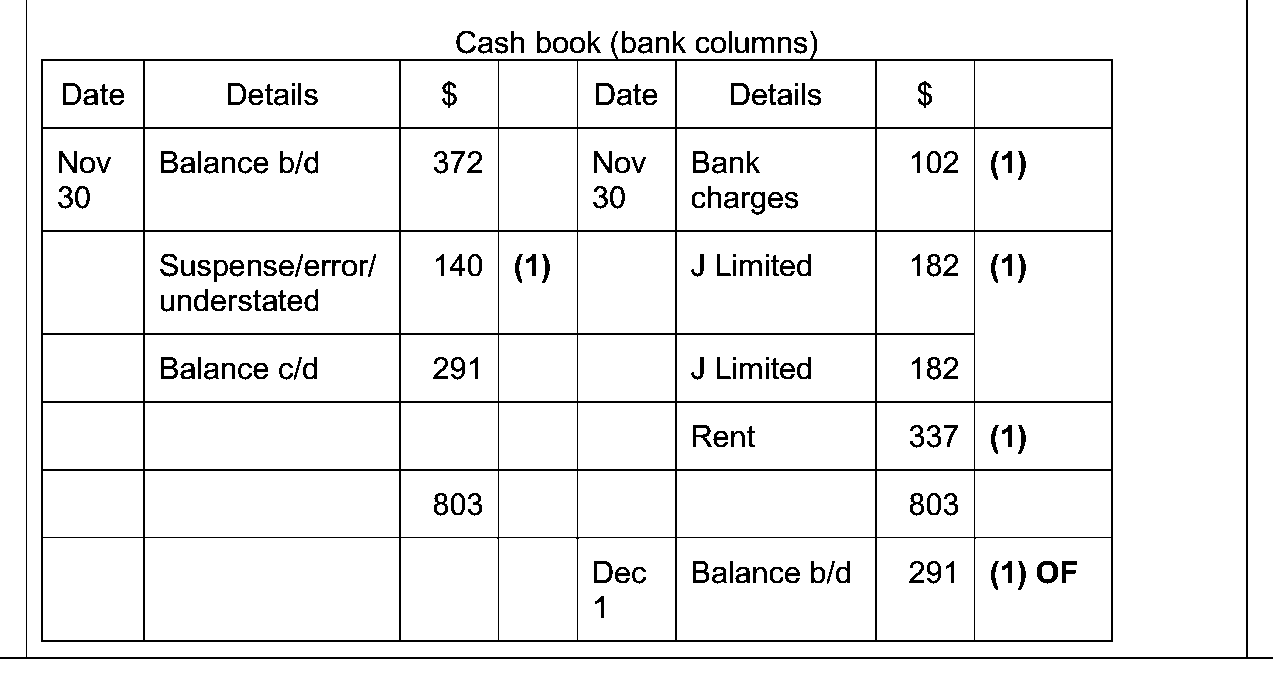
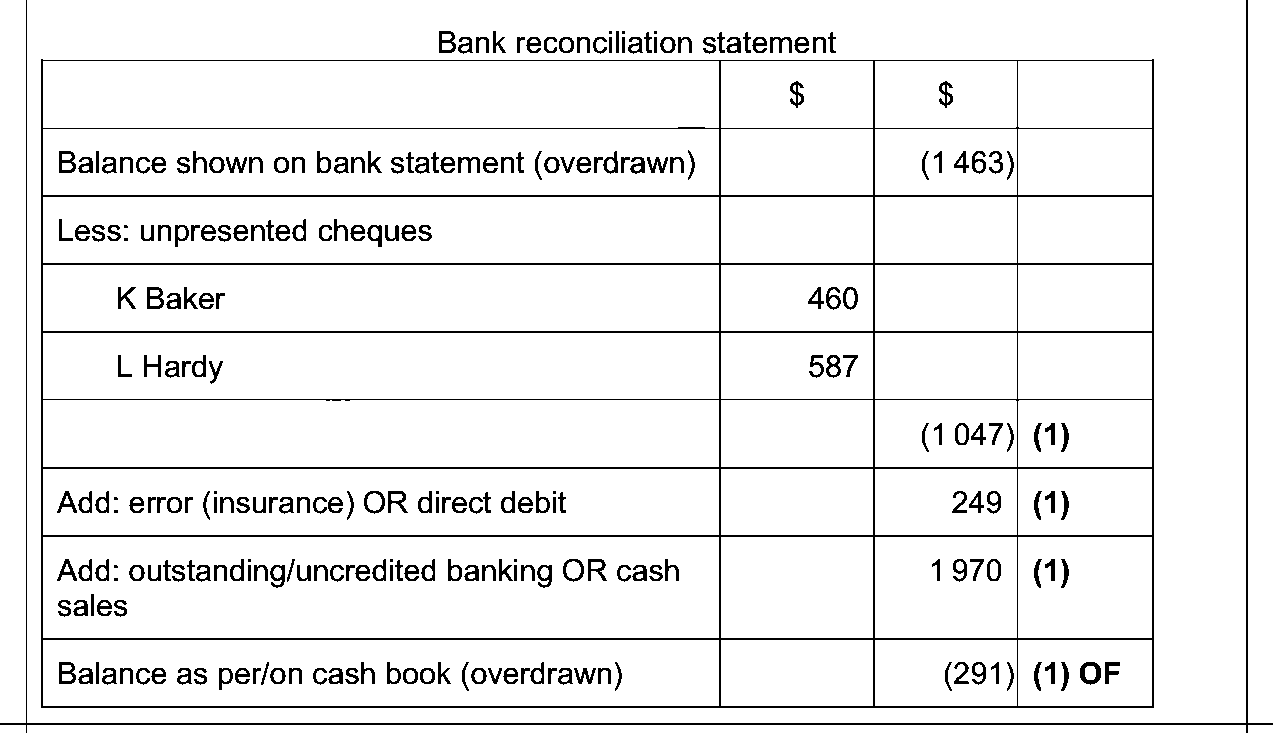
Faisal received a bank statement for the month ended 30 November 2025. The bank statement showed his business had an overdraft of $1463 on that date, but the cash book showed a debit balance of $372. A comparison of the bank statement and cash book (bank columns) revealed the following: 1 The bank statement showed an entry for bank charges of $102 which had not been recorded in the cash book. 2 At the end of the month, there were unpresented cheques: K Baker $460 and L Hardy $587. 3 The balance of the cash book had been understated by $140. 4 A cheque received from a customer, J Limited, for $182 had been dishonoured by the bank. It was correctly recorded in the bank statement but had been entered on the wrong side of the cash book. 5 The bank statement included a direct debit of $249 for insurance. This should have been charged to Faisal’s personal account and not the business bank account. 6 A standing order of $337 for rent had been included in the bank statement but had been omitted from the cash book. 7 Cash sales of $1970 had been paid into the bank on 30 November 2025 and recorded in the cash book. This transaction had not yet been recorded by the bank.
(a) Prepare an updated cash book at 30 November 2025. [5 marks]

(b) Prepare a bank reconciliation statement at 30 November 2025. [4 marks]

(c) Identify two features of a standing order payment. [2 marks]
(d) Explain two reasons why it is important for a business to be able to prepare complete and accurate financial statements. [4 marks]
(a)

(b)

(c)
A standing order is paid automatically by the bank on the instructions of the customer (1) The payment is made at regular or fixed intervals/every month/recurring (1) A standing order is for an agreed fixed sum (1) Max 2 Accept other valid responses.
(d)
Accounting records will be used as the basis for decision making/future planning about the business (1). Unless they are error free, decisions are likely to lack validity/ensures reliability (1). Accounting records will be used by a range of stakeholders (1), who could be misled by any inaccurate information (1). Inaccurate accounting records could mean that a business fails to meet legal requirements/tax authority requirements (1), leading to possible penalties (1). To assess the performance of the business/enable to make comparisons (1) and can then identify which parts to improve (1). To gain bank loans/investors (1) need to see existing liabilities/profit to make decisions (1). Max 2 reasons 2 marks (1 mark for identification of reason and 1 mark for development) Accept other valid responses.
Naila is a retailer. All sales are on a cash basis; all purchases are made on credit. The following details are available for the year ended 31 December 2024.
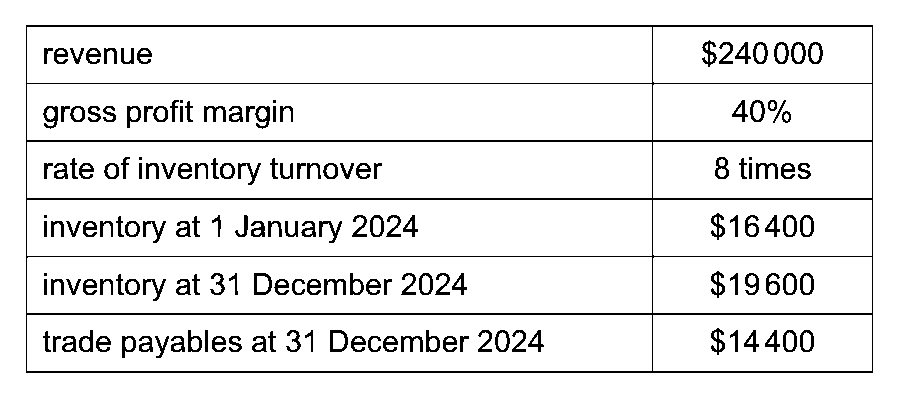
(a)(i) Calculate the following for the year ended 31 December 2024: cost of sales [1 marks]
(a)(ii) Calculate the following for the year ended 31 December 2024: purchases. [2 marks]
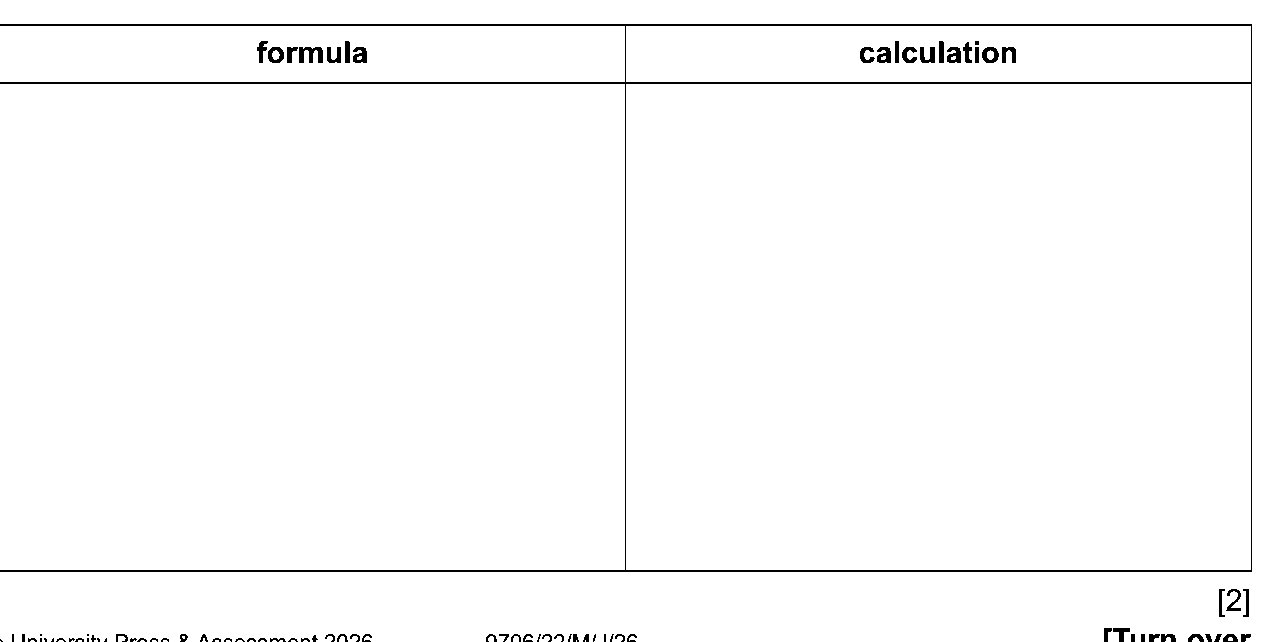
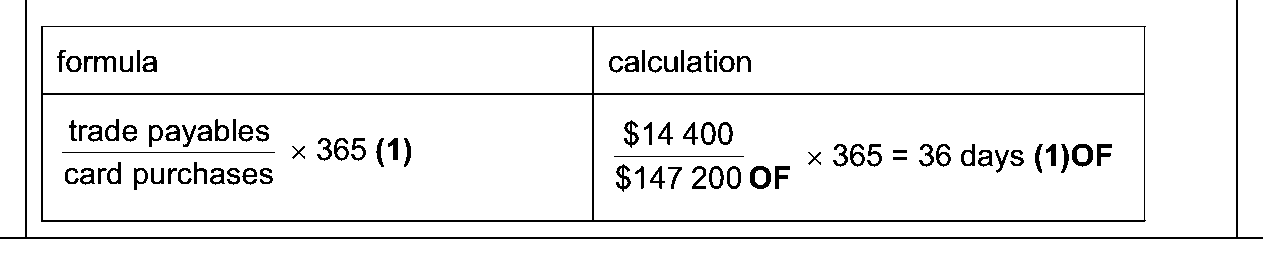
(b) Calculate the trade payables turnover (days) for the year ended 31 December 2024, stating the formula used. [2 marks]
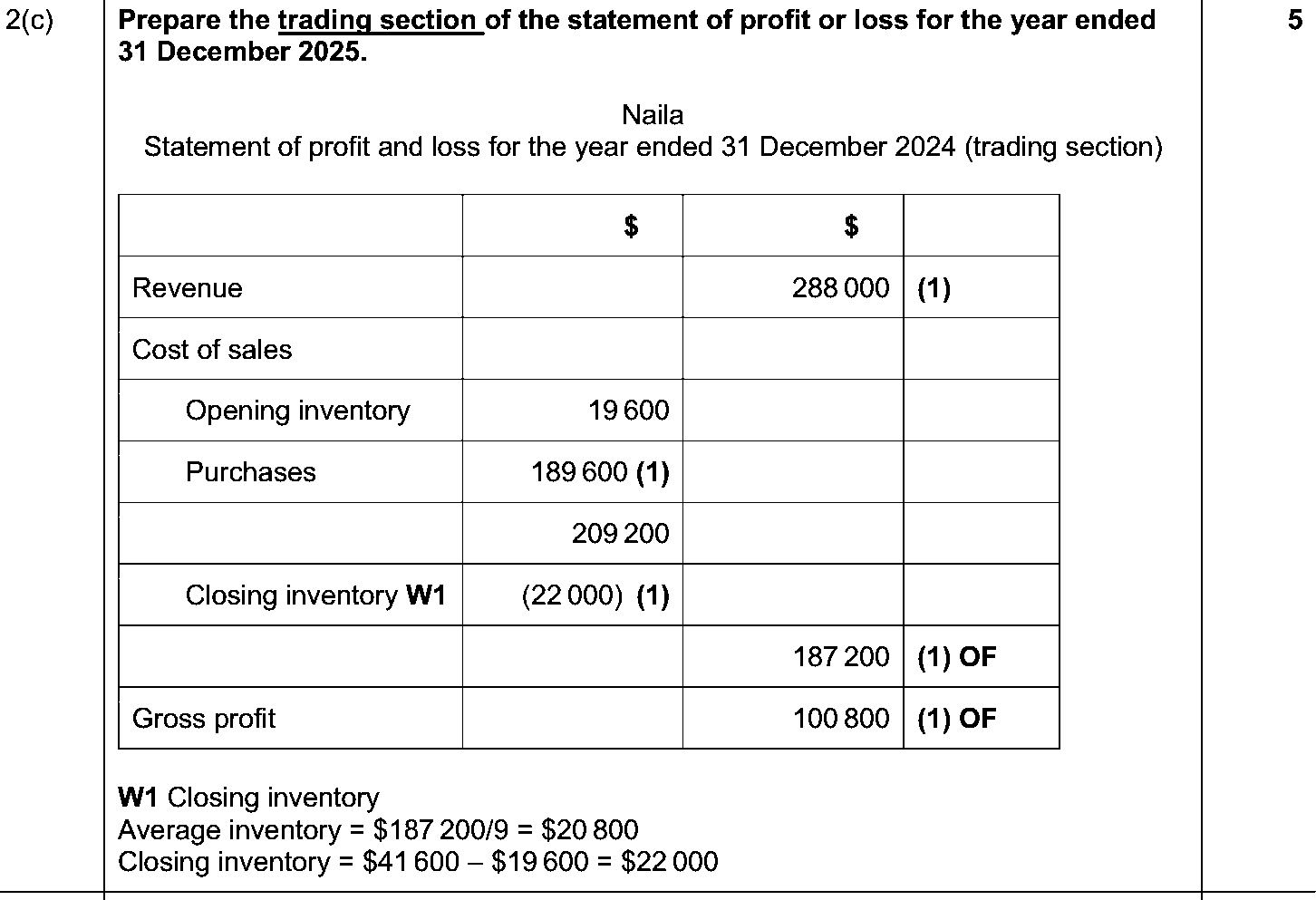
(c) Prepare the trading section of the statement of profit or loss for the year ended 31 December 2025. [5 marks]
During the year ended 31 December 2025, the following results were achieved compared to the year ended 31 December 2024. 1 Revenue increased by 20%. 2 The gross profit margin was reduced to 35%. 3 The rate of inventory turnover increased to 9 times.

Workings:
(d) Advise Naila whether or not she should go ahead with her proposal. Justify your answer by considering the advantages and disadvantages of the proposal. [5 marks]
Naila wishes to further improve the rate of inventory turnover. She is proposing to stop dealing in any slow‑selling items.
(a)(i)
cost of sales 60% $240 000 = $144 000 (1)
(a)(ii)
Cost of sales $144 000 from 2(a)(i) (1) OF + closing inventory $19 600 – opening inventory $16 400 = $147 200 (1) OF
(b)
(c)
Faisal received a bank statement for the month ended 30 November 2025. The bank statement showed his business had an overdraft of $1463 on that date, but the cash book showed a debit balance of $372. A comparison of the bank statement and cash book (bank columns) revealed the following: 1 The bank statement showed an entry for bank charges of $102 which had not been recorded in the cash book. 2 At the end of the month, there were unpresented cheques: K Baker $460 and L Hardy $587. 3 The balance of the cash book had been understated by $140. 4 A cheque received from a customer, J Limited, for $182 had been dishonoured by the bank. It was correctly recorded in the bank statement but had been entered on the wrong side of the cash book. 5 The bank statement included a direct debit of $249 for insurance. This should have been charged to Faisal’s personal account and not the business bank account. 6 A standing order of $337 for rent had been included in the bank statement but had been omitted from the cash book. 7 Cash sales of $1970 had been paid into the bank on 30 November 2025 and recorded in the cash book. This transaction had not yet been recorded by the bank.
(a) Prepare an updated cash book at 30 November 2025. [5 marks]

(b) Prepare a bank reconciliation statement at 30 November 2025. [4 marks]

(c) Identify two features of a standing order payment. [2 marks]
(d) Explain two reasons why it is important for a business to be able to prepare complete and accurate financial statements. [4 marks]
(a)
(b)
(c)
A standing order is paid automatically by the bank on the instructions of the customer (1) The payment is made at regular or fixed intervals/every month/recurring (1) A standing order is for an agreed fixed sum (1) Max 2 Accept other valid responses.
(d)
Accounting records will be used as the basis for decision making/future planning about the business (1). Unless they are error free, decisions are likely to lack validity/ensures reliability (1). Accounting records will be used by a range of stakeholders (1), who could be misled by any inaccurate information (1). Inaccurate accounting records could mean that a business fails to meet legal requirements/tax authority requirements (1), leading to possible penalties (1). To assess the performance of the business/enable to make comparisons (1) and can then identify which parts to improve (1). To gain bank loans/investors (1) need to see existing liabilities/profit to make decisions (1). Max 2 reasons 2 marks (1 mark for identification of reason and 1 mark for development) Accept other valid responses.
The directors of N Limited use ratios to review the performance of the company. The following details are available for the previous two years.
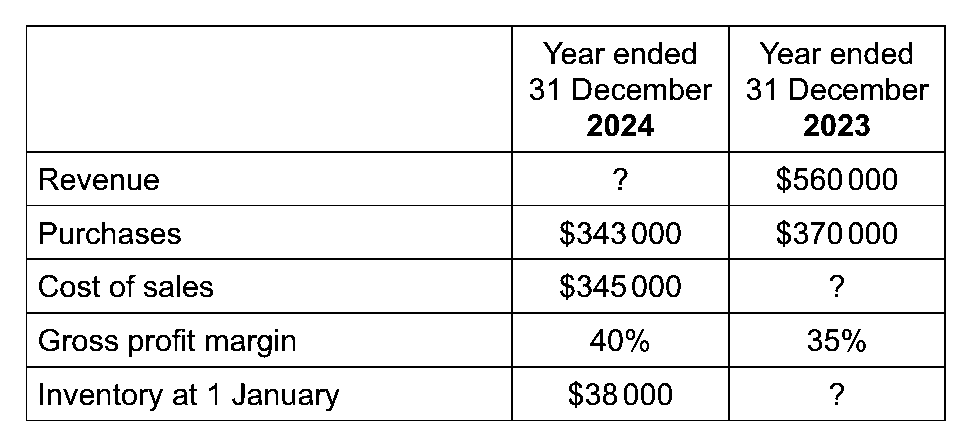
(a) Calculate the opening inventory at 1 January 2023. [3 marks]
(b) Calculate the revenue for the year ended 31 December 2024. [2 marks]
(c) Calculate the closing inventory at 31 December 2024. [1 marks]
(d) Calculate the inventory turnover (days) for each of the years ended 31 December 2023 and 2024. Year ended 31 December 2023 Year ended 31 December 2024 [5 marks]
(e) Identify two possible drawbacks which could result from this suggestion. [2 marks]
The directors wish to improve the inventory turnover (days) ratio. One director has suggested reducing inventory levels.
(f) Identify two ways in which the inventory turnover (days) ratio could be improved other than by reducing inventory levels. [2 marks]
(a)
Cost of sales = 65% $560 000 = $364 000 (1) Cost of sales $364 000 – (purchases $370 000 – closing inventory $38 000, i.e. $332 000 (1)) = $32 000 (1)
(b)
Revenue = Cost of sales $345 000(1) 100/60 = $575 000 (1)
(c)
Closing inventory 2024 = (opening inventory $38 000 + purchases $343 000) – cost of sales $345 000 = $36 000 (1)
(d)

(e)
Risk of ‘stock-outs’/can’t meet demand(1) Loss of trade discount from supplier (because of smaller orders) (1) Increased delivery costs/administrative costs (1) Suppliers may not deliver on time/suppliers may strike(1) Max 2 Accept other valid responses
(f)
Changing product range to items more in demand (1) Reducing selling prices/offer discounts (1) Advertise/promotion to attract more sales (1) Max 2 Accept other valid responses
Khaled, the owner of a retail business, provided the following information.
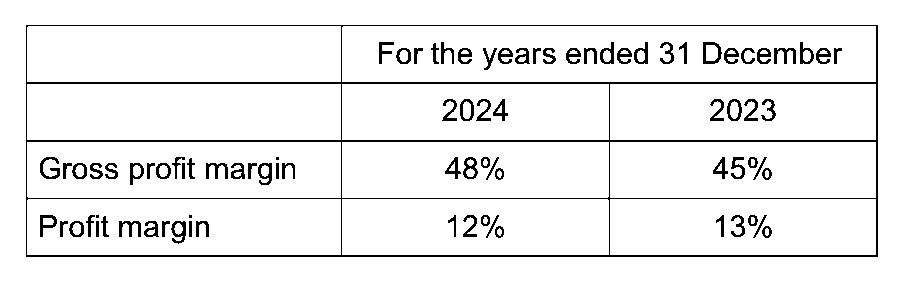
(a) State the formula for calculating each of the following ratios. Gross profit margin Profit margin [2 marks]
(b) Suggest two reasons which could explain the increase in the gross profit margin comparing 2024 with 2023. [2 marks]
(c) Suggest two reasons which could explain the decrease in profit margin comparing 2024 with 2023, despite the increase in the gross profit margin. [2 marks]
(d) Explain with reasons whether or not you agree with Khaled’s view of his business’s liquidity position. Justify your answer by commenting on both ratios. [5 marks]
Khaled has compared the recent liquidity ratios for his business with ratios for businesses of a similar size and trading in the same goods.

Khaled is pleased with the results of this comparison.
(e) Explain two other reasons why Khaled may find it difficult to make valid comparisons with similar businesses. [4 marks]
Khaled is aware that size of business and trading in similar goods are not the only factors to be considered in making comparisons with similar businesses.
(a)

(b)
Selling prices were increased (1) Cost of sales was reduced (1)
(e)
Financial reports for other businesses may not be immediately available or unavailable (1) and circumstances could change considerably during this delay (1).
Khaled, the owner of a retail business, provided the following information.
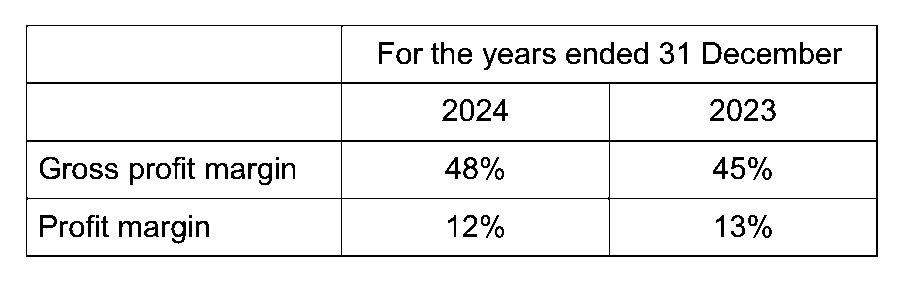
(a) State the formula for calculating each of the following ratios. Gross profit margin Profit margin [2 marks]
(b) Suggest two reasons which could explain the increase in the gross profit margin comparing 2024 with 2023. [2 marks]
(c) Suggest two reasons which could explain the decrease in profit margin comparing 2024 with 2023, despite the increase in the gross profit margin. [2 marks]
(d) Explain with reasons whether or not you agree with Khaled’s view of his business’s liquidity position. Justify your answer by commenting on both ratios. [5 marks]
Khaled has compared the recent liquidity ratios for his business with ratios for businesses of a similar size and trading in the same goods.
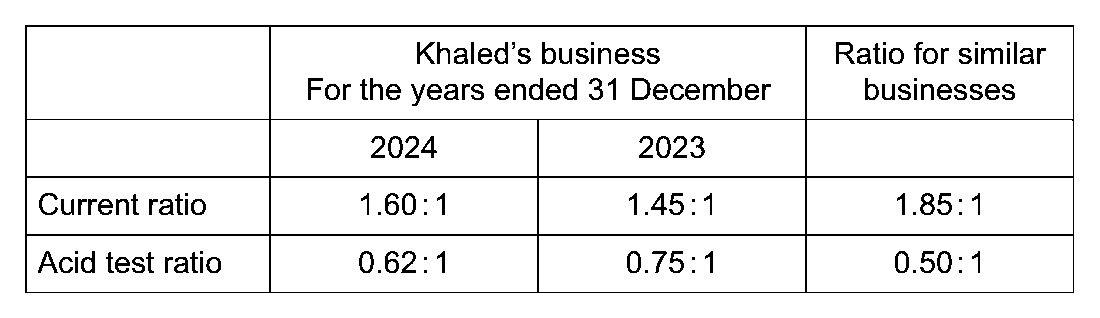
Khaled is pleased with the results of this comparison.
(e) Explain two other reasons why Khaled may find it difficult to make valid comparisons with similar businesses. [4 marks]
Khaled is aware that size of business and trading in similar goods are not the only factors to be considered in making comparisons with similar businesses.
(a)

(b)
Selling prices were increased (1) Cost of sales was reduced (1)
(e)
Financial reports for other businesses may not be immediately available or unavailable (1) and circumstances could change considerably during this delay (1).
🔒 Unlock every Accounting information for stakeholders question from 2020–2024
All 76 come with their mark schemes, answers and case studies, and appear in the practice tool above once you’re signed in. It’s free.
Questions and mark schemes are from past Cambridge papers and are reproduced for revision. Topical Vault is an independent revision resource, not affiliated with or endorsed by Cambridge Assessment International Education.
Each topic opens this practice tool with only that topic’s questions, plus how often it comes up and every question on it in one list.