Question 14Feb/Mar 20269706/121 mark
A sole trader did not write off an irrecoverable debt. What are the effects of this on the financial statements?

Show answer
ACorrect answer
Cambridge 9706, Paper 1 & 2. 1,558 questions, 2020 to 2026.
Pages reproduced from the original Cambridge question papers and mark schemes. Tables, ruled accounts and answer templates are cropped images, not retyped — shown on a white card so they stay readable in dark mode. Paper 2 questions with parts in more than one topic are filed whole under every topic they touch; parts outside the chosen topics are dimmed. Click any image to enlarge it. Mark schemes are hidden until you choose to reveal them.
Irrecoverable debts, debts recovered, and the allowance for irrecoverable (doubtful) debts.
31 past paper questions on this topic since 2020, across 11 exam sessions.
| Year | Paper 1 | Paper 2 | Total | Chart |
|---|---|---|---|---|
| 2026 | 1 | 0 | 1 | |
| 2025 | 4 | 4 | 8 | |
| 2024 | 4 | 2 | 6 | |
| 2023 | 0 | 1 | 1 | |
| 2022 | 5 | 0 | 5 | |
| 2021 | 2 | 3 | 5 | |
| 2020 | 3 | 2 | 5 |
The whole topic on one page, with answers and mark schemes. Printing this page prints just this list.
A sole trader did not write off an irrecoverable debt. What are the effects of this on the financial statements?
ACorrect answer
A business makes an allowance for irrecoverable debts at the year end. Which accounting concepts have been applied?

BCorrect answer
The amount of trade receivables at the year end of Year 2, before deducting the allowance for irrecoverable debts, was the same as at the end of Year 1. There were no irrecoverable debts in either year. The sole trader reduced the rate of allowance for irrecoverable debts in Year 2. What is the effect of this action on profit for the year and on current assets?
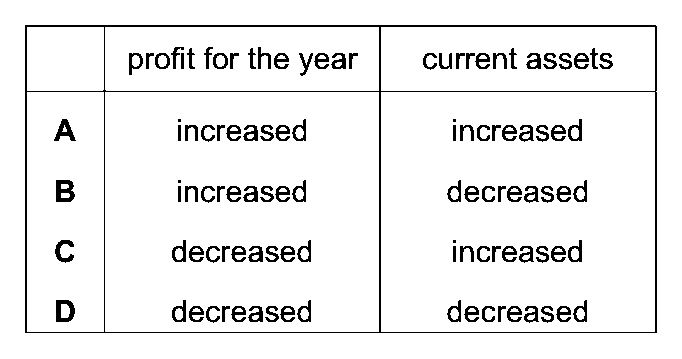
ACorrect answer
Which items would increase the profit for the year?
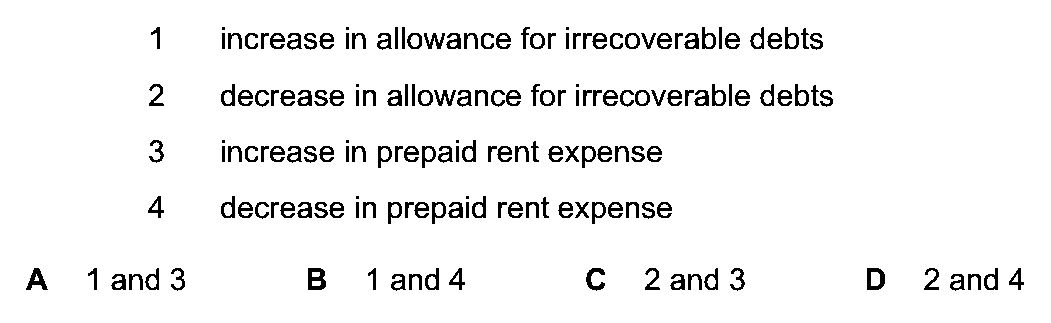
CCorrect answer
Which items would increase the profit for the year?
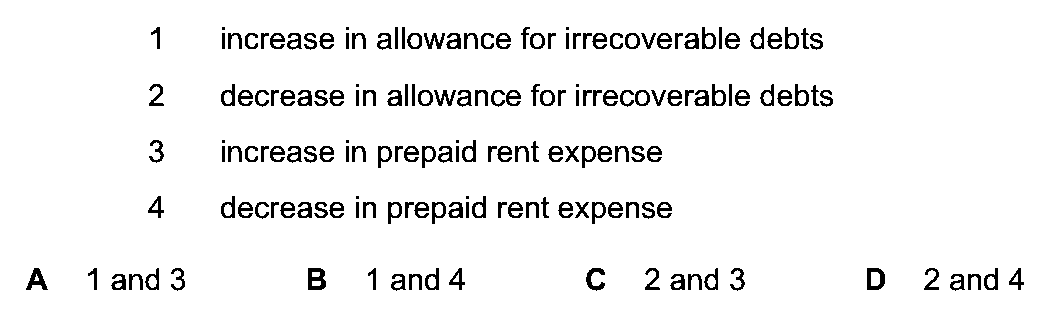
CCorrect answer
Bilal provided the following information for his service business for the year ended 31 December 2024. 1 Receipts and payments for the year ended 31 December 2024 included:

2 On 3 On 1 January 2024, the allowance for irrecoverable debts was $632. On 31 December 2024, Bilal decided to increase the allowance for irrecoverable debts by 1%. 4 On 1 January 2024, electricity charges of $270 were outstanding. On 31 December 2024, electricity charges of $490 were prepaid. 5 On 1 May 2024, part of the business premises was rented out at $1650 for every three months receivable in advance. 6 On 1 November 2024, the advertising campaign commenced. It will end on 31 January 2026. 7 During the year ended 31 December 2024, a motor vehicle, cost $21 000, was sold for $9100. It had been depreciated for three years at 20% per annum using the reducing balance method. No depreciation is provided in the year of sale. 8 Non-current assets at

(a) Prepare the statement of profit or loss for the year ended 31 December 2024. Use the space provided on page 4 to show your workings. [14 marks]
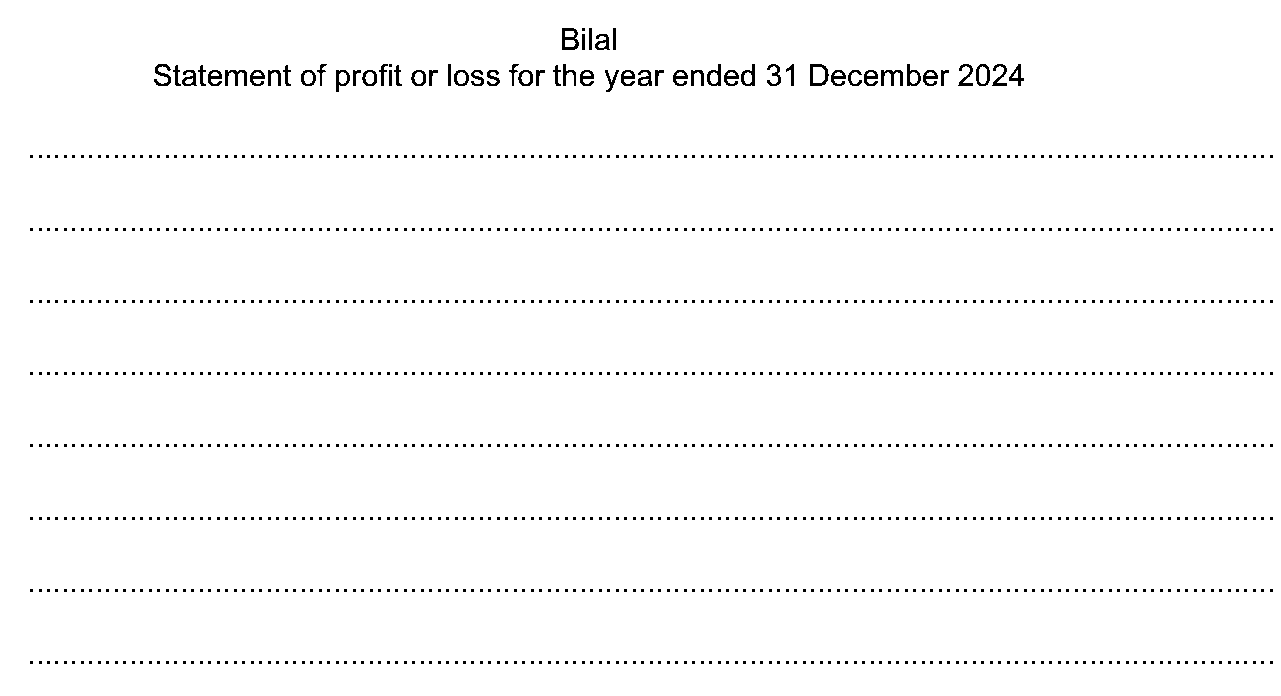
Workings: Revenue Allowance for irrecoverable debts Electricity charges Rent received Advertising campaign Profit or loss on disposal of motor vehicle Depreciation
(b) Prepare an extract from the statement of financial position at 31 December 2024, showing the assets section only. [7 marks]
At 31 December 2024, the cash at bank balance was $8950.

Assets Workings:
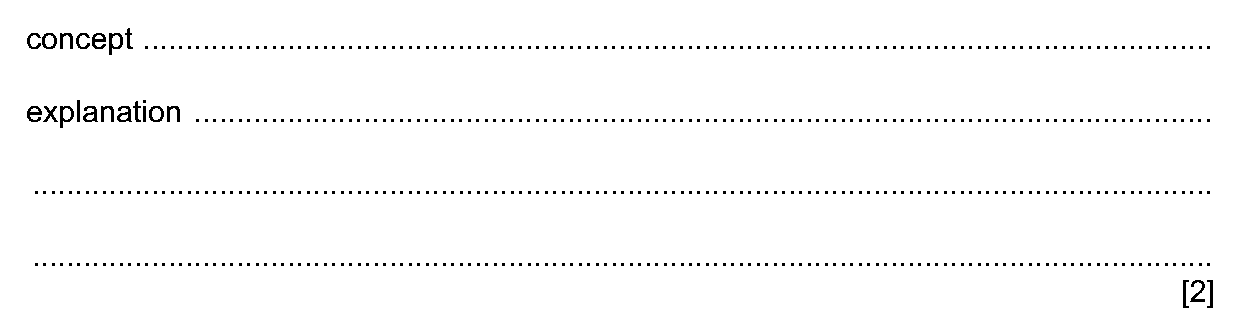
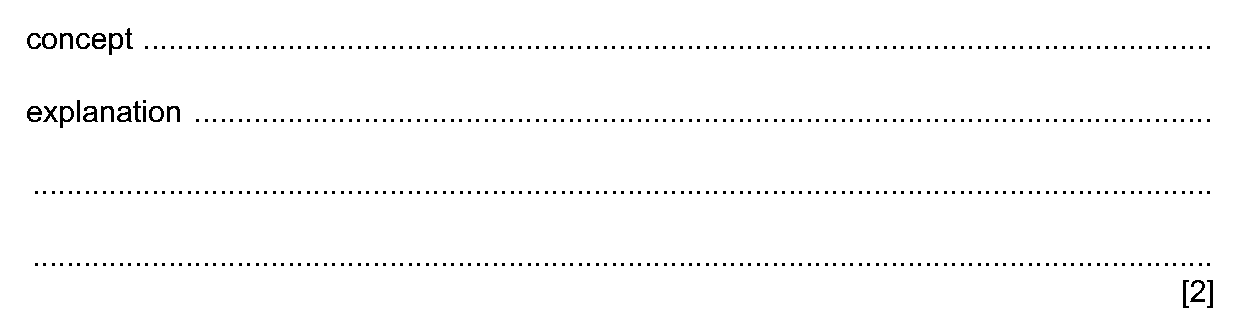
(c)(i) Explain, with reference to an accounting concept, why Bilal: maintains an allowance for irrecoverable debts [2 marks]

(c)(ii) Explain, with reference to an accounting concept, why Bilal: always uses the same method of depreciation for each class of non-current asset. [2 marks]
(d) Advise Bilal which option he should choose. Justify your choice by discussing both options. [5 marks]
Bilal hopes to expand his business and to move to larger premises. He is considering the following options. Option A: Renting out the whole of the current business premises and taking out a lease on new premises. Option B: Selling the current business premises and using the proceeds to partly finance the purchase of new premises. He is aware that he will also need a bank loan to finance the balance of the purchase price of the new premises.
(a)

Workings: W1 Cash fees $78 440 + credit fees ($34 290 – $4 200) = $108 530 (1) W2 Rent receivable: $550 8 = $4 400 (1) W3 Original allowance: $632/$15 800% = 4% (1) New allowance: 5% 11 600 = $580 (1) Decrease in allowance: $632 – $580 = $52 (1) OF W4 Business premises: 2% $120 000 = $2 400 (1) Motor vehicle: 20% $26 000 = $5 200 (1) Furniture and equipment: $22 000 10% = $2 200 (1)
End of 2021: $21 000 80% = $16 800 End of 2022: $16 800 80% = $13 440 End of 2023: $13 440 80% = $10 752 Loss on disposal: $10 752 (1) – $9 100 = $1 652 (1) OF W6 $4 500 2/15 = $600 (1) W7 $3 610 – $270 (1) – $490 (1)= $2 850
(b)

W1 Advertising campaign $3 900 (1) + electricity charges $490(1) = $4 390
(d)
discussing both options. Option A (max 2)
Zak has not maintained full accounting records for his retail business. He has provided the following details for the year ended 31 December 2024.

Inventory levels increased by $2730 during the year ended 31 December 2024. Zak’s policy is to sell all goods to achieve a gross profit margin of 40%.
(a) Calculate the revenue for the year ended 31 December 2024. [4 marks]
(b) Calculate the amount owed by credit customers at 31 December 2024. [4 marks]
Zak is not certain how much the business is owed by its credit customers at 31 December 2024. The following information is available. 1 At 1 January 2024, credit customers owed $11 880. 2 Credit sales are 75% of total sales. 3 Bank statements show that $96 900 was received from credit customers during the year ended 31 December 2024. 4 Some credit customers were given a 5% cash discount for prompt payment. Zak estimates that 20% of all receipts from credit customers were made after deducting the cash discount.
(c) Identify two ways, other than allowing a cash discount, in which credit control can be improved. [2 marks]
Zak would like to improve the credit control of his business.
(d) State two benefits of improving credit control. [2 marks]
(e) State three ways in which the security of data can be ensured within a computerised accounting system. [3 marks]
Zak has decided to prepare full accounting records in future, using a computerised accounting system. However, he is concerned about the security of data.
(a)
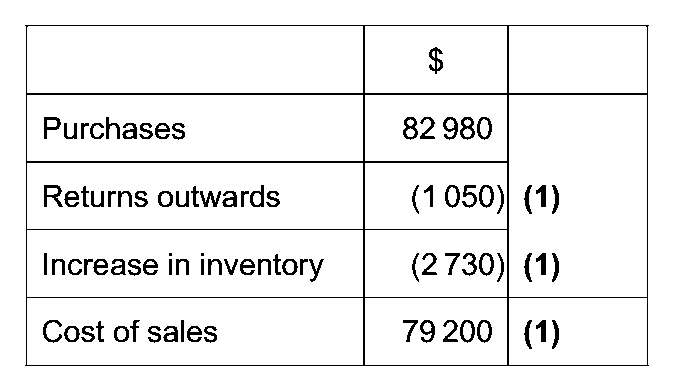
Revenue: Cost of sales $79 200 OF 1⅔ = 132 000 (1) OF or ($79 200 OF/ 60) 100 = 132 000 (1) OF
(b)
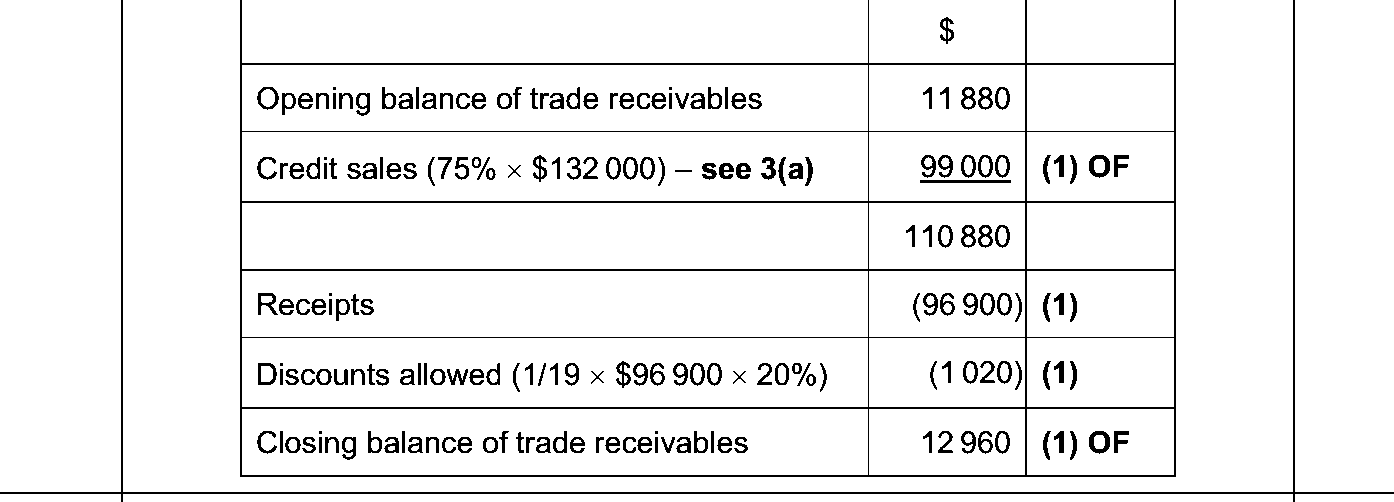
(c)
can be improved. Charge interest on overdue accounts (1) Set credit limits in individual cases (1) Send statements/reminders (1) Stopping supplies until overdue amounts have been paid (1) Ask for a deposit/payment up front (1) Accept other valid responses Max 2
(d)
May improve liquidity (1) Reduced risk of irrecoverable debts (1) Accept other valid responses
(e)
computerised accounting system. Install anti-virus packages (1) Use ‘strong’ passwords (1) Restricted access to data (1) Use encrypted USB drives (1) Introduce policy restricting employee’s access to other websites (1) Train staff how to notice suspicious activity (1) Automatic lockdown or logging out (1) Saving/backing up of work (1) Accept other valid responses Max 3
Bilal provided the following information for his service business for the year ended 31 December 2024. 1 Receipts and payments for the year ended 31 December 2024 included:

2 On 3 On 1 January 2024, the allowance for irrecoverable debts was $632. On 31 December 2024, Bilal decided to increase the allowance for irrecoverable debts by 1%. 4 On 1 January 2024, electricity charges of $270 were outstanding. On 31 December 2024, electricity charges of $490 were prepaid. 5 On 1 May 2024, part of the business premises was rented out at $1650 for every three months receivable in advance. 6 On 1 November 2024, the advertising campaign commenced. It will end on 31 January 2026. 7 During the year ended 31 December 2024, a motor vehicle, cost $21 000, was sold for $9100. It had been depreciated for three years at 20% per annum using the reducing balance method. No depreciation is provided in the year of sale. 8 Non-current assets at
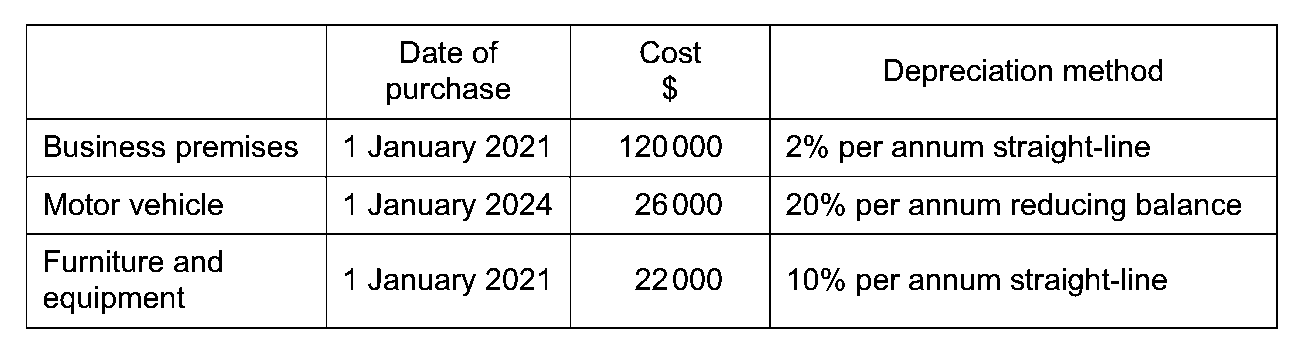
(a) Prepare the statement of profit or loss for the year ended 31 December 2024. Use the space provided on page 4 to show your workings. [14 marks]

Workings: Revenue Allowance for irrecoverable debts Electricity charges Rent received Advertising campaign Profit or loss on disposal of motor vehicle Depreciation
(b) Prepare an extract from the statement of financial position at 31 December 2024, showing the assets section only. [7 marks]
At 31 December 2024, the cash at bank balance was $8950.

Assets Workings:
(c)(i) Explain, with reference to an accounting concept, why Bilal: maintains an allowance for irrecoverable debts [2 marks]

(c)(ii) Explain, with reference to an accounting concept, why Bilal: always uses the same method of depreciation for each class of non-current asset. [2 marks]
(d) Advise Bilal which option he should choose. Justify your choice by discussing both options. [5 marks]
Bilal hopes to expand his business and to move to larger premises. He is considering the following options. Option A: Renting out the whole of the current business premises and taking out a lease on new premises. Option B: Selling the current business premises and using the proceeds to partly finance the purchase of new premises. He is aware that he will also need a bank loan to finance the balance of the purchase price of the new premises.
(a)

Workings: W1 Cash fees $78 440 + credit fees ($34 290 – $4 200) = $108 530 (1) W2 Rent receivable: $550 8 = $4 400 (1) W3 Original allowance: $632/$15 800% = 4% (1) New allowance: 5% 11 600 = $580 (1) Decrease in allowance: $632 – $580 = $52 (1) OF W4 Business premises: 2% $120 000 = $2 400 (1) Motor vehicle: 20% $26 000 = $5 200 (1) Furniture and equipment: $22 000 10% = $2 200 (1)
End of 2021: $21 000 80% = $16 800 End of 2022: $16 800 80% = $13 440 End of 2023: $13 440 80% = $10 752 Loss on disposal: $10 752 (1) – $9 100 = $1 652 (1) OF W6 $4 500 2/15 = $600 (1) W7 $3 610 – $270 (1) – $490 (1)= $2 850
(b)

W1 Advertising campaign $3 900 (1) + electricity charges $490(1) = $4 390
(d)
discussing both options. Option A (max 2)
Sara and Viraj are in partnership and own a wholesale business. At 1 January 2024, the partners had the following balances.

During the year ended 31 December 2024, the following drawings had been recorded.

The following balances were also available at 31 December 2024.
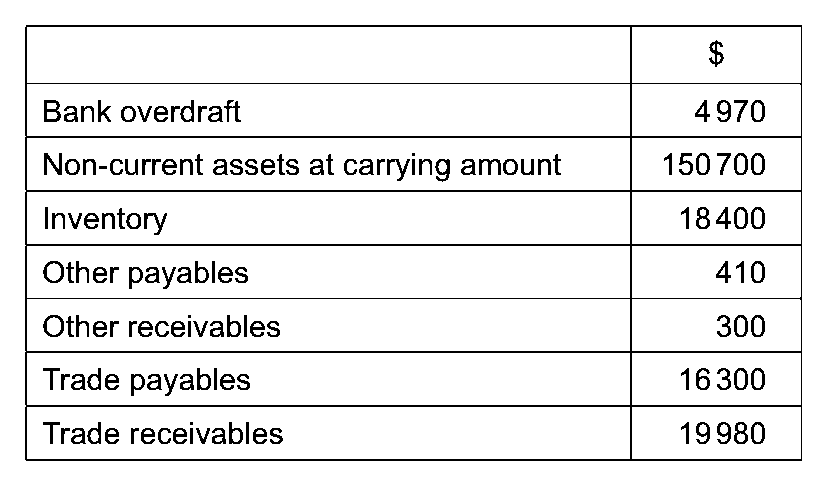
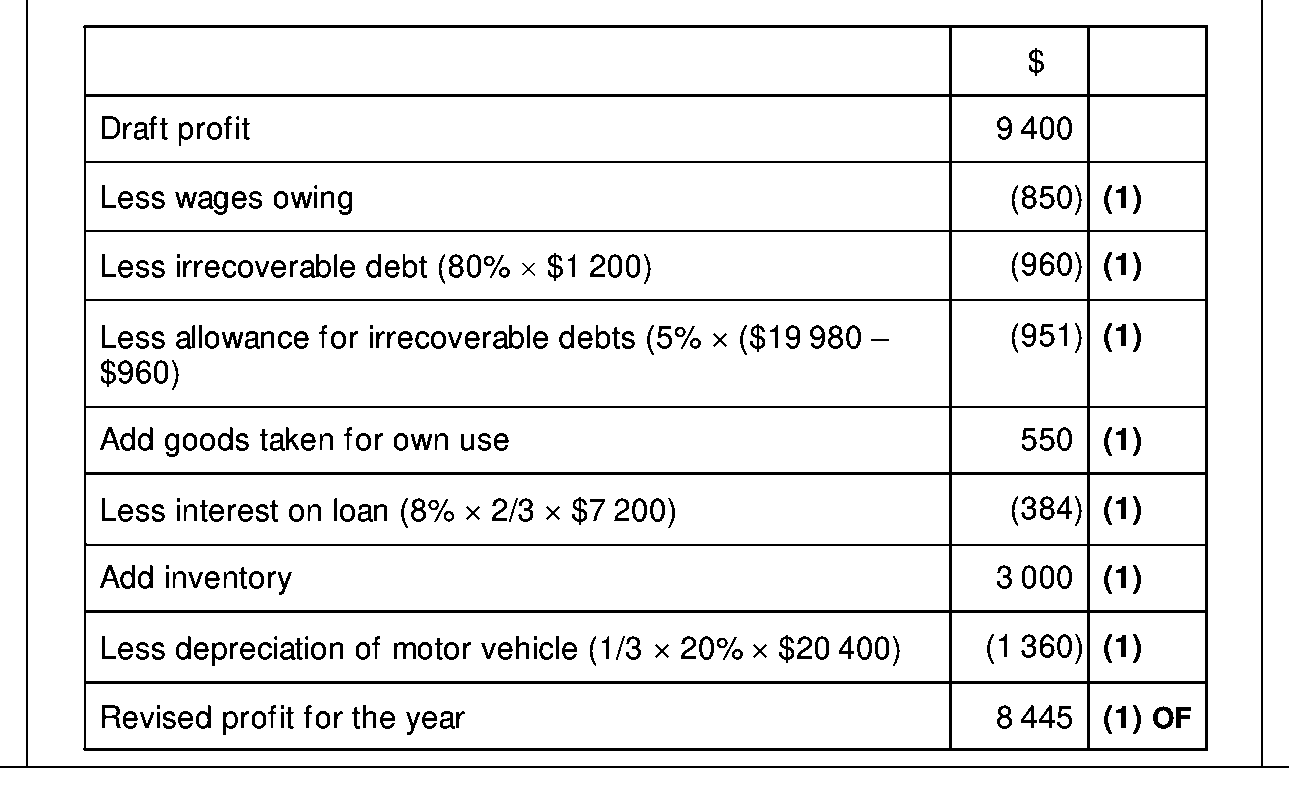
The draft profit for the year ended 31 December 2024 was $9400 before accounting for the following: 1 Wages, $850, were owing. 2 A credit customer, owing $1200, had gone out of business. The partners believe that 20% of the amount outstanding will be recovered, and the remaining 80% is to be written off. 3 The partners have decided to create an allowance for irrecoverable debts of 5% of trade receivables. 4 Viraj had taken goods for own use valued at cost, $550. 5 Viraj had provided a loan to the partnership on 1 May 2024 of $7200 at 8% interest per annum. The loan is repayable in full at the end of five years. Interest on the loan had not been accounted for. 6 Closing inventory had been understated by $3000. 7 Sara had introduced into the business a motor vehicle, valued at $20 400, on 1 September 2024. Motor vehicles are depreciated by 20% per annum using the straight‑line method on a month‑by‑month basis.
(a) Calculate the revised profit for the year ended 31 December 2024. [8 marks]
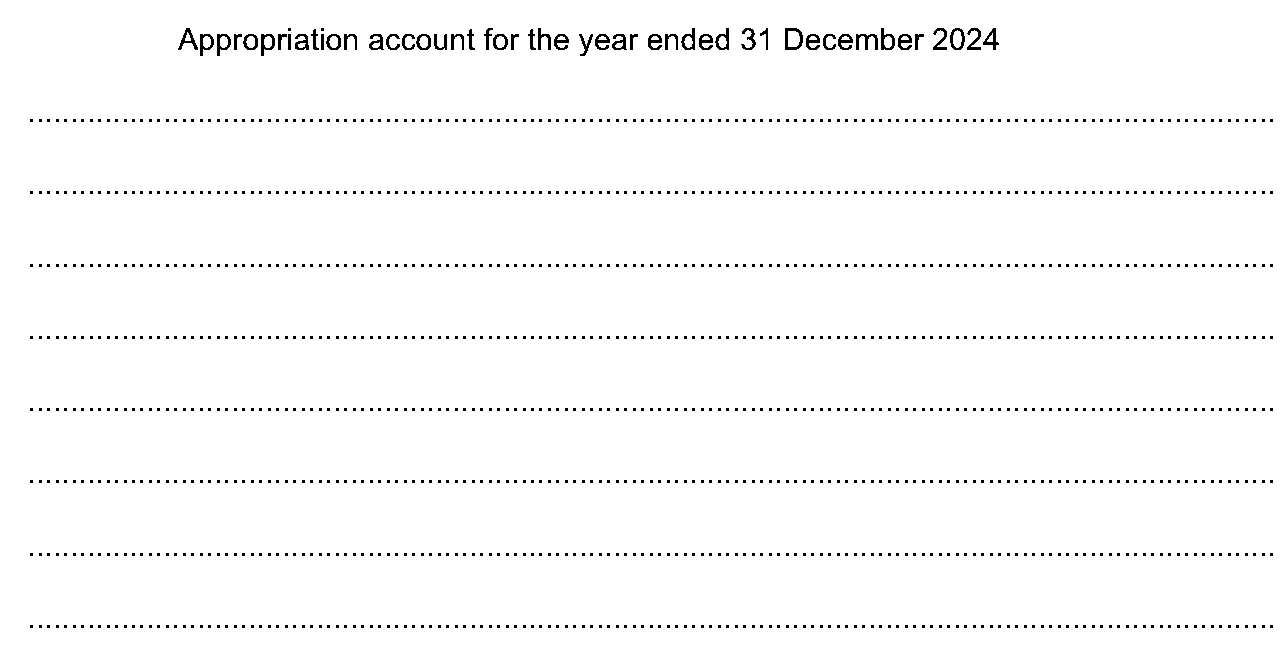
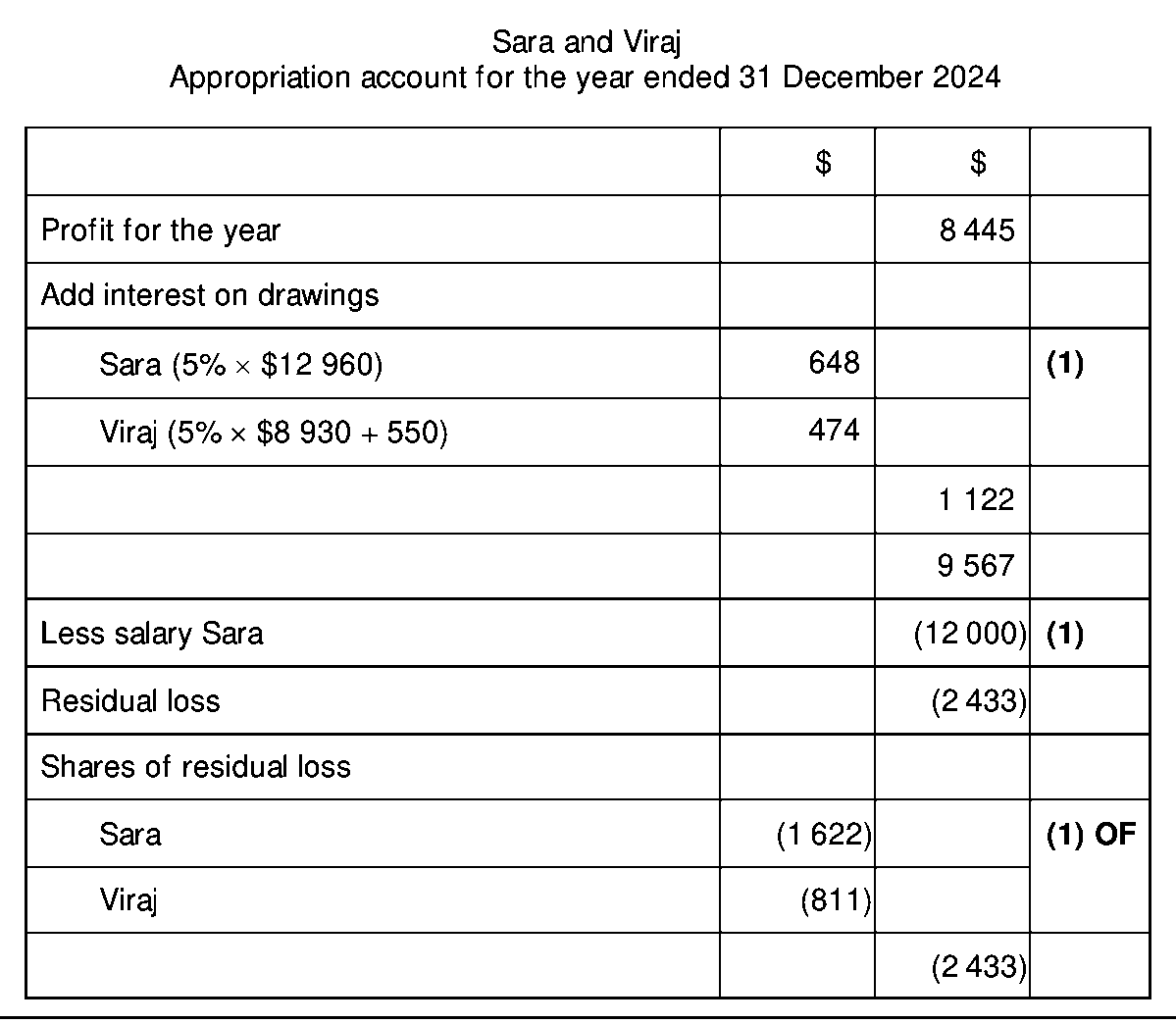
(b) Prepare the appropriation account for the year ended 31 December 2024. [3 marks]
The partners share profits and losses in the ratio Sara : Viraj, 2 : 1, after providing for the following: 1 Interest is charged on each partner’s drawings at 5% on the total of drawings for the year in excess of $10 000. 2 Sara is entitled to a salary of $12 000 per annum.
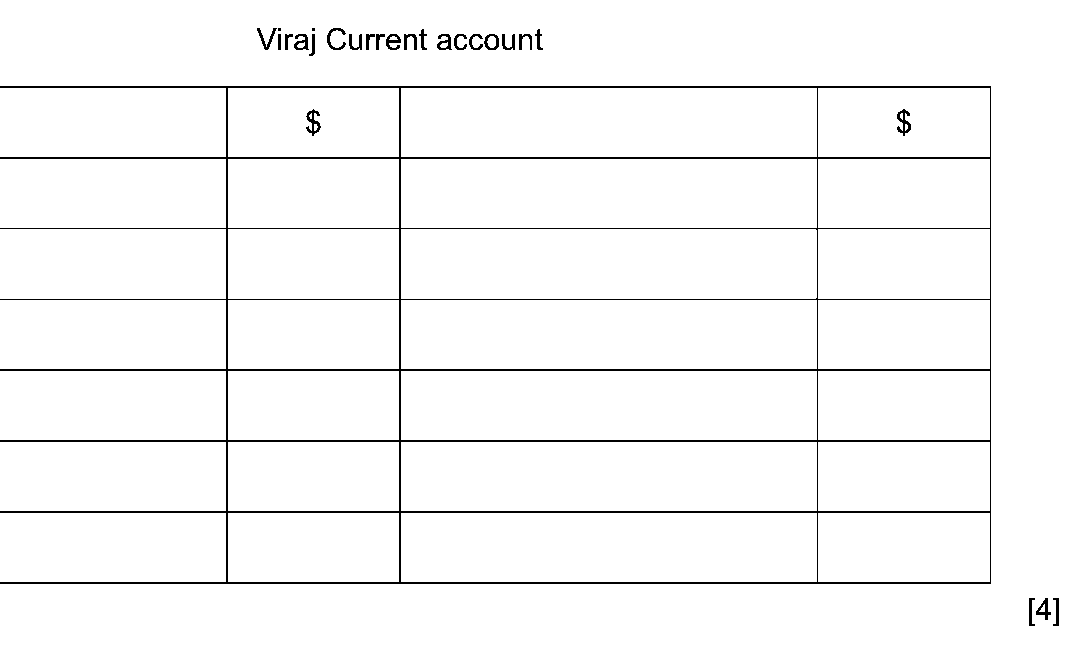
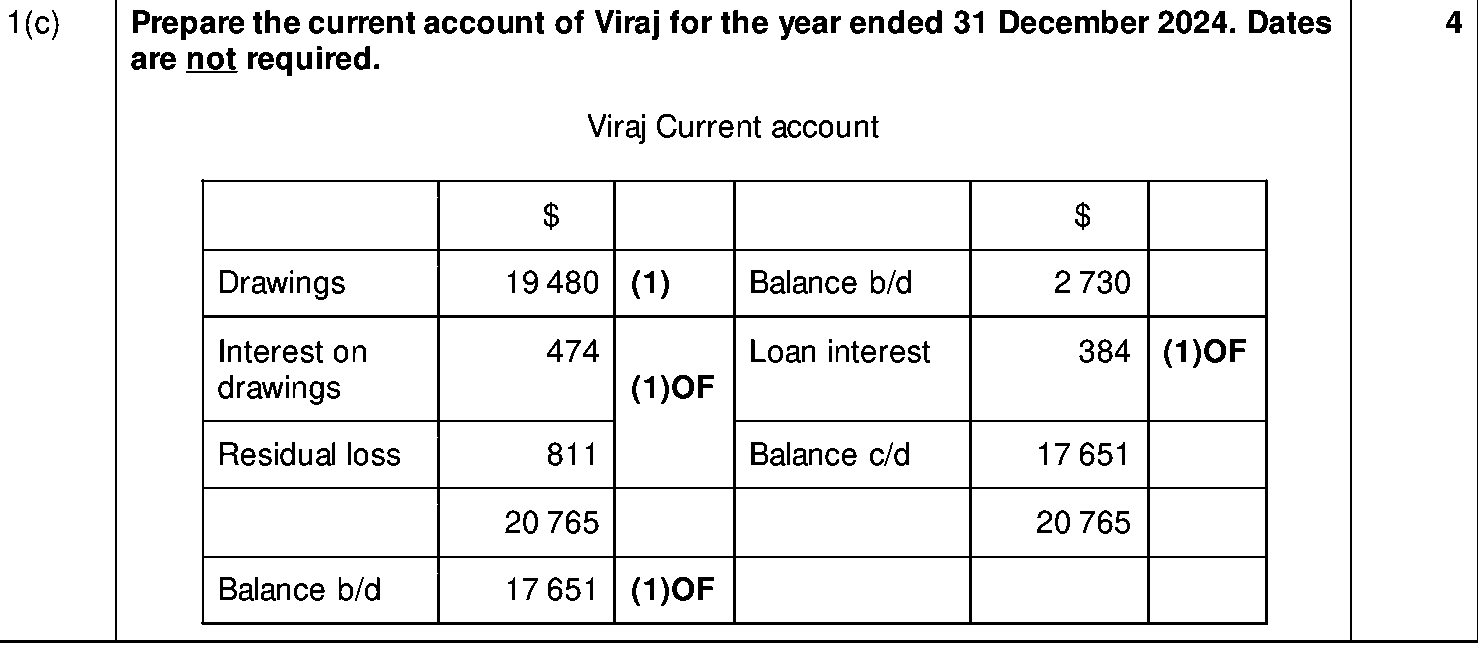
(c) Prepare the current account of Viraj for the year ended 31 December 2024. Dates are not required. [4 marks]
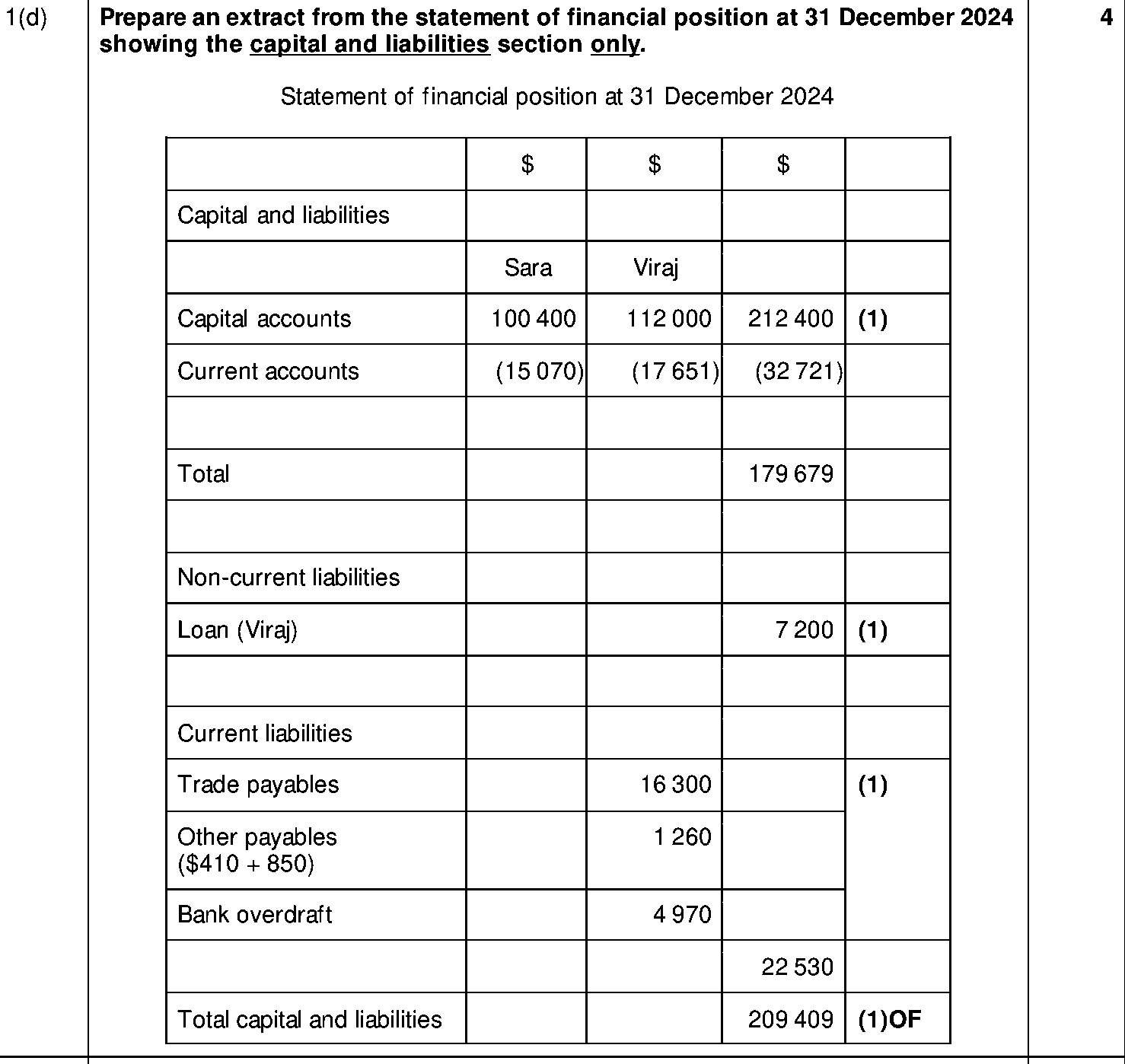
(d) Prepare an extract from the statement of financial position at 31 December 2024 showing the capital and liabilities section only. [4 marks]
On 31 December 2024, the balance of Sara’s current account was $15 070 debit.

Capital and liabilities
(e)(i) Explain, with reference to an accounting concept, the correct treatment of: goods taken for own use by the owner of a business [2 marks]

(e)(ii) Explain, with reference to an accounting concept, the correct treatment of: irrecoverable debts. [2 marks]

(f) Advise the partners which option they should choose. Justify your answer by discussing both options. [7 marks]
The partners are concerned about the liquidity of the business. The current credit terms are 30 days for both credit suppliers and credit customers. They have noticed that some credit customers are delaying the settlement of their invoices, whilst credit suppliers are always paid within 30 days. They are considering two options: Option A: introducing a 5% cash discount for all credit customers’ invoices settled within 25 days. Option B: paying credit suppliers within 35 days.
(a)
(b)
(c)
(d)
(e)(i)
(i) goods taken for own use by the owner of a business Concept: business entity concept (1) Explanation: only transactions affecting the business are recorded in the business’s books of account (1). The business and owner are two separate (legal) entities (1) Max 1 mark for explanation Accept other valid responses.
(e)(ii)
(ii) irrecoverable debts Concept: prudence concept (1) Explanation: profits and assets OR trade receivables should not be overstated (1) losses should be accounted for as soon as they are recognised (1) Max 1 mark for explanation Accept other valid responses.
(f)
discussing both options. Option A (max 3) For The early settlement will improve the cash flow position/liquidity (1) May reduce possibility of irrecoverable debts (1) Might attract new customers so increasing revenue/sales (1) Trade receivables turnover will improve (1) Against Will reduce the amount of cash received (1) Expenses will increase due to higher discount allowed (1) Will reduce the amount of profit (1) Customers may not be encouraged to pay within 25 days (1) Customers may switch to other suppliers offering better terms so reduces revenue (1) Option B (max 3) For Improve the cash flow position/liquidity (1) Against It may damage the reputation of the business (1) It may result in the loss of cash discounts (1) It may cause a loss of suppliers/refuse credit terms (due to the extended settlement terms) (1) Suppliers may charge interest on late payment (1) Decision supported with a comment (1) Accept other valid responses
🔒 Unlock every Irrecoverable debts question from 2020–2024
All 22 come with their mark schemes, answers and case studies, and appear in the practice tool above once you’re signed in. It’s free.
Questions and mark schemes are from past Cambridge papers and are reproduced for revision. Topical Vault is an independent revision resource, not affiliated with or endorsed by Cambridge Assessment International Education.
Each topic opens this practice tool with only that topic’s questions, plus how often it comes up and every question on it in one list.