Statements of financial position for sole traders · AS Level Accounting
Cambridge 9706, Paper 1 & 2. 1,558 questions, 2020 to 2026.
Topic
Year
Pages reproduced from the original Cambridge question papers and mark schemes. Tables,
ruled accounts and answer templates are cropped images, not retyped — shown on a white card so
they stay readable in dark mode. Paper 2 questions with parts in more than one topic are filed whole
under every topic they touch; parts outside the chosen topics are dimmed. Click any image to enlarge
it. Mark schemes are hidden until you choose to reveal them.
About Statements of financial position for sole traders
The statement of financial position for a sole trader: non-current and current assets, current and non-current liabilities, and capital.
60 past paper questions on this topic since 2020, across 13 exam sessions.
How often it comes up
Year
Paper 1
Paper 2
Total
Chart
2026
3
0
3
2025
8
3
11
2024
15
1
16
2023
10
0
10
2022
8
0
8
2021
6
0
6
2020
5
1
6
Every 2025–2026 question on Statements of financial position for sole traders
The whole topic on one page, with answers and mark schemes. Printing this page prints just this list.
Paper 1 · Multiple choice (11)
Question 14May/Jun 20269706/111 mark
A sole trader’s financial year ends on 31 December. How is the profit for the year calculated? A net assets at 1 January −net assets at 31 December + drawings for the year B net assets at 1 January −net assets at 31 December −drawings for the year C net assets at 31 December −net assets at 1 January + drawings for the year D net assets at 31 December −net assets at 1 January −drawings for the year
Show answer
CCorrect answer
Question 14May/Jun 20269706/131 mark
A sole trader’s financial year ends on 31 December. How is the profit for the year calculated? A net assets at 1 January −net assets at 31 December + drawings for the year B net assets at 1 January −net assets at 31 December −drawings for the year C net assets at 31 December −net assets at 1 January + drawings for the year D net assets at 31 December −net assets at 1 January −drawings for the year
Show answer
CCorrect answer
Question 1Feb/Mar 20269706/121 mark
Which statement about a sole trader is not correct?
AAdditional capital can be brought in at any time.
BDrawings are unlimited.
CLiabilities are limited to the capital introduced.
DThe ability to raise finance may be limited.
Show answer
CCorrect answer
Question 15Oct/Nov 20259706/111 mark
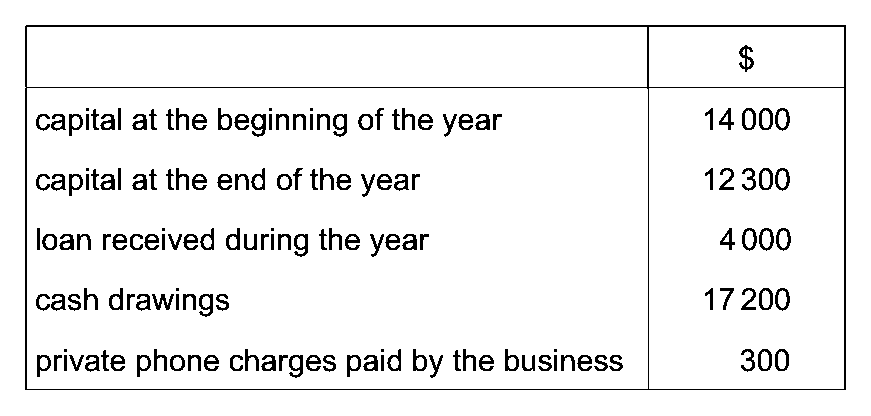
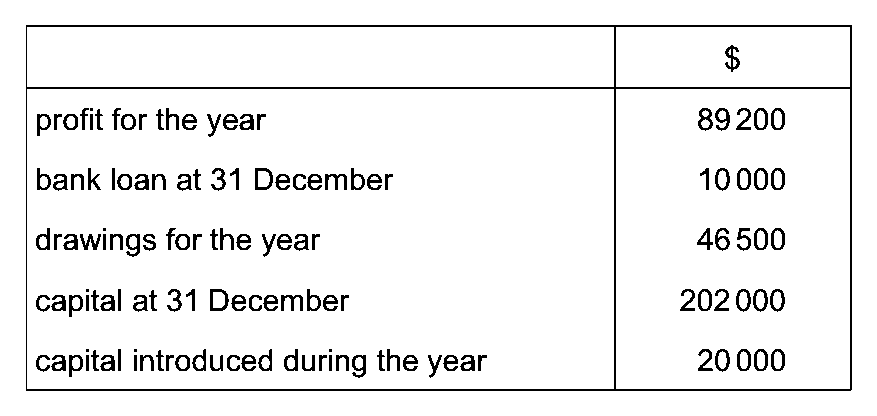
Jaime provided the following information.
What was the profit for the year?
Show answer
CCorrect answer
Question 10Oct/Nov 20259706/121 mark
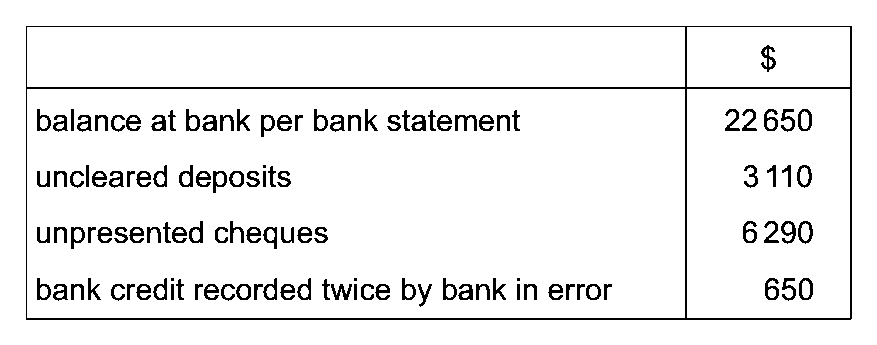
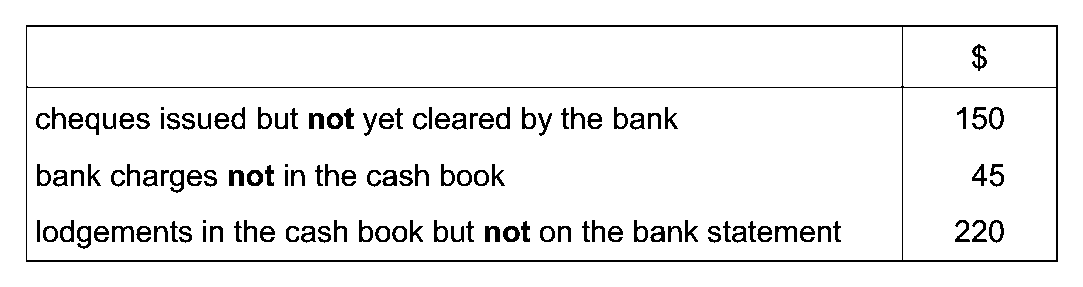
At 31 December, the following information is available about a company’s banking transactions.
Which value for bank should be recorded in the statement of financial position at 31 December?
Show answer
ACorrect answer
Question 14Oct/Nov 20259706/121 mark
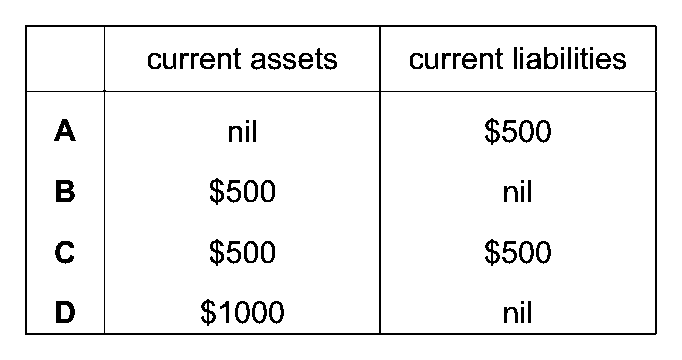
A sole trader rented out part of his business office on 1 January 2024 at $500 per month for 24 months. During the year ended 31 December 2024, he received the following amounts:
rent of $5500
rent deposit of $500 refundable at the end of month 24. Which amounts should be shown in the statement of financial position at 31 December 2024?
Show answer
CCorrect answer
Question 18Oct/Nov 20259706/121 mark
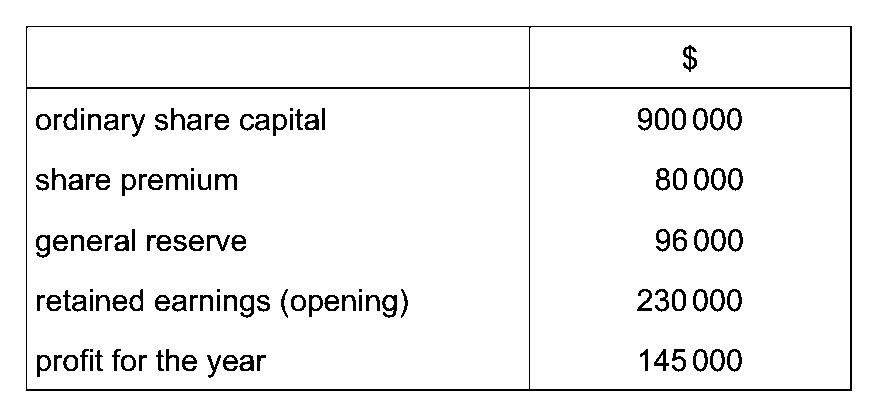
The following information is extracted from the draft statement of financial position of a limited company at 31 December.
What is the maximum amount of dividend that the limited company can declare?
Show answer
CCorrect answer
Question 16Oct/Nov 20259706/131 mark
Jane has just completed her first year in business as a sole trader. The following details are available for the year ended 31 December.
How much capital did Jane begin the business with?
Show answer
CCorrect answer
Question 9May/Jun 20259706/111 mark
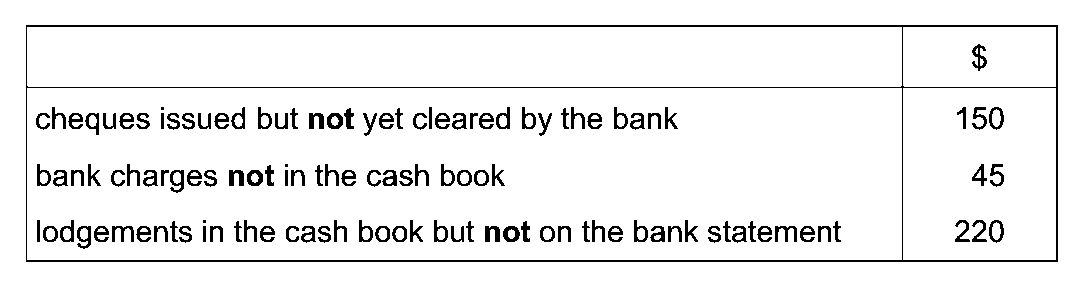
A draft statement of financial position shows a bank balance of $1400. The following information is now available.
Which figure is shown on the bank statement?
Show answer
ACorrect answer
Question 9May/Jun 20259706/131 mark
A draft statement of financial position shows a bank balance of $1400. The following information is now available.
Which figure is shown on the bank statement?
Show answer
ACorrect answer
Question 20Feb/Mar 20259706/121 mark
Sunil was reviewing the statement of financial position of a business. The statement of profit or loss was not available. Why was Sunil interested in the current assets of the business?
Ato assess its future prospects
Bto be able to calculate efficiency ratios
Cto discover if it is profitable
Dto see if it is able to pay debts as they fall due
Show answer
DCorrect answer
Paper 2 · Structured questions (3)
Question 2Oct/Nov 20259706/2315 marks
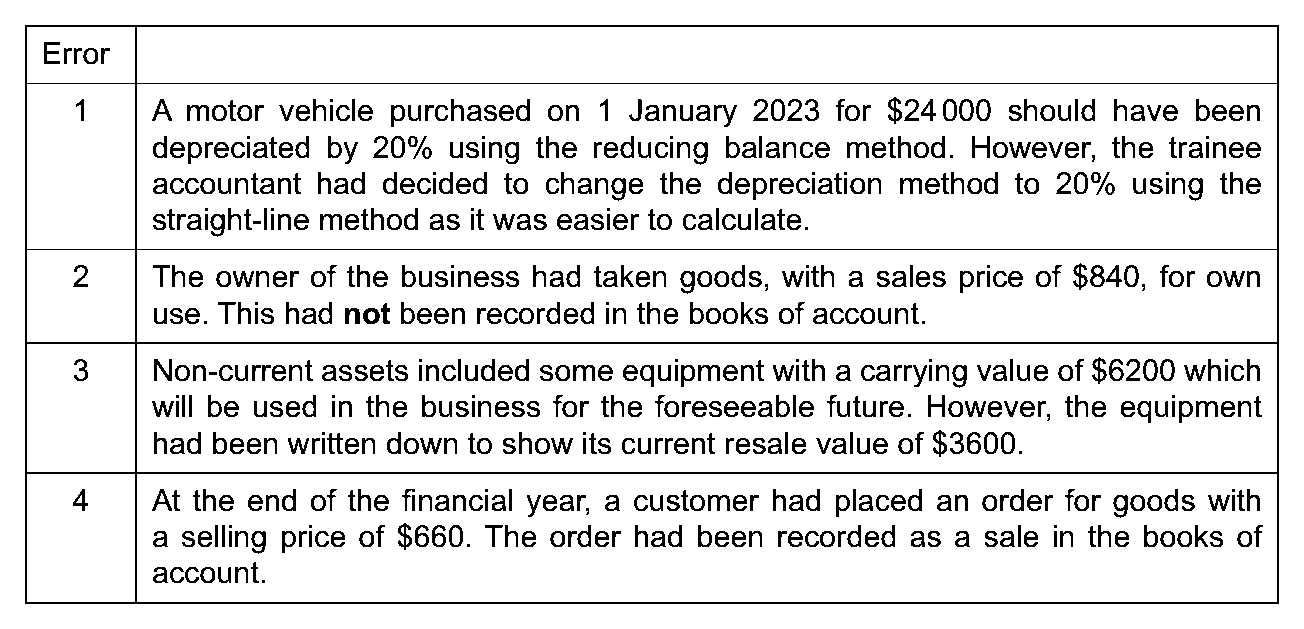
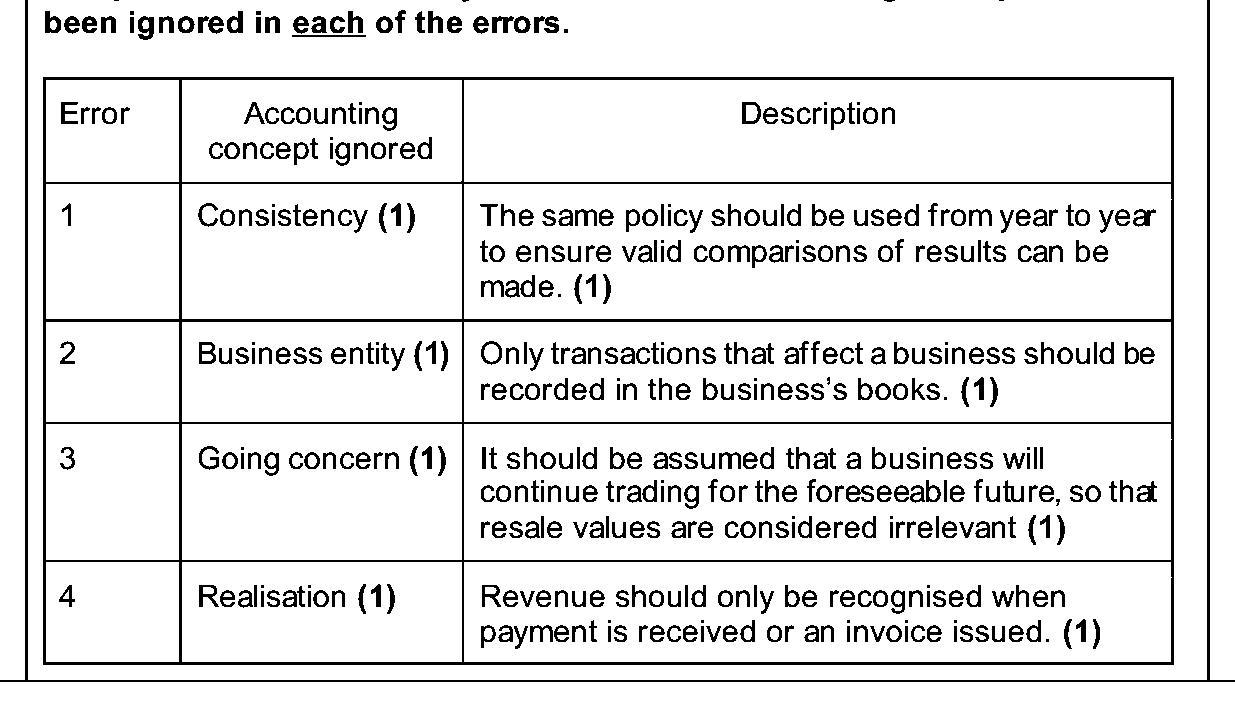
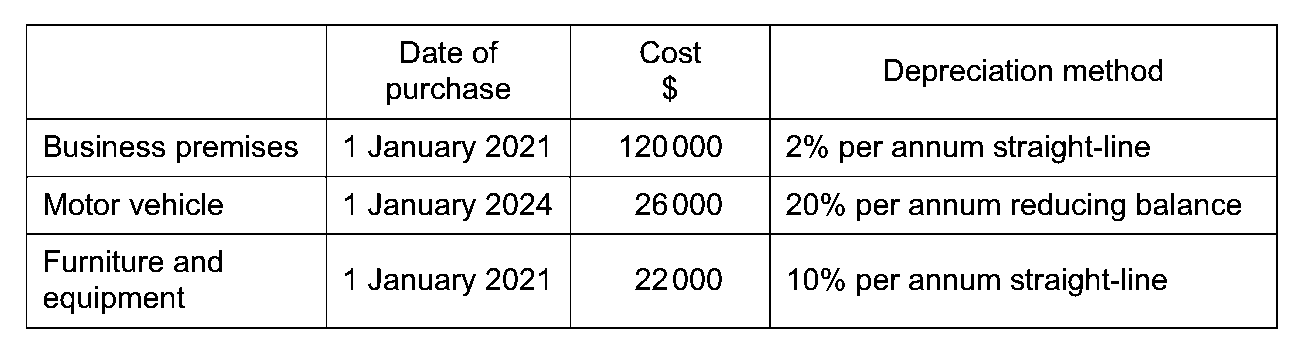
A trainee accountant recently produced the financial statements for a business for the year ended 31 December 2024. However, the following errors were discovered. Error
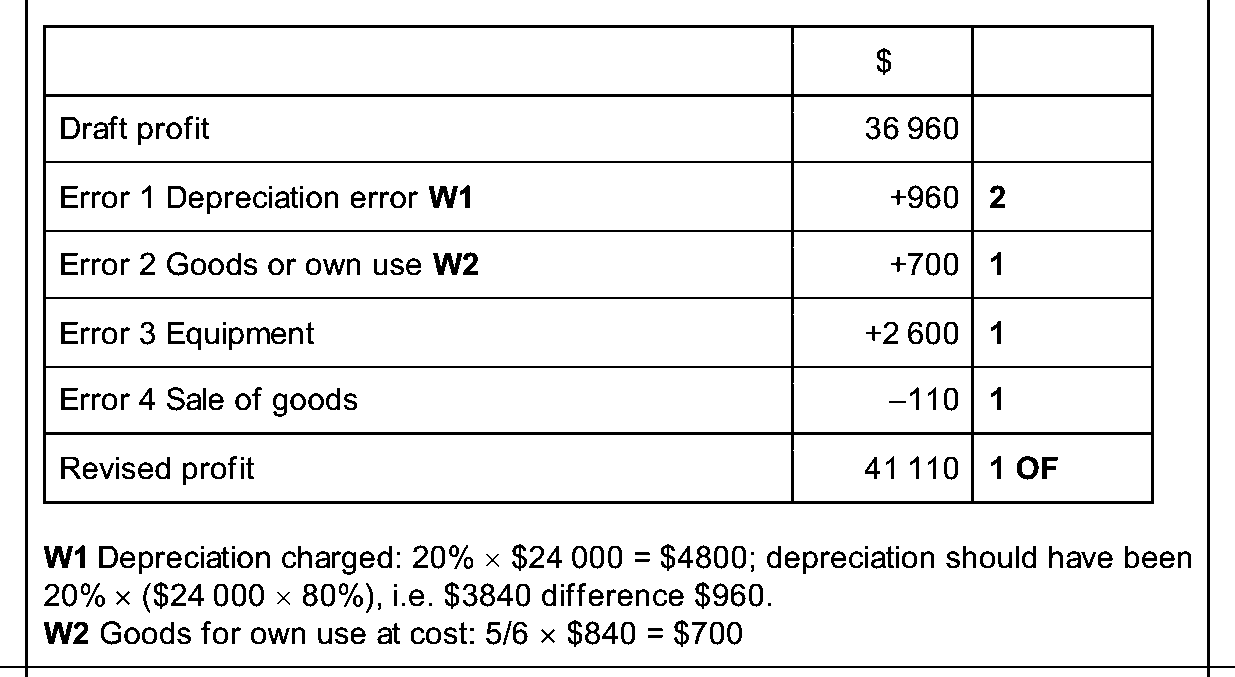
The business sells all goods with a mark‑up of 20%. The draft profit for the year ended 31 December 2024 was $36 960.
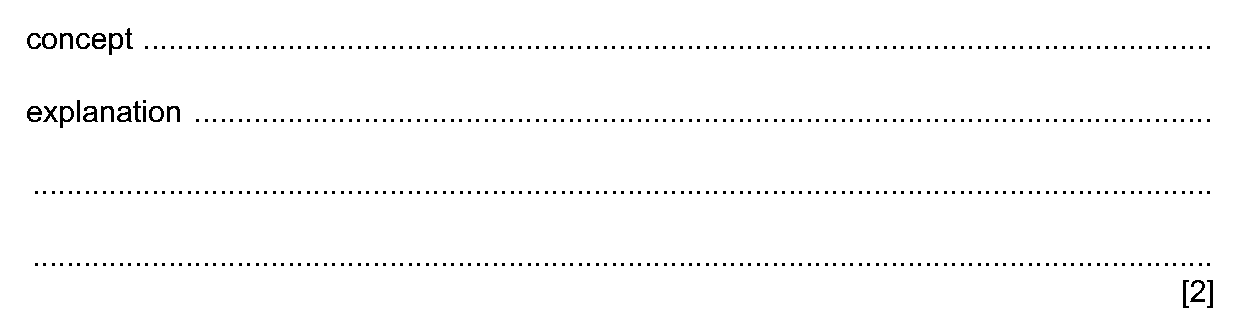
(a) Complete the table to identify and describe the accounting concept which has been ignored in each of the errors. [8 marks]
(b) Calculate the revised profit for the year ended 31 December 2024. [6 marks]
The owner of the business wishes to correct the errors that the trainee accountant has made.
(c) State which accounting concept should be applied when deciding whether or not to record this asset in the statement of financial position. [1 marks]
The business has a highly skilled workforce, and the owner is of the opinion that this asset should be reflected in the statement of financial position.
Show mark scheme
(a)
(b)
Question 1May/Jun 20259706/2130 marks
Bilal provided the following information for his service business for the year ended 31 December 2024. 1 Receipts and payments for the year ended 31 December 2024 included:
2 On 3 On 1 January 2024, the allowance for irrecoverable debts was $632. On 31 December 2024, Bilal decided to increase the allowance for irrecoverable debts by 1%. 4 On 1 January 2024, electricity charges of $270 were outstanding. On 31 December 2024, electricity charges of $490 were prepaid. 5 On 1 May 2024, part of the business premises was rented out at $1650 for every three months receivable in advance. 6 On 1 November 2024, the advertising campaign commenced. It will end on 31 January 2026. 7 During the year ended 31 December 2024, a motor vehicle, cost $21 000, was sold for $9100. It had been depreciated for three years at 20% per annum using the reducing balance method. No depreciation is provided in the year of sale. 8 Non-current assets at
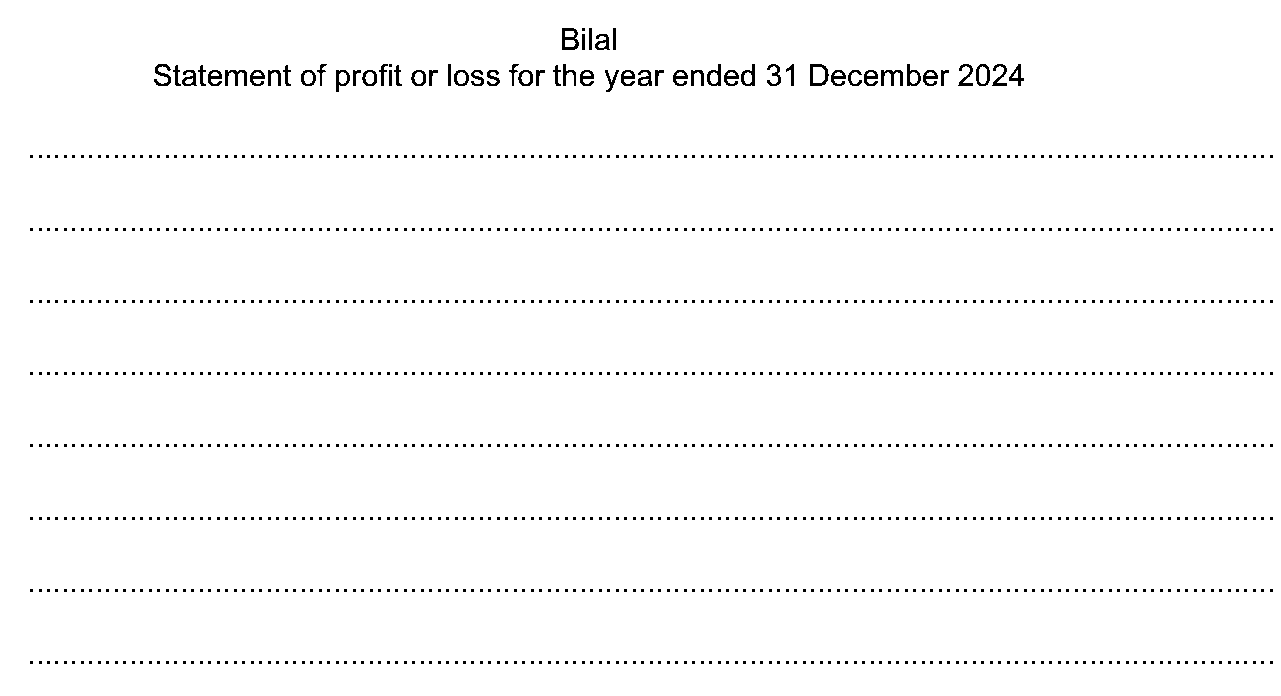
(a) Prepare the statement of profit or loss for the year ended 31 December 2024. Use the space provided on page 4 to show your workings. [14 marks]
Workings: Revenue Allowance for irrecoverable debts Electricity charges Rent received Advertising campaign Profit or loss on disposal of motor vehicle Depreciation
(b) Prepare an extract from the statement of financial position at 31 December 2024, showing the assets section only. [7 marks]
At 31 December 2024, the cash at bank balance was $8950.
Assets Workings:
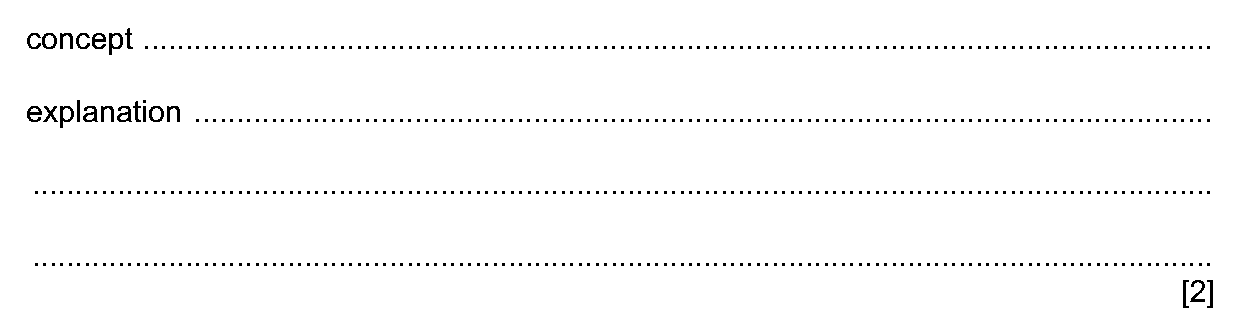
(c)(i) Explain, with reference to an accounting concept, why Bilal: maintains an allowance for irrecoverable debts [2 marks]
(c)(ii) Explain, with reference to an accounting concept, why Bilal: always uses the same method of depreciation for each class of non-current asset. [2 marks]
(d) Advise Bilal which option he should choose. Justify your choice by discussing both options. [5 marks]
Bilal hopes to expand his business and to move to larger premises. He is considering the following options. Option A: Renting out the whole of the current business premises and taking out a lease on new premises. Option B: Selling the current business premises and using the proceeds to partly finance the purchase of new premises. He is aware that he will also need a bank loan to finance the balance of the purchase price of the new premises.
Retains ownership of potentially valuable non-current asset (1)
Rent received will help finance cost of lease of new premises (1)
Less permanent arrangement, offering future flexibility (1) Option B (max 2)
Will gain a potentially more valuable non-current asset (1)
Will lose current rental income (1)
Will incur costs in selling current premises and purchasing new premises (1)
Will incur interest costs on bank loan (1) Decision supported with a comment (1) Accept other valid responses
Question 1May/Jun 20259706/2330 marks
Bilal provided the following information for his service business for the year ended 31 December 2024. 1 Receipts and payments for the year ended 31 December 2024 included:
2 On 3 On 1 January 2024, the allowance for irrecoverable debts was $632. On 31 December 2024, Bilal decided to increase the allowance for irrecoverable debts by 1%. 4 On 1 January 2024, electricity charges of $270 were outstanding. On 31 December 2024, electricity charges of $490 were prepaid. 5 On 1 May 2024, part of the business premises was rented out at $1650 for every three months receivable in advance. 6 On 1 November 2024, the advertising campaign commenced. It will end on 31 January 2026. 7 During the year ended 31 December 2024, a motor vehicle, cost $21 000, was sold for $9100. It had been depreciated for three years at 20% per annum using the reducing balance method. No depreciation is provided in the year of sale. 8 Non-current assets at
(a) Prepare the statement of profit or loss for the year ended 31 December 2024. Use the space provided on page 4 to show your workings. [14 marks]
Workings: Revenue Allowance for irrecoverable debts Electricity charges Rent received Advertising campaign Profit or loss on disposal of motor vehicle Depreciation
(b) Prepare an extract from the statement of financial position at 31 December 2024, showing the assets section only. [7 marks]
At 31 December 2024, the cash at bank balance was $8950.
Assets Workings:
(c)(i) Explain, with reference to an accounting concept, why Bilal: maintains an allowance for irrecoverable debts [2 marks]
(c)(ii) Explain, with reference to an accounting concept, why Bilal: always uses the same method of depreciation for each class of non-current asset. [2 marks]
(d) Advise Bilal which option he should choose. Justify your choice by discussing both options. [5 marks]
Bilal hopes to expand his business and to move to larger premises. He is considering the following options. Option A: Renting out the whole of the current business premises and taking out a lease on new premises. Option B: Selling the current business premises and using the proceeds to partly finance the purchase of new premises. He is aware that he will also need a bank loan to finance the balance of the purchase price of the new premises.
9706/11 · Oct/Nov 2024 · Question 11The opening balance on a purchases ledger… 🔒
9706/12 · Oct/Nov 2024 · Question 14The current assets of a company include… 🔒
9706/12 · Oct/Nov 2024 · Question 20Which ratio measures the efficiency of a… 🔒
9706/12 · Oct/Nov 2024 · Question 24The inventory movements of a business in… 🔒
9706/13 · Oct/Nov 2024 · Question 12At the end of the year, the… 🔒
+ 41 more, by year in the table above
Questions and mark schemes are from past Cambridge papers and are reproduced for revision. Topical Vault is an independent revision resource, not affiliated with or endorsed by Cambridge Assessment International Education.
AS Level Accounting questions by topic
Each topic opens this practice tool with only that topic’s questions, plus how often it comes up and every question on it in one list.
Pick a paper, sub-topics and years to draw from (leave any blank for "all"), choose
how many questions you want, and we'll open a new worksheet page with a random set for you to review
and download.