← Topical Vault

Market structure · IGCSE Economics

Cambridge 0455, Paper 1 & 2. 2,888 questions, 2019 to 2026.

Topic
Year

Paper 1 multiple-choice questions and Paper 2 structured questions, from the original Cambridge material. Paper 2 case studies and mark schemes are reproduced as extracted text, with data tables and charts kept as cropped images rather than retyped. A question tagged under a second chapter shows that as a cross-link; it is only filed once, under its primary chapter.

About Market structure

Market structure: competitive markets and monopoly, and how each affects prices, quality, choice, profit and efficiency.

48 past paper questions on this topic since 2019, across 28 exam sessions.

How often it comes up

YearPaper 1Paper 2TotalChart
2026325
2025437
2024246
2023426
2022336
2021145
2020336
2019347

Every 2025–2026 question on Market structure

The whole topic on one page, with answers and mark schemes. Printing this page prints just this list.

Paper 1 · Multiple choice (7)

Question 16June 20260455/111 mark

How is a government most likely to prevent the growth of monopolies?

  • Aby encouraging mergers in the private sector
  • Bby establishing nationalised industries
  • Cby promoting the benefits of economies of scale
  • Dby reducing barriers to entry into an industry
Show answer

DCorrect answer

Question 16June 20260455/121 mark
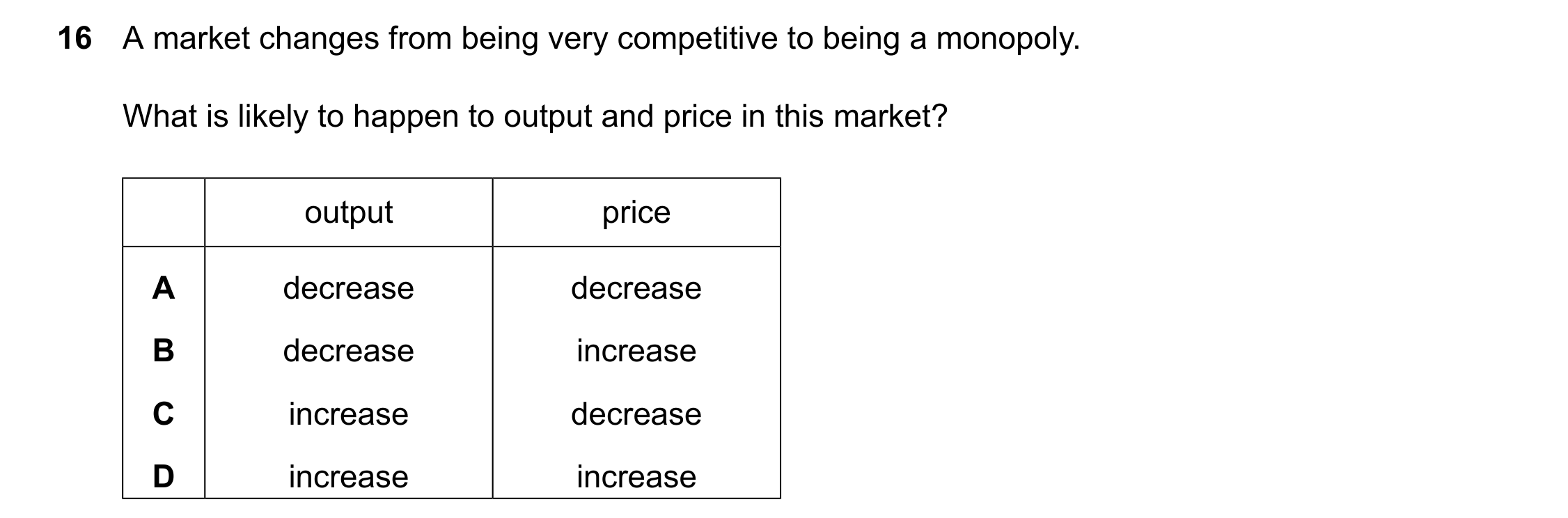
0455/12 June 2026 question 16
Show answer

ACorrect answer

Question 16March 20260455/121 mark
0455/12 March 2026 question 16
Show answer

CCorrect answer

Question 16Oct/Nov 20250455/121 mark

What is likely to be found when there are many small firms in an industry?

  • AThere are few barriers to entry.
  • BThere is high expenditure on research and development.
  • CThere is little competition.
  • DVery large capital costs are needed to establish a firm.
Show answer

ACorrect answer

Question 16Oct/Nov 20250455/131 mark

What would make the existence of a monopoly market more likely?

  • Aconsumers prefer a variety of choice in products
  • Bsignificant economies of scale can be achieved
  • Cthere are low barriers to entry and exit for firms
  • Dthere are no restrictions on international trade
Show answer

BCorrect answer

Question 16May/June 20250455/121 mark
0455/12 May/June 2025 question 16
Show answer

CCorrect answer

Question 16May/June 20250455/131 mark
0455/13 May/June 2025 question 16
Show answer

BCorrect answer

Paper 2 · Structured questions (5)

Case study: How high will Uruguay’s retirement age go?

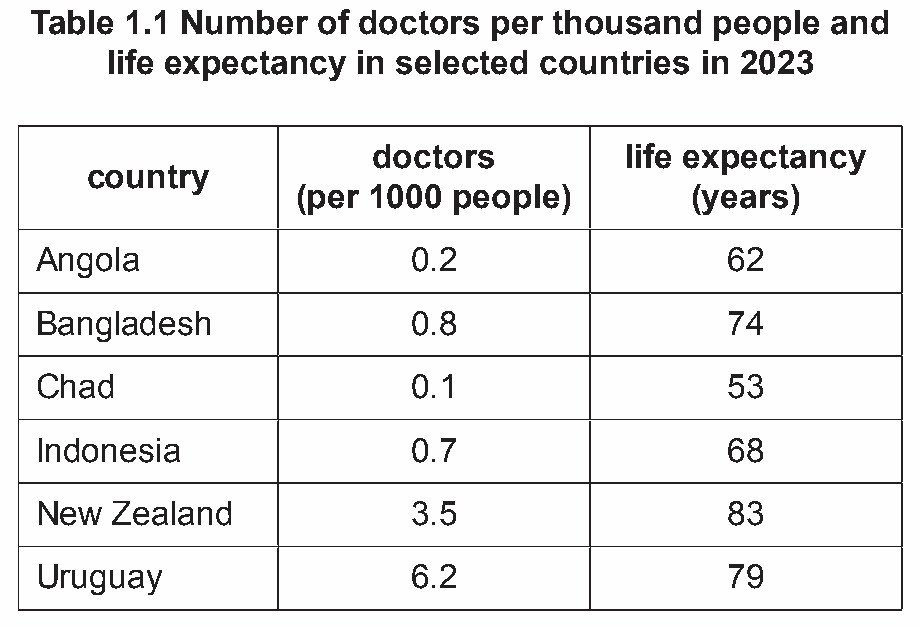
Uruguay fact file 2023 population 3.5m gross domestic product (GDP) $77.0bn government revenue $10.7bn government budget deficit $2.5bn In 2023, the Uruguayan Government raised the retirement age from 60 to 65. There are concerns about the current high government spending on pensions and it is expected that life expectancy in the country will continue to rise. A higher retirement age will have an impact on the country’s labour force, with most workers employed in the tertiary sector. The average age of Uruguay’s population is increasing due to a fall in the birth rate and emigration of young workers. Many Uruguayan workers emigrate to the United States (US) where wages are higher. However, income inequality is considerably lower in Uruguay than in the US. The tax system in Uruguay is more progressive than in the US, and the Uruguayan Government spends a higher percentage of GDP on education and healthcare. In both Uruguay and the US, there is increasing demand for swimming pools. These use a large amount of water. Demand for some luxury items, such as swimming pools, is increasing in Uruguay. Demand for healthcare is also rising which is likely to increase the number of doctors in Uruguay. Table 1.1 shows the number of doctors per thousand people and life expectancy in selected countries. Table 1.1 Number of doctors per thousand people and life expectancy in selected countries in 2023 doctors life expectancy country (per 1000 people) (years) Angola 0.2 62 Bangladesh 0.8 74 Chad 0.1 53 Indonesia 0.7 68 New Zealand 3.5 83 Uruguay 6.2 79 In 2023, Uruguay experienced its lowest inflation rate for eighteen years. This low level of inflation encouraged investment in the country. It changed the international competitiveness of the country’s products against its main trading partners, which had higher inflation rates. It also had an impact on the cost of debt in the country and firms’ willingness to increase their output. Prices change at different rates in different markets. In several markets in Uruguay, there is only one firm. All of Uruguay’s monopolies can set the price of the products they sell. Having monopoly power can also affect the firm’s average total cost and the quality of what they produce.

Uruguay fact file 2023
Table 1.1 Number of doctors per thousand people and
Question 1(h)May/Jun 20260455/216 marks

Discuss whether or not Uruguay’s consumers would benefit from more of its markets becoming monopolies.

Show mark scheme

Discuss whether or not Uruguay’s consumers would benefit from more of its markets becoming monopolies. Award up to 4 marks for logical reasons why it might, which may include:

  • (average) total cost may be low (1) due to economies of scale (1) example (1) which may reduce price (1)
  • higher profits (1) which are reinvested / spent on research and development (1) more innovation / better quality (1) create new products (1). Award up to 4 marks for logical reasons why it might not, which may include:
  • (average) total cost may be high (1) due to diseconomies of scale (1) example (1)
  • price may be high (1) ability to set prices (1) due to lack of competition (1) lower purchasing power / real income (1)
  • quality may be low (1) lack of innovation (1) complacency (1)
  • choice may be less (1) inelastic demand / necessity (1) Question Answer Marks Guidance
Stimulus: 0455/22

Some countries stop firms contacting their workers outside of their normal working hours. In 2024, Australia joined 16 other countries when it passed a law to protect workers’ free time. Such legislation can increase the health and motivation of workers and is supported by trade unions. However, it can reduce the price elasticity of supply of firms in both competitive and monopoly markets.

Question 4(c)Feb/Mar 20260455/226 marks

Analyse how a competitive market differs from a monopoly market.

Show mark scheme

Analyse how a competitive market differs from a monopoly Note: Listing any characteristics Max 3 marks. market. Also allow 25% or 40% share of the market. Coherent analysis which might include: Some candidates may use the perfect competition

  • a competitive market contains a number of firms (1) while a model for a ‘competitive market’. monopoly has one firm / a firm with a 100% share of the market (1). In this case accept the shared ideas: many firms,
  • it is relatively easy for a firm to enter a competitive market (1) competition, consumer choice, and limited market whereas there may be barriers to entry in a monopoly market (1). power, but not the extra theoretical conditions of
  • In a competitive market firms are price takers (1) in a monopoly perfect competition. market firms are price makers (1). Note: Award up to 4 marks for content on either
  • firms in a competitive market may be too small to take advantage market. of economies of scale/to experience diseconomies of scale (1) while a monopoly may be large enough to experience economies of scale/diseconomies of scale (1).
  • prices may be lower (1) quality higher in a competitive market (1) more efficient/quicker response to changing consumer preferences/greater consumer sovereignty (1).
  • PED will be higher/more elastic in a competitive market (1) as consumers will have substitutes to switch to/there will be a choice of products (1) PED will be lower / more inelastic in a monopoly market (1) as consumers will have no substitutes to switch to/there will be no choice of products (1).
  • profit may be high(er) in a monopoly market (1) which could be used to spend on research and development (1) improving the product (1). Profit is likely to be lower in a competitive market (1). Question Answer Marks Guidance
Stimulus: 0455/21

Street vendors mostly operate outside of the formal economy to avoid government regulation. However, many are now entering the formal economy. This has led to more government revenue, increased productivity and higher economic growth. Some governments plan to take measures to increase the number of firms in the economy.

---

Question 5(d)Oct/Nov 20250455/218 marks

Discuss whether or not an increase in the number of firms will benefit an economy.

Show mark scheme

Why it might not: Level Description Marks

  • firms may be smaller
  • may not be able to take advantage of economies of 1 There is a simple attempt at using 1-2 scale economic definitions and
  • may be wasteful duplication terminology. Some reference may be
  • may have lower profits and so invest less, lower made to economic theory, with innovation. occasional understanding. 0 A mark of zero should be awarded 0 for no creditable content.
Stimulus: 0455/22

In 2022, Paraguay’s production possibility curve (PPC) shifted to the right. Paraguay has a mixed economic system. Its government provides merit goods and public goods. The country’s private sector is a major producer of shampoo. The firms in the shampoo industry make use of division of labour. There are several firms in the industry, but the number is declining. There is a possibility that soon there may be just one firm in the industry.

Question 3(d)May/Jun 20250455/228 marks

Discuss whether or not consumers would benefit from only one firm producing shampoo.

Show mark scheme

Discuss whether or not consumers would benefit from Level Description Marks only one firm producing shampoo. 3 A reasoned discussion which accurately 6–8 In assessing each answer, use the table opposite. examines both sides of the economic argument, making use of economic Why they might: information and clear and logical

  • one firm may be able to benefit from economies of scale analysis to evaluate economic issues
  • lower average cost may lead to lower prices and situations. One side of the argument
  • firm may spend a large amount on research and may have more depth than the other, but development due to high profits and security overall both sides of the argument are
  • quality of product may be high considered and developed. There is
  • less time / less effort choosing shampoo. thoughtful evaluation of economic concepts, terminology, information Why they might not: and/or data appropriate to the question.
  • lack of competition may drive up prices The discussion may also point out the
  • lack of choice possible uncertainties of alternative
  • if quality is poor, cannot switch to substitutes decisions and outcomes.
  • firm may experience diseconomies of scale. 2 A reasoned discussion which makes use 3–5 of economic information and clear analysis to evaluate economic issues and situations. The answer may lack some depth and development may be one-sided. There is relevant use of economic concepts, terminology, information and data appropriate to the question. 3(d) Level Description Marks 1 There is a simple attempt at using 1–2 economic definitions and terminology. Some reference may be made to economic theory, with occasional understanding. 0 A mark of zero should be awarded for no 0 creditable content.
Stimulus: 0455/23

The public sector in Andorra is focusing on developing the healthcare, biotechnology and sports industries. Andorra has the natural advantage of being a mountainous country. Several winter sports firms in Andorra have recently merged. This will affect the level of competition in the winter sports market in Andorra.

Question 3(d)May/Jun 20250455/238 marks

Discuss whether or not competitive markets are beneficial for consumers.

Show mark scheme

Level Description Marks 1 There is a simple attempt at using 1–2 economic definitions and terminology. Some reference may be made to economic theory, with occasional understanding. 0 A mark of zero should be awarded for no 0 creditable content.

36 more questions from 2019–2024

🔒 Unlock every Market structure question from 2019–2024

All 36 come with their mark schemes, answers and case studies, and appear in the practice tool above once you’re signed in. It’s free.

Create a free accountSign in

A few of them

  • 0455/21 · Oct/Nov 2024 · Question 3(c)Analyse the effects of increased competition amongst… 🔒
  • 0455/22 · Oct/Nov 2024 · Question 5(c)Analyse the benefits consumers may gain from… 🔒
  • 0455/23 · Oct/Nov 2024 · Question 2(b)Explain two characteristics… 🔒
  • 0455/22 · May/Jun 2024 · Question 2(c)Analyse how the closure of firms may… 🔒
  • 0455/12 · Oct/Nov 2023 · Question 17What is an example of government macroeconomic… 🔒
  • + 31 more, by year in the table above

Questions and mark schemes are from past Cambridge papers and are reproduced for revision. Topical Vault is an independent revision resource, not affiliated with or endorsed by Cambridge Assessment International Education.

IGCSE Economics questions by topic

Each topic opens this practice tool with only that topic’s questions, plus how often it comes up and every question on it in one list.

  1. Ch 1The nature of the economic problem
  2. Ch 2Factors of production
  3. Ch 3Opportunity cost
  4. Ch 4Production possibility curves
  5. Ch 5Microeconomics and macroeconomics
  6. Ch 6The role of markets in allocating resources
  7. Ch 7Demand
  8. Ch 8Supply
  9. Ch 9Price determination
  10. Ch 10Price changes
  11. Ch 11Price elasticity of demand
  12. Ch 12Price elasticity of supply
  13. Ch 13Market economic system
  14. Ch 14Market failure
  15. Ch 15Mixed economic system
  16. Ch 16Money and banking
  17. Ch 17Households
  18. Ch 18Workers
  19. Ch 19Trade unions
  20. Ch 20Firms
  21. Ch 21Firms and production
  22. Ch 22Firms, costs, revenue and objectives
  23. Ch 23Market structure
  24. Ch 24The role of government
  25. Ch 25The macroeconomic aims of government
  26. Ch 26Fiscal policy
  27. Ch 27Monetary policy
  28. Ch 28Supply-side policies
  29. Ch 29Economic growth
  30. Ch 30Employment and unemployment
  31. Ch 31Inflation and deflation
  32. Ch 32Living standards
  33. Ch 33Poverty
  34. Ch 34Population
  35. Ch 35Differences in economic development between countries
  36. Ch 36International specialisation
  37. Ch 37Free trade and protection
  38. Ch 38Foreign exchange rates
  39. Ch 39Current account of balance of payments