← Topical Vault

Microeconomics and macroeconomics · IGCSE Economics

Cambridge 0455, Paper 1 & 2. 2,888 questions, 2019 to 2026.

Topic
Year

Paper 1 multiple-choice questions and Paper 2 structured questions, from the original Cambridge material. Paper 2 case studies and mark schemes are reproduced as extracted text, with data tables and charts kept as cropped images rather than retyped. A question tagged under a second chapter shows that as a cross-link; it is only filed once, under its primary chapter.

About Microeconomics and macroeconomics

The difference between microeconomics and macroeconomics, and the decision makers in each: consumers, workers, producers and government.

26 past paper questions on this topic since 2019, across 14 exam sessions.

How often it comes up

YearPaper 1Paper 2TotalChart
2026101
2025303
2024224
2023202
2022404
2021303
2020527
2019202

Every 2025–2026 question on Microeconomics and macroeconomics

The whole topic on one page, with answers. Printing this page prints just this list.

Paper 1 · Multiple choice (4)

Question 4June 20260455/121 mark

What would be classified by an economist as a macroeconomic aim?

  • Aa government increasing the unit tax on petrol
  • Ba central bank having an inflation target of 2%
  • Ca monopoly increasing its profit target by 2%
  • Da trade union increasing the living standards of its members
Show answer

BCorrect answer

Question 4Oct/Nov 20250455/121 mark
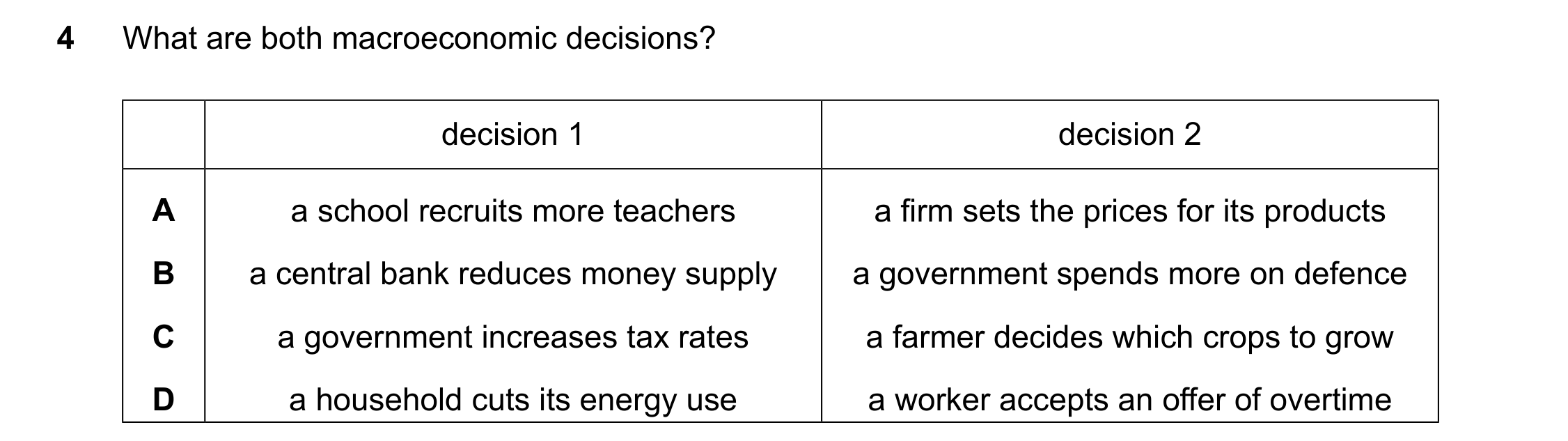
0455/12 Oct/Nov 2025 question 4
Show answer

CCorrect answer

Question 4Oct/Nov 20250455/131 mark

What is not a function of prices in a market economy?

  • Aprices allow income to be distributed equally
  • Bprices ration scarce resources among economic agents
  • Cprices rise and fall to reflect shortages and surpluses
  • Dprices send information to consumers and producers
Show answer

ACorrect answer

Question 4May/June 20250455/121 mark
0455/12 May/June 2025 question 4
Show answer

BCorrect answer

22 more questions from 2019–2024

🔒 Unlock every Microeconomics and macroeconomics question from 2019–2024

All 22 come with their mark schemes, answers and case studies, and appear in the practice tool above once you’re signed in. It’s free.

Create a free accountSign in

A few of them

  • 0455/11 · Oct/Nov 2024 · Question 4Which person is most likely to make… 🔒
  • 0455/12 · Oct/Nov 2024 · Question 10What is an important role of a… 🔒
  • 0455/23 · Oct/Nov 2024 · Question 3(a)Identify two decision-makers involved… 🔒
  • 0455/22 · May/Jun 2024 · Question 3(a)Identify the difference between microeconomics… 🔒
  • 0455/13 · Oct/Nov 2023 · Question 15Some governments allow monopoly markets… 🔒
  • + 17 more, by year in the table above

Questions and mark schemes are from past Cambridge papers and are reproduced for revision. Topical Vault is an independent revision resource, not affiliated with or endorsed by Cambridge Assessment International Education.

IGCSE Economics questions by topic

Each topic opens this practice tool with only that topic’s questions, plus how often it comes up and every question on it in one list.

  1. Ch 1The nature of the economic problem
  2. Ch 2Factors of production
  3. Ch 3Opportunity cost
  4. Ch 4Production possibility curves
  5. Ch 5Microeconomics and macroeconomics
  6. Ch 6The role of markets in allocating resources
  7. Ch 7Demand
  8. Ch 8Supply
  9. Ch 9Price determination
  10. Ch 10Price changes
  11. Ch 11Price elasticity of demand
  12. Ch 12Price elasticity of supply
  13. Ch 13Market economic system
  14. Ch 14Market failure
  15. Ch 15Mixed economic system
  16. Ch 16Money and banking
  17. Ch 17Households
  18. Ch 18Workers
  19. Ch 19Trade unions
  20. Ch 20Firms
  21. Ch 21Firms and production
  22. Ch 22Firms, costs, revenue and objectives
  23. Ch 23Market structure
  24. Ch 24The role of government
  25. Ch 25The macroeconomic aims of government
  26. Ch 26Fiscal policy
  27. Ch 27Monetary policy
  28. Ch 28Supply-side policies
  29. Ch 29Economic growth
  30. Ch 30Employment and unemployment
  31. Ch 31Inflation and deflation
  32. Ch 32Living standards
  33. Ch 33Poverty
  34. Ch 34Population
  35. Ch 35Differences in economic development between countries
  36. Ch 36International specialisation
  37. Ch 37Free trade and protection
  38. Ch 38Foreign exchange rates
  39. Ch 39Current account of balance of payments