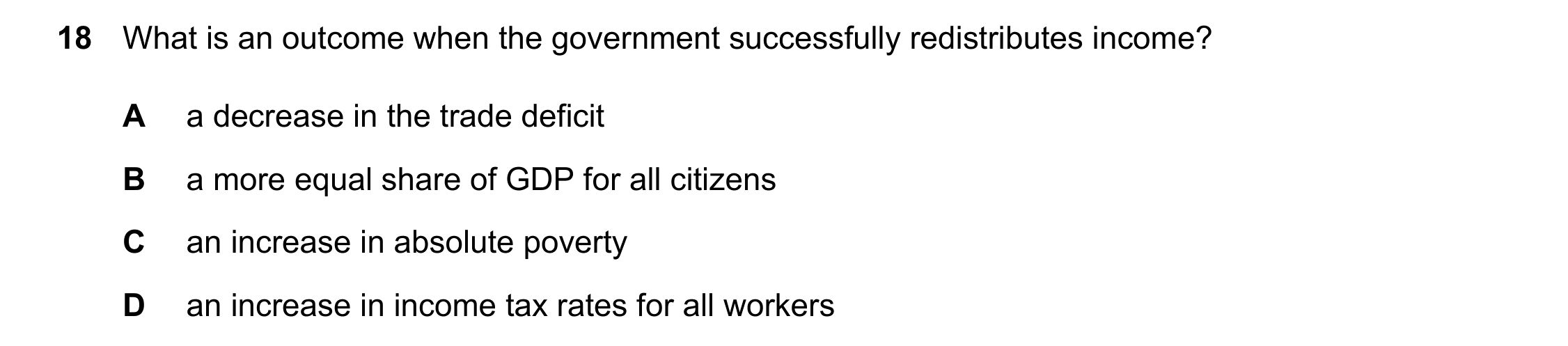
Question 18June 20260455/131 mark
Show answer
BCorrect answer
Cambridge 0455, Paper 1 & 2. 2,888 questions, 2019 to 2026.
Paper 1 multiple-choice questions and Paper 2 structured questions, from the original Cambridge material. Paper 2 case studies and mark schemes are reproduced as extracted text, with data tables and charts kept as cropped images rather than retyped. A question tagged under a second chapter shows that as a cross-link; it is only filed once, under its primary chapter.
The macroeconomic aims of government: economic growth, full employment, stable prices and balance of payments stability, plus redistribution of income, and the conflicts between these aims.
41 past paper questions on this topic since 2019, across 25 exam sessions.
| Year | Paper 1 | Paper 2 | Total | Chart |
|---|---|---|---|---|
| 2026 | 2 | 2 | 4 | |
| 2025 | 4 | 2 | 6 | |
| 2024 | 4 | 1 | 5 | |
| 2023 | 1 | 2 | 3 | |
| 2022 | 5 | 2 | 7 | |
| 2021 | 4 | 5 | 9 | |
| 2020 | 1 | 1 | 2 | |
| 2019 | 4 | 1 | 5 |
The whole topic on one page, with answers and mark schemes. Printing this page prints just this list.
BCorrect answer
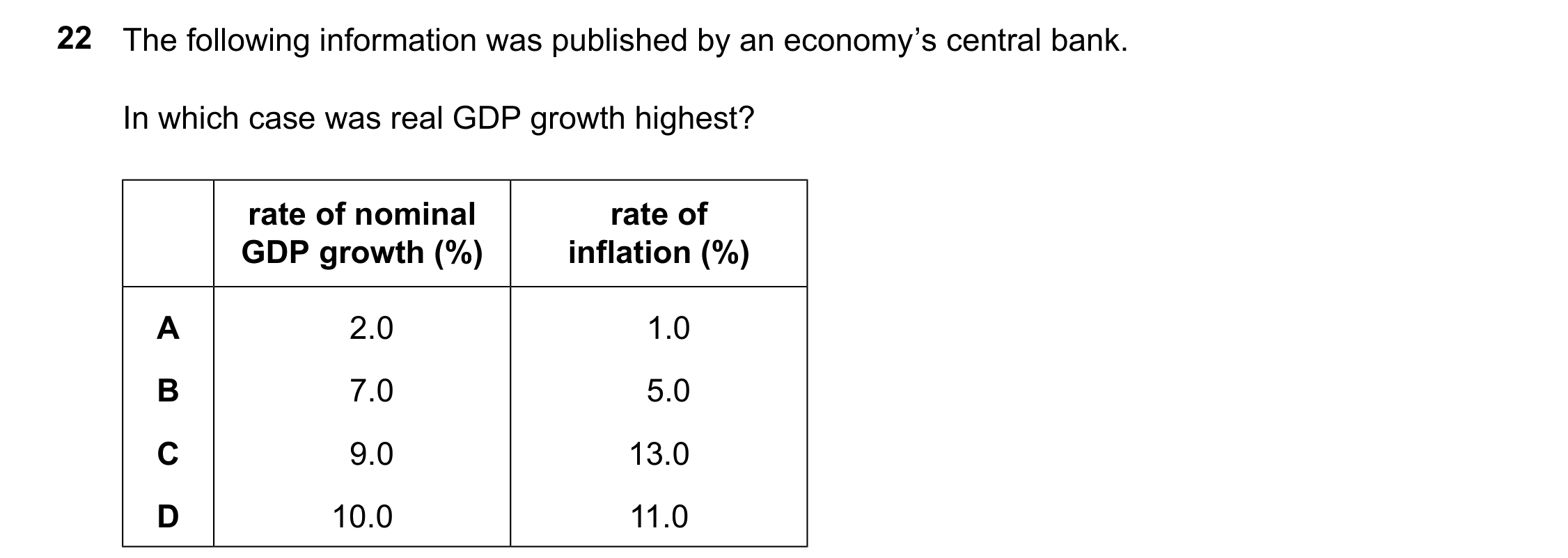
BCorrect answer
A government has stated for the next year it has four main aims. 1 low and stable inflation 2 providing subsidies to farmers 3 raising productivity of workers in the public sector 4 stability in the balance of payments What are the two macroeconomic aims for the government?
BCorrect answer
In rural areas in developing countries, farmers grow food for their own consumption. Why might this mean that the GDP is a weak measure of the standard of living in those countries?
DCorrect answer
Brazil’s real GDP fell by 3.8% in a year. What might have caused this?
CCorrect answer
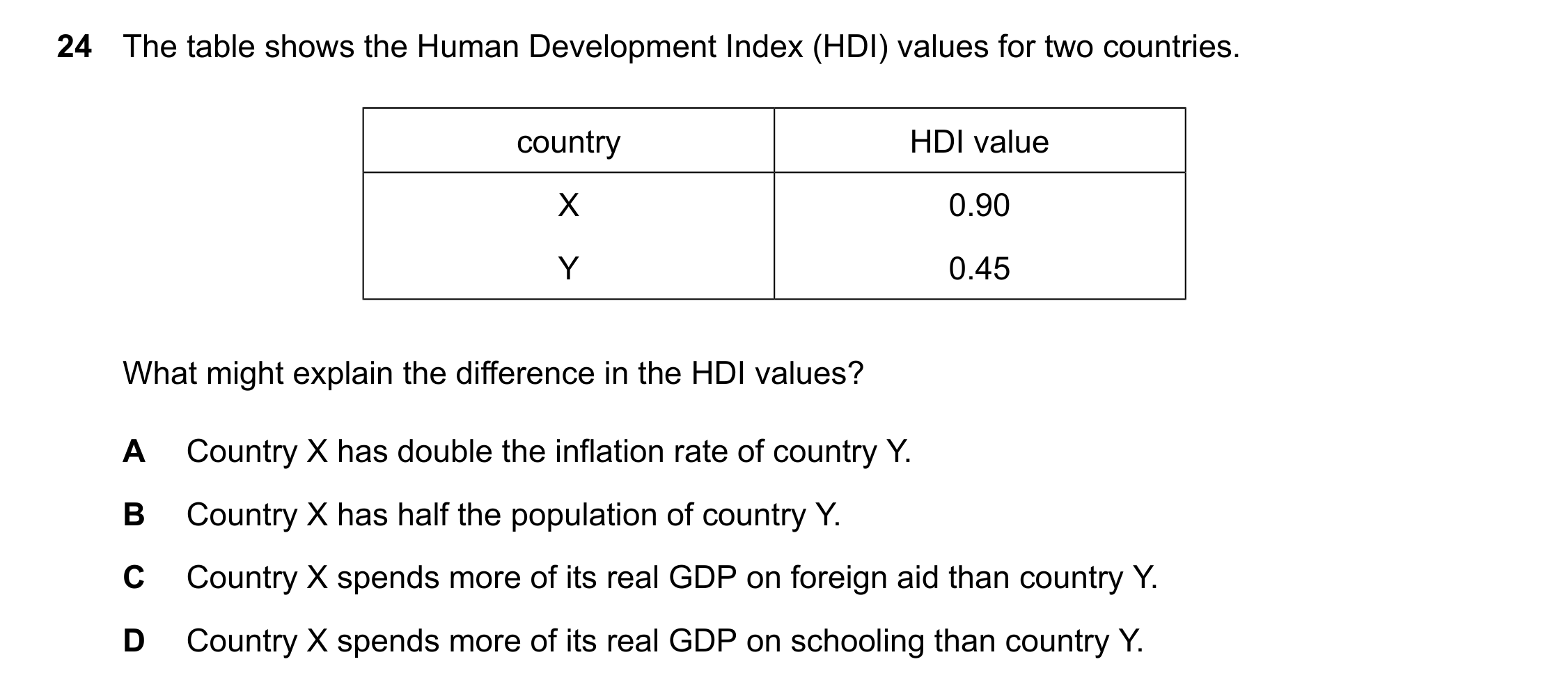
DCorrect answer
Temperatures continue to rise throughout the world. This affects the health of those who work outside and their productivity. Higher temperatures can also reduce the hours they work and their incomes. However, there are benefits for some entrepreneurs and their firms. For example, demand for air conditioners continues to increase. Higher output of a range of products can affect economic growth and poverty.
---
Analyse how a decrease in productivity could affect a government’s macroeconomic aims.
Analyse how a decrease in productivity could affect a Maximum 3 marks for only identification government’s macroeconomic aims. Accept but do not expect: Coherent analysis which might include:
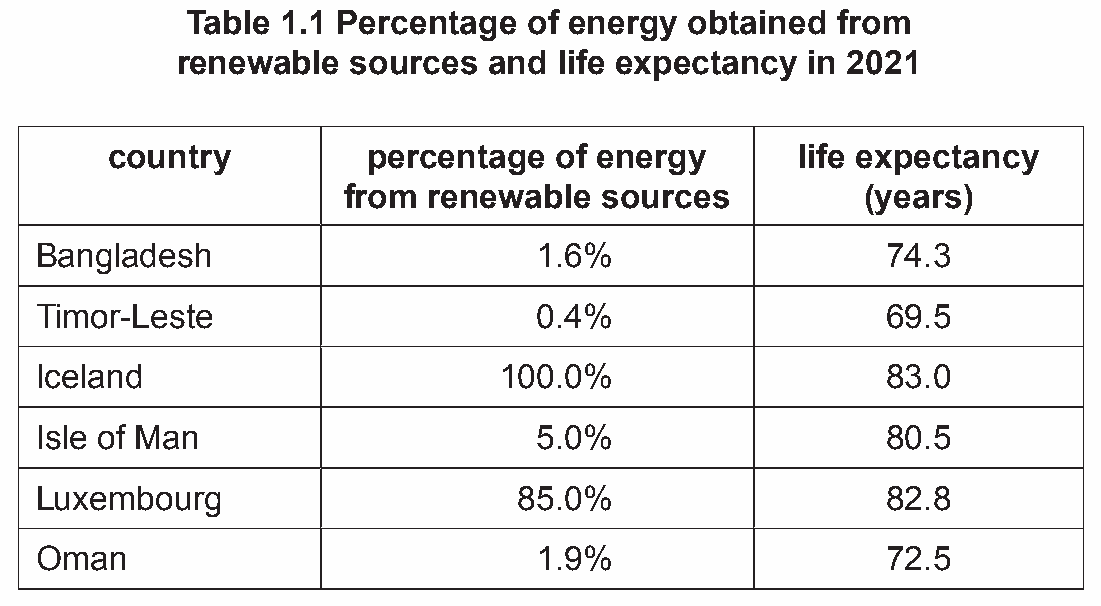
Isle of Man fact file 2022 gross domestic product (GDP) $7.0bn insurance industry share of GDP 18.0% GDP growth rate 10.3% unemployment rate 0.7% The Isle of Man is an island located between the United Kingdom (UK) and Ireland. Its geographical location has helped to attract foreign labour and capital. In 2022, it had a very low unemployment rate and high GDP growth rate. The island has the same monetary policy as the UK but sets its own fiscal policy. Some fiscal policy measures have attracted many insurance firms to operate on the island. The Isle of Man is set to generate as much as 75% of its electricity from renewable sources by 2026. A higher percentage of renewable energy generation may reduce pollution and affect health and life expectancy. In addition, energy costs could also decrease which will affect secondary sector firms such as food processors. Table 1.1 shows the percentage of energy obtained from renewable sources and life expectancy in selected countries in 2021. Table 1.1 Percentage of energy obtained from renewable sources and life expectancy in 2021 country percentage of energy life expectancy from renewable sources (years) Bangladesh 1.6% 74.3 Timor-Leste 0.4% 69.5 Iceland 100.0% 83.0 Isle of Man 5.0% 80.5 Luxembourg 85.0% 82.8 Oman 1.9% 72.5 Goods are transported to and from the island by air or sea. The government has increased spending to improve the airport and move the economy’s production possibility curve (PPC). The increased spending was used to increase the number of employees and improve the airport building. This has affected the number of flight cancellations. However, some airport users are still not satisfied. Some industries are also dissatisfied as the government is not funding projects which affect these other industries directly. Firms deciding whether to invest in the Isle of Man consider several influences including the level of demand and labour availability. The market for goods and services on the island is very small. However, there is free trade with neighbouring countries. Foreign workers are attracted by the low cost of living in the Isle of Man. However, some workers stay for only a short period of time before moving to jobs elsewhere.
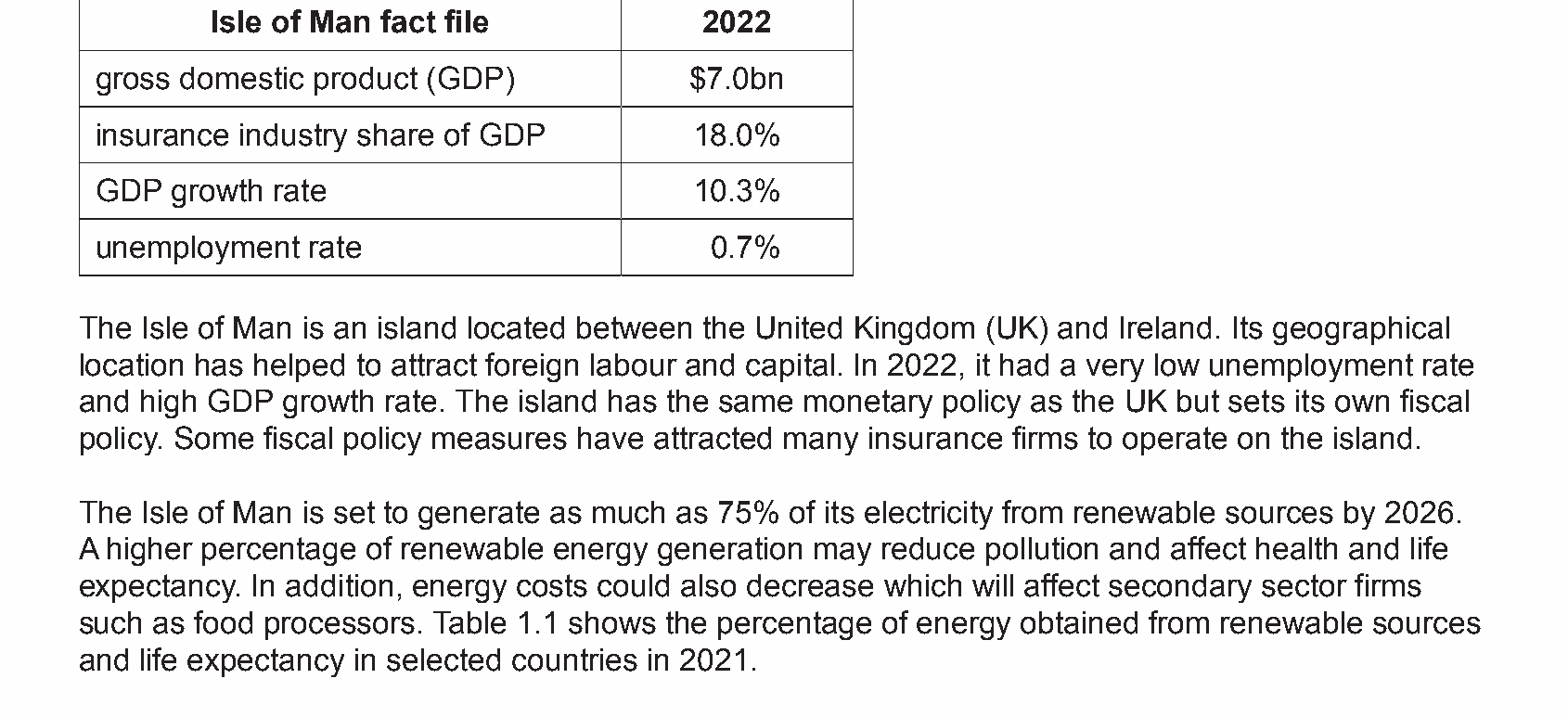
Explain one government macroeconomic aim that has been achieved in the Isle of Man.
Explain one macroeconomic aim of the government that has been achieved in the Isle of Man. High GDP growth rate (1) more output / more goods and services in the economy (1) Low unemployment (1) people who are willing and able to find a job were able to find jobs / fewer people out of the labour force cannot find a job (1)
In 2023, India became the country with the largest population. This may affect the government’s macroeconomic aims. In 2018, the Indian Government cut the country’s corporation (corporate income) tax rate from 35% to 25%. Between 2019 and 2022, India’s inflation rate averaged 6%. Some economists suggested that to achieve its central inflation rate target, the government should cut its spending.
Identify two macroeconomic aims of government that may conflict.
Identify two macroeconomic aims of government that If more than two macroeconomic aims given, consider the may conflict. first three.
One of the world’s more expensive roads opened in Montenegro in 2022. To build the road, the Montenegro Government was helped by a foreign commercial bank and another multinational company (MNC). This new road could help the Montenegro Government achieve its macroeconomic aims and increase Montenegro’s international trade. MNCs can have a significant impact on the host countries in which they locate.
Analyse how building roads can help a government achieve its macroeconomic aims.
Analyse how building roads can help a government achieve its macroeconomic aims. Coherent analysis which might include: Building roads may involve government spending (1) creates jobs / requires labour (1) such as road builders (1) reducing unemployment (1) increase income (1) increase consumption (1) support other industries (1) such as raw material suppliers / private contractors (1) which increases total demand in the economy (1). Building roads may lead to reduced transport costs / cheaper transport (1) due to greater efficiency / productivity / time saving (1) reducing overall costs of production (1) increasing investment / attracting MNCs (1) causing economic growth (1) increased exports (1) improving the current account balance (1) reducing cost-push inflation (1). Building roads could lead to better quality transportation / easier access to places of work (1) reducing unemployment (1) may reduce poverty (1).
🔒 Unlock every The macroeconomic aims of government question from 2019–2024
All 31 come with their mark schemes, answers and case studies, and appear in the practice tool above once you’re signed in. It’s free.
Questions and mark schemes are from past Cambridge papers and are reproduced for revision. Topical Vault is an independent revision resource, not affiliated with or endorsed by Cambridge Assessment International Education.
Each topic opens this practice tool with only that topic’s questions, plus how often it comes up and every question on it in one list.