Question 12June 20260455/121 mark
Show answer
ACorrect answer
Cambridge 0455, Paper 1 & 2. 2,888 questions, 2019 to 2026.
Paper 1 multiple-choice questions and Paper 2 structured questions, from the original Cambridge material. Paper 2 case studies and mark schemes are reproduced as extracted text, with data tables and charts kept as cropped images rather than retyped. A question tagged under a second chapter shows that as a cross-link; it is only filed once, under its primary chapter.
Workers: what influences the choice of occupation, how wages are determined, why earnings differ, and the division of labour and specialisation.
103 past paper questions on this topic since 2019, across 28 exam sessions.
| Year | Paper 1 | Paper 2 | Total | Chart |
|---|---|---|---|---|
| 2026 | 1 | 5 | 6 | |
| 2025 | 4 | 9 | 13 | |
| 2024 | 6 | 10 | 16 | |
| 2023 | 1 | 7 | 8 | |
| 2022 | 0 | 7 | 7 | |
| 2021 | 9 | 6 | 15 | |
| 2020 | 7 | 9 | 16 | |
| 2019 | 4 | 18 | 22 |
The whole topic on one page, with answers and mark schemes. Printing this page prints just this list.
ACorrect answer
BCorrect answer
A restaurant employs two chefs who make all of the meals that are served to customers. What is most likely to increase the productivity of the chefs?
DCorrect answer
CCorrect answer
A car-wash firm has 3 workers. Before specialisation, each worker washed 5 cars per day. After specialisation, 30 cars per day are washed. What is the percentage increase in productivity?
BCorrect answer
In 2023, Argentina had a high inflation rate and a deficit on the current account of its balance of payments. Very high inflation can affect how efficiently the price mechanism works. As Argentina’s products have different price elasticities of demand, the impact of price changes affected the demand for products to different extents. The high inflation also encouraged workers to try to increase their wages and some industries to ask for protection from foreign competition.
Analyse the influences on workers’ ability to gain a wage rise.
Analyse the influences on workers’ ability to gain a Maximum 3 marks for only identification wage rise. Coherent analysis which might include:
Temperatures continue to rise throughout the world. This affects the health of those who work outside and their productivity. Higher temperatures can also reduce the hours they work and their incomes. However, there are benefits for some entrepreneurs and their firms. For example, demand for air conditioners continues to increase. Higher output of a range of products can affect economic growth and poverty.
---
Explain two reasons why a person may be prepared to work outside in high temperatures.
Explain two reasons why a person may be prepared to One mark each for each of two factors identified and one work outside in high temperatures. mark for each of two explanations. Logical explanation which might include: If more than two factors are given, consider the first three.
Kuwait fact file 2023 labour force 2.4m gross domestic product (GDP) $160bn surplus on the current account of $64bn the balance of payments Kuwait, a country in the Middle East, has a relatively large current account surplus. Countries, including China, India and South Korea, buy oil and electrical equipment from Kuwait. These countries’ firms also pay to have ships insured in Kuwait and for financial advice from Kuwaiti banks. Products that are exported create employment and income. However, Kuwaiti exports are then not available to be consumed in Kuwait. Kuwait is a high-income country with a relatively long life expectancy. It has good quality education and healthcare. The price of a range of products is cheaper in Kuwait than in Europe and the United States. For example, in 2023, the price of jeans and monthly access to the internet were cheaper in Kuwait. These price differences may change in the future as a result of changes in indirect taxes. In recent years, there has been an increase in the number of Kuwaiti workers employed in the country’s high-technology industries. Kuwait had a low unemployment rate in 2023, but a relatively high youth unemployment rate. Table 1.1 shows the unemployment rate and the youth unemployment rate (15 –24 year olds) in selected countries in 2023. Table 1.1 The unemployment rate and youth unemployment rate in selected countries in 2023 country unemployment rate (%) youth unemployment rate (%) Argentina 6.8 30.0 Australia 3.7 10.8 Bahamas 10.1 30.5 Eswatini 22.6 51.0 Jordan 19.2 40.5 Kuwait 2.2 25.5 The Kuwaiti Government aims to reduce youth unemployment and to encourage an increase in the proportion of workers employed in the private sector. Whether workers will move from the public sector to the private sector will depend on, for example, wages, job security and working conditions in the two sectors. Infrastructure projects in Kuwait influence employment. One example is the construction of the Mubarak Al-Kabeer port on Boubyan Island, a very popular tourist area in Kuwait. It is hoped that the port will change the cost of sea transport and create many jobs for Kuwait’s young workers. However, some are concerned that the port may create noise, water and air pollution and have an impact on the wildlife on and around the island. There is also the possibility that the land could be put to better use.


Discuss whether or not workers would benefit from moving from the public sector to the private sector.
In 2023, a foreign multinational company (MNC) expanded its copper mine in Mongolia. The mine was opened ten years before when it created more than 15 000 jobs, reducing unemployment in the country. While mining increased in Mongolia, mines in some other countries were closed. Over time, the closure of mines has contributed to the decline of the primary sector in some countries. In contrast, the tertiary sector in most countries has increased.
Identify two disadvantages of working as a miner.
Identify two disadvantages of working as a miner. If more than two disadvantages are given, consider the first three.
Some countries stop firms contacting their workers outside of their normal working hours. In 2024, Australia joined 16 other countries when it passed a law to protect workers’ free time. Such legislation can increase the health and motivation of workers and is supported by trade unions. However, it can reduce the price elasticity of supply of firms in both competitive and monopoly markets.
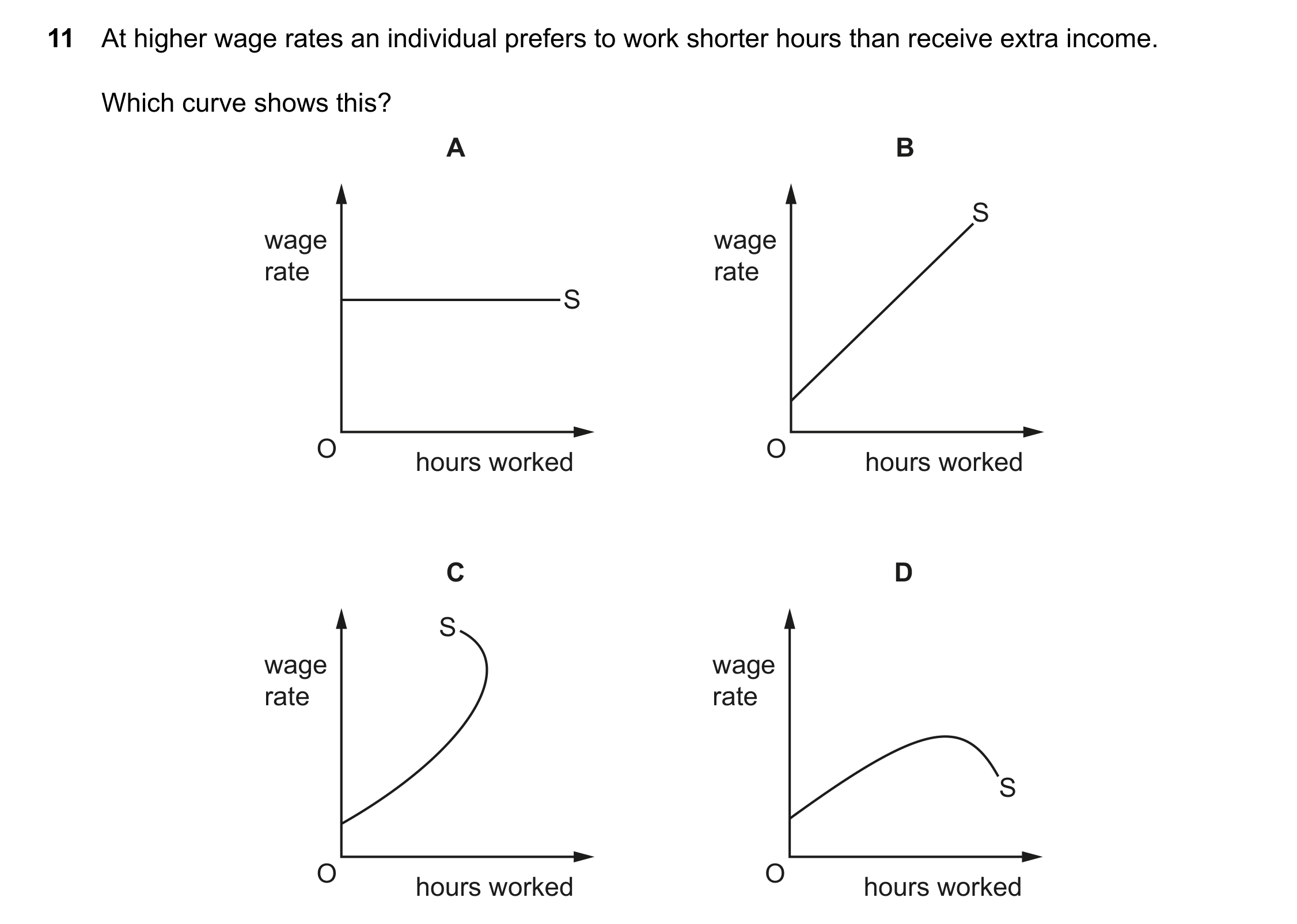
Explain two reasons why a worker may choose to work long hours.
Explain two reasons why a worker may choose to work long If more than 2 reasons are given, consider the hours. first 3. Logical explanation which might include: One mark each for each of two reasons identified and one mark for each of two explanations.
In the first half of 2022, Guyana’s GDP grew by 36.4%. Most of this growth was due to higher output in the primary sector. The government used some of the tax revenue generated from this growth to fund long‑run development projects such as infrastructure and education. However, in the short run, there was a rise in house prices.
Identify two examples of primary sector industries.
Identify two examples of primary sector industries. If more than two primary industries are given, consider the first three. Two from: Accept two specific examples, e.g. growing wheat, catching
Lanzarote, a Spanish island, was once an area with very high rates of poverty. However, the rise of tourism has greatly reduced unemployment. The government is trying to attract more workers to the island by using non‑wage factors. Lanzarote’s low taxes also attract workers to the island. Mobility of labour in the island’s economy has also increased.
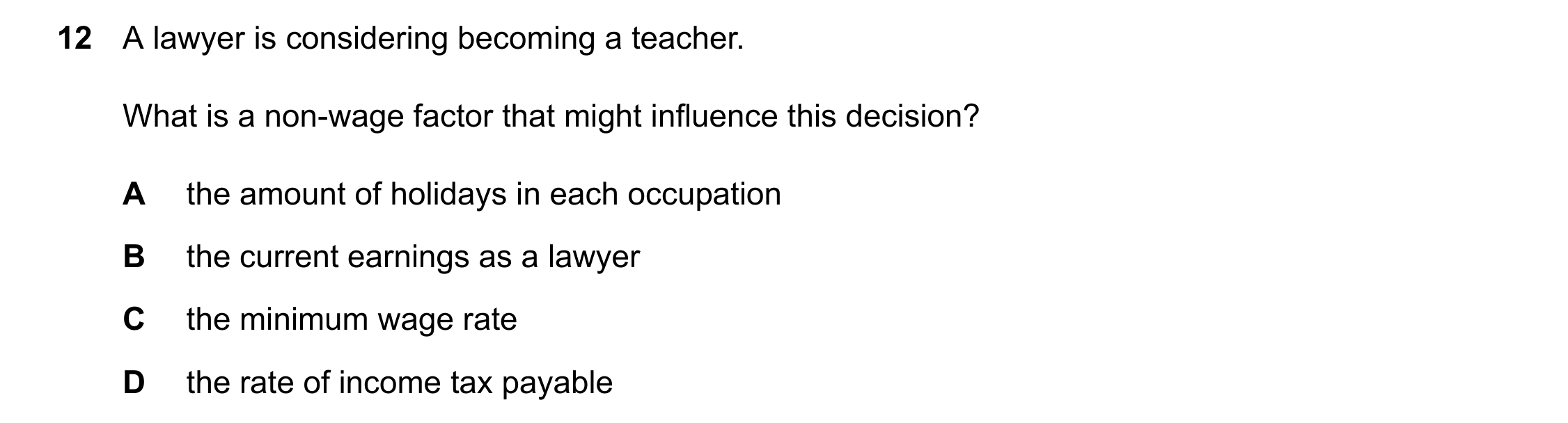
Identify two non‑wage factors that may influence a worker’s job choice.
Identify two non-wage factors that may influence a Accept any relevant non-wage factors. worker’s job choice. If more than two non-wage factors are given, consider the Two from: first three.
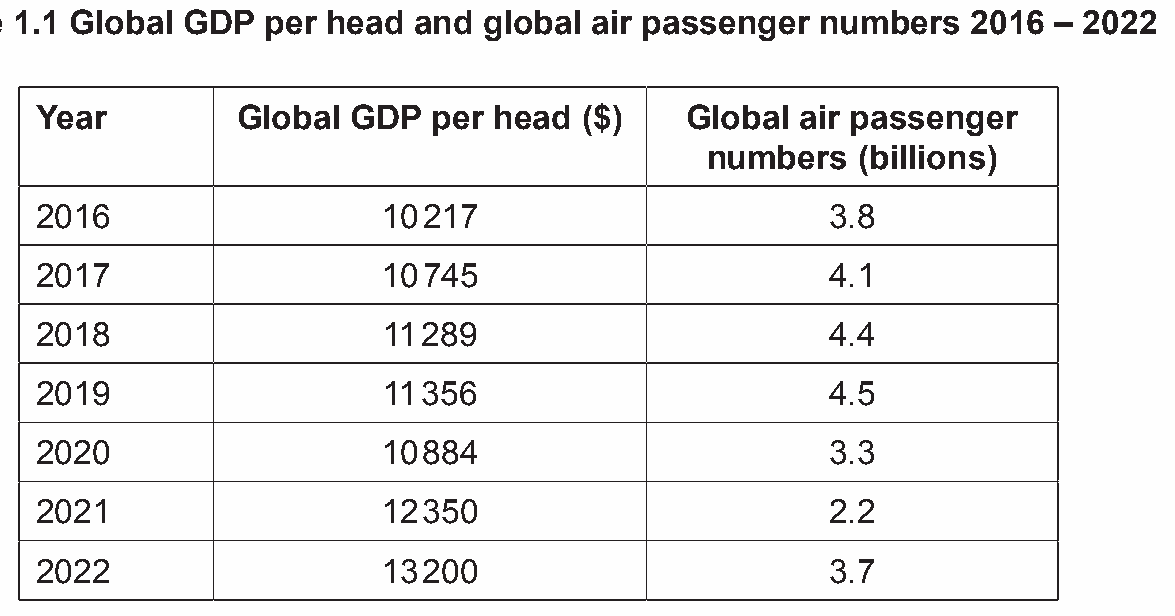
Japan fact file 2022 Population 125m Total labour force including foreign workers 70m Foreign workers 1.75m Inflation rate 2.5% % of income saved 29% Japan has a high average age of population and a varied economic performance. It has a low birth rate, low inflation rate, good healthcare, high life expectancy and low unemployment rate. Fewer Japanese people enter the labour force each year. It is predicted that Japan’s labour force will fall by 10 million by 2040. Many young Japanese people emigrate to Australia, Canada and the US in search of higher wages. However, Japan now experiences net immigration although foreign workers are currently only a small proportion of Japan’s labour force. To achieve an annual economic growth rate of 1.2%, it has been estimated that the number of foreign workers would have to increase to 7 million by 2040. Some foreign workers are discouraged from working in Japan due to the requirement to pass a Japanese language test. Only the most skilled are allowed to stay for more than 5 years and to bring their families with them. Many Japanese industries are affected by labour shortages and the country’s decline in population. For example, the fall in population has affected the quantity of furniture traded. It has also influenced the country’s air transport industry. Air travel is the most important method of transport in Japan for foreign travel and long-distance internal travel. Japan’s air passenger numbers follow a similar pattern to global air passenger numbers. Table 1.1 shows global GDP per head and global air passenger numbers between 2016 and 2022. Table 1.1 Global GDP per head and global air passenger numbers 2016 – 2022 Year Global GDP per head ($) Global air passenger numbers (billions) 2016 10 217 3.8 2017 10 745 4.1 2018 11 289 4.4 2019 11 356 4.5 2020 10 884 3.3 2021 12 350 2.2 2022 13 200 3.7 Demand for goods and services, including air travel, is influenced by how much people save. Japanese people save a relatively high proportion of their income. This has affected the country’s inflation rate, current account balance of the balance of payments and its economic growth rate. Japan’s macroeconomic performance is also influenced by the mobility of its labour force. There are several reasons why the mobility of Japan’s labour force may change in the future. These include its ageing labour force and possible changes in education and training, house prices and the quality and price of transport.
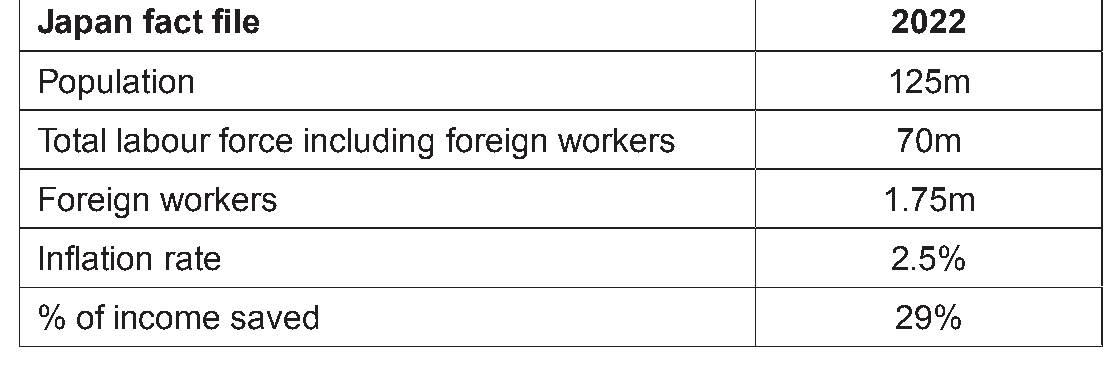
Explain two ways Japan could attract more foreign workers.
Explain two ways Japan could attract more foreign One mark each for two ways identified and one mark each workers. for two explanations. Logical explanation which might include: If more than two ways are given, consider the first three. Only the 3 listed identifications can be credited, and
Central banks influence their countries’ money supply. Central banks also regulate commercial banks. Households benefit from these commercial banks in several ways. In recent years, commercial banks have introduced new technology. Global online banking increased by 14% between 2019 and 2022. These advances in technology were combined with a greater use of division of labour.
Discuss whether or not division of labour will benefit workers.
Discuss whether or not division of labour will benefit Level Description Marks workers. 3 A reasoned discussion which accurately 6–8 In assessing each answer, use the table opposite. examines both sides of the economic argument, making use of economic Why they might: information and clear and logical analysis
In 2023, the Canadian Prime Minister said that his country’s aim was to increase immigration to half a million a year. This was because the country was experiencing labour shortages and an increase in life expectancy. More workers in Canada would increase the tax revenue available to spend on pensions, and more workers would also increase consumer spending. An increase in the immigration of both skilled and unskilled workers might affect the country’s car industry.
---
Explain two ways a firm could attract skilled workers from another country.
Explain two ways a firm could attract skilled workers One mark each for two ways identified and one mark each from another country. for two explanations. Logical explanation which might include: If more than two ways are given, consider the first three.
Discuss whether or not the wages of workers employed by car firms will increase in the future.
Discuss whether or not the wages of workers employed Level Description Marks by car firms will increase in the future. 3 A reasoned discussion which accurately 6–8 In assessing each answer, use the table opposite. examines both sides of the economic argument, making use of economic Why they might: information and clear and logical analysis
In recent years, the quantity of Latvia’s factors of production has changed. Since 2008, its capital has increased and its land has not changed significantly, but its labour force and its enterprise have decreased. Enterprise and conditions of supply can affect firms’ prices. In 2022, the Latvian Government increased the country’s national minimum wage (NMW). Its NMW did, however, remain one of the lowest in the European Union.
Discuss whether or not a rise in a national minimum wage will harm an economy.
Level Description Marks 1 There is a simple attempt at using 1–2 economic definitions and terminology. Some reference may be made to economic theory, with occasional understanding. 0 A mark of zero should be awarded for 0 no creditable content. Question Answer Marks Guidance
In 2022, Paraguay’s production possibility curve (PPC) shifted to the right. Paraguay has a mixed economic system. Its government provides merit goods and public goods. The country’s private sector is a major producer of shampoo. The firms in the shampoo industry make use of division of labour. There are several firms in the industry, but the number is declining. There is a possibility that soon there may be just one firm in the industry.
Analyse how division of labour can benefit firms.
Analyse how division of labour can benefit firms. Coherent analysis which might include:
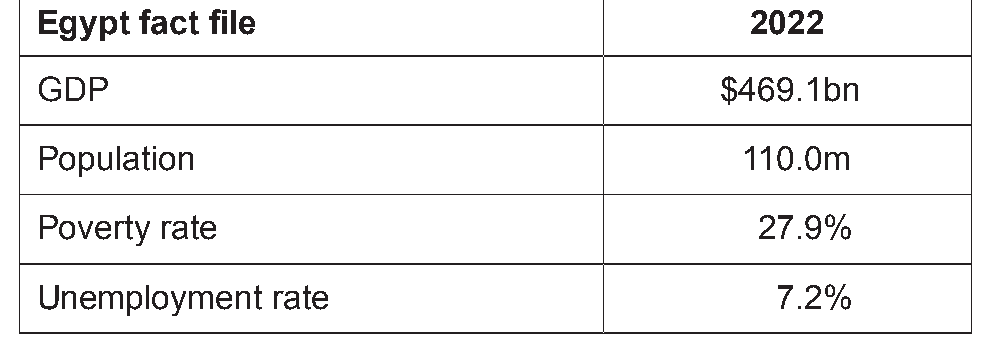
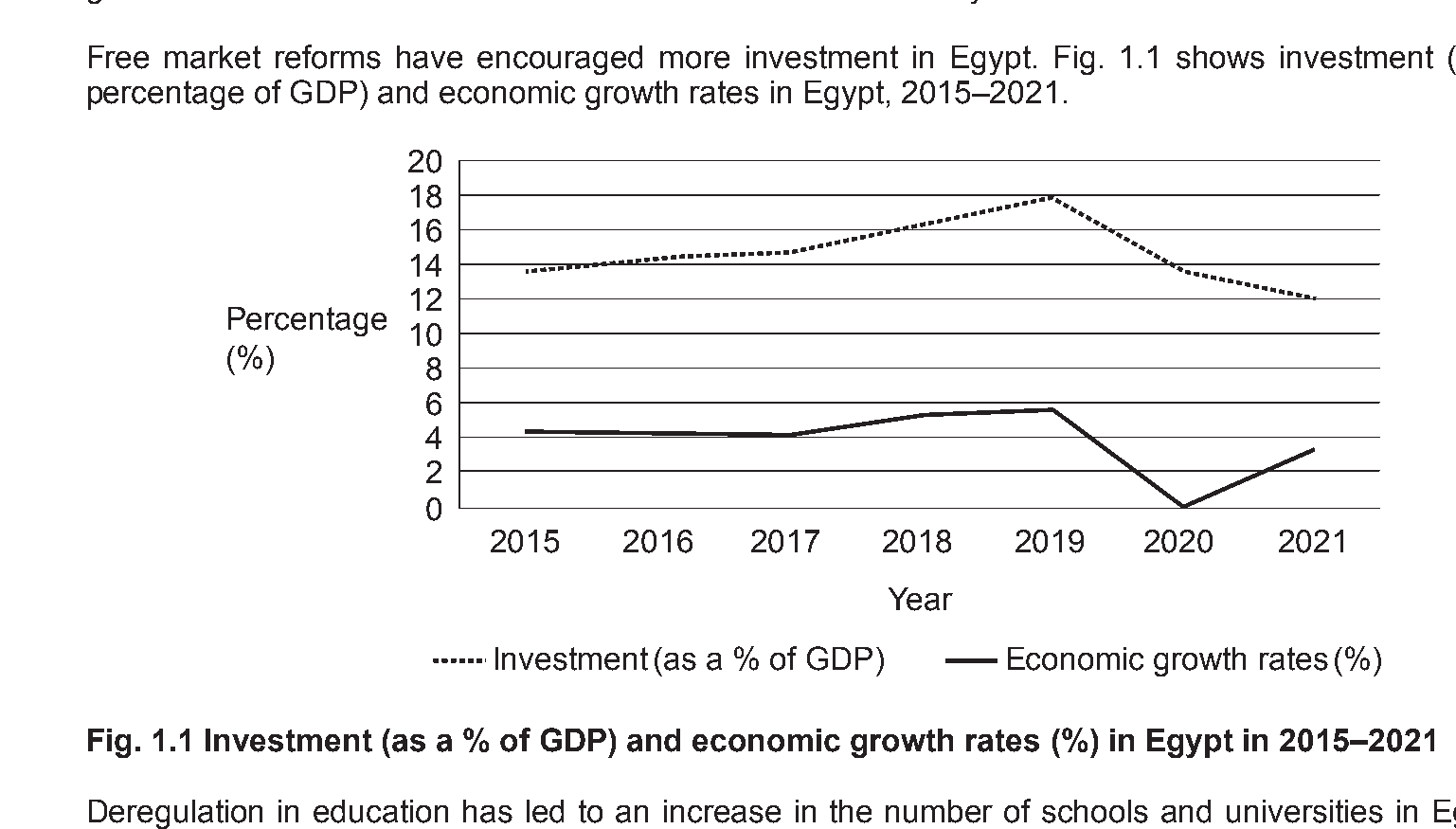
Egypt fact file 2022 GDP $469.1bn Population 110.0m Poverty rate 27.9% Unemployment rate 7.2% Egypt has always attracted tourists due to the pyramids and other ancient wonders. However, the tertiary sector is not the only source of economic growth; the primary and secondary sectors also contribute to economic growth. Egypt’s exports include personal travel, oil, citrus fruits, gold and textiles. There has been a building boom recently in Egypt. A new city is being built which requires finance, raw materials and labour. Firms are taking a big risk with this project as they are building houses before demand for them has been confirmed. If incomes fall, for example, the market for housing might be unprofitable. Tourism is a good source of economic growth for Egypt. The country has attractions that were built thousands of years ago and natural attractions such as beautiful beaches and a warm climate. It has good infrastructure and is considered a safe and secure country which also attract tourists. Free market reforms have encouraged more investment in Egypt. Fig. 1.1 shows investment (as a percentage of GDP) and economic growth rates in Egypt, 2015–2021. Percentage 10 (%) 8 2015 2016 2017 2018 2019 2020 2021 Investment (as a % of GDP) Economic growth rates (%) Fig. 1.1 Investment (as a % of GDP) and economic growth rates (%) in Egypt in 2015–2021 Deregulation in education has led to an increase in the number of schools and universities in Egypt. Increased opportunities for education and training will ensure future improvements in living standards. However, the opening of more private schools and universities might increase inequality as private education may remain unaffordable for some income groups. In 2022, the Egyptian currency halved in value against the US dollar. The fall in the value of the currency affected inflation and the purchasing power of Egyptians. However, certain industries such as tourism have benefited from this as holidays in Egypt have become more affordable for non-Egyptians.
Identify two of Egypt’s primary sector exports.
Identify two of Egypt’s primary sector exports. Accept any two Two from: oil (1), citrus fruits (1), gold (1)
🔒 Unlock every Workers question from 2019–2024
All 84 come with their mark schemes, answers and case studies, and appear in the practice tool above once you’re signed in. It’s free.
Questions and mark schemes are from past Cambridge papers and are reproduced for revision. Topical Vault is an independent revision resource, not affiliated with or endorsed by Cambridge Assessment International Education.
Each topic opens this practice tool with only that topic’s questions, plus how often it comes up and every question on it in one list.