Question 4May/June 20269609/125 marks
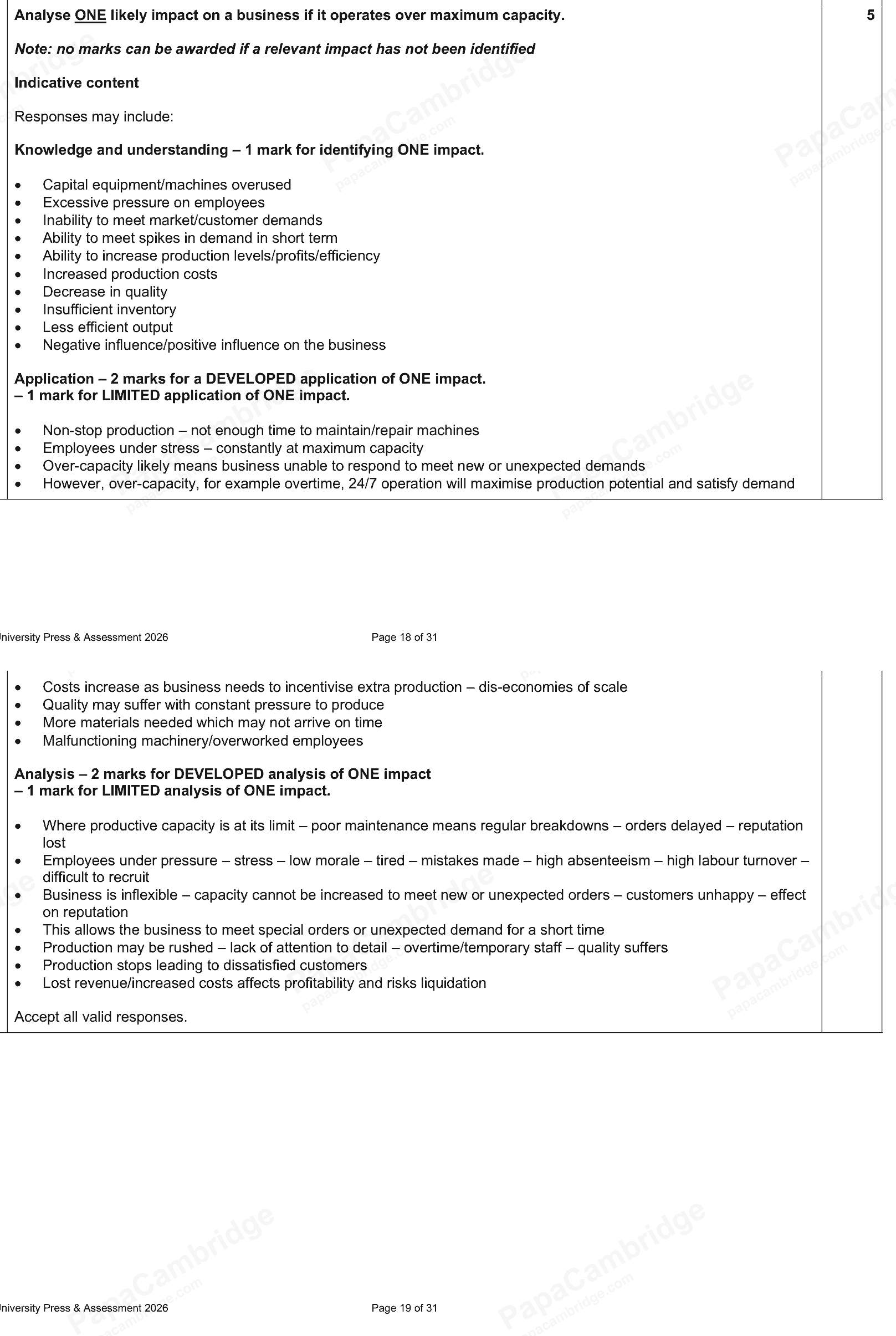
Analyse one likely impact on a business if it operates over maximum capacity.
Show mark scheme
Cambridge 9609, Paper 1 & 2. 1,080 questions, 2020 to 2026.
Case studies and questions reproduced from the original Cambridge material; mark schemes are cropped from the official mark scheme PDFs. Papers from 2020–2022 were set on the previous syllabus and can touch content that is A Level today — those topics are marked “A Level content” above.
Measuring and improving capacity utilisation, the effects of under- and over-utilisation, and the benefits and risks of outsourcing.
16 past paper questions on this topic since 2020, across 8 exam sessions.
| Year | Paper 1 | Paper 2 | Total | Chart |
|---|---|---|---|---|
| 2026 | 2 | 2 | 4 | |
| 2025 | 1 | 4 | 5 | |
| 2024 | 5 | 1 | 6 | |
| 2020 | 0 | 1 | 1 |
The whole topic on one page, with answers and mark schemes. Printing this page prints just this list.
Analyse one likely impact on a business if it operates over maximum capacity.
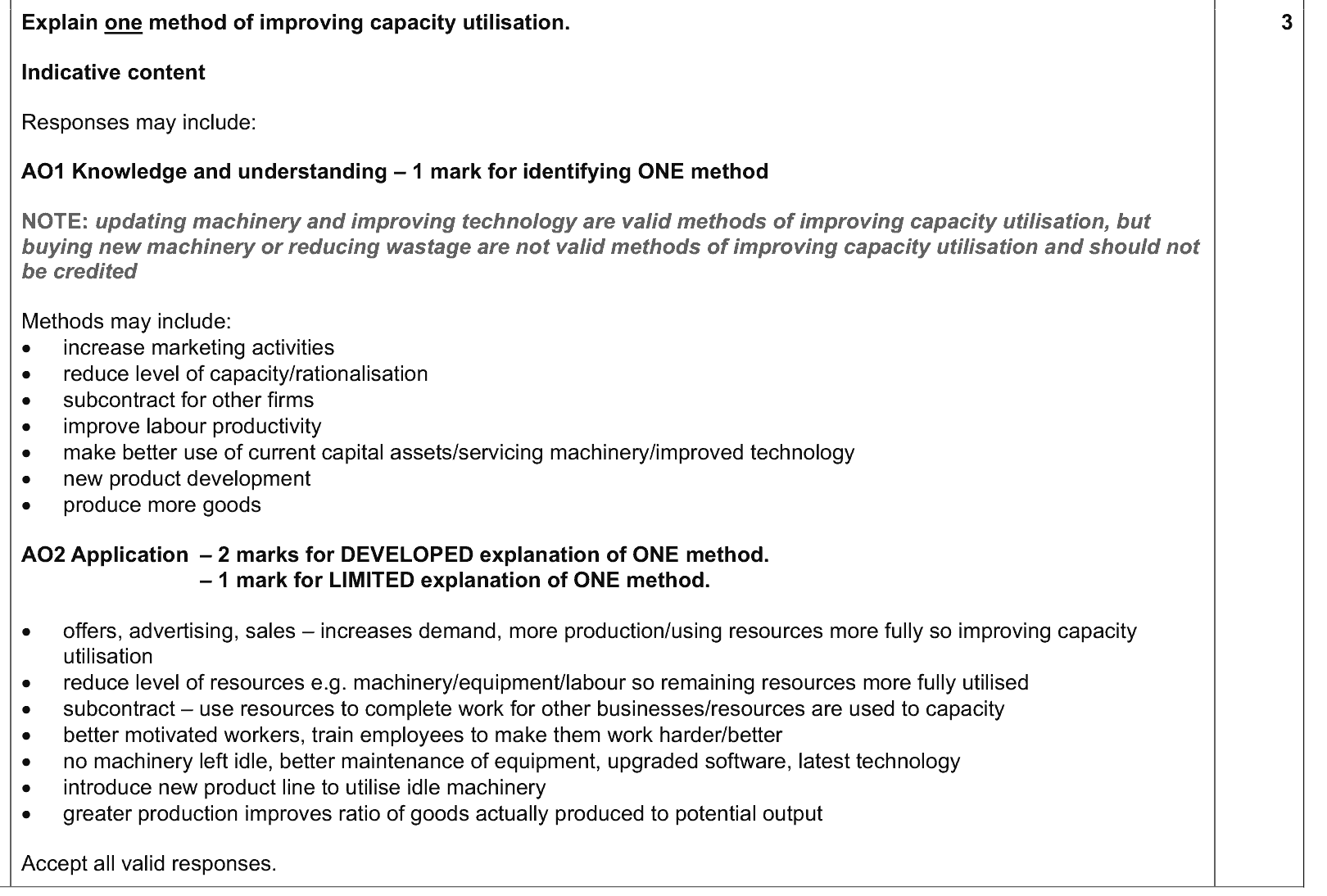
Explain one method of improving capacity utilisation.
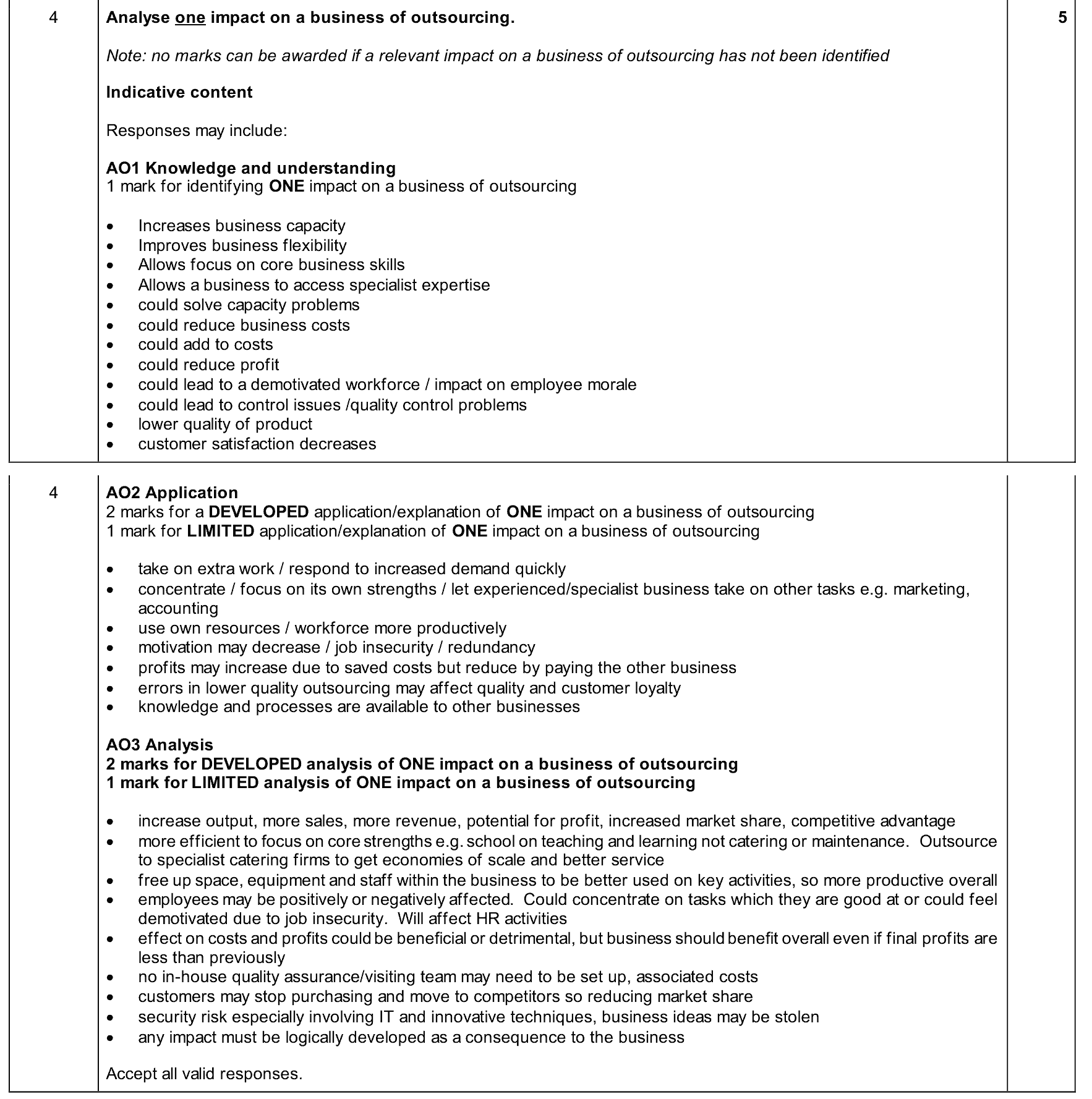
Analyse one impact on a business of outsourcing.
LC is a private limited company based in country J, specialising in the manufacture of
high‑quality, eco‑friendly candles. Founded in 2018, LC has grown quickly by using a highly
effective approach to place (distribution channels).
LC sources raw materials from local and international suppliers. LC’s customers are mainly
specialist retail shops (B2B) and online shoppers (B2C). LC operates in a dynamic market 5
but is committed to supporting communities through job creation and sustainability. LC is
seen by the local community as a valuable contributor to the local economy.
LC has the production capacity to manufacture 500 000 candles per year and has 50
employees. LC has two products: ‘Plain Candles’, at a price of $7 each, and ‘Luxury
Candles’, at a price of $8 each. LC sells twice as many Plain Candles compared to 10
Luxury Candles.
When allocating costs to each product, LC uses a full costing approach. Table 2.1 shows
some key data for LC in 2025.

The owners have decided to convert LC to a public limited company. This will likely increase the value of their shares. However, the directors are concerned about this decision.
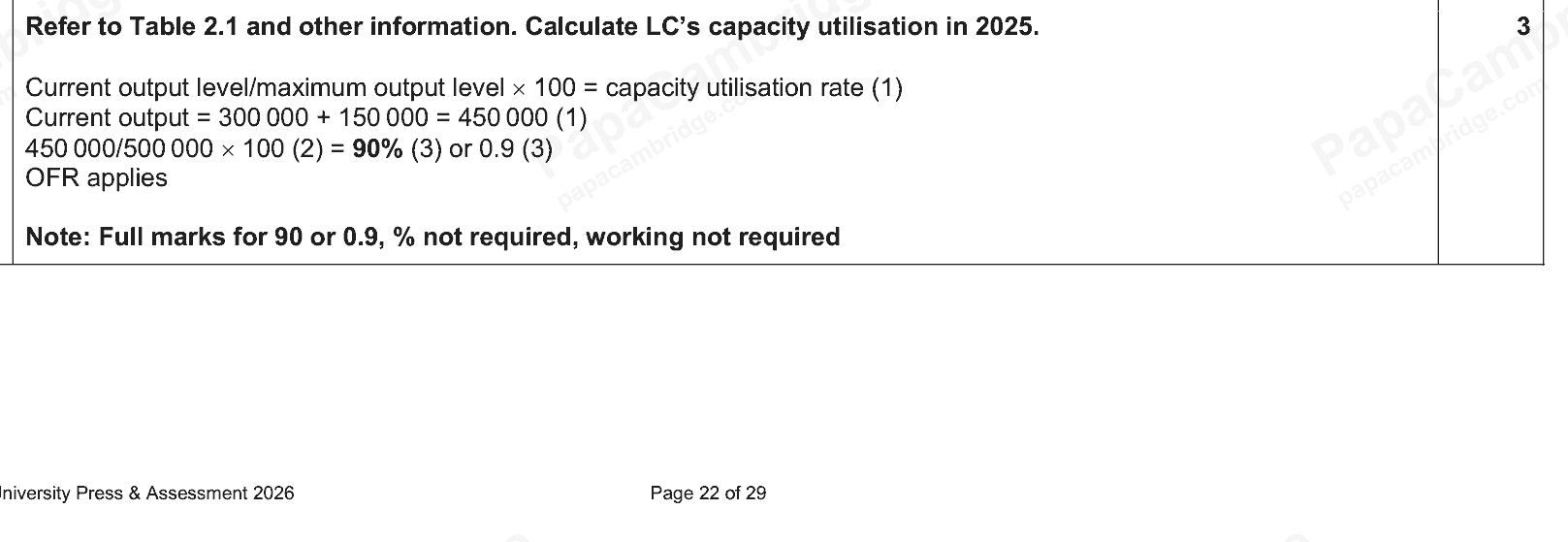
Refer to Table 2.1 and other information. Calculate LC’s capacity utilisation in 2025.
Refers to: images/cases/s26_23_p3_Table_2_1_Key_data_for_LC_in_2025.png
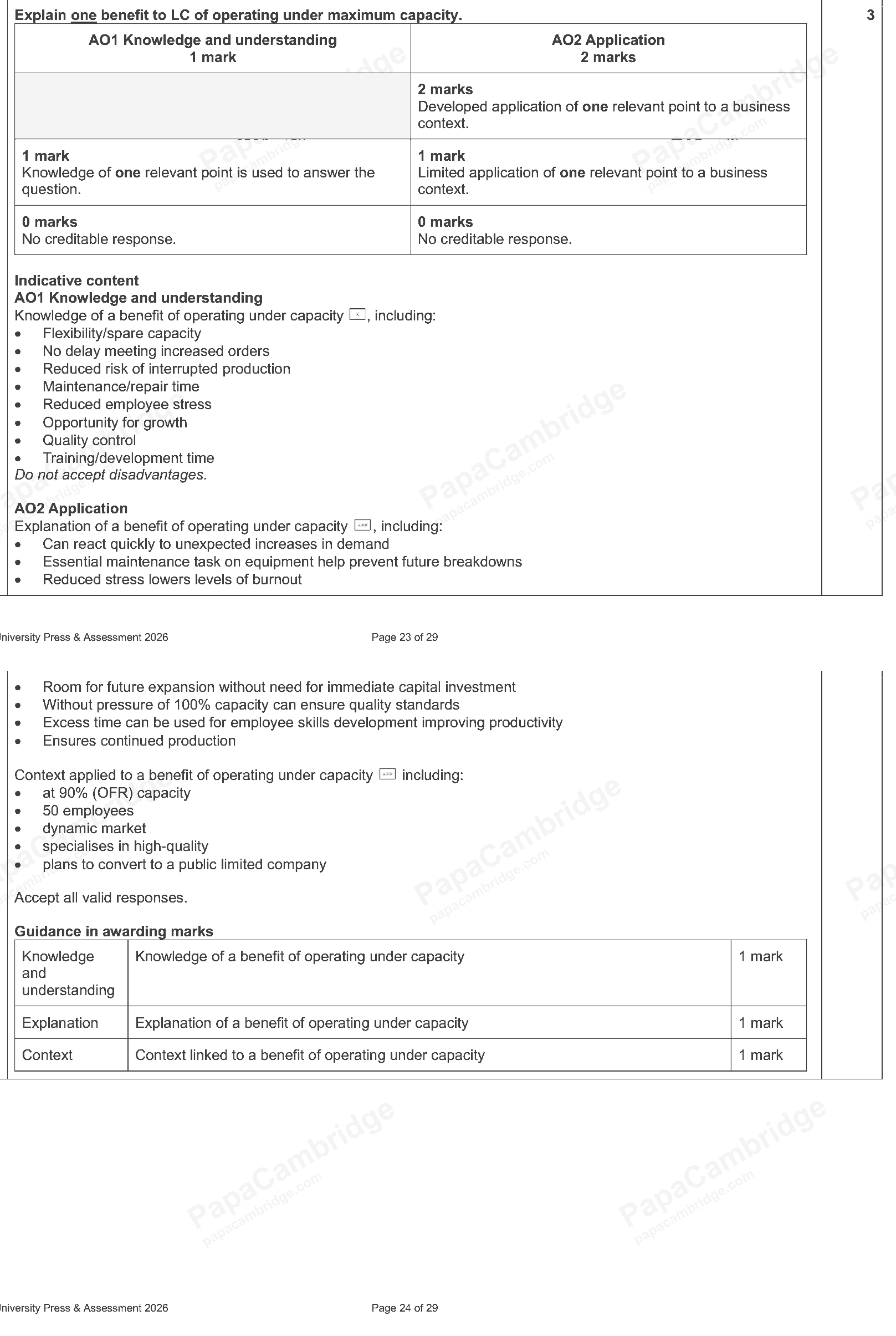
Explain one benefit to LC of operating under maximum capacity.
NN is a small business owned by Natalia. NN produces and sells a range of natural skincare products. In 2020, Natalia started making her own skincare products at home using natural ingredients. She realised that there was a demand for her products among her friends and family. Natalia then decided to turn her hobby into a business and launched NN in 2021. 5 Natalia operates her business from a rented workshop with limited space, where she makes her products by hand. She buys her ingredients from local suppliers who share her values of environmentally friendly production. NN has been growing steadily and has gained a loyal customer base. NN has received positive reviews from beauty magazines. Natalia’s skincare products are sold through her 10 own website, social media platforms and local retailers who specialise in selling natural products. Natalia is developing a new face cream. Table 2.1 shows price and cost estimates for the new face cream.

The skincare market is very competitive. There are many established brands that offer similar products to NN, but with wider distribution channels. Natalia needs to balance her time between production, managing orders, delivery, marketing 20 and other administrative tasks. She works long hours and is stressed and exhausted. Natalia is considering outsourcing to increase NN’s production capacity.
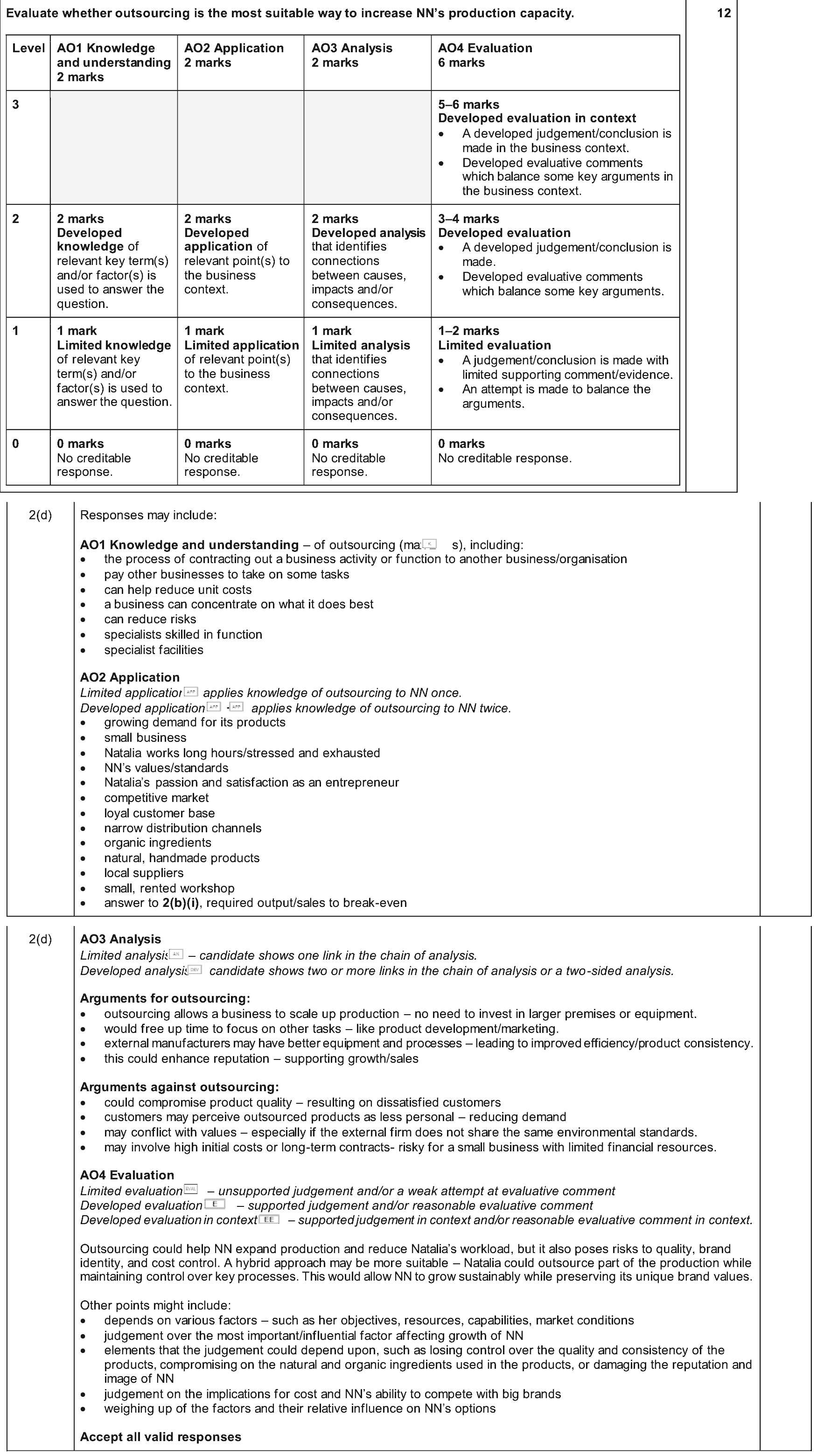
Evaluate whether outsourcing is the most suitable way to increase NN’s production capacity.
Drake has a law degree and works for a partnership of lawyers during the day. Drake owns a website that gives free legal advice. He works on the website in the evenings and at the weekend. He started the website as a hobby, but the website has grown to over 20 000 users and he now sells advertising on his videos and on the website. 5 Drake uses outsourcing for some areas of his website. He has recently been sent a report showing variances in the budget from the previous month (see Table 2.1).

Drake has now left his job and is focusing full time on the website. He rebranded the website as Law Advice Forum (LAF). Drake’s business plan for LAF included:
Explain the term outsourcing.

NS is a private limited company set up by Saira and Chantal as a social enterprise. NS sells natural hair care products and focuses on customer (market) orientation. The main aims of Saira and Chantal include donating to local charities and improving gender equality in the workplace. NS began by selling its products to small, independent businesses in country H. NS 5 expanded its range slowly based on customer feedback, specific requests on its blog, and sales data. NS explored additional finance opportunities required for expansion. NS approached John, who owns manufacturing facilities in country H and has significant marketing experience. He invested into NS in return for ownership of one third of the business. John’s main aim is to 10 increase long-term profits in order to maximise the return on his investment. In the five years since John’s investment, NS has become the market leader in country H for natural hair care products. NS products are now sold in major cosmetic retailers. NS recently analysed its output in 2024 (see Table 1.1).

Saira and Chantal have decided to employ a Marketing Manager for NS. Fig 1.2 shows an extract from the job advertisement. 20 Marketing Manager

Refer to Table 1.1. Calculate NS’s capacity utilisation in 2024.
Refers to: images/cases/s25_21_p2_Table_1_1_NS_output_data_for_2024.png

Explain one possible disadvantage to NS of high capacity utilisation.

🔒 Unlock every Capacity utilisation and outsourcing question from 2020–2024
All 7 come with their mark schemes, answers and case studies, and appear in the practice tool above once you’re signed in. It’s free.
Questions and mark schemes are from past Cambridge papers and are reproduced for revision. Topical Vault is an independent revision resource, not affiliated with or endorsed by Cambridge Assessment International Education.
Each topic opens this practice tool with only that topic’s questions, plus how often it comes up and every question on it in one list.