Question 1(a)May/June 20269609/112 marks
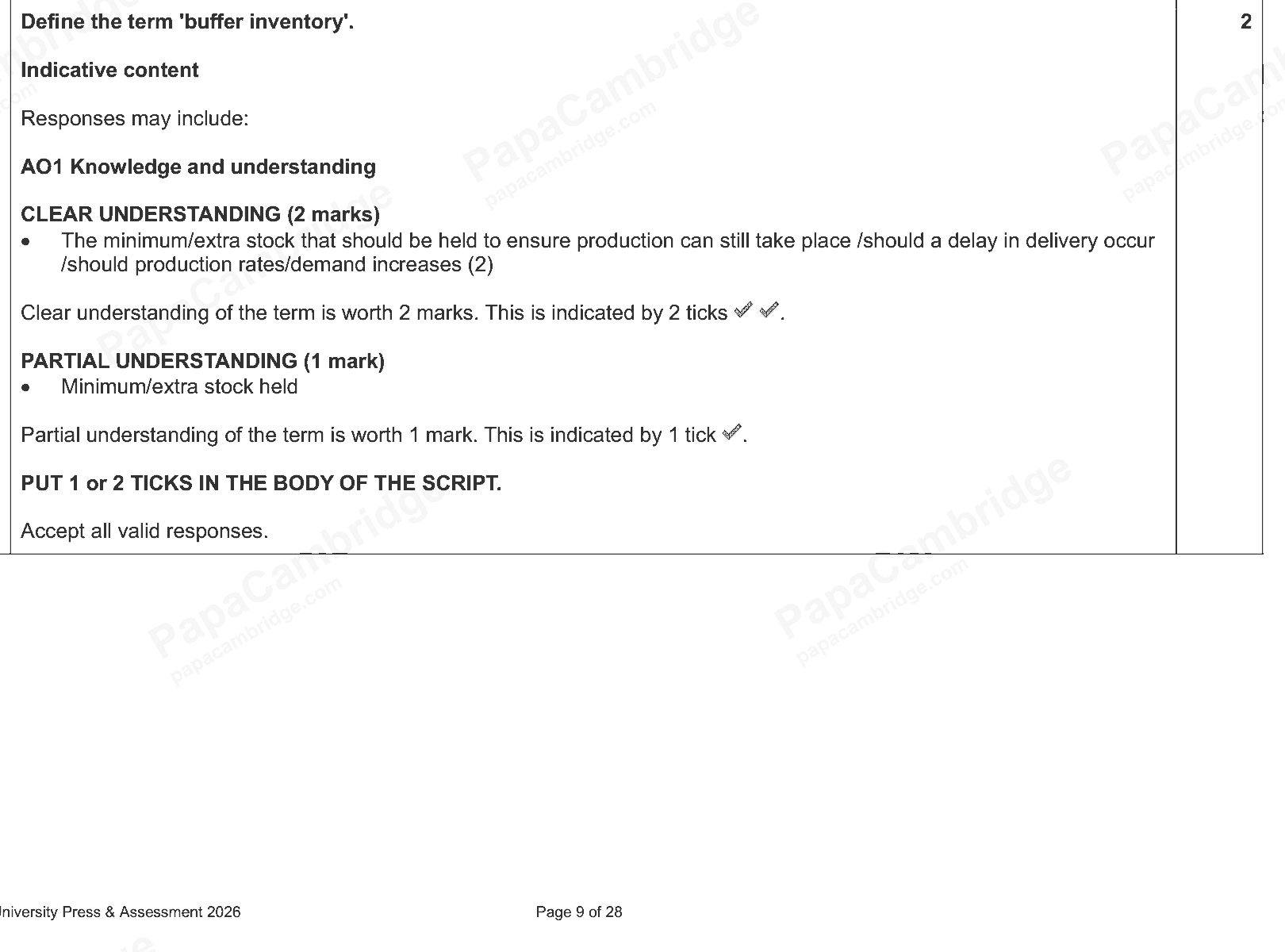
Define the term ‘buffer inventory’.
Show mark scheme
Cambridge 9609, Paper 1 & 2. 1,080 questions, 2020 to 2026.
Case studies and questions reproduced from the original Cambridge material; mark schemes are cropped from the official mark scheme PDFs. Papers from 2020–2022 were set on the previous syllabus and can touch content that is A Level today — those topics are marked “A Level content” above.
Why businesses hold inventory, inventory control charts, buffer inventory and reorder levels, and just-in-time inventory management.
41 past paper questions on this topic since 2020, across 16 exam sessions.
| Year | Paper 1 | Paper 2 | Total | Chart |
|---|---|---|---|---|
| 2026 | 2 | 4 | 6 | |
| 2025 | 5 | 3 | 8 | |
| 2024 | 2 | 4 | 6 | |
| 2023 | 3 | 4 | 7 | |
| 2022 | 2 | 3 | 5 | |
| 2021 | 4 | 2 | 6 | |
| 2020 | 2 | 1 | 3 |
The whole topic on one page, with answers and mark schemes. Printing this page prints just this list.
Define the term ‘buffer inventory’.
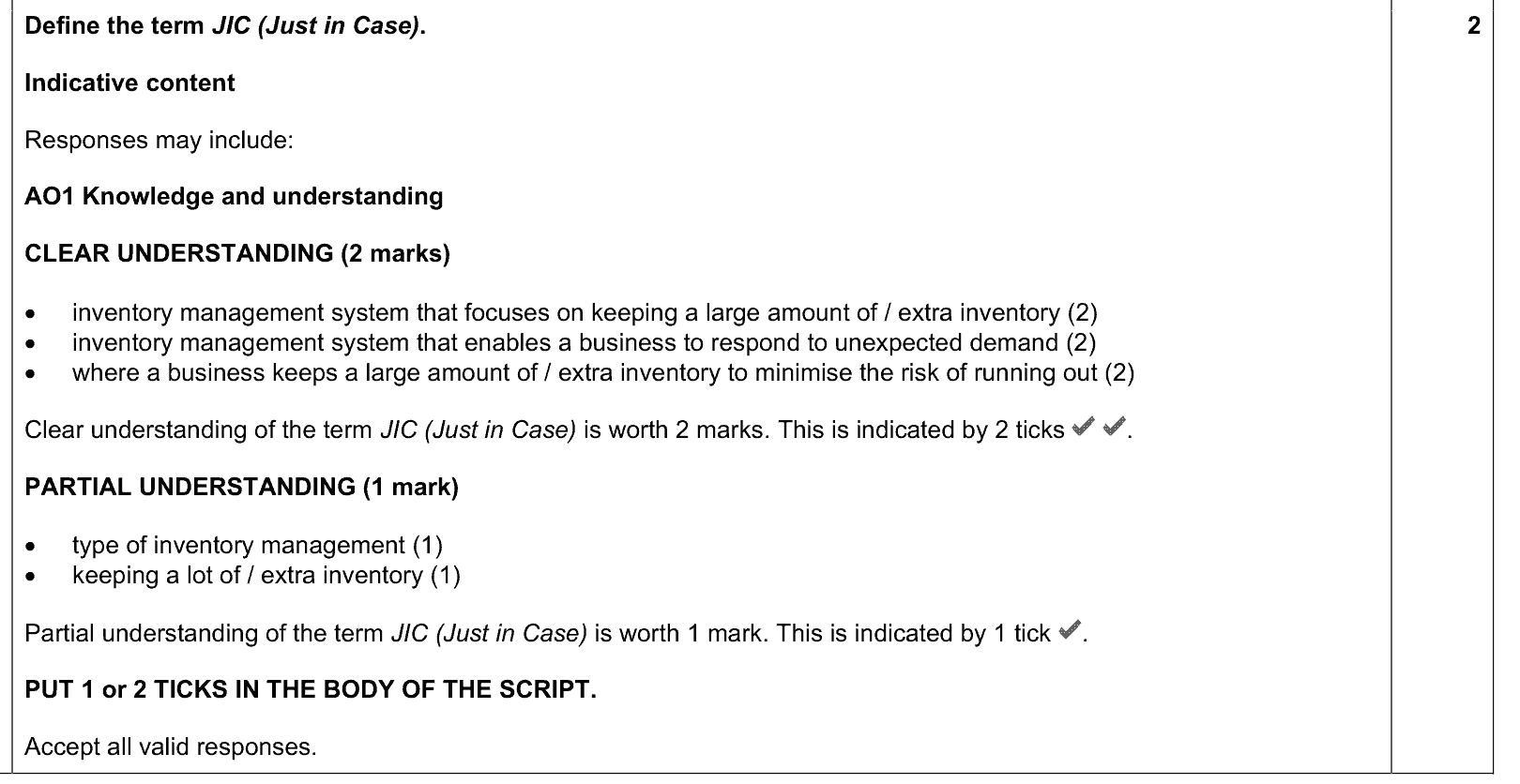
Define the term JIC (Just in Case).
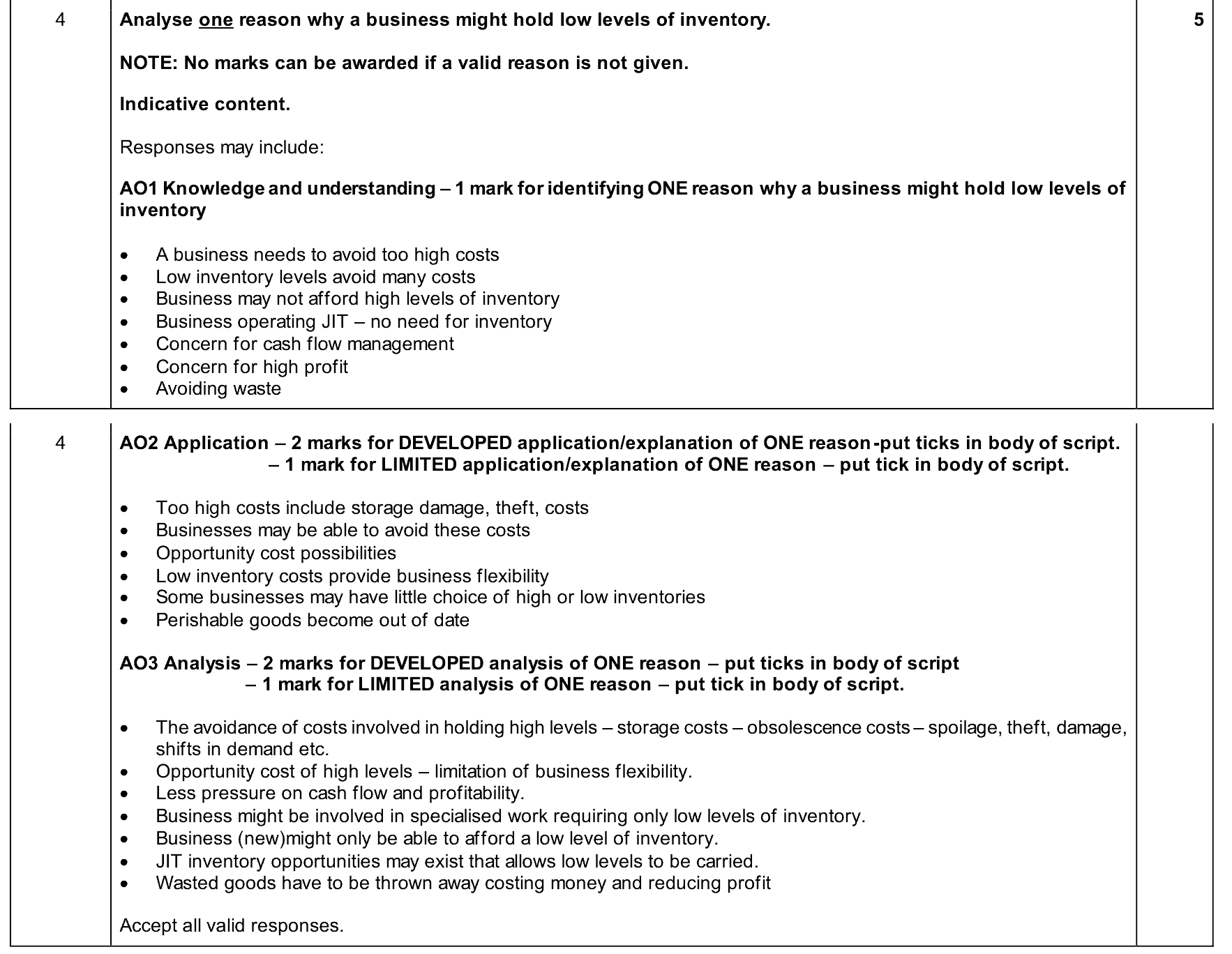
Analyse one reason why a business might hold low levels of inventory.
Define the term inventory re-order level.

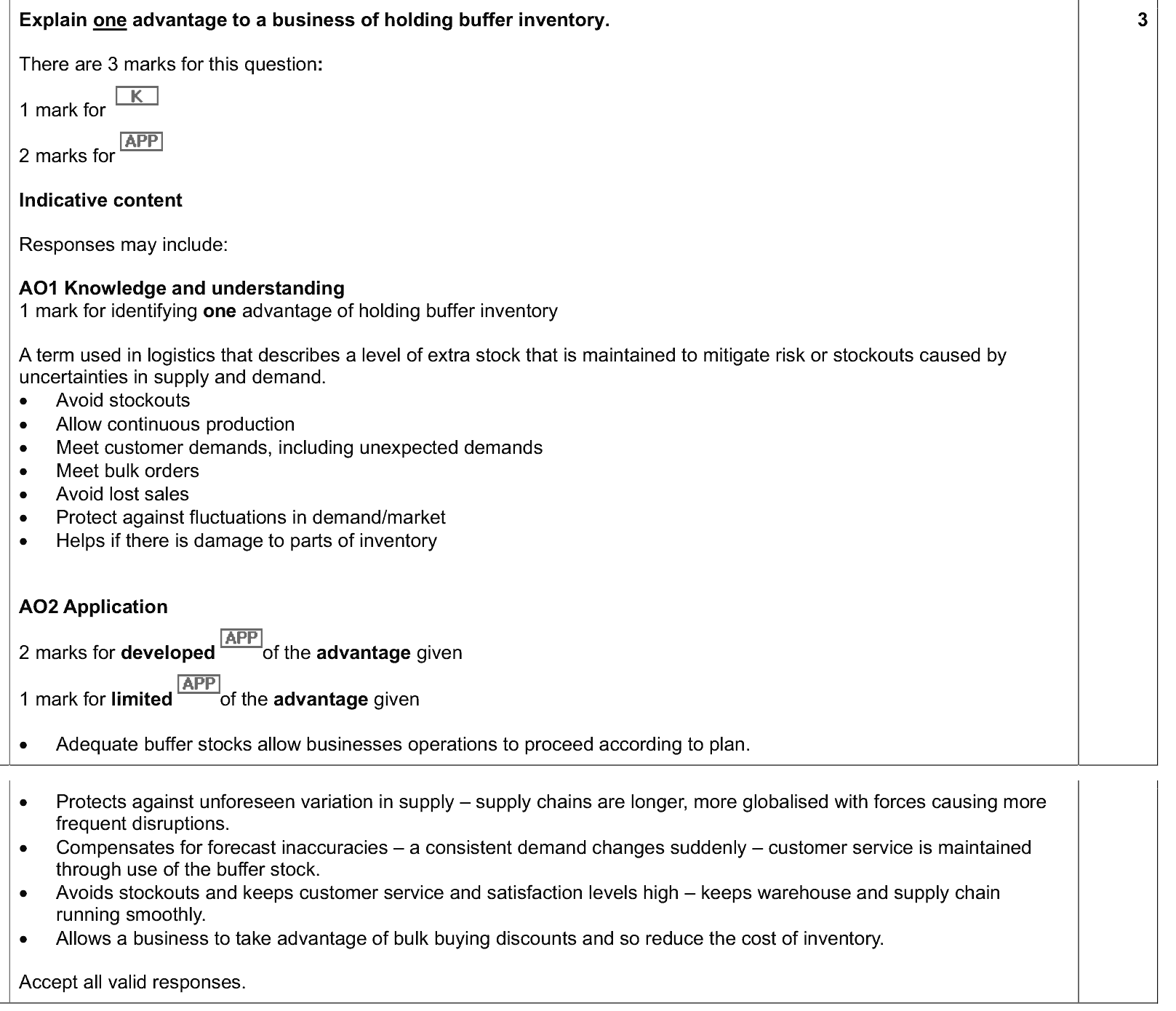
Explain one advantage to a business of holding buffer inventory.
Define the term Just in Time (JIT).
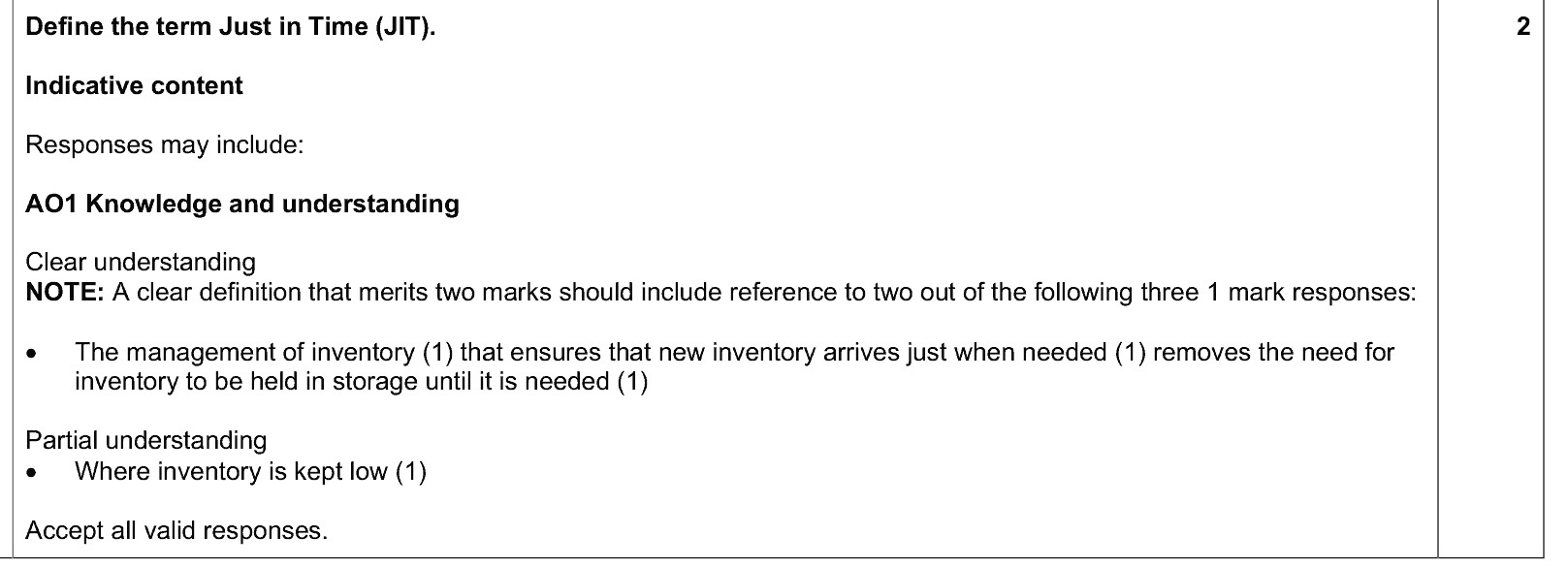
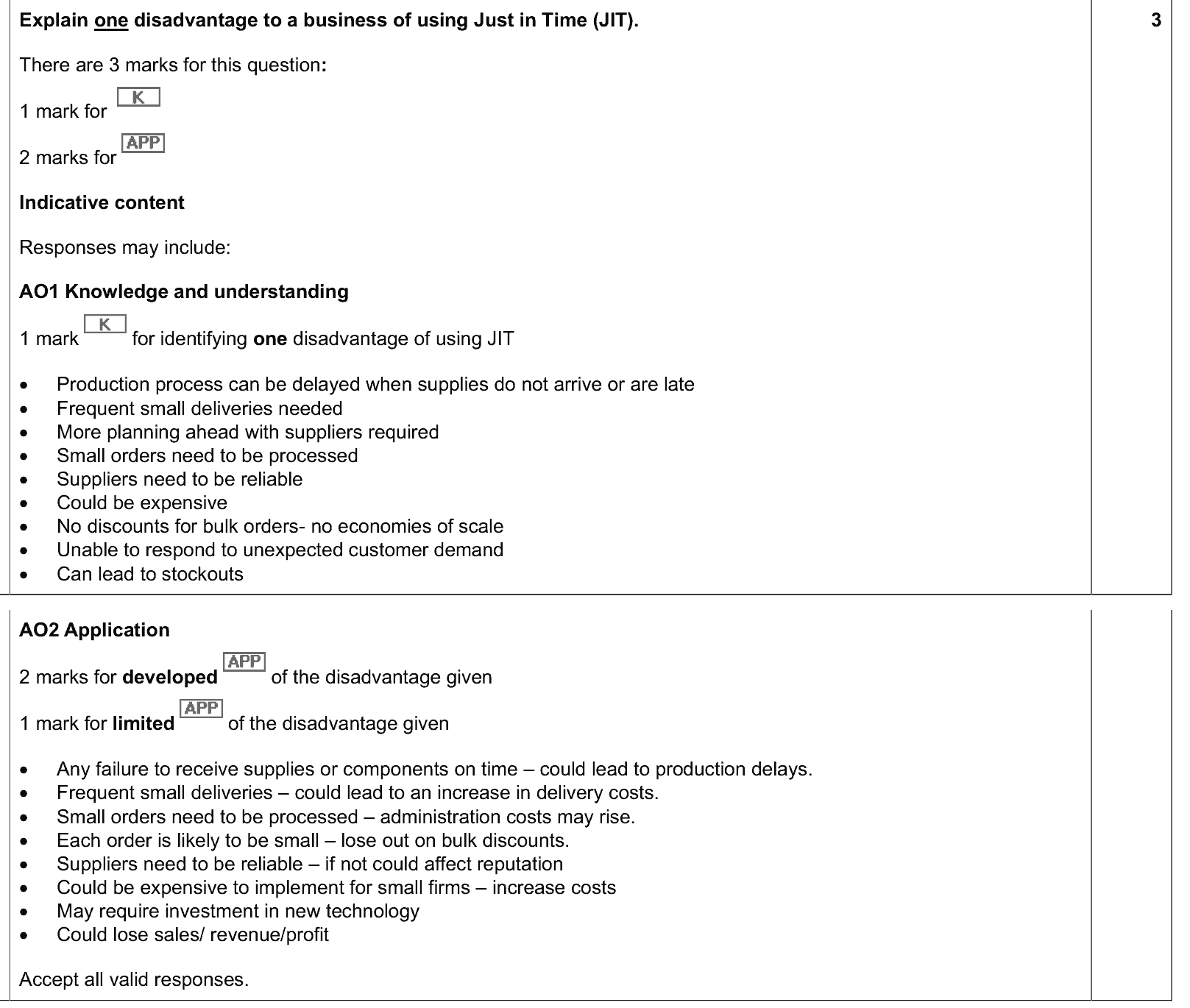
Explain one disadvantage to a business of using Just in Time (JIT).
DW operates a franchise as a franchisor. Driving instructors can become a franchisee and
sell driving lessons under the DW brand. DW has grown very quickly, gaining a 25% share
of the market in three years.
Driving instructors must prepare a business plan when applying to become a DW
franchisee. To prepare the business plan, the driving instructor must carry out primary 5
market research to assess potential customer demand for driving lessons in their area.
DW sets budgets each year. The budget for advertising was $25 500 in 2025. However, DW
actually spent $31 800 on advertising in 2025.
The prices for DW driving lessons are set by DW’s finance manager, who uses break‑even
analysis to make pricing decisions. 10
In addition to driving lessons, DW sells a ‘learn to drive’ book which customers can buy
from its website with next day delivery. The book is very popular, and the business uses JIC
(Just in Case) inventory management.
DW’s website generates over $28 000 of revenue each year from sales of the ‘learn to
drive’ book. The website is updated by the website manager and an IT assistant. The 15
website manager designs the website and resolves any technical problems. The IT
assistant helps the manager with simple programming and administrative tasks.
The website manager will retire in two months’ time. A new website manager will need
to be recruited. The human resource manager needs to decide whether the new website
manager should be recruited internally or externally. 20
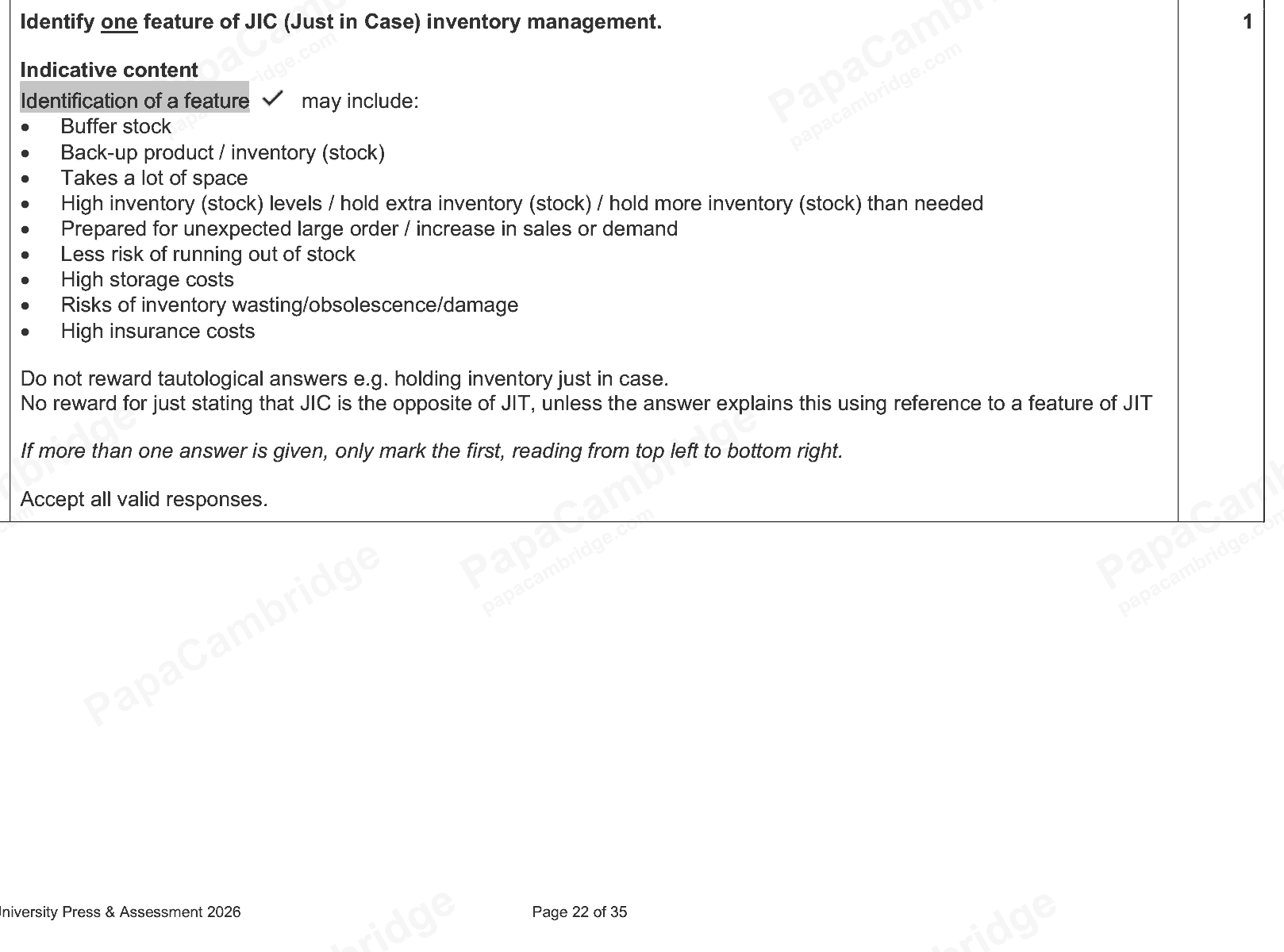
Identify one feature of JIC (Just in Case) inventory management.
Zorba had always had a passion for flower arranging. When he was made redundant from his job as an engineer last year, he decided to use all of his savings to set up a flower shop called ZF. Although Zorba did not require any additional finance, he decided to write a business plan before setting up ZF. Table 2.1 shows an extract from his business plan, showing the 5 planned expenditure for ZF.

Zorba opened ZF at the start of January 2026. However, Zorba encountered a number of problems with Supply Chain Management during the first three months of ZF’s trading. 15 These included:
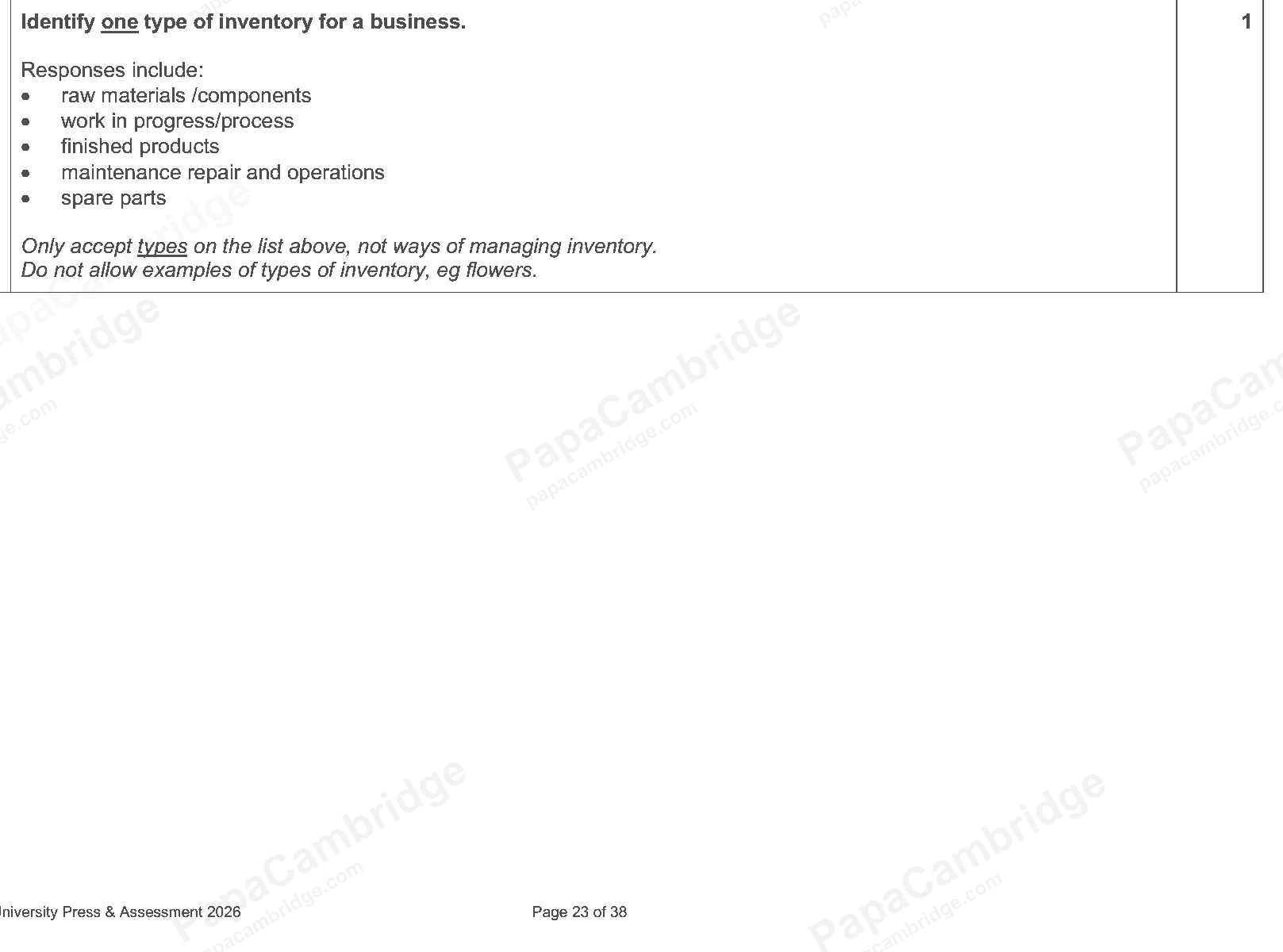
Identify one type of inventory for a business.
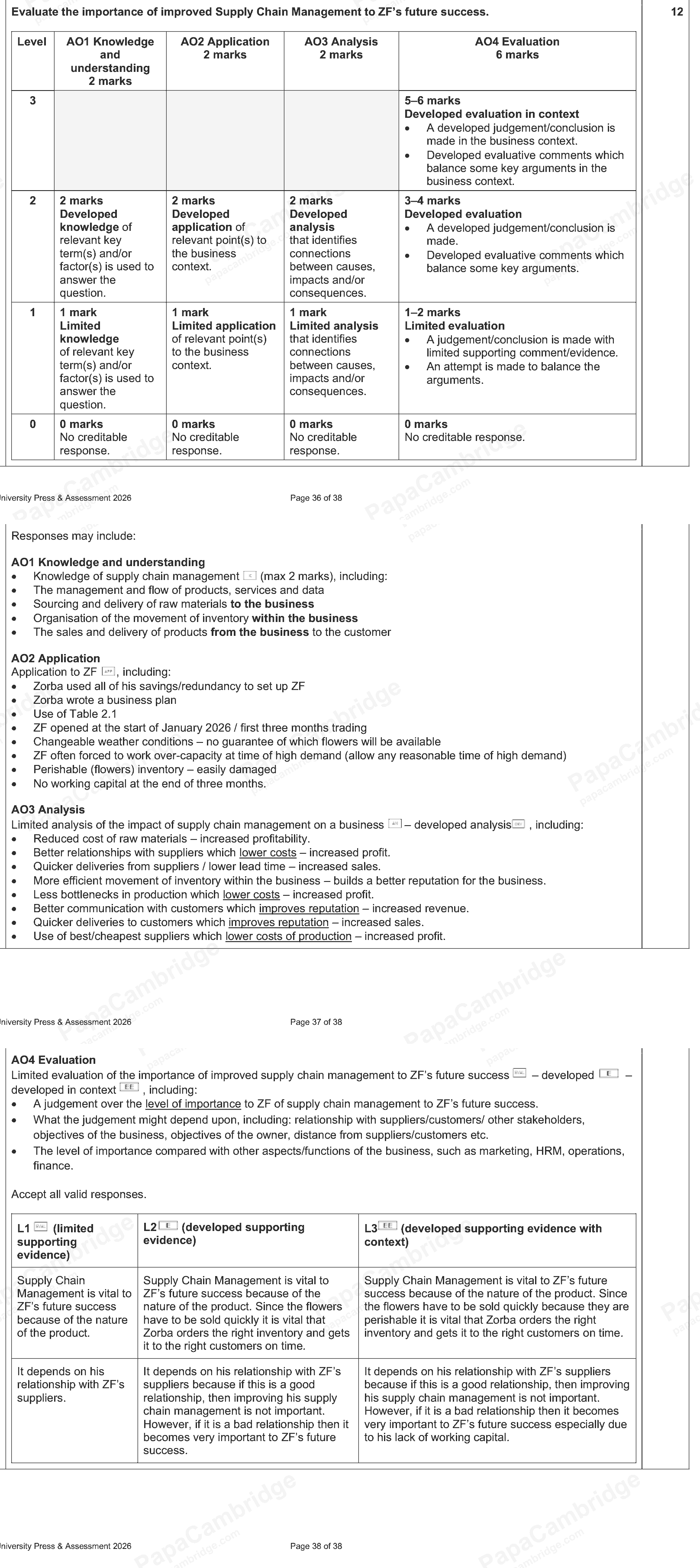
Evaluate the importance of improved Supply Chain Management to ZF’s future success.
Yvette is the managing partner of YV, a veterinary (vet) practice in city P. There are four partners of YV, each of whom is a fully qualified and experienced veterinary surgeon. Each partner specialises in the care of different types of animals. Yvette specialises in the care of small animals, including dogs, cats and rodents. Table 2.1 shows a cash flow forecast that Yvette has created for the next three months. 5

Yvette is proposing a merger between YV and AV, which is YV’s main competitor in city P.
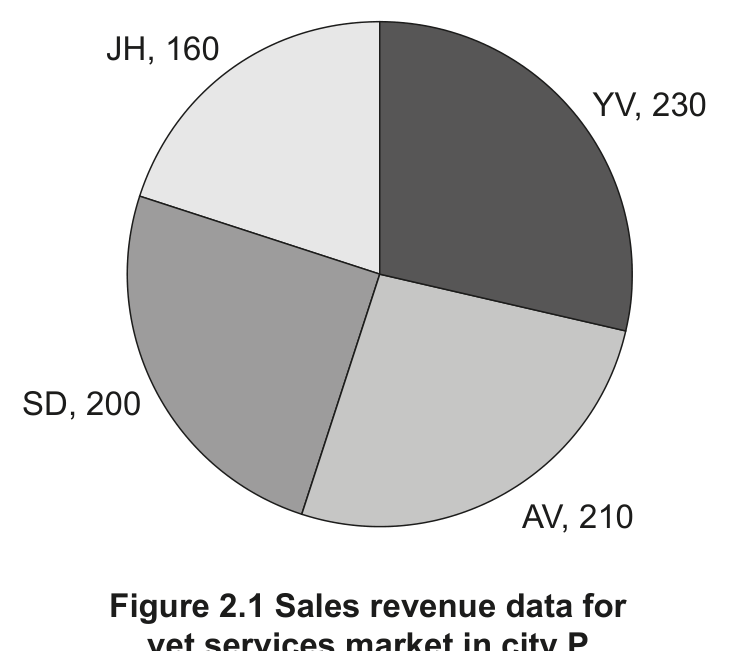
Figure 2.1 shows sales revenue data for the vet services market in city P.
sales revenue ($000s)
JH, 160
YV, 230
SD, 200
AV, 210
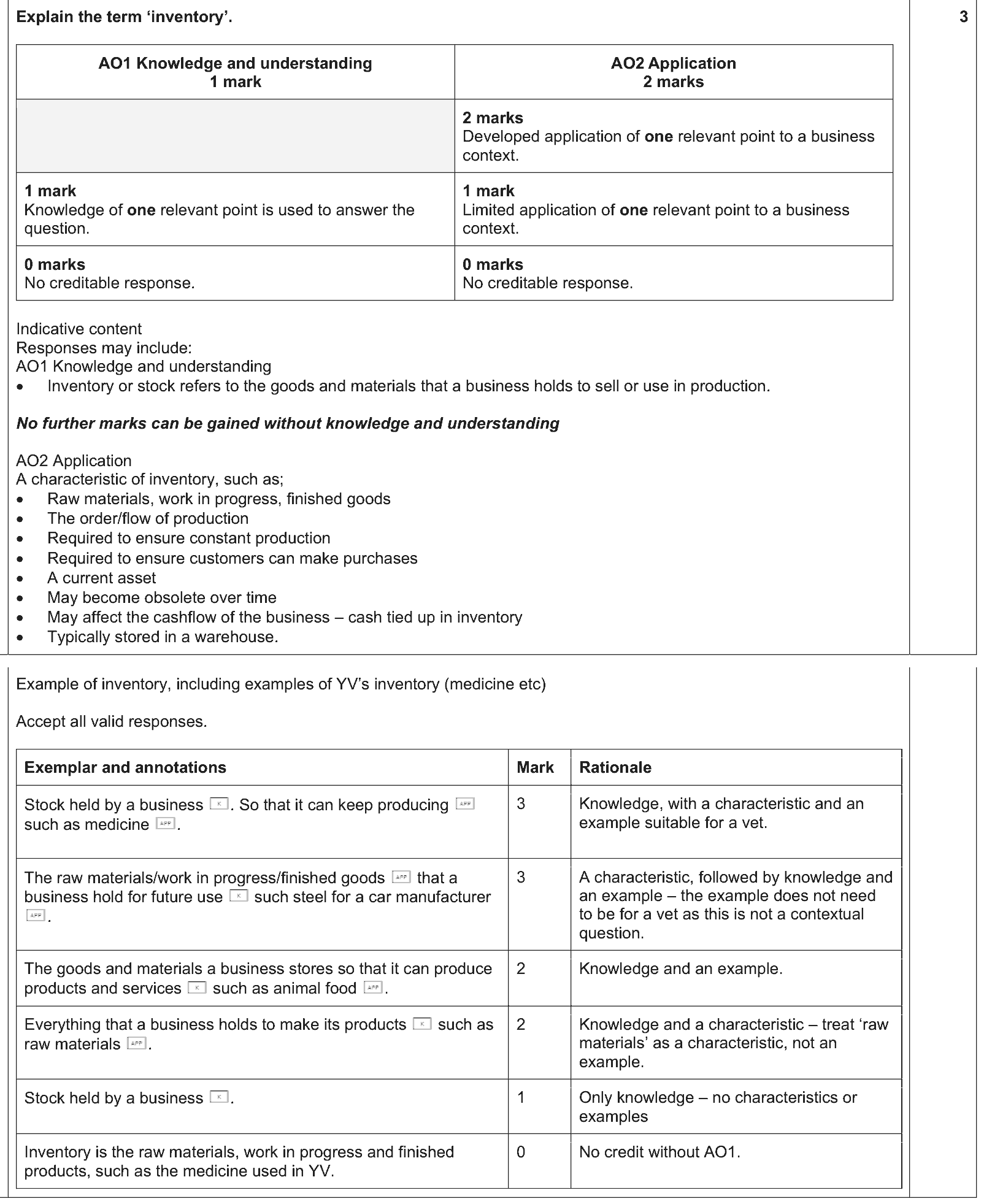
Explain the term ‘inventory’.
PD is a mass market fizzy drinks manufacturer in country Z. The fizzy drinks market in
country Z is dominated by a few well-known brands. The total market value is $5.3bn and
the PD brand has a 17% share of this market.
Pablo was recruited to be the Marketing Director of PD in 2022. He launched a new
promotional campaign based on trending music on social media. He decided to use social 5
media influencers to focus on this market.
Online feedback of the campaign was poor. Many of PD’s customers did not want to be
associated with trending music. National news highlighted the negative feedback and PD’s
sales volume decreased by 20% within a week and continued falling. This led to excess
inventory in PD’s warehouses. The bad publicity also caused a drop in PD’s share price and 10
a negative impact on cash flow.
Fig. 2.1 shows feedback from a recent questionnaire where previous PD customers were
asked what they thought about the promotional campaign.
quite positive
very positive
no opinion
very negative 120
quite negative

Pablo has called an emergency meeting of PD’s marketing managers to repair the damage 15 done to the PD brand from this recent promotional campaign.
Analyse two possible costs to PD of holding inventory.

TT is a private limited company in country J. TT has contracts to deliver products to secondary, tertiary and quaternary sector businesses. QZ is one of the largest manufacturers in country J and plans to outsource its supply chain management. A contract has been agreed between TT and QZ based on the following cost and revenue data (see Table 1.1). TT’s Sales Manager has forecast that TT will make 5 5 000 deliveries with the new contract.

TT employs 120 drivers. The majority of these drivers are white men aged between 40 and 60. A national newspaper has recently criticised the truck industry in country J for not having diversity and equality in the workplace. Klide, the Marketing Manager, has been set an objective to increase TT’s revenue. He has 15 decided to target small online retailers. TT will pick up individual products from the small online retailers and deliver them to households. This would require a new fleet of smaller trucks but has the potential to increase TT’s revenue. Klide plans to use digital promotion to target these small online retailers.
Explain the term supply chain management.

Reliable Car Repairs (RCR) is owned by Freya and her brother Kye as a partnership. The business was set up five years ago in city B and repairs a wide range of cars. Freya recently carried out some primary market research. The qualitative data from the market research showed that customers like the speed of RCR’s service as many repairs were completed within 24 hours. 5 RCR’s market share has increased annually over the past five years. The total sales in the market in 2023 were $700 000. Table 2.1 shows RCR’s data for 2024.

The owners are always looking to improve the performance of the business and have an objective of increasing efficiency. Freya and Kye have no experience of repairing cars and so employ two mechanics to carry out this work. The mechanics have both been employed by the business since it was set up. Kye supervises the mechanics using a democratic management style. 15 The business holds a large quantity of inventory as different cars need different components. The business buys components from two suppliers which have both supplied RCR since it was set up. The partners are thinking of introducing Just in Time (JIT).
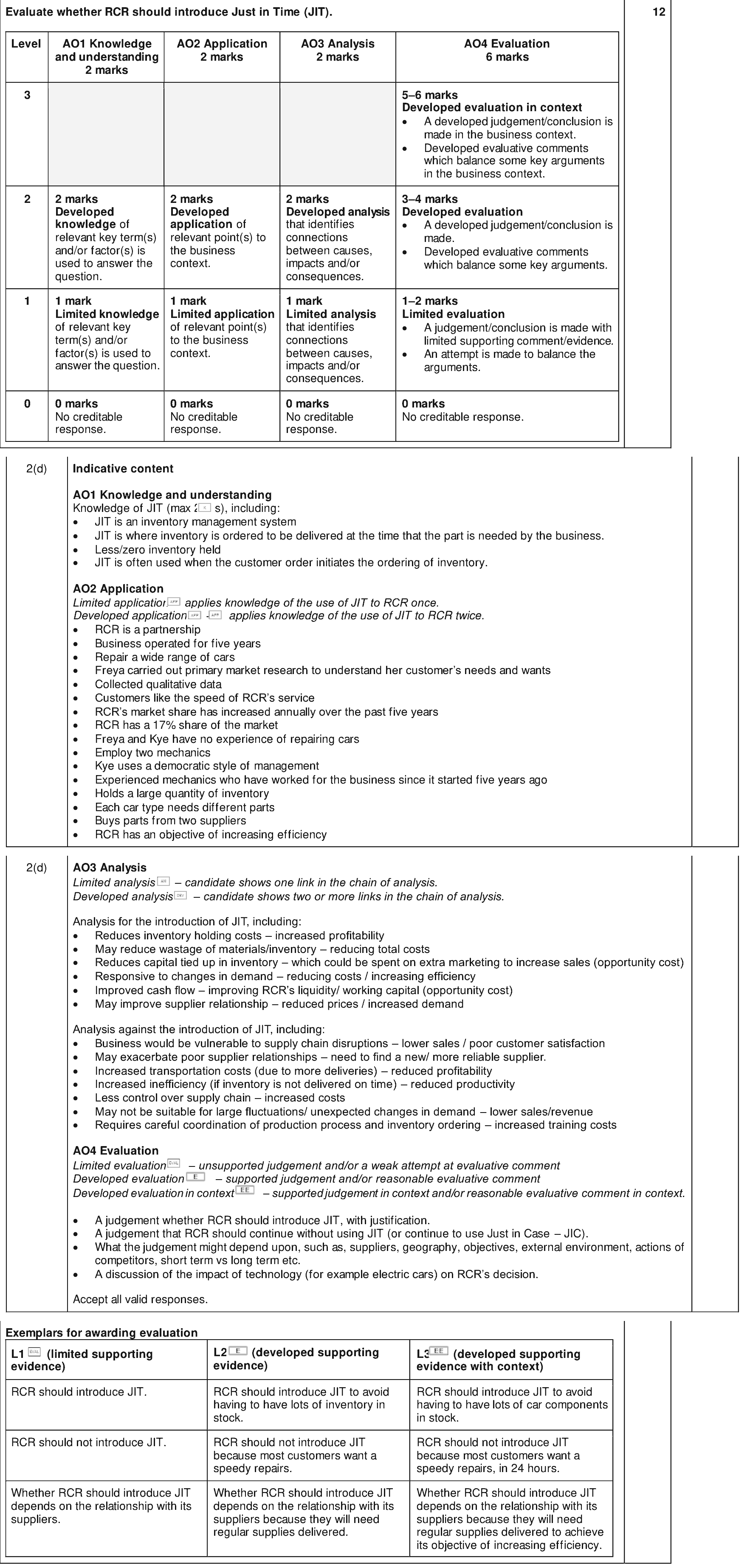
Evaluate whether RCR should introduce Just in Time (JIT).
🔒 Unlock every Inventory management question from 2020–2024
All 27 come with their mark schemes, answers and case studies, and appear in the practice tool above once you’re signed in. It’s free.
Questions and mark schemes are from past Cambridge papers and are reproduced for revision. Topical Vault is an independent revision resource, not affiliated with or endorsed by Cambridge Assessment International Education.
Each topic opens this practice tool with only that topic’s questions, plus how often it comes up and every question on it in one list.