Question 6(b)May/June 20269609/1112 marks
‘Having a unique selling point (USP) is the most important part of the marketing mix for the success of a mobile phone manufacturer.’ Evaluate this view.
Show mark scheme

Cambridge 9609, Paper 1 & 2. 1,080 questions, 2020 to 2026.
Case studies and questions reproduced from the original Cambridge material; mark schemes are cropped from the official mark scheme PDFs. Papers from 2020–2022 were set on the previous syllabus and can touch content that is A Level today — those topics are marked “A Level content” above.
Product decisions, the product life cycle and extension strategies, and pricing methods and price elasticity of demand.
76 past paper questions on this topic since 2020, across 19 exam sessions.
| Year | Paper 1 | Paper 2 | Total | Chart |
|---|---|---|---|---|
| 2026 | 2 | 2 | 4 | |
| 2025 | 7 | 2 | 9 | |
| 2024 | 5 | 8 | 13 | |
| 2023 | 8 | 7 | 15 | |
| 2022 | 5 | 3 | 8 | |
| 2021 | 6 | 7 | 13 | |
| 2020 | 4 | 10 | 14 |
The whole topic on one page, with answers and mark schemes. Printing this page prints just this list.
‘Having a unique selling point (USP) is the most important part of the marketing mix for the success of a mobile phone manufacturer.’ Evaluate this view.
Explain one stage of the product life cycle.

Analyse two benefits to a business of using a Boston Matrix.

Analyse two benefits to a business of product portfolio analysis.

Explain one pricing method.

Evaluate the view that new product development is the most important activity for the success of a toy manufacturer.

Define the term price discrimination.
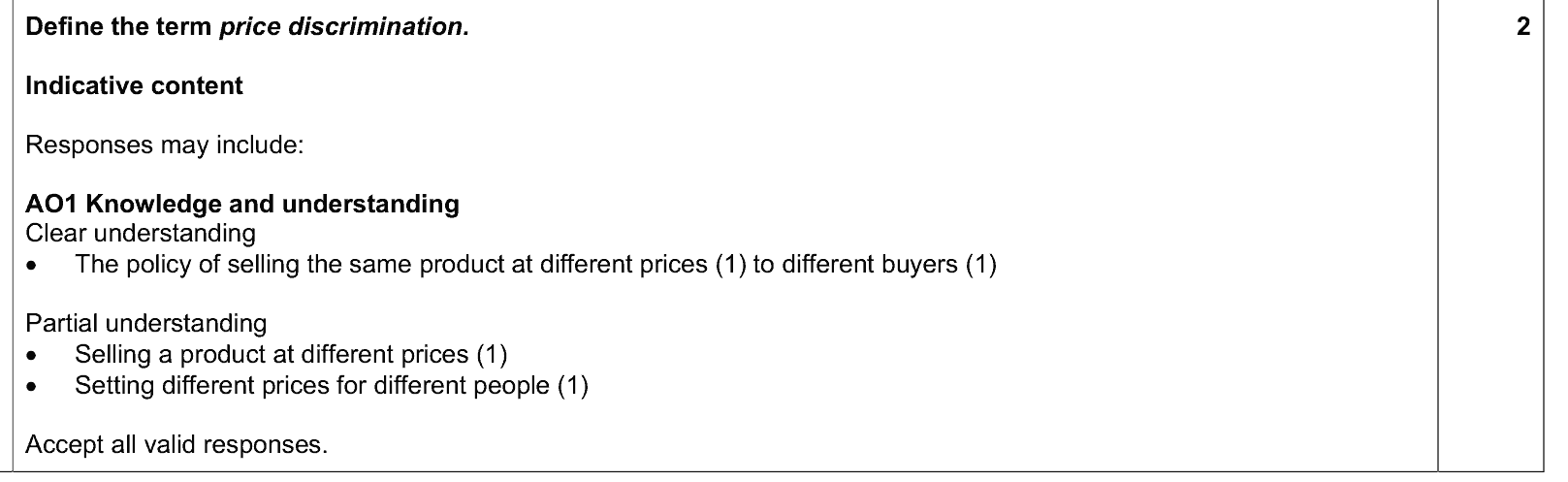
Explain one disadvantage to a business of using competitive pricing.
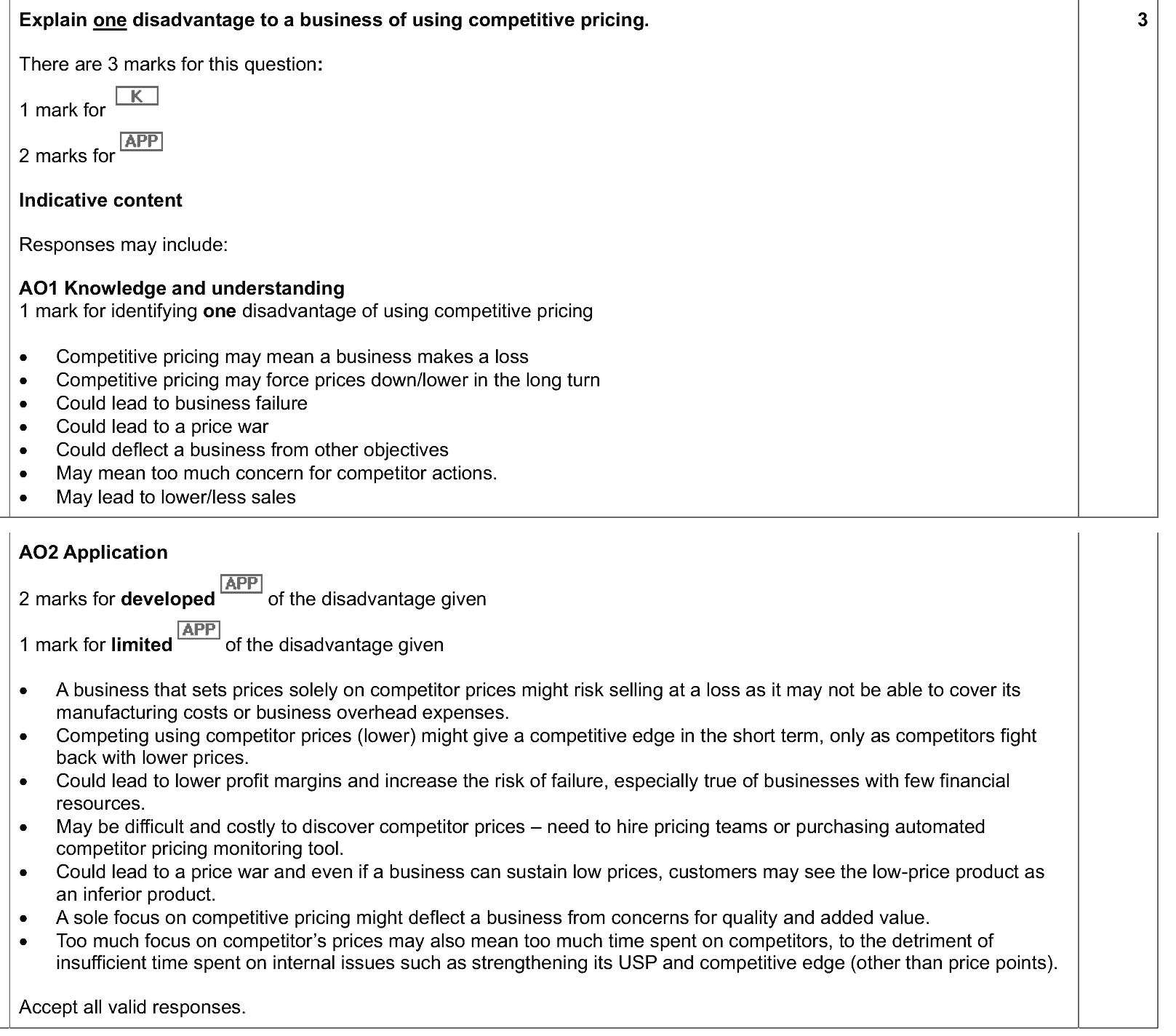
Analyse one reason why a business may use cost-based pricing.

CC manufactures a range of cola drinks aimed at the mass market. The company is the market leader for cola drinks in country N. CC produces four variants of its cola drink:

CC’s sales of Cherry cola have decreased by 12% over the past year. The marketing
manager is planning to carry out market research to investigate the reason for this
decrease. The research will collect qualitative data. The marketing manager will use this
data to make decisions about a marketing campaign to increase sales.
CC has 4 factories in country N and employs 1750 employees. All employees are paid 20
using a time‑based payment method and the work is repetitive. Operations are capital
intensive. The human resource manager is concerned that employees lack motivation,
leading to high labour turnover. Labour turnover has increased by 8% over the past year.
The human resource manager is considering changing the employee payment method from
time‑based to piece rate. 25
Refer to Table 1.1 and other information. Calculate the price of one bottle of Sugar‑free cola.
Refers to: images/cases/s26_21_p2_Table_1_1_Cost_information_for_one_bottle_of_S.png

Kamal is a successful social media influencer. In 2020, Kamal launched his own social media platform, called Influencer Xperience (IX), operating in the quaternary sector of the economy. Kamal targeted other social media influencers with IX’s promotion. IX allows influencers to manage and publish videos on its platform. The unique selling point of IX is that it provides the influencers with better and more detailed information than any other platform. 5 IX is a free-to-use service for social media influencers. IX charges other businesses to advertise on the platform. The price of advertising space is set each month, using dynamic pricing, based on how many users click on an advertisement (price per click). Table 1.1 shows some data about advertising on IX’s platform.

IX’s operations are labour intensive and Kamal describes his management style as laissez-faire. IX has 30 employees who are all managed by Kamal (see Table 1.2).
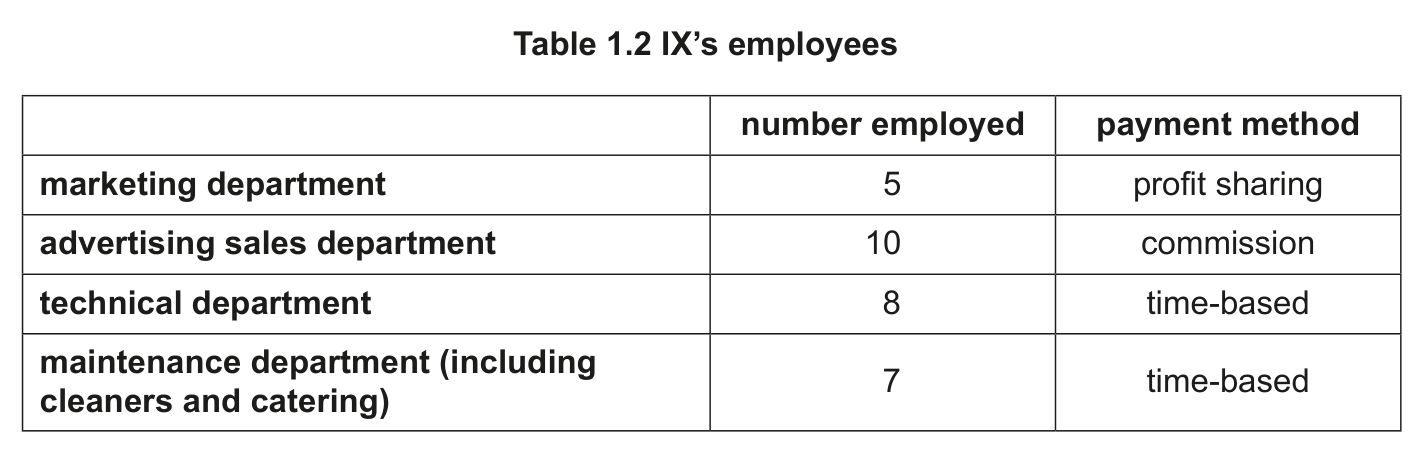
Analyse one advantage and one disadvantage to IX of using dynamic pricing.

FF is a partnership in country Q that grows a range of fruits and vegetables, such as apples,
carrots and potatoes. FF also provides an advisory service to other farmers. The partnership
was established in 2018 by three friends, Amrit, Harry and Sally, who provided the working
capital. Their aim was to produce healthy and tasty food for themselves and others.
FF grows crops using natural methods and practices. The produce is free from chemicals 5
and pesticides. It only uses renewable energy sources, such as solar panels and wind
turbines. It harvests the crops by hand or using simple machines that minimise damage or
waste, but this is labour intensive.
FF sells its products directly to consumers through its own farm shop and online delivery
service. It also sells to local restaurants. Table 2.1 shows information on FF’s revenue and 10
costs in 2024.

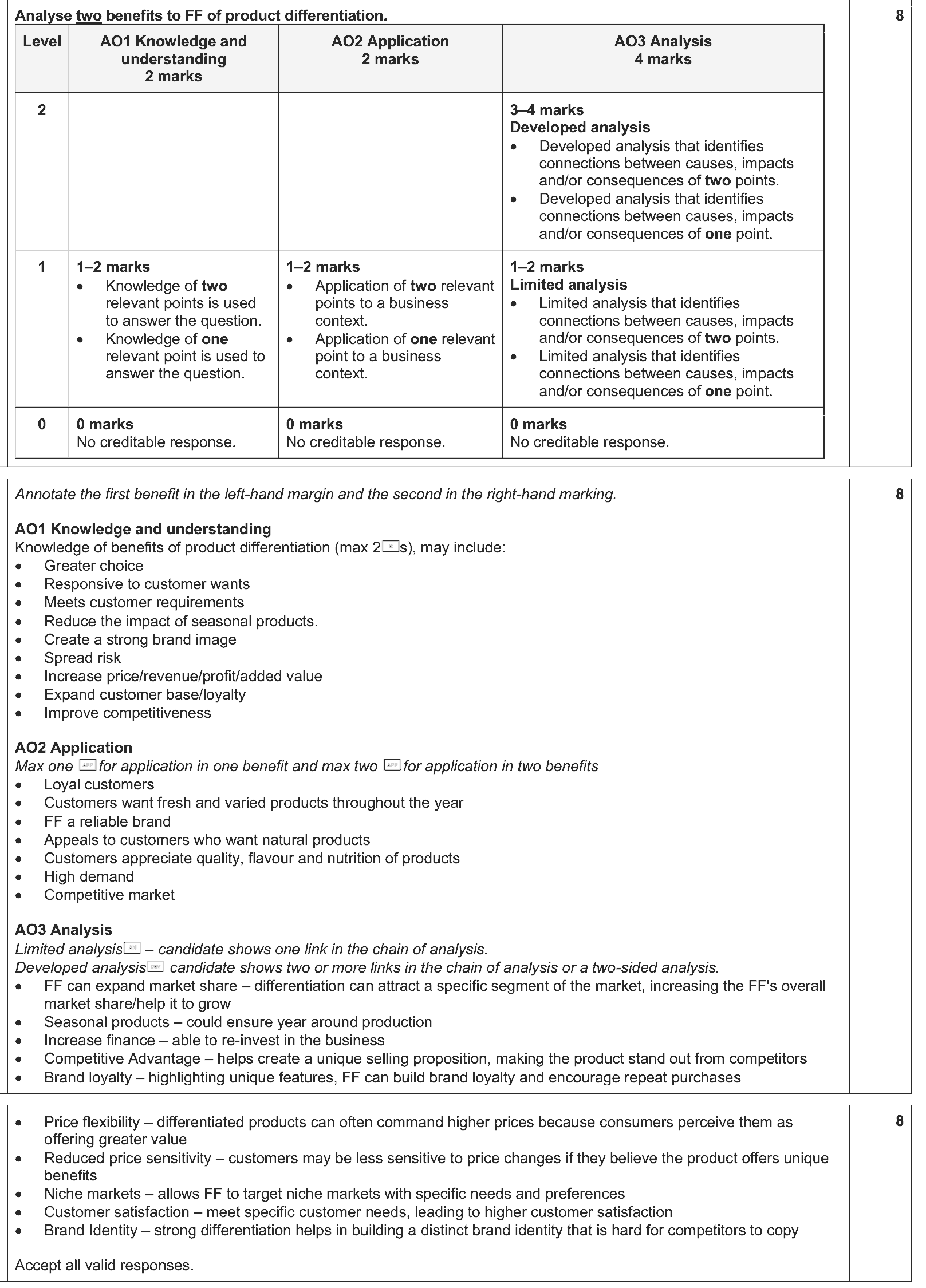
FF has gained a loyal customer base who appreciate the quality, flavour and nutrition of its products. However, FF also faces some challenges and risks in the competitive and uncertain food market. FF has limited capacity in producing crops. Weather conditions affect its yield and quality. It also must deal with pests, diseases and natural disasters that could 20 damage or destroy its crops. Another challenge that FF faces is the high level of demand for its products in the market. The partnership must meet the expectations and requirements of its customers who want fresh, varied and consistent products throughout the year.
Analyse two benefits to FF of product differentiation.
Frank grows fruit, including oranges, on his farm in country J. He sells his fruit at a market in a local city one day a week. Frank is a sole trader and operates in the primary and tertiary sectors. He set up FF using all of his redundancy money from a previous job with a large company. Frank’s business objective is to increase profit by 10% by the end of 2026. He also has a 5 target profitability of 25% by the same date. He uses the data from break-even analysis to make business decisions. Table 1.1 shows forecast data for the sale of oranges in July 2025.

Frank has two main competitors:
Evaluate whether Frank should introduce price skimming.

🔒 Unlock every The marketing mix: product and price question from 2020–2024
All 63 come with their mark schemes, answers and case studies, and appear in the practice tool above once you’re signed in. It’s free.
Questions and mark schemes are from past Cambridge papers and are reproduced for revision. Topical Vault is an independent revision resource, not affiliated with or endorsed by Cambridge Assessment International Education.
Each topic opens this practice tool with only that topic’s questions, plus how often it comes up and every question on it in one list.