Question 5(b)May/June 20259609/1312 marks
Evaluate whether cash flow forecasting is the most important activity for the success of a fashion clothing manufacturer.
Show mark scheme

Cambridge 9609, Paper 1 & 2. 1,080 questions, 2020 to 2026.
Case studies and questions reproduced from the original Cambridge material; mark schemes are cropped from the official mark scheme PDFs. Papers from 2020–2022 were set on the previous syllabus and can touch content that is A Level today — those topics are marked “A Level content” above.
Cash flow forecasts: how to construct and interpret them, and methods of improving cash flow.
20 past paper questions on this topic since 2020, across 13 exam sessions.
| Year | Paper 1 | Paper 2 | Total | Chart |
|---|---|---|---|---|
| 2026 | 0 | 2 | 2 | |
| 2025 | 1 | 1 | 2 | |
| 2024 | 1 | 0 | 1 | |
| 2023 | 2 | 3 | 5 | |
| 2022 | 2 | 3 | 5 | |
| 2021 | 1 | 3 | 4 | |
| 2020 | 1 | 0 | 1 |
The whole topic on one page, with answers and mark schemes. Printing this page prints just this list.
Evaluate whether cash flow forecasting is the most important activity for the success of a fashion clothing manufacturer.
Zorba had always had a passion for flower arranging. When he was made redundant from his job as an engineer last year, he decided to use all of his savings to set up a flower shop called ZF. Although Zorba did not require any additional finance, he decided to write a business plan before setting up ZF. Table 2.1 shows an extract from his business plan, showing the 5 planned expenditure for ZF.

Zorba opened ZF at the start of January 2026. However, Zorba encountered a number of problems with Supply Chain Management during the first three months of ZF’s trading. 15 These included:
Explain one way that Zorba could manage his trade payables more effectively.

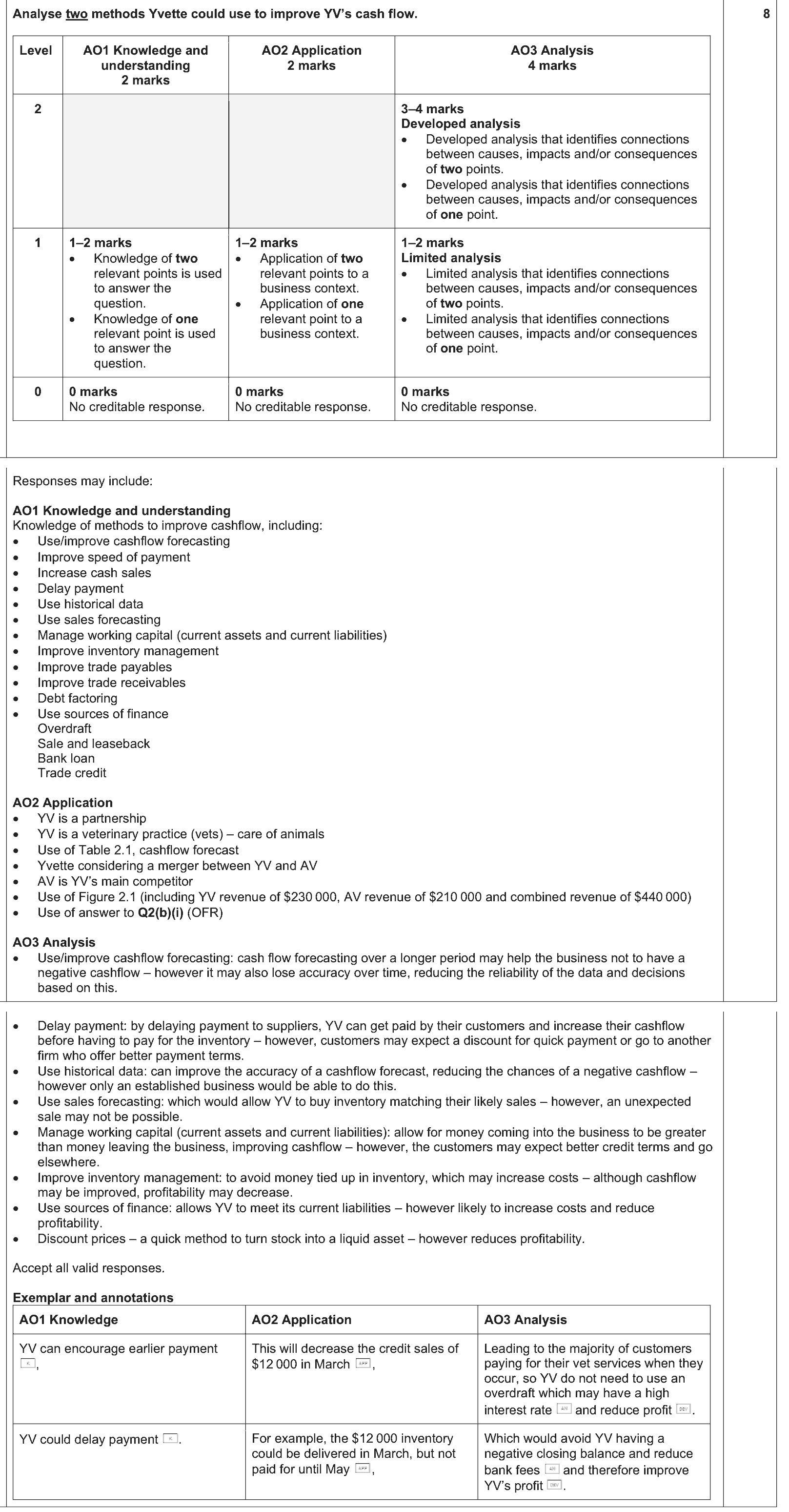
Yvette is the managing partner of YV, a veterinary (vet) practice in city P. There are four partners of YV, each of whom is a fully qualified and experienced veterinary surgeon. Each partner specialises in the care of different types of animals. Yvette specialises in the care of small animals, including dogs, cats and rodents. Table 2.1 shows a cash flow forecast that Yvette has created for the next three months. 5

Yvette is proposing a merger between YV and AV, which is YV’s main competitor in city P.
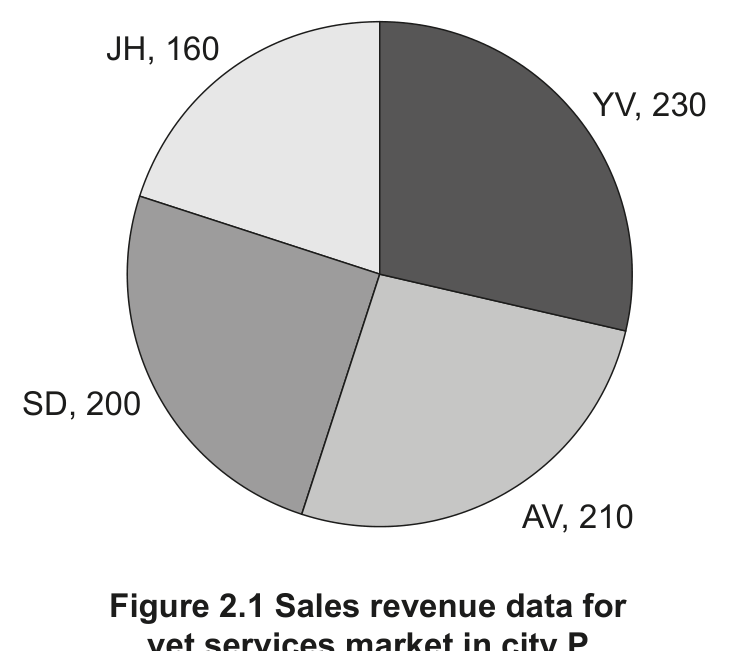
Figure 2.1 shows sales revenue data for the vet services market in city P.
sales revenue ($000s)
JH, 160
YV, 230
SD, 200
AV, 210
Analyse two methods Yvette could use to improve YV’s cash flow.
PD is a mass market fizzy drinks manufacturer in country Z. The fizzy drinks market in
country Z is dominated by a few well-known brands. The total market value is $5.3bn and
the PD brand has a 17% share of this market.
Pablo was recruited to be the Marketing Director of PD in 2022. He launched a new
promotional campaign based on trending music on social media. He decided to use social 5
media influencers to focus on this market.
Online feedback of the campaign was poor. Many of PD’s customers did not want to be
associated with trending music. National news highlighted the negative feedback and PD’s
sales volume decreased by 20% within a week and continued falling. This led to excess
inventory in PD’s warehouses. The bad publicity also caused a drop in PD’s share price and 10
a negative impact on cash flow.
Fig. 2.1 shows feedback from a recent questionnaire where previous PD customers were
asked what they thought about the promotional campaign.
quite positive
very positive
no opinion
very negative 120
quite negative

Pablo has called an emergency meeting of PD’s marketing managers to repair the damage 15 done to the PD brand from this recent promotional campaign.
Explain the term cash flow.

🔒 Unlock every Forecasting and managing cash flows question from 2020–2024
All 16 come with their mark schemes, answers and case studies, and appear in the practice tool above once you’re signed in. It’s free.
Questions and mark schemes are from past Cambridge papers and are reproduced for revision. Topical Vault is an independent revision resource, not affiliated with or endorsed by Cambridge Assessment International Education.
Each topic opens this practice tool with only that topic’s questions, plus how often it comes up and every question on it in one list.