← Topical Vault

Business activity · IGCSE Business

Cambridge 0450, Paper 1 & 2. 1,484 questions, 2019 to 2026.

Topic
Year

Every question begins with its business context — a short case for Paper 1, a full case study (shared across all four questions on that paper) for Paper 2. Mark schemes show the typed marking points alongside a cropped image of the official mark scheme page for exact wording.

About Business activity

Why businesses exist: needs and wants, scarcity, opportunity cost and specialisation, and how businesses add value.

23 past paper questions on this topic since 2019, across 14 exam sessions.

How often it comes up

YearPaper 1Paper 2TotalChart
2026011
2025202
2024314
2023213
2022314
2021224
2020202
2019213

Every 2025–2026 question on Business activity

The whole topic on one page, with answers and mark schemes. Printing this page prints just this list.

Paper 1 · Short answer and structured (2)

Scenario

DJU manufactures clothing including jeans and trousers. There are 90 employees working in its
factory. DJU uses specialisation when making its products. The Managing Director is reviewing
DJU’s cost and output data. An extract is shown in Table 4.1. She wants to know how lower interest
rates might affect the business. DJU’s directors are considering different ways a business could
grow including taking over a competitor.
Table 4.1
Extract from DJU’s cost and output data (per week)
Fixed costs $400000
Total costs $595000
Total output 85000 units

Case material
Question 4(d)Oct/Nov 20250450/126 marks

Explain one advantage and one disadvantage to DJU of using specialisation when making its products. Advantage: Explanation: Disadvantage: Explanation:

Show mark scheme

Explain one advantage and one disadvantage to DJU of using specialisation when making its products. Award 1 mark for identification of each relevant advantage/disadvantage (max 2). Award 1 mark for each relevant reference to this business (max 2). Award 1 mark for each relevant explanation (max 2). Points might include: Advantages:

  • Higher output/quantity produced [k] of clothing [app] so able to meet orders (on time) [an]
  • Quicker/cheaper to train employees [k] so does not increase total cost costs [an] above $595 000 (per week) [app]
  • Increased efficiency [k] which can increase output / lead to less waste [an] in the factory [app]
  • Employee should become a skilled/expert / employee can specialise in what they are good at [k] becoming more efficient in that task [an]
  • Easier to use machinery to perform tasks [k] which can speed up production [an]
  • Fewer mistakes/errors made / better quality [k] leading to fewer customer complaints / lower costs of production / better reputation / less waste [an] Disadvantages:
  • Workers less motivated [k] of the 90 employees [app] so maybe more likely to leave the business / more errors [an]
  • Workers cannot cover for absent colleagues / may be the only person who can do that task/job [k] which could mean manufacturing may stop / slow down [an]
  • Need to train employees [k] increasing training costs / increased cash outflows [an]
  • Not spread risk [k] Other appropriate responses should be credited.
Mark scheme, 0450/12 Oct/Nov 2025 question 4(d)
Scenario

Brendan wants to be a successful entrepreneur. He plans to start up a flower shop using government support. Brendan’s brother has offered to form a business partnership with him. Brendan knows it is important for a new business to use a suitable pricing method. He has already identified ways the business can increase added value. Brendan wants to know how an economic boom might affect his business.

Question 1(d)May/Jun 20250450/116 marks

Explain two ways Brendan could increase added value for his business. Way 1: Explanation: Way 2: Explanation:

Show mark scheme

Explain two ways Brendan could increase added value for his business. Award 1 mark for identification of each relevant way (max 2). Award 1 mark for each relevant reference to this business (max 2). Award 1 mark for each relevant explanation (max 2). Points might include:

  • Set high prices [k] which widens the gap between the cost and price [an] for the flowers [app]
  • Lower (input) costs [k] by buying cheaper materials [an] for this new business [app]
  • Branding/marketing/packaging [k] to give the idea of higher quality [an]
  • Unique design/products [k] making it more desirable than similar products [an] which could influence its pricing method [app]
  • Improve convenience [k] so products are immediately available [an] in the shop [app]
  • (Improve) quality/service [k] Other appropriate responses should be credited.
Mark scheme, 0450/11 May/Jun 2025 question 1(d)

Paper 2 · Case study (1)

Case study: Kitty’s Homeshoes (KH)

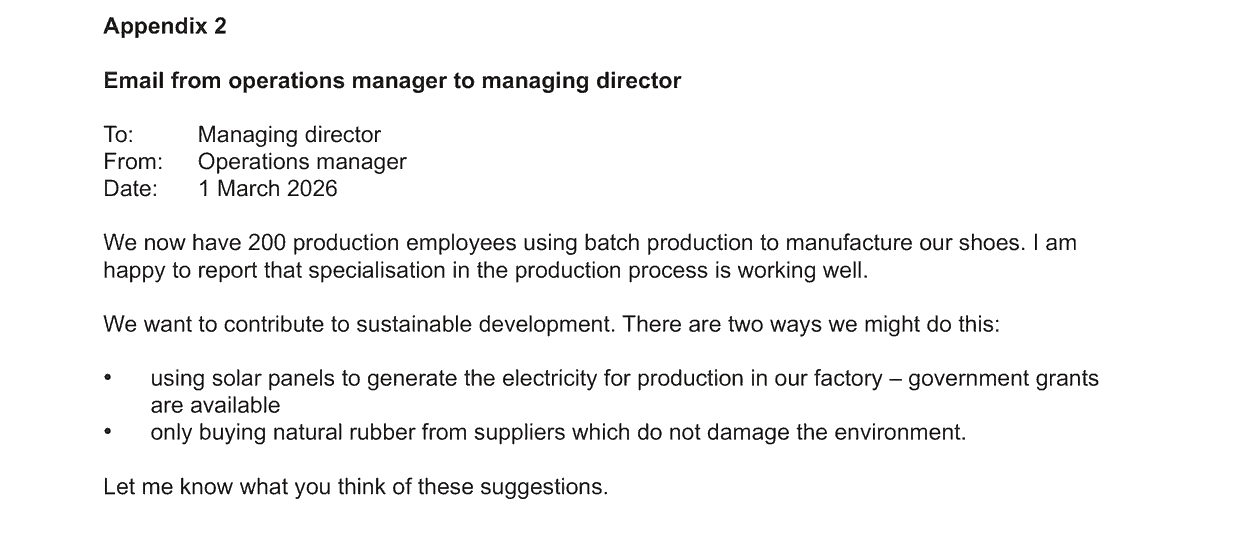
KH is a private limited company. It manufactures shoes for people with large feet. People with large feet often find it difficult to buy shoes to fit them. KH started producing shoes for this niche market 10 years ago. KH has a good brand image and charges a high price for its shoes. The marketing director has produced an advertisement for its current products shown in Appendix 1. She knows it is important that the advertisement meets all the legal controls on marketing. KH’s shoes are made from imported high-quality natural rubber extracted from trees. KH’s suppliers have cleared forests to grow their rubber trees. Pressure groups have been posting their concerns on social media. KH has started to sell its shoes online which has increased its sales. KH’s managing director wants to expand the business and plans to build a second factory. A new operations manager will need to be recruited. Internal or external recruitment could be used for this position. All KH’s managers are encouraged to use delegation. KH’s marketing director is considering whether to produce shoes of all sizes and to start selling to a mass market. If KH starts selling to a mass market many changes will need to be made.

Appendix 1
Appendix 2
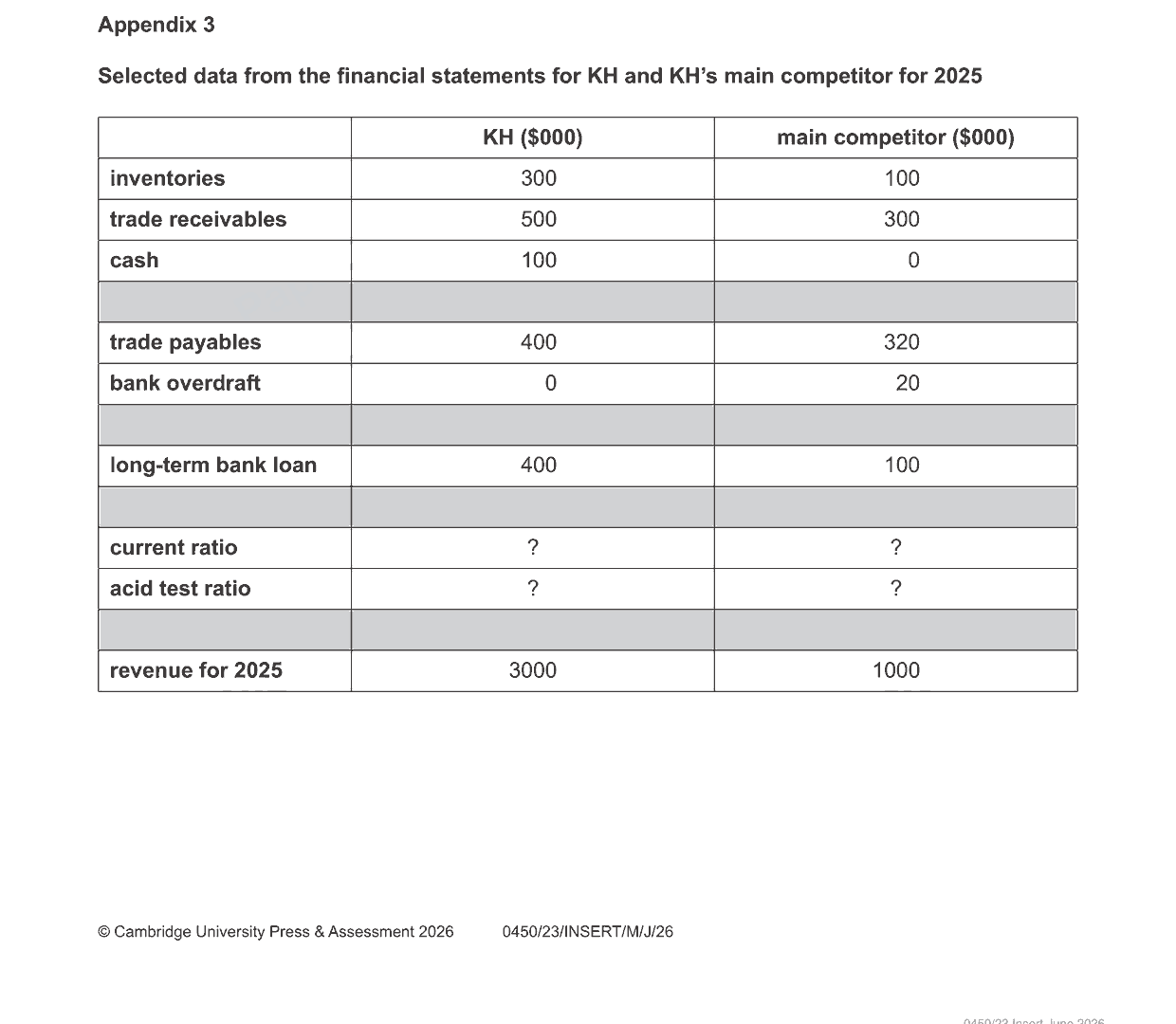
Appendix 3
Question 1(a)May/Jun 20260450/238 marks

Explain two advantages for KH of using specialisation in the production process. advantage 1 explanation advantage 2 explanation

Show mark scheme

Explain two advantages for KH of using specialisation in the production 8 process. Award 1 mark for each advantage (max 2). Award a maximum of 3 additional marks for each explanation of the advantage of specialisation in the production process – one of which must be applied to this context. Relevant advantages might include:

  • Higher output - increased efficiency in production – lower average costs
  • Quicker to train employees - production workers are trained in one task / they specialise in this one task - cheaper to train workers
  • Keeps unit costs low - less time taken by workers moving between tasks in the factory – so prices may be reduced
  • Higher quality - performing only one task makes worker expert - more efficient in that task
  • Less waste – as keep repeating the same task - so fewer mistakes may be made
  • Easier to introduce machinery to perform tasks – speeds up production process For example: Production employees are trained in one task (1) when manufacturing shoes (app) and will be quicker to train in this one task. (1) Therefore, it will be cheaper for KH to train employees and training costs will be lower (1). Application might include: shoes; large feet; private limited company; high- quality raw materials; natural rubber; large shoe sizes; batch production; niche market; good brand image; sells products at high prices; imports raw materials; 200 production employees; financial data from Appendix 3.
Mark scheme, 0450/23 May/Jun 2026 question 1(a)

20 more questions from 2019–2024

🔒 Unlock every Business activity question from 2019–2024

All 20 come with their mark schemes, answers and case studies, and appear in the practice tool above once you’re signed in. It’s free.

Create a free accountSign in

A few of them

  • 0450/12 · Oct/Nov 2024 · Question 1(e)Explain two ways a business can increase… 🔒
  • 0450/13 · May/Jun 2024 · Question 1(e)Explain two ways a business might increase… 🔒
  • 0450/21 · May/Jun 2024 · Question 1(b)Consider the following two ways EP could… 🔒
  • 0450/12 · Feb/Mar 2024 · Question 1(a)Define… 🔒
  • 0450/13 · Oct/Nov 2023 · Question 1(a)Identify two benefits to a business of… 🔒
  • + 15 more, by year in the table above

Questions and mark schemes are from past Cambridge papers and are reproduced for revision. Topical Vault is an independent revision resource, not affiliated with or endorsed by Cambridge Assessment International Education.

IGCSE Business questions by topic

Each topic opens this practice tool with only that topic’s questions, plus how often it comes up and every question on it in one list.

  1. Ch 1Business activity
  2. Ch 2Classification of businesses
  3. Ch 3Enterprise, business growth and size
  4. Ch 4Types of business organisation
  5. Ch 5Business objectives and stakeholder objectives
  6. Ch 6Motivating employees
  7. Ch 7Organisation and management
  8. Ch 8Recruitment, selection and training of employees
  9. Ch 9Internal and external communication
  10. Ch 10Marketing, competition and the customer
  11. Ch 11Market research
  12. Ch 12The marketing mix: product
  13. Ch 13The marketing mix: price
  14. Ch 14The marketing mix: place
  15. Ch 15The marketing mix: promotion
  16. Ch 16Technology and the marketing mix
  17. Ch 17Marketing strategy
  18. Ch 18Production of goods and services
  19. Ch 19Costs, scale of production and break-even analysis
  20. Ch 20Achieving quality production
  21. Ch 21Location decisions
  22. Ch 22Business finance: needs and sources
  23. Ch 23Cash flow forecasting and working capital
  24. Ch 24Income statements
  25. Ch 25Statement of financial position
  26. Ch 26Analysis of accounts
  27. Ch 27Economic issues
  28. Ch 28Environmental and ethical issues
  29. Ch 29Business and the international economy