Enterprise, business growth and size · IGCSE Business
Cambridge 0450, Paper 1 & 2. 1,484 questions, 2019 to 2026.
Topic
Year
Every question begins with its business context — a short case for Paper 1, a full
case study (shared across all four questions on that paper) for Paper 2. Mark schemes show the typed
marking points alongside a cropped image of the official mark scheme page for exact wording.
About Enterprise, business growth and size
Entrepreneurs and business plans, ways of measuring business size, how and why businesses grow (internal and external growth, mergers and takeovers), and why some businesses fail.
119 past paper questions on this topic since 2019, across 23 exam sessions.
How often it comes up
Year
Paper 1
Paper 2
Total
Chart
2026
8
5
13
2025
12
3
15
2024
11
3
14
2023
13
4
17
2022
8
8
16
2021
9
6
15
2020
11
6
17
2019
8
4
12
Every 2025–2026 question on Enterprise, business growth and size
The whole topic on one page, with answers and mark schemes. Printing this page prints just this list.
Paper 1 · Short answer and structured (20)
Scenario
Peter wants to start up a small business as a photographer who takes photographs at weddings. He has been told that there is government support available for new businesses. Peter will operate his business as a sole trader. He is considering using crowdfunding as a source of finance. Peter knows that many businesses fail.
Question 1(a)May/Jun 20260450/112 marks
Identify two ways the size of a business can be measured. way 1 way 2
Show mark scheme
Identify two ways the size of a business can be measured. Award one mark per way (max 2). Points might include:
(Number of) employees/size of workforce / (amount of) labour
Value of output / value of sales / revenue/turnover
Number of customers / numbers of sales / volume of output
(Value of) capital employed / value of statement of financial position
Market share
(Number of) outlets/shops/factories Other appropriate responses should be credited.
Question 1(b)May/Jun 20260450/112 marks
Identify two reasons why governments support new businesses. reason 1 reason 2
Show mark scheme
Identify two reasons why governments support new businesses. Award one mark per reason (max 2). Points might include:
Reduce unemployment/create jobs
Increase competition
Increase output / increase GDP / economic growth
Benefit society/improve environment
Small businesses can grow
Generate taxation/taxes
Motivate/encourage entrepreneurs/innovation
Reduce imports / increase export
Provide a variety of goods/services/can provide specialist goods
Some start-up/smaller businesses often have lower costs than larger businesses and can pass these onto consumers through lower prices
Help attract investors/businesses from other countries. Other appropriate responses should be credited.
Question 1(c)May/Jun 20260450/114 marks
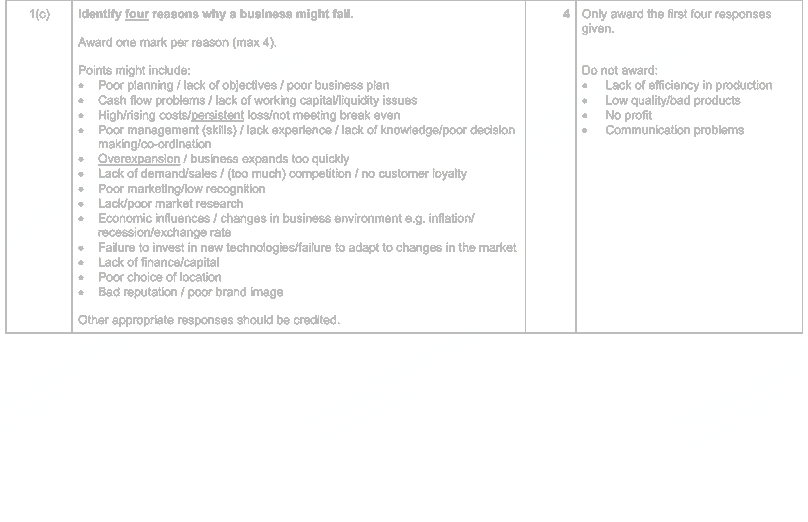
Identify four reasons why a business might fail. reason 1 reason 2 reason 3 reason 4
Show mark scheme
Identify four reasons why a business might fail. Award one mark per reason (max 4). Points might include:
Poor planning / lack of objectives / poor business plan
Cash flow problems / lack of working capital/liquidity issues
High/rising costs/persistent loss/not meeting break even
Lack of demand/sales / (too much) competition / no customer loyalty
Poor marketing/low recognition
Lack/poor market research
Economic influences / changes in business environment e.g. inflation/ recession/exchange rate
Failure to invest in new technologies/failure to adapt to changes in the market
Lack of finance/capital
Poor choice of location
Bad reputation / poor brand image Other appropriate responses should be credited.
Scenario
Amina is an entrepreneur. She plans to start up a business selling pens and paper and has collected some market research data. Amina has decided to sell her products using ecommerce. She is considering different methods of advertising to use for her pens and paper. Amina wants to know why some businesses remain small.
Question 2(a)May/Jun 20260450/122 marks
Define ‘entrepreneur’.
Show mark scheme
Define ‘entrepreneur’. Award 2 marks for a full definition. Award 1 mark for a partial definition.
The person who (organises, operates and) takes the risk to start a new business [2]
An individual who takes the financial risk of starting (and managing) a new business [2]
A person who combines factors of production to start a business [2] Partial definition e.g.
A person/individual who starts/sets up a business [1].
Question 2(e)May/Jun 20260450/126 marks
Explain two reasons why a business might remain small. Which reason is likely to be the most important? Justify your answer.
Show mark scheme
Explain two reasons why a business might remain small. Which reason is likely to be the most important? Justify your answer. Award up to 2 marks for identification of relevant points. Award up to 2 marks for relevant development of points. Award up to 2 marks for justified decision about which reason is likely to be the most important. Points might include:
Owner’s choice/objectives [k] as owner does not want the responsibility/stress for managing a large(r) business OR owner wants control over business (decisions) OR want to avoid increased financial risk [an] AND/OR so may achieve a better work life balance [an]
Limited access/availability of finance / low profit / liquidity/limited/low working capital [k] so cannot afford/not have enough funds to expand /reinvest [an]
Market size/ amount of customers / level of demand / operate in a niche market [k] limiting potential revenue [an]
High competition / a few large businesses may control market [k] so difficult for a small business to compete / customers may be brand loyal to competitors [an] AND/OR lower sales / lower market share [an]
Wants to maintain close relationship with its customers/ provide a personal service / type of industry/product/service offered [k] allowing them to build customer loyalty [an]
Remain flexible / able to respond quickly to changes in consumer tastes [k] to help maintain consumer loyalty [an]
Lack of knowledge/skills /experience / limited access to/lack of suitable labour / lack of suitable employees [k]
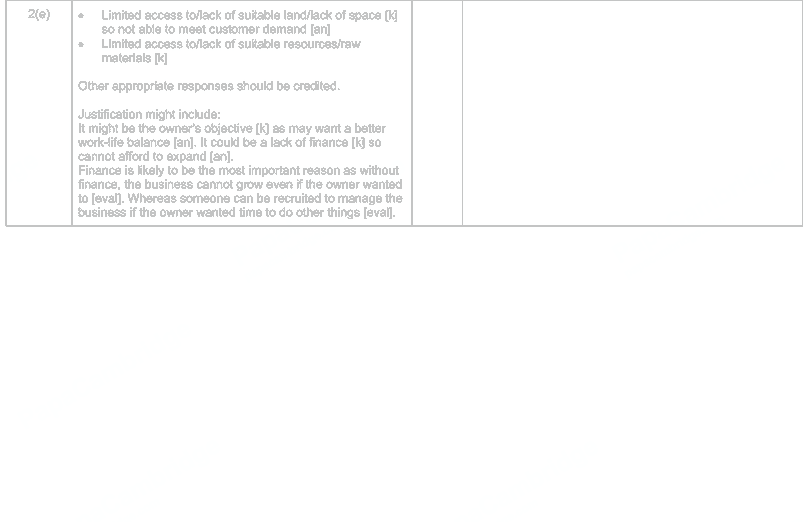
Limited access to/lack of suitable land/lack of space [k] so not able to meet customer demand [an]
Limited access to/lack of suitable resources/raw materials [k] Other appropriate responses should be credited. Justification might include: It might be the owner’s objective [k] as may want a better work-life balance [an]. It could be a lack of finance [k] so cannot afford to expand [an]. Finance is likely to be the most important reason as without finance, the business cannot grow even if the owner wanted to [eval]. Whereas someone can be recruited to manage the business if the owner wanted time to do other things [eval].
Scenario
CNR is a bank in country X. It is a private limited company. One of CNR’s business objectives is growth and the directors are planning to merge the bank with one of its competitors. This decision will affect many stakeholder groups. After the merger, CNR will have 8000 branches and 36000 employees. The managing director knows she will have to find a suitable method of communication to inform CNR’s employees about the merger.
Question 3(e)May/Jun 20260450/136 marks
Explain two possible problems a business might experience as it grows. Which problem is likely to be the most important? Justify your answer.
Show mark scheme
Explain two possible problems a business might experience as it grows. Which problem is likely to be the most important? Justify your answer. Award up to 2 marks for identification of relevant points. Award up to 2 marks for relevant development of points. Award up to 2 marks for justified decision about which problem of growth is likely to be the most important. Points might include:
Communication problems/miscommunication [k] leading to mistakes/ errors [an]
Difficult to control (many people) [k] which could slow down decision-making [an]
Co-ordination problems (between departments) [k] which could decrease efficiency [an]
Lower levels of employee motivation/morale [k] leading to higher levels of absenteeism [an]
Need more finance / lack of finance / need more working capital / cash flow problems [k]
Difficult/need to find more space/larger building / lack of space [k] which could increase fixed costs/rent [an]
Difficult to access/find more raw materials [k] may increase variable costs [an]
Need/difficult to find suitable employees [k] leading to higher recruitment/training/labour costs [an] Other appropriate responses should be credited. Justification might include: It can be difficult to control [k] which could slow down decision-making [an]. Another problem is that it may be difficult to recruit more employees [k] leading to higher recruitment costs [an]. Control is the most important problem because slow decisions could mean opportunities are missed [eval], whereas a business could introduce machinery reducing the number of employees needed [eval].
Scenario
Asha started ASW 5 years ago in country Z. ASW sets up and manages websites for other businesses. It has grown in size and now manages websites for 25 businesses. Asha is concerned about potential problems for ASW as the business continues to grow. Taxes in country Z are increasing and Asha is aware that this could affect ASW. Asha has a business plan and regularly reviews her business objectives. She knows that globalisation could provide opportunities for her business.
Question 4(a)Feb/Mar 20260450/122 marks
Define ‘business plan’.
Show mark scheme
Define ‘business plan’. Award 2 marks for a full definition. Award 1 mark for a partial definition.
A document containing the business objectives and important details about the operations/finance/owners of the (new) business. [2]
A detailed written document outlining the purpose and aims of a business which is often used to persuade lenders/investors to finance a business proposal. [2] Partial definition, e.g.
Provides information about business objectives/aims. [1] Other appropriate responses should be credited.
Question 4(c)Feb/Mar 20260450/124 marks
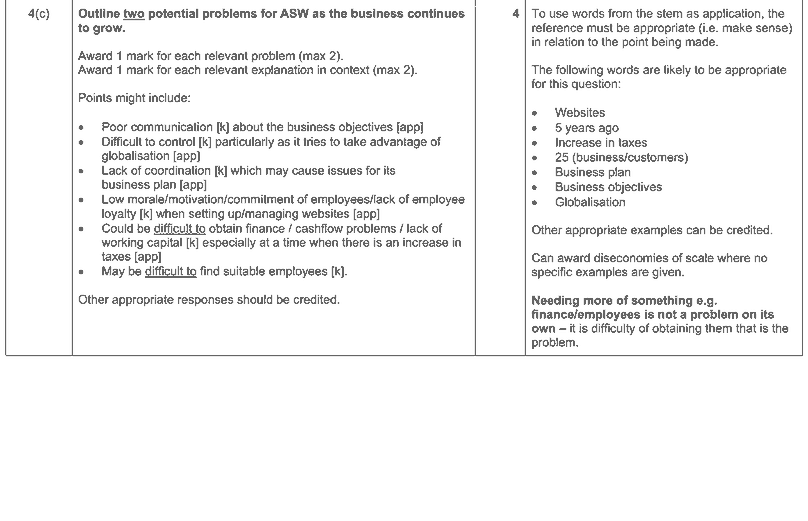
Outline two potential problems for ASW as the business continues to grow. problem 1 problem 2
Show mark scheme
Outline two potential problems for ASW as the business continues to grow. Award 1 mark for each relevant problem (max 2). Award 1 mark for each relevant explanation in context (max 2). Points might include:
Poor communication [k] about the business objectives [app]
Difficult to control [k] particularly as it tries to take advantage of globalisation [app]
Lack of coordination [k] which may cause issues for its business plan [app]
Low morale/motivation/commitment of employees/lack of employee loyalty [k] when setting up/managing websites [app]
Could be difficult to obtain finance / cashflow problems / lack of working capital [k] especially at a time when there is an increase in taxes [app]
May be difficult to find suitable employees [k]. Other appropriate responses should be credited.
Scenario
WMH is a business which operates in the secondary sector. It makes furniture including tables and chairs. WMH’s employees are all members of a trade union. The Managing Director knows the business is likely to remain small. She is considering introducing new technology into WMH’s factory. She also knows it is important for a manufacturing business to choose a suitable location for a factory.
Question 1(c)Oct/Nov 20250450/114 marks
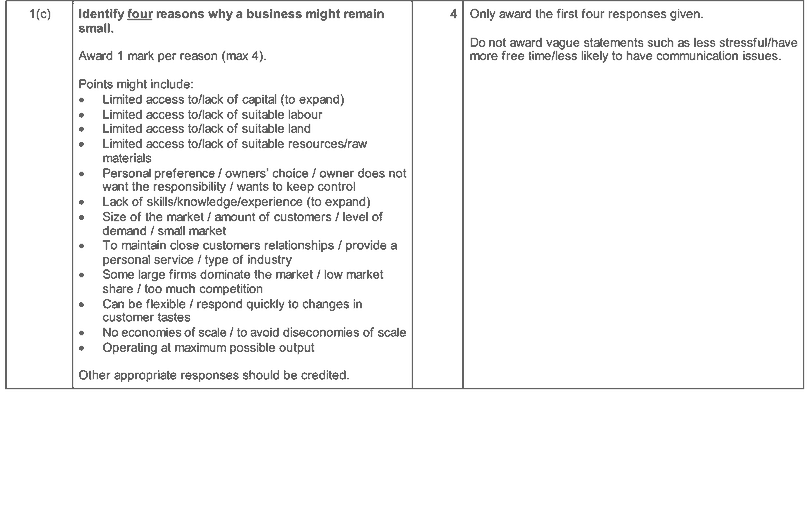
Identify four reasons why a business might remain small. Reason 1: Reason 2: Reason 3: Reason 4:
Show mark scheme
Identify four reasons why a business might remain small. Award 1 mark per reason (max 4). Points might include:
Limited access to/lack of capital (to expand)
Limited access to/lack of suitable labour
Limited access to/lack of suitable land
Limited access to/lack of suitable resources/raw materials
Personal preference / owners’ choice / owner does not want the responsibility / wants to keep control
Lack of skills/knowledge/experience (to expand)
Size of the market / amount of customers / level of demand / small market
To maintain close customers relationships / provide a personal service / type of industry
Some large firms dominate the market / low market share / too much competition
Can be flexible / respond quickly to changes in customer tastes
No economies of scale / to avoid diseconomies of scale
Operating at maximum possible output Other appropriate responses should be credited.
Scenario
Miguel plans to start up a gym (sports club). It will offer a range of fitness classes including yoga. The business will be a partnership with his sister. Miguel thinks the size of the business will remain small. Secondary market research will be used to help make decisions including which pricing method to use. Miguel knows it is important for a new business to select a suitable location.
Question 3(b)Oct/Nov 20250450/122 marks
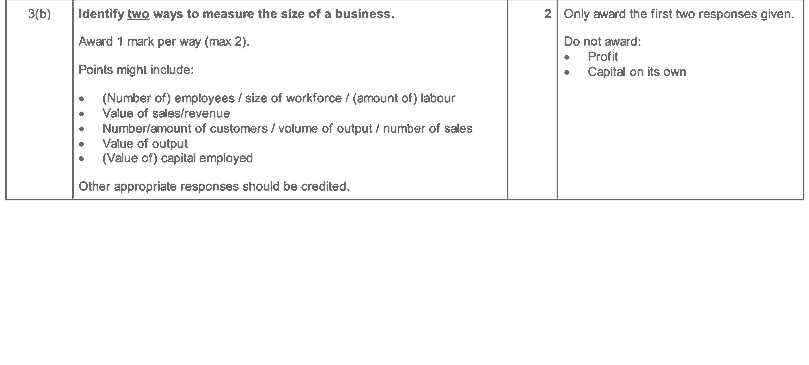
Identify two ways to measure the size of a business. Way 1: Way 2:
Show mark scheme
Identify two ways to measure the size of a business. Award 1 mark per way (max 2). Points might include:
(Number of) employees / size of workforce / (amount of) labour
Value of sales/revenue
Number/amount of customers / volume of output / number of sales
Value of output
(Value of) capital employed Other appropriate responses should be credited.
Scenario
DJU manufactures clothing including jeans and trousers. There are 90 employees working in its factory. DJU uses specialisation when making its products. The Managing Director is reviewing DJU’s cost and output data. An extract is shown in Table 4.1. She wants to know how lower interest rates might affect the business. DJU’s directors are considering different ways a business could grow including taking over a competitor. Table 4.1 Extract from DJU’s cost and output data (per week) Fixed costs $400000 Total costs $595000 Total output 85000 units
Question 4(e)Oct/Nov 20250450/126 marks
Do you think the advantages of taking over a competitor are greater than the disadvantages? Justify your answer.
Show mark scheme
Do you think the advantages of taking over a competitor are greater than the disadvantages? Justify your answer. Award up to 2 marks for identification of relevant points. Award up to 2 marks for relevant development of points. Award up to 2 marks for a justified decision as to whether the advantages of taking over a competitor are greater than the disadvantages. Points might include: Advantages:
Gain brand name/image of competitor / better reputation [k] leading to increasing customer loyalty [an] AND/OR more sales [an]
Economies of scale [k] leading to lower average/unit costs [an]
Access new skills/expertise/resources/ideas (from other business) [k]
More capacity/output [k] leading to possible economies of scale [an] Disadvantages:
Increased costs [k] which the business might not be able to afford [an]
Possible clash of management styles [k] leading to wrong decisions being taken [an]
Could demotivate employees [k] lowering efficiency [an]
Difficult to coordinate [k] could lead to mistakes/errors [an]
Poor communication [k] which could demotivate employees [an]
Less choice for customers [k] Other appropriate responses should be credited. Justification might include: One advantage of a taking over a competitor is less competition [k] which could allow the business to increase prices [an]. However, there could be a high cost [k] which the business might not be able to afford [an]. The advantages are greater because the combination of less competition and higher prices may lead to higher revenue [eval] which may help cover the costs of the takeover [eval].
Scenario
Max is an entrepreneur who wants to start up a business selling books. He has decided to use ecommerce. Max has been told there is government support for start-up businesses. He will use market research to help make business decisions. Max knows it is important for a new business to build customer loyalty.
Question 2(a)Oct/Nov 20250450/132 marks
Define ‘entrepreneur’.
Show mark scheme
Define ‘entrepreneur’. Award 2 marks for a full definition. Award 1 mark for a partial definition.
An individual who takes the financial risk of starting (and managing) a new business [2]
A person who takes the risk for a new business venture [2] Partial definition e.g.
A person who starts/sets up a business [1]
Question 2(b)Oct/Nov 20250450/132 marks
Identify two reasons why governments support start-up businesses. Reason 1: Reason 2:
Show mark scheme
Identify two reasons why a governments support start- up businesses. Award 1 mark per reason (max 2). Points might include:
Create jobs / reduce unemployment
Increase competition
Increase output / improve gross domestic product / increase GDP
Generate taxation/taxes
Motivate/encourage entrepreneurs
(Business) can grow (into larger businesses in the future)
Reduce imports / increase exports
Provide a wider variety of goods/services Other appropriate responses should be credited.
Scenario
Brendan wants to be a successful entrepreneur. He plans to start up a flower shop using government support. Brendan’s brother has offered to form a business partnership with him. Brendan knows it is important for a new business to use a suitable pricing method. He has already identified ways the business can increase added value. Brendan wants to know how an economic boom might affect his business.
Question 1(b)May/Jun 20250450/112 marks
Identify two ways a government can support business start-ups. Way 1: Way 2:
Show mark scheme
Identify two ways a government can support business start-ups. Award 1 mark for each way (max 2). Points might include:
Grants/subsidies
(Low interest) loans
Low-cost/rent-free premises
Provide training
Tax relief/lower tax/tax holiday
Advice/help with research
Help promote/advertise the business
Provide mentors Other appropriate responses should be credited.
Scenario
PKN manufactures glass. Contributing to sustainable development is important to the business. PKN has factories in 30 countries. It has 27000 employees. The Managing Director knows PKN has benefited from globalisation. She plans to expand the business using external growth. Retained profit is one source of finance a business could use to fund expansion. Some of PKN’s directors are concerned about possible diseconomies of scale as the business grows.
Question 4(a)May/Jun 20250450/112 marks
Identify two methods of external growth a business might use. Method 1: Method 2:
Show mark scheme
Identify two methods of external growth a business might use. Award 1 mark for each method (max 2). Points might include:
Horizontal integration
Forward integration
Backward integration
Conglomerate/diversification
Joint venture Other appropriate responses should be credited.
Scenario
Hal wants to be a successful entrepreneur. He plans to leave his job to start up a bakery. The bakery will operate in the private sector. The business will have many stakeholder groups. Hal has been told it is important for a new business to select an appropriate source of start-up capital. He also knows new businesses are at a greater risk of failure.
Question 3(b)May/Jun 20250450/122 marks
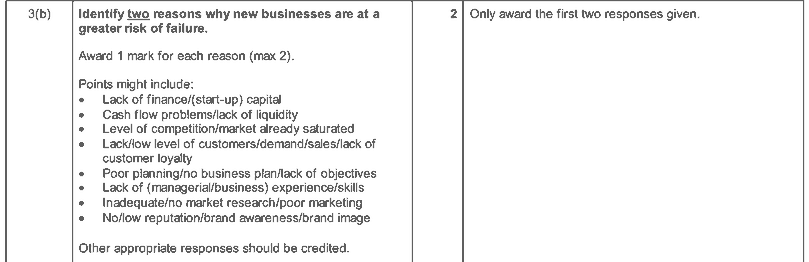
Identify two reasons why new businesses are at a greater risk of failure. Reason 1: Reason 2:
Show mark scheme
Identify two reasons why new businesses are at a greater risk of failure. Award 1 mark for each reason (max 2). Points might include:
Lack of finance/(start-up) capital
Cash flow problems/lack of liquidity
Level of competition/market already saturated
Lack/low level of customers/demand/sales/lack of customer loyalty
Poor planning/no business plan/lack of objectives
Lack of (managerial/business) experience/skills
Inadequate/no market research/poor marketing
No/low reputation/brand awareness/brand image Other appropriate responses should be credited.
Question 3(d)May/Jun 20250450/126 marks
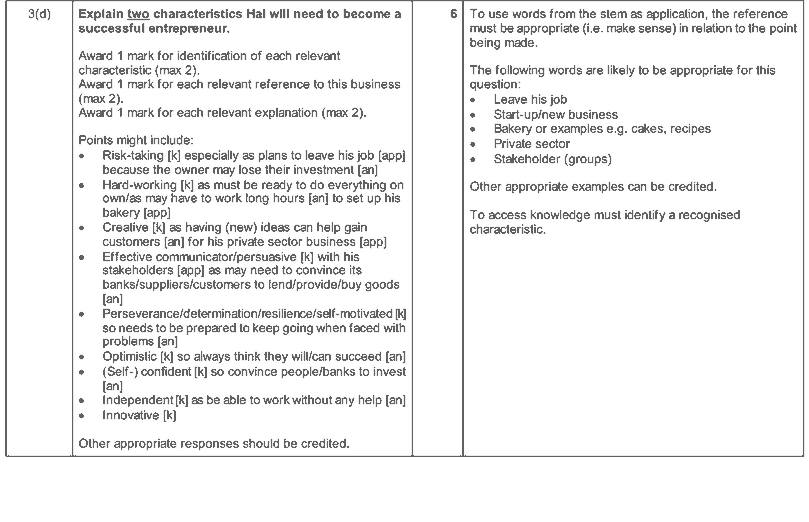
Explain two characteristics Hal will need to become a successful entrepreneur. Characteristic 1: Explanation: Characteristic 2: Explanation:
Show mark scheme
Explain two characteristics Hal will need to become a successful entrepreneur. Award 1 mark for identification of each relevant characteristic (max 2). Award 1 mark for each relevant reference to this business (max 2). Award 1 mark for each relevant explanation (max 2). Points might include:
Risk-taking [k] especially as plans to leave his job [app] because the owner may lose their investment [an]
Hard-working [k] as must be ready to do everything on own/as may have to work long hours [an] to set up his bakery [app]
Creative [k] as having (new) ideas can help gain customers [an] for his private sector business [app]
Effective communicator/persuasive [k] with his stakeholders [app] as may need to convince its banks/suppliers/customers to lend/provide/buy goods [an]
Perseverance/determination/resilience/self-motivated [k] so needs to be prepared to keep going when faced with problems [an]
Optimistic [k] so always think they will/can succeed [an]
(Self-) confident [k] so convince people/banks to invest [an]
Independent [k] as be able to work without any help [an]
Innovative [k] Other appropriate responses should be credited.
Scenario
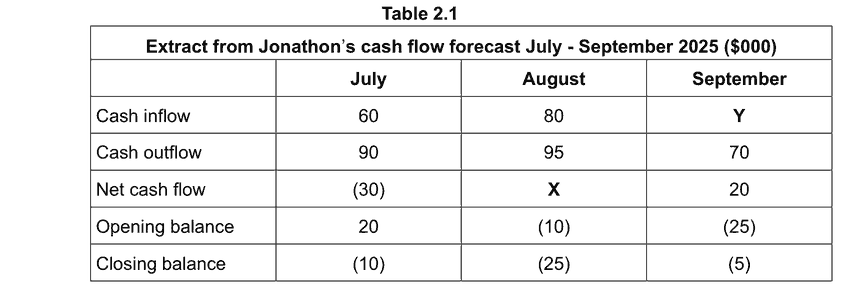
Jonathon is a sole trader. He owns a shop selling office equipment including printers. To encourage sales Jonathon allows customers 4 weeks to pay for the office equipment. Jonathon thinks his business is likely to remain small. He knows managing cash flow is important for his business and he has prepared a cash flow forecast. An extract is shown in Table 2.1. Table 2.1 Extract from Jonathon’s cash flow forecast July - September 2025 ($000) July August September Cash inflow 60 80 Y Cash outflow 90 95 70 Net cash flow (30) X 20 Opening balance 20 (10) (25) Closing balance (10) (25) (5)
Question 2(a)May/Jun 20250450/132 marks
Identify two ways to measure the size of a business. Way 1: Way 2:
Show mark scheme
Identify two ways to measure the size of a business. Award 1 mark per way (max 2). Points might include:
(Value of) capital employed
Value of output / sales OR revenue
Number of customers / sales / volume / amount of output
(Number of) employees Other appropriate responses should be credited.
Question 2(c)May/Jun 20250450/134 marks
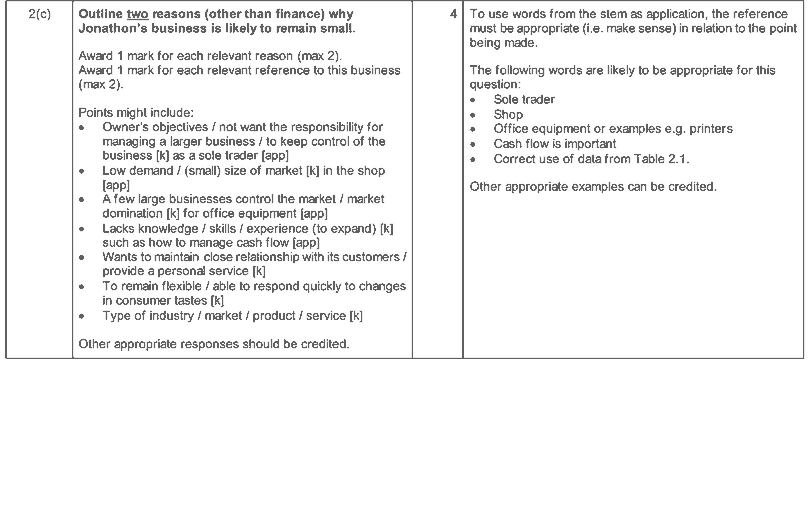
Outline two reasons (other than finance) why Jonathon’s business is likely to remain small. Reason 1: Reason 2:
Show mark scheme
Outline two reasons (other than finance) why Jonathon’s business is likely to remain small. Award 1 mark for each relevant reason (max 2). Award 1 mark for each relevant reference to this business (max 2). Points might include:
Owner’s objectives / not want the responsibility for managing a larger business / to keep control of the business [k] as a sole trader [app]
Low demand / (small) size of market [k] in the shop [app]
A few large businesses control the market / market domination [k] for office equipment [app]
Lacks knowledge / skills / experience (to expand) [k] such as how to manage cash flow [app]
Wants to maintain close relationship with its customers / provide a personal service [k]
To remain flexible / able to respond quickly to changes in consumer tastes [k]
Type of industry / market / product / service [k] Other appropriate responses should be credited.
Scenario
Rachel’s business produces and sells chocolate bars. Quality is important. Rachel is a sole trader who received government support when she started up her business. The business operates in a competitive market. Rachel is considering ways to increase sales of her best-selling product. She is also planning to introduce a new chocolate bar. Rachel knows deciding which pricing method to use for a new product is important.
Question 2(b)Feb/Mar 20250450/122 marks
Identify two ways a government can support business start-ups. Way 1: Way 2:
Show mark scheme
Identify two ways a government can support business start-ups. Award 1 mark for each relevant way [max 2]. Points might include:
Providing (low cost) loans / low interest rates
Providing grants
Low-cost rent
Lower tax / tax relief
Providing training
Providing advice / research / marketing data
Providing mentors Other appropriate responses should be credited.
Paper 2 · Case study (8)
Case study: Youth Clothes (YC)
Ashanti has just completed a degree in business studies at university. She plans to start up her own clothes shop called YC in Main City in country X. Ashanti will be a sole trader and thinks she has the right characteristics to be a successful entrepreneur. Her target market is customers between 16 and 30 years of age. Ashanti has written a business plan to help her when she starts YC. She has $20 000 in savings which she could invest in the business. Ashanti needs to decide whether to use owners’ savings, a bank loan or leasing to purchase the equipment for her shop. Ashanti will employ an assistant manager and 3 more people to help her in the shop. She knows that legal controls over employment may benefit her employees. Ashanti wants to make sure her employees will be motivated, and she needs to decide the best way to do this. Ashanti needs to decide on the product range to sell in her shop. Appendix 3 contains financial information about the two product ranges she is considering selling. Ashanti will only sell one of these product ranges when she first opens her shop and must decide which one to choose.
Question 1(a)May/Jun 20260450/218 marks
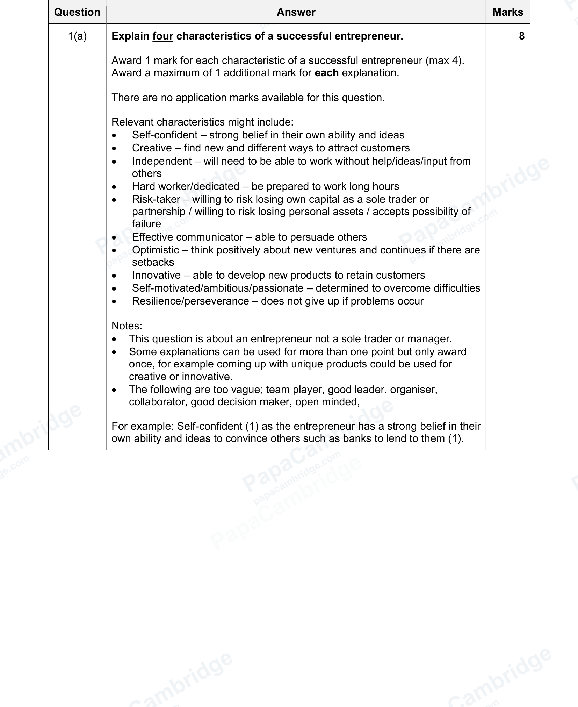
Explain four characteristics of a successful entrepreneur. characteristic 1 characteristic 2 characteristic 3 characteristic 4
Show mark scheme
Explain four characteristics of a successful entrepreneur. 8 Award 1 mark for each characteristic of a successful entrepreneur (max 4). Award a maximum of 1 additional mark for each explanation. There are no application marks available for this question. Relevant characteristics might include:
Self-confident – strong belief in their own ability and ideas
Creative – find new and different ways to attract customers
Independent – will need to be able to work without help/ideas/input from others
Hard worker/dedicated – be prepared to work long hours
Risk-taker – willing to risk losing own capital as a sole trader or partnership / willing to risk losing personal assets / accepts possibility of failure
Effective communicator – able to persuade others
Optimistic – think positively about new ventures and continues if there are setbacks
Innovative – able to develop new products to retain customers
Self-motivated/ambitious/passionate – determined to overcome difficulties
Resilience/perseverance – does not give up if problems occur Notes:
This question is about an entrepreneur not a sole trader or manager.
Some explanations can be used for more than one point but only award once, for example coming up with unique products could be used for creative or innovative.
The following are too vague; team player, good leader. organiser, collaborator, good decision maker, open minded, For example: Self-confident (1) as the entrepreneur has a strong belief in their own ability and ideas to convince others such as banks to lend to them (1).
Question 2(a)May/Jun 20260450/218 marks
Explain how the following two sections of a business plan could help Ashanti when starting her business.
market research
human resources market research explanation human resources explanation
Show mark scheme
Explain how the following two sections of a business plan could help 8 Ashanti when starting her business.
market research
human resources Award 1 mark for how each section a business plan could help Ashanti (max 2). Award a maximum of 3 additional marks for each explanation of the section of a business plan and how could help Ashanti – one of which must be applied to this context. Market research
Able to identify the needs of the market as being targeted at a specific age group – so inventory is more likely to be attractive to this market – sales are likely to be higher
Market research helps to identify that there is sufficient demand for the products – as there may be a gap in the market – shows that the business is more likely to be successful
To help set prices – at a level that will be suitable for the target market – and to be more competitive with other businesses
To help gain a bank loan – to show that the new business is likely to have the demand to be successful – to be able to repay any loan she takes out
To help identify competitor behaviour – to find out about the range of products available – so she can differentiate the clothes she sells Human resources
To estimate how many people need to be employed – to ensure all tasks are completed – so that the business can operate efficiently
To be able to calculate the cost of wages to be paid by Ashanti - to pay the employees a competitive rate – so she will budget the correct amount for the business to pay
To identify the skills needed by employees – so that the employees can carry out their tasks correctly – not make mistakes
Helps decide if Ashanti needs a manager – to run the business when she isn’t there – so that she doesn’t have to close Notes:
This question is about planning for the future rather than what has been done.
The business will sell rather than produce clothes.
Do not award functions of market research or human resources.
For market research it is the effectiveness that should be discussed rather than the process. For example: Market research will help YC to identify the market as being targeted at a specific age group (1) this will mean products are more likely to be attractive to this market (1) and sales are likely to be higher (1) making the start-up clothes shop more likely to succeed (app). Application could include: clothes; clothes shop; sole trader; target market aged 16–30; $20 000; 3/4 employees; 40% are in age group 16–30; use competitive pricing method; use social media; economic growth predicted to be 4%; information from Appendix 3.
Case study: KE (Kitchen Equipment)
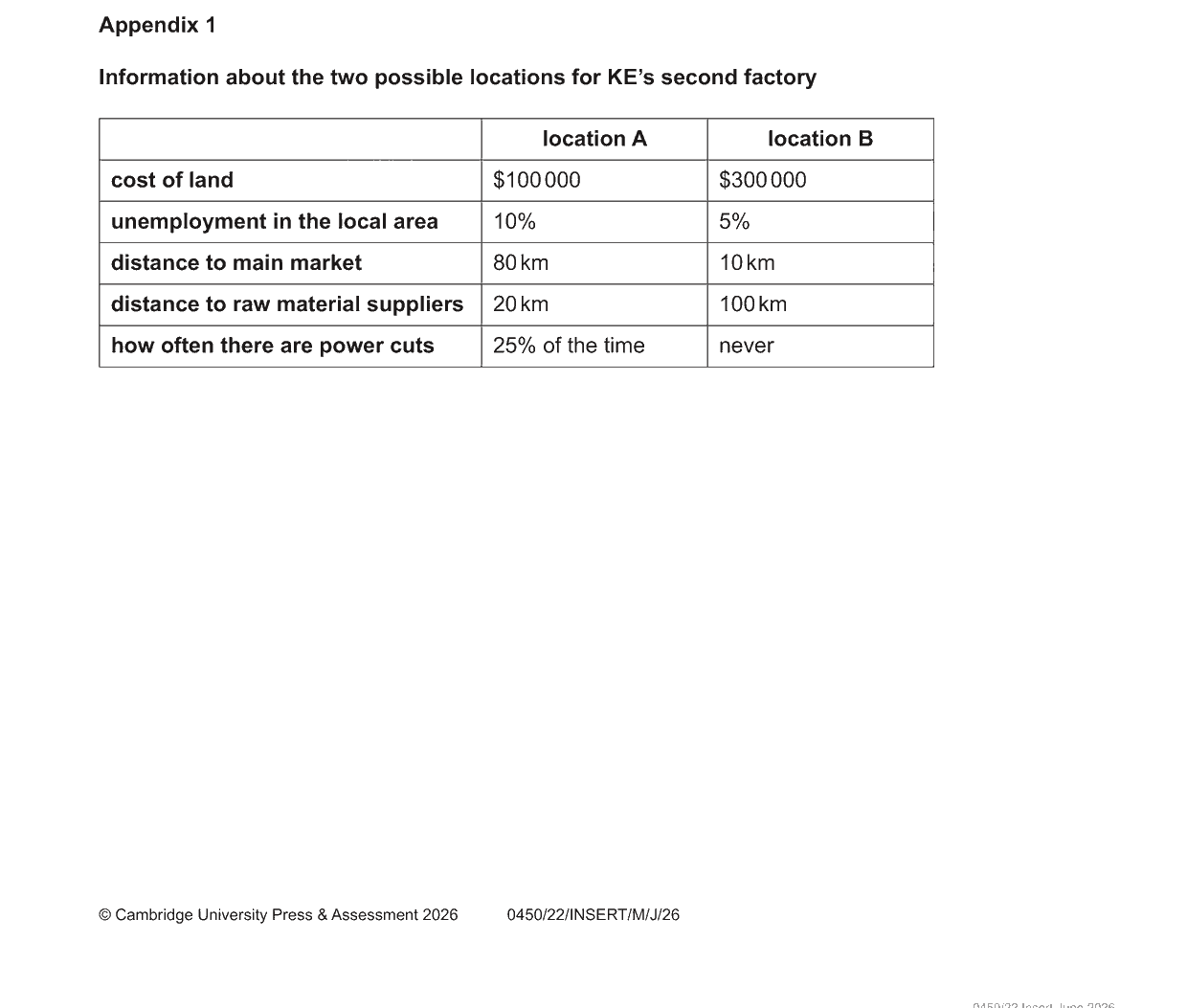
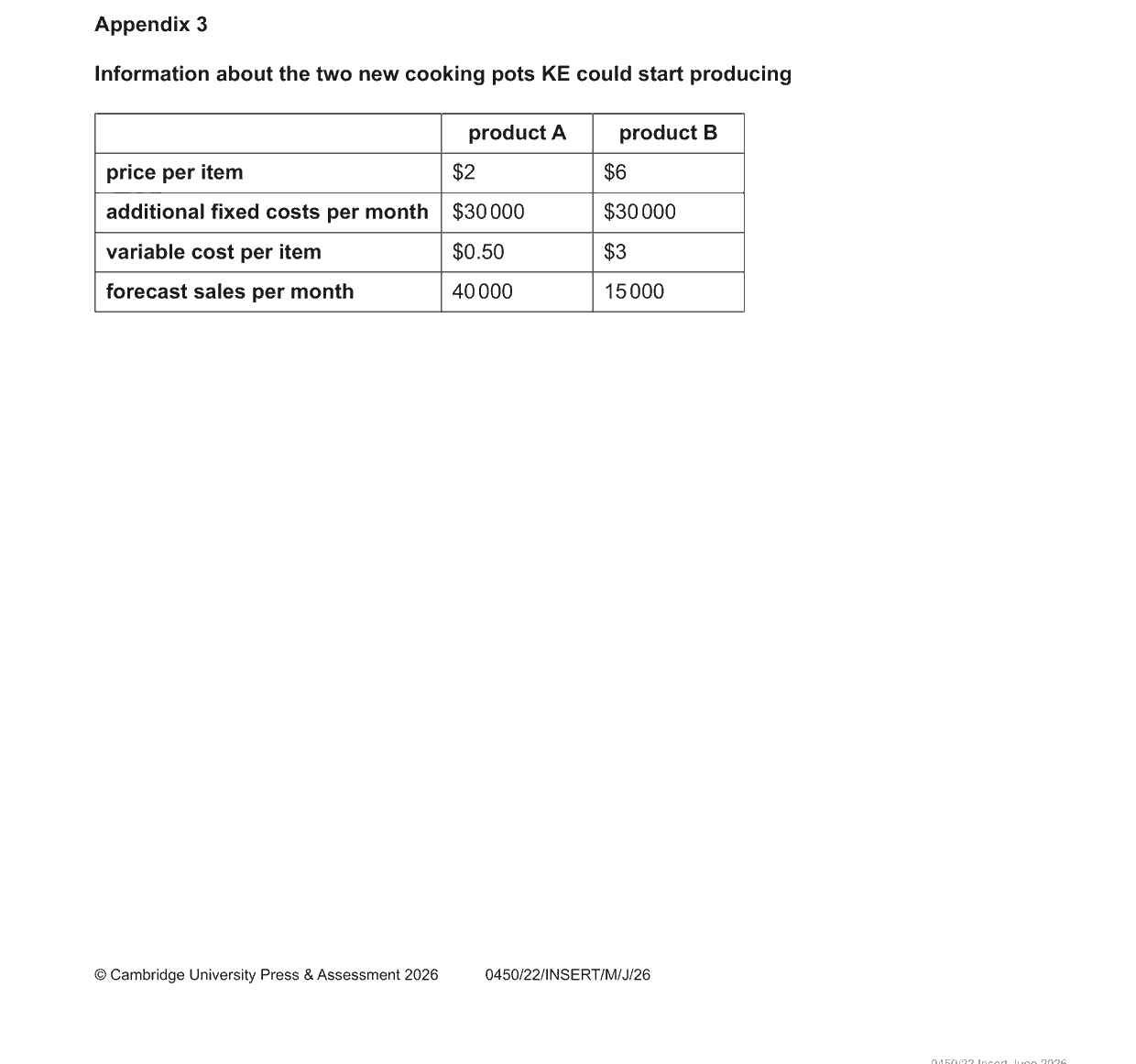
KE is a public limited company in country X. It has 10 000 employees. KE manufactures cooking equipment such as cooking pots, which it sells at low prices. KE produces 20 million cooking pots per year in its factory, and sells its products in country X. The market for cooking pots is very competitive. KE uses simple packaging to help keep costs low. KE is planning to build a second factory. The existing factory is working at maximum output and is unable to meet growing demand. The second factory will allow KE to increase sales from $90 million to $180 million per year. KE needs to choose between two possible locations for the second factory. Information about the two locations is shown in Appendix 1. KE does not currently use lean production. The operations director plans to introduce lean production in both the existing factory and the second factory. Training for all employees is important for KE. KE is planning to produce a new cooking pot when it opens the second factory. The marketing director will use primary market research to help decide whether to produce product A or product B. Information about the two new cooking pots in shown in Appendix 3. KE wants to choose the cooking pot with the highest potential revenue and profit.
Question 1(a)May/Jun 20260450/228 marks
Explain four ways to measure the size of KE. way 1 way 2 way 3 way 4
Show mark scheme
Explain four ways to measure the size of KE. 8 Award 1 mark for each way of measuring size (max 4). Award a maximum of 1 additional mark for each explanation of the way which must be applied to this context.
Number of people employed – it employs a large number of people at 10 000
Value of sales – it has a large current value of output at $90m per year
Capital employed – it is a public limited company
Volume of output– it has an output of 20 million units produced each year For example: Number of people employed (1) KE has at a high number at 10 000 employees (app). Notes:
Do not award number of factories, profit, type of business. amount of machinery or value of shares. Application might include: cooking pots/equipment; employs 10 000 people; public limited company; output of 20 million cooking pots; value of output is $90m/$180m; sells in the home country; competitive market; numerical information from Appendix 1 and 3.
Case study: Coffee, Tea and Desserts (CTD)
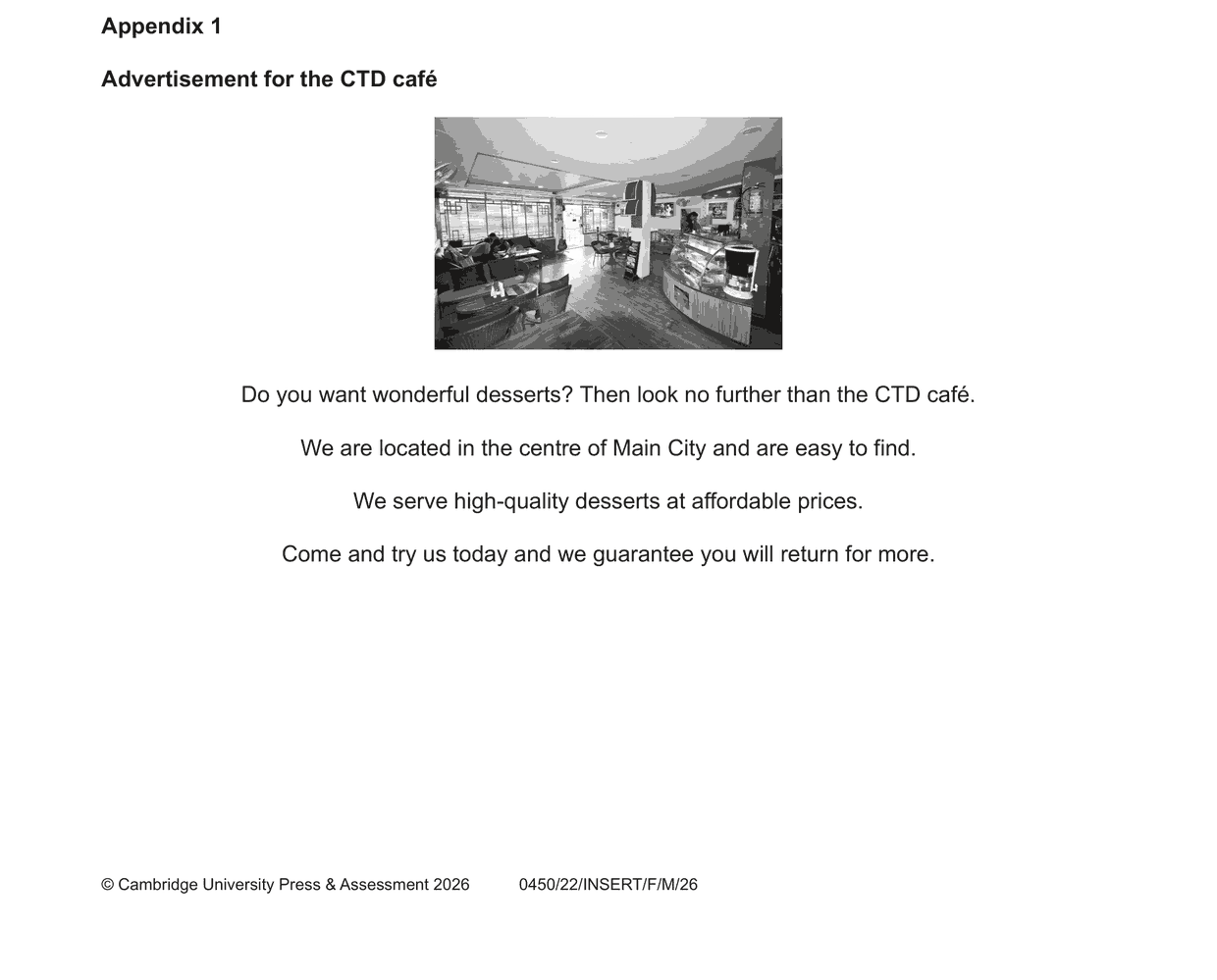
Nadia started CTD 4 years ago in the centre of Main City. CTD is a successful café that sells coffee, tea and desserts. Nadia operates as a sole trader. When she opened her café she wanted the business to remain small. Nadia has 3 employees serving customers in the café. CTD has a reputation for selling high-quality desserts. Nadia has 8 employees making the desserts in the café kitchen. Each worker carries out a task and then passes the part-finished product on to the next employee until the dessert is finished. Nadia knows that CTD’s good reputation could be lost if the high quality of her desserts is not maintained. Nadia is considering the best way to continue to produce high-quality desserts in her kitchen. Nadia uses cost-plus pricing for all the food and drinks CTD sells. She knows promotion is important for CTD as she wants to encourage new customers and create brand loyalty amongst her existing customers. Most of CTD’s customers are people working or shopping in the city centre who walk past the café. Nadia is now planning to expand and open a second café in Main City. Nadia is considering whether to set up a new café or to take over a competitor’s café. Nadia is recruiting a café manager for the second café whichever option she chooses. She has three applicants to choose between. Information about these applicants is shown in Appendix 3.
Appendix 2 — not directly referenced by any question in this paper
Email from Nadia’s accountant to Nadia To: Nadia From: Nadia’s accountant Date: 1 February 2026 Hi Nadia I have reviewed CTD’s accounts and assessed the short-term and long-term financial needs of the business. I have noticed that at certain times of the year the café has a cash flow problem. You need to carefully plan when to buy ingredients for the café. Have you thought about asking for trade credit from your suppliers? I know you plan to expand the business by opening a second café in Main City. Please be aware that the government will increase interest rates from 2% to 6% in the next two months.
Question 1(a)Feb/Mar 20260450/228 marks
Explain four reasons why a business might remain small. reason 1 reason 2 reason 3 reason 4
Show mark scheme
Explain four reasons why a business might remain small. 8 Award 1 mark for each reason why the business might remain small (max 4). Award a maximum of 1 additional mark for each explanation. There are no application marks available for this question. Relevant reasons might include the following.
The type of industry a business operates in – if the business is in the personal customer service sector, then customers would receive individual attention.
Market size – the business may not have sufficient customers to grow larger.
Owner’s objectives – they may feel they lack the management skills to run a larger business.
Access to and availability of capital – if it is difficult to gain access to enough capital then the business may not be able to grow even if the owners wanted to.
Market domination – some industries are dominated by large businesses that benefit from economies of scale making it very difficult for small businesses to compete with them.
Owner wants to keep a close relationship with customers – builds customer loyalty. For example: Market size (1) the business may not have sufficient customers to grow larger. (1)
Question 3(b)Feb/Mar 20260450/2212 marks
Consider the advantages and disadvantages of the following two methods of growth CTD could use. Which method of growth should CTD use? Justify your answer.
setting up a new café
taking over a competitor’s café setting up a new café taking over a competitor’s café recommendation
Show mark scheme
Consider the advantages and disadvantages of the following two 12 methods of growth CTD could use. Which method of growth should CTD use? Justify your answer.
setting up a new café
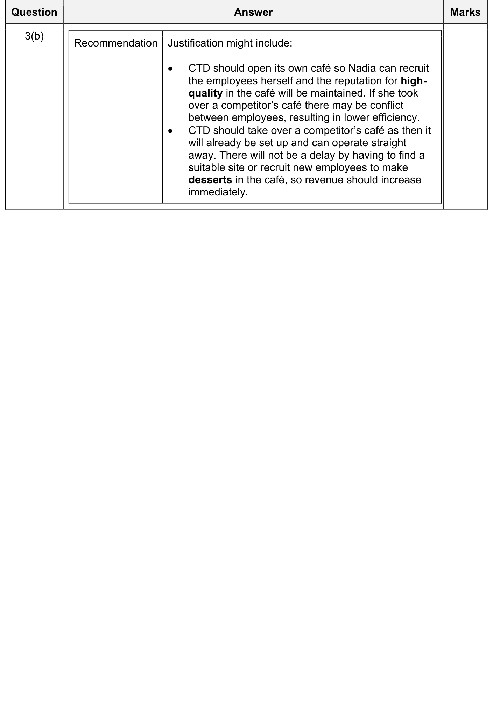
taking over a competitor’s café Level Description Marks Sound application of knowledge and understanding of relevant business concepts using appropriate terminology. Detailed discussion of both methods of growth. 3 Well-justified recommendation. 9–12 Candidates discussing both methods of growth in detail, in context and with a well-justified recommendation including why the alternative was rejected should be rewarded with the top marks in the band. Sound application of knowledge and understanding of relevant business concepts using appropriate terminology. Detailed discussion of at least one method of growth. 2 5–8 Judgement with some justification / some evaluation of choice made. Candidates discussing in detail both methods of growth and applying it to the case should be rewarded with the top marks in the band. Limited application of knowledge and understanding of relevant business concepts. Limited ability to discuss methods of growth with little / no explanation. 1 1–4 Simple judgement with limited justification / limited evaluation of choice made. Candidates outlining both methods of growth in context should be rewarded with the top marks in the band. 0 No creditable response 0 Recommendation Justification might include:
CTD should open its own café so Nadia can recruit the employees herself and the reputation for high- quality in the café will be maintained. If she took over a competitor’s café there may be conflict between employees, resulting in lower efficiency.
CTD should take over a competitor’s café as then it will already be set up and can operate straight away. There will not be a delay by having to find a suitable site or recruit new employees to make desserts in the café, so revenue should increase immediately.
Case study: Luxury Bathrooms (LB)
LB is a large private limited company. The business was started 20 years ago in country X. LB manufactures luxury bathroom products including baths, showers and basins, which it sells to specialist retail shops. The Managing Director knows that working capital is important. LB has recently introduced new machinery into its factory. The business has continued to grow each year and has benefited from economies of scale including financial, purchasing and managerial. The market for luxury bathrooms is very competitive in country X. LB plans to produce a new range of bathroom products. It is using primary market research to decide which products to manufacture. LB also needs to choose which channel of distribution to use. It could sell the new range of bathroom products to the same specialist retail shops as its existing products, or sell directly to customers through its website. LB currently uses its website to provide information and does not sell its products through it. LB wants to enter the luxury bathroom market in country Y. It plans to build a factory in country Y in 2026. LB will probably use a bank loan to finance the building of the factory. LB needs to communicate the expansion plans to all of its employees. Choosing the most suitable method of communication will be important.
Appendix 3 — referenced by Q4(b)
Newspaper article from City News in country Y, September 2025 The economy in country Y is growing and consumer incomes are rising. This is causing an increase in demand for luxury items for the home which is forecast to continue. There are many local businesses manufacturing bathroom products. The government is aware that multinational companies are considering locating factories in country Y. There are both benefits and drawbacks to country Y of allowing businesses from other countries to build their factories here.
---
Question 1(b)Oct/Nov 20250450/2112 marks
Consider the following three economies of scale for LB. Which economy of scale is likely to have benefited LB the most? Justify your answer.
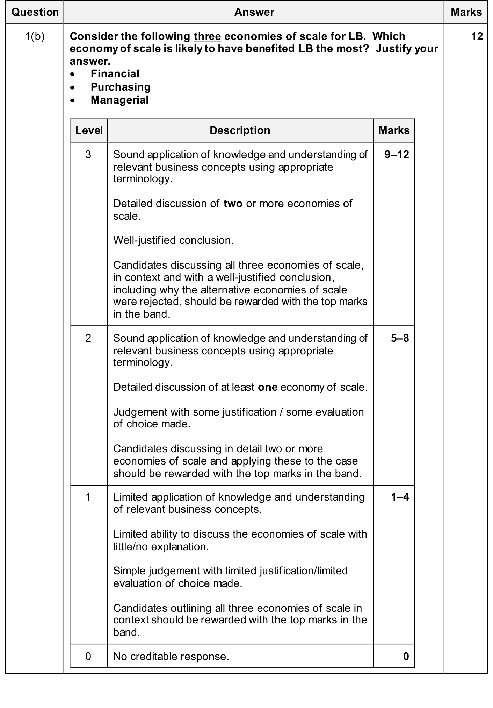
Consider the following three economies of scale for LB. Which 12 economy of scale is likely to have benefited LB the most? Justify your answer.
Financial
Purchasing
Managerial Level Description Marks 3 Sound application of knowledge and understanding of 9–12 relevant business concepts using appropriate terminology. Detailed discussion of two or more economies of scale. Well-justified conclusion. Candidates discussing all three economies of scale, in context and with a well-justified conclusion, including why the alternative economies of scale were rejected, should be rewarded with the top marks in the band. 2 Sound application of knowledge and understanding of 5–8 relevant business concepts using appropriate terminology. Detailed discussion of at least one economy of scale. Judgement with some justification / some evaluation of choice made. Candidates discussing in detail two or more economies of scale and applying these to the case should be rewarded with the top marks in the band. 1 Limited application of knowledge and understanding 1–4 of relevant business concepts. Limited ability to discuss the economies of scale with little/no explanation. Simple judgement with limited justification/limited evaluation of choice made. Candidates outlining all three economies of scale in context should be rewarded with the top marks in the band. 0 No creditable response. 0 Relevant points might include: Financial • Raise finance more easily and cheaply – as lower risk of not repaying debts due to larger size of business
Banks may offer lower interest rates – lower costs of borrowing for the expansion of the large business than if it was a smaller business Purchasing • Bulk buy components – discounts / cheaper prices for bulk purchases – reduces average / unit cost of components
May be able to lower prices – as average cost of each product is lower – becomes more competitive – increases sales of bathroom products – revenue increases Managerial • Specialist managers can be employed – better at their jobs / more knowledgeable as only carried out this task – e.g. marketing manager knows best place to advertise to be more cost efficient
Able to attract the most talented managers – more efficient in manufacturing luxury bathroom products Conclusion Justification might include:
Financial economies of scale will have the greatest effect as LB plans to expand and build a new factory in another country and will probably need to raise some of the finance by borrowing. This will keep down the repayment costs of expanding. LB is already producing on a large scale so the increased benefits from the purchasing and managerial economies may be limited leaving financial economies giving the biggest reduction in unit costs.
Purchasing economies of scale will have the greatest effect on LB’s average costs as it produces bathroom products on a large scale so discounts on components will reduce unit costs by a significant amount, increasing gross profit and profit.
Managerial economies of scale will have the biggest effect on unit costs as all managers will be experienced in producing showers and baths and are specialists in their areas leading to efficiencies in all departments of the business.
Case study: Fun Florals (FF)
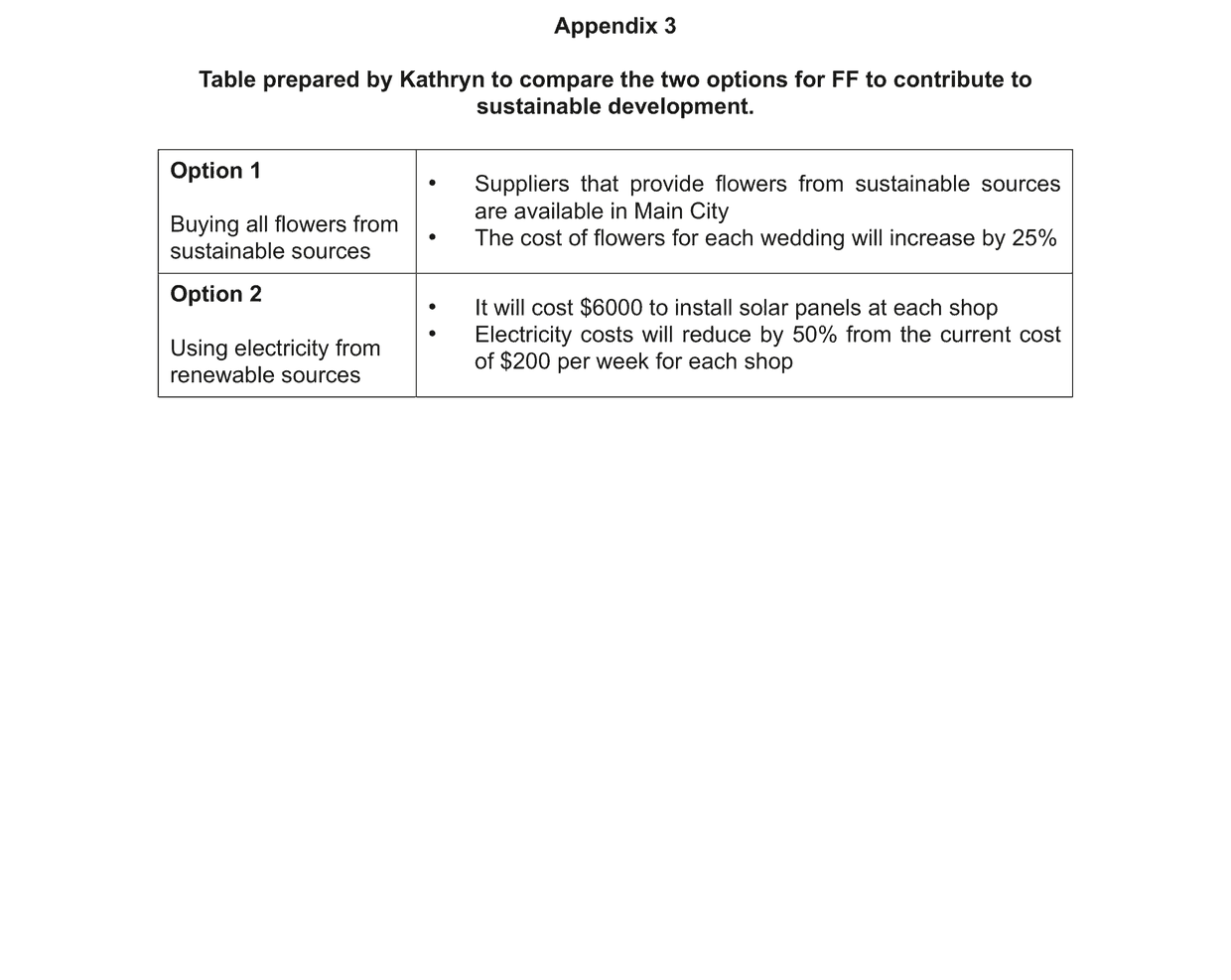
FF is a small business owned by Kathryn. It has 2 small shops in Main City which sell wedding flowers. Each shop has 4 employees. FF has a good reputation for providing high-quality flower arrangements. Most flower shops provide flowers for many occasions, but FF operates in a niche market as it only provides flowers for weddings. The average price customers pay for FF’s wedding flowers is $2000. Kathryn buys flowers from her suppliers every day to ensure that the flowers are fresh and last a long time. She has a good relationship with her suppliers who provide the flowers and other items such as ribbons and packaging materials. Kathryn knows that communication with her suppliers is important. She uses job production for each customer’s order. Kathryn wants to open a larger third shop in the centre of Main City and has written a business plan. She is considering which marketing mix to use for this new shop. FF will need finance for working capital. Kathryn has the choice of using either a bank overdraft or trade credit. Kathryn wants FF to contribute to sustainable development. Many of her customers have told her they are concerned about global warming. Appendix 3 shows information about two ways Kathryn could use to contribute to sustainable development.
Appendix 2 — referenced by Q2(b)
Email to Kathryn from FF’s Marketing Assistant To: Kathryn From: Marketing Assistant Date: 1 October 2025 Hi Kathryn I have outlined a possible marketing mix for the new larger shop in the centre of Main City. Let me know what you think.
Price – using cost-plus pricing for the wedding flowers as we know not all flowers cost the same.
Place – selling some of our flowers through wedding planners (businesses which plan weddings for customers).
Promotion – using television advertising.
Question 1(a)Oct/Nov 20250450/228 marks
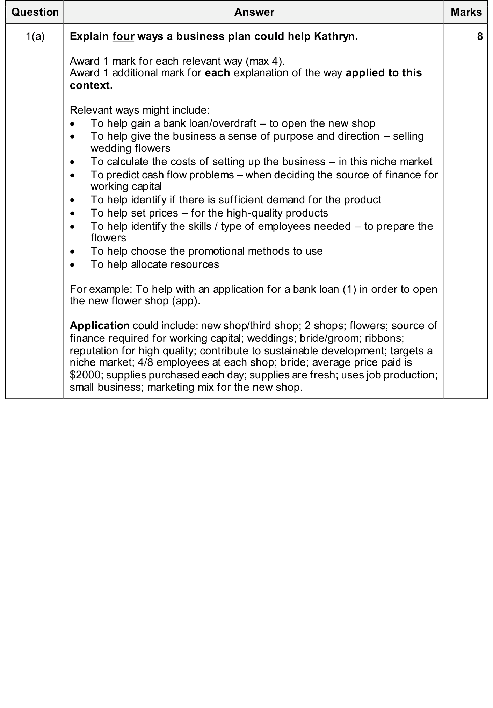
Explain four ways a business plan could help Kathryn. Way 1: Way 2: Way 3: Way 4:
Show mark scheme
Explain four ways a business plan could help Kathryn. 8 Award 1 mark for each relevant way (max 4). Award 1 additional mark for each explanation of the way applied to this context. Relevant ways might include:
To help gain a bank loan/overdraft – to open the new shop
To help give the business a sense of purpose and direction – selling wedding flowers
To calculate the costs of setting up the business – in this niche market
To predict cash flow problems – when deciding the source of finance for working capital
To help identify if there is sufficient demand for the product
To help set prices – for the high-quality products
To help identify the skills / type of employees needed – to prepare the flowers
To help choose the promotional methods to use
To help allocate resources For example: To help with an application for a bank loan (1) in order to open the new flower shop (app). Application could include: new shop/third shop; 2 shops; flowers; source of finance required for working capital; weddings; bride/groom; ribbons; reputation for high quality; contribute to sustainable development; targets a niche market; 4/8 employees at each shop; bride; average price paid is $2000; supplies purchased each day; supplies are fresh; uses job production; small business; marketing mix for the new shop.
Case study: Comfy Rugs (CR)
Charly has worked for a large rug manufacturer in country P for 10 years. She is planning to leave and set up her own business later this year. It will be called CR and will make luxury rugs. She knows that new businesses are at a greater risk of failing than existing businesses. Charly has $10 000 of her own money to invest in a factory to make the rugs. She will also need to apply for a $20 000 bank loan. Charly has to decide which type of business organisation to choose for her new business. She could be a sole trader or set up CR as a private limited company. Charly will need to understand the functions of management required to operate CR whichever type of business organisation she chooses. Charly needs to choose a location for her new factory. Appendix 2 has information about two possible locations. She will have to decide the best location to produce her rugs. Charly forecasts that demand for her rugs will be 20 rugs per week in the first year. Charly must decide the best way to sell her luxury rugs when she starts producing them. The three options for CR are as follows:
selling through CR’s own shop
selling online by setting up a website
selling to a wholesaler which sells rugs to many retailers in country P.
Appendix 1 — not directly referenced by any question in this paper
Email from Charly to her accountant To: Accountant From: Charly Date: 1 February 2025 I have been told that I need to produce a cash flow forecast. This will be important because the rugs are expensive to produce. I will need to hold inventory of raw materials as well as finished rugs before they are sold. Please tell me what to include in the cash inflows and cash outflows in the cash flow forecast. I do not want to run out of cash and have to apply for an overdraft. I already plan to take out a bank loan to set up the factory.
Appendix 3 — referenced by Q4(b)
Newspaper article in Main News, 3 January 2025 The government in country P reduced taxes last year to help the economy to grow. For example, the taxes on people’s incomes decreased by 5% and the taxes on business profits decreased by 2%. The government is concerned that the economy is starting to grow too fast. Banks are increasing their interest rates from 4% to 7%. This will have different effects on different businesses in country P.
---
Question 1(a)Feb/Mar 20250450/228 marks
Explain four reasons why new businesses are at a greater risk of failing than existing businesses. Reason 1: Reason 2: Reason 3: Reason 4:
Show mark scheme
Explain four reasons why new businesses are at a greater risk of failing 8 than existing businesses. Award 1 mark for each relevant reason (max 4). Award a maximum of 1 additional mark for each explanation. There are no application marks available for this question. Relevant reasons might include:
Lacks finance – liquidity/cash flow problems
Poor planning – lack of experience / may not have a business plan
May lack management knowledge – lacks efficiency / not competitive / higher costs
Inadequate research – no effective market research / not identified customer needs
Lack of demand / poor quality product – cannot pay for costs from sales revenue
Difficulties entering a new market – does not have brand loyalty / there is high competition in the market
Difficulty competing with larger established firms in the market – as cannot benefit from economies of scale
Overexpansion – tries to grow too quickly at the start
Unable to respond quickly enough to changes in the external influences – for example not responding to increase in online sales For example: Lacks finance (1) may not have sufficient liquidity to pay current liabilities (1).
91 more questions from 2019–2024
🔒 Unlock every Enterprise, business growth and size question from 2019–2024
All 91 come with their mark schemes, answers and case studies, and appear in the practice tool above once you’re signed in. It’s free.
0450/12 · Oct/Nov 2024 · Question 1(b)Identify two reasons why a business might… 🔒
0450/12 · Oct/Nov 2024 · Question 4(d)Explain two possible diseconomies of scale as… 🔒
0450/13 · Oct/Nov 2024 · Question 2(b)Identify two characteristics of a… 🔒
+ 86 more, by year in the table above
Questions and mark schemes are from past Cambridge papers and are reproduced for revision. Topical Vault is an independent revision resource, not affiliated with or endorsed by Cambridge Assessment International Education.
IGCSE Business questions by topic
Each topic opens this practice tool with only that topic’s questions, plus how often it comes up and every question on it in one list.
Pick a paper, sub-topics and years to draw from (leave any blank for "all"), choose
how many questions you want, and we'll open a new worksheet page with a random set for you to review
and download.