← Topical Vault

Income statements · IGCSE Business

Cambridge 0450, Paper 1 & 2. 1,484 questions, 2019 to 2026.

Topic
Year

Every question begins with its business context — a short case for Paper 1, a full case study (shared across all four questions on that paper) for Paper 2. Mark schemes show the typed marking points alongside a cropped image of the official mark scheme page for exact wording.

About Income statements

The income statement: revenue, cost of sales, gross profit and profit, and how the statement is used to make decisions.

31 past paper questions on this topic since 2019, across 15 exam sessions.

How often it comes up

YearPaper 1Paper 2TotalChart
2026101
2025516
2024123
2023426
2022404
2021303
2020213
2019505

Every 2025–2026 question on Income statements

The whole topic on one page, with answers and mark schemes. Printing this page prints just this list.

Paper 1 · Short answer and structured (6)

Scenario

BTV’s 16 factories use flow production to manufacture cars. Maintaining quality is important. The
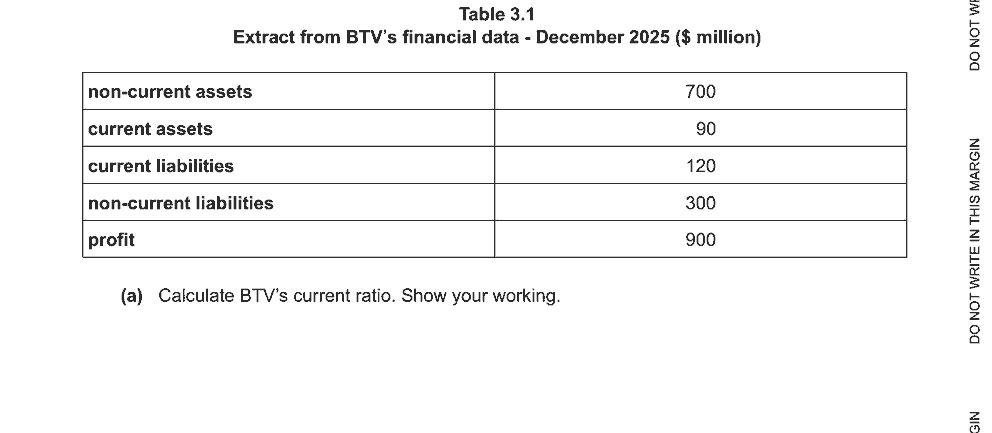
managing director is reviewing BTV’s financial data including profit. An extract is shown in Table 3.1.
She knows there are many external users of accounts who are interested in this data.
Table 3.1
Extract from BTV’s financial data - December 2025 ($ million)
non-current assets 700
current assets 90
current liabilities 120
non-current liabilities 300
profit 900

Case material
Question 3(e)May/Jun 20260450/126 marks

Explain two reasons why profit might be important to a business. Which reason is likely to be the most important? Justify your answer.

Show mark scheme

Explain two reasons why profit might be important to a business. Which reason is likely to be the most important? Justify your answer. Award up to 2 marks for identification of relevant points. Award up to 2 marks for relevant development of points. Award up to 2 marks for justified decision about which reason is likely to be the most important. Points might include:

  • Use as a source of funds / reinvest back into the business [k] as there is no interest to pay [an] AND/OR allowing the business to expand [an]
  • Measure of success [k] as low profit could suggest the business is not worth continuing/starting [an] OR which could help attract investors [an]
  • Reward for risk-taking/return on shareholder/owner’s investment / pay dividends [k] as otherwise they could invest elsewhere [an] OR so keep/ not sell shares / buy more shares [an] AND/OR motivate them to work harder/carry on/earn more [an]
  • Help attract investors [k] as may invest their money in hope of making a return on investment [an] OR allowing the business to grow/expand [an]
  • Allow business to share profit with employees [k] which could increase motivation [an]
  • Help decide whether to continue making/selling a product [k] Other appropriate responses should be credited. Justification might include: It can act as a measure of success [k] as low profit could suggest the business is not worth continuing [an]. It can be used as a source of funds [k] as there is no interest to pay [an]. Providing a source of funds is likely to be the most important reason because by being able to expand it could result in increased profit in the future [eval] which may help ensure there are positive returns for the owners [eval].
Mark scheme, 0450/12 May/Jun 2026 question 3(e) (page 1 of 2)
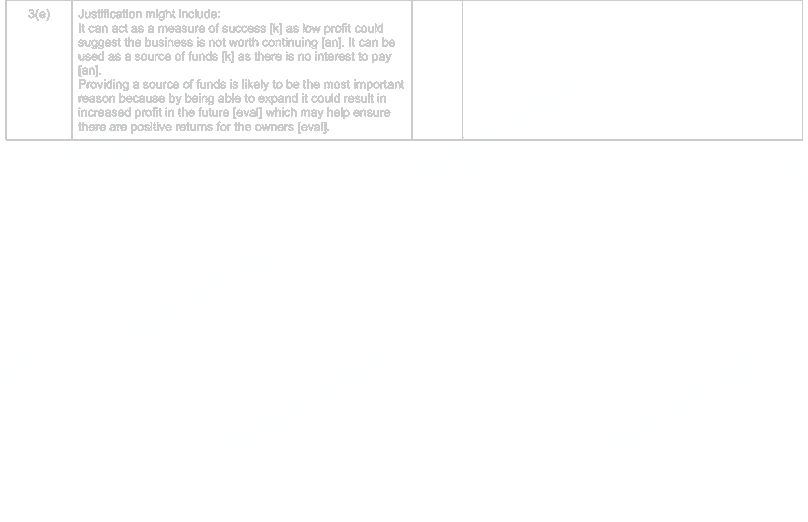
Mark scheme, 0450/12 May/Jun 2026 question 3(e) (page 2 of 2)
Scenario

KPX manufactures computers. The business imports 60% of its raw materials. The Operations
Director is considering ways to use lean production methods in KPX’s factory. The Finance Director
is reviewing KPX’s financial data to calculate the value of its expenses. An extract is shown in Table
1.1.
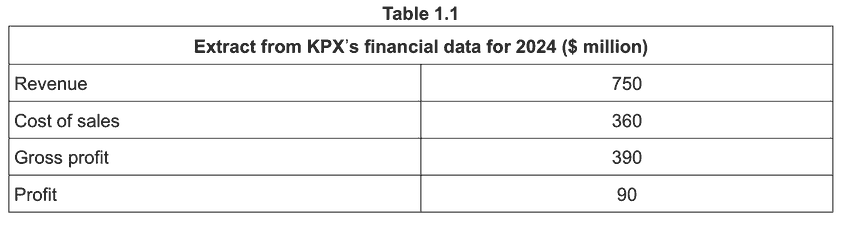
Table 1.1
Extract from KPX’s financial data for 2024 ($ million)
Revenue 750
Cost of sales 360
Gross profit 390
Profit 90

Case material
Question 1(b)Oct/Nov 20250450/132 marks

Calculate KPX’s expenses in 2024. Show your working. Working: Final answer:

Show mark scheme

Calculate KPX’s expenses in 2024. Show your working. Award 2 marks for a correct answer. Award 1 mark for correct method but incorrect answer. Correct answer [2] i.e. $300 million Correct method but incorrect answer e.g.

  • Gross profit – profit [1]
  • $390m – $90m [1] If correct answer given with no working shown, award 2 marks.
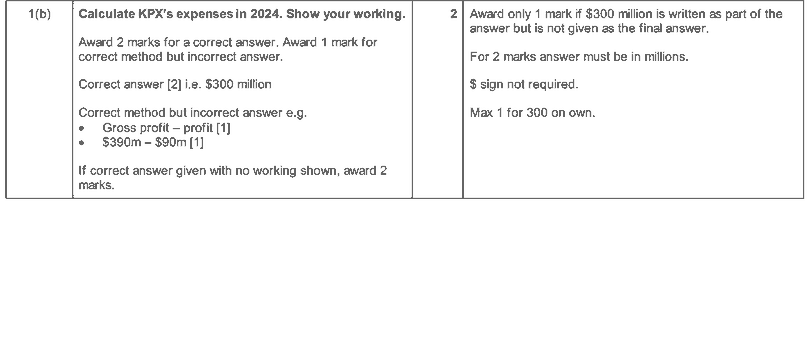
Mark scheme, 0450/13 Oct/Nov 2025 question 1(b)
Question 1(e)Oct/Nov 20250450/136 marks

Explain two reasons why profit is important for a business. Which reason is likely to be the most important? Justify your answer.

Show mark scheme

Explain two reasons why profit is important for a business. Which reason is likely to be the most important? Justify your answer. Award up to 2 marks for identification of relevant points. Award up to 2 marks for relevant development of points. Award up to 2 marks for a justified decision about which reason is likely to be the most important. Points might include:

  • Provides a source of funds [k] as no interest to pay [an]
  • Reward for risk-taking [k] as owners invest their money in hope of making a return on investment / motivate them to continue [an]
  • Represents a return on shareholder/owner’s investment/enterprise [k] as otherwise they could invest elsewhere [an]
  • Help attract investors/finance [k] which could help the business to expand [an]
  • Measure of success [k] as low profit could suggest the business is not worth continuing/starting up [an]
  • Need for long-term survival [k] Other appropriate responses should be credited. Justification might include: It can provide a source of funds [k] for which there is no interest to pay [an]. It is also a reward for risk-taking [k] as owners invest their money in the hope of making a return on their investment [an]. Providing a source of funds is most important because if successful, this could provide the owners with more profit in the future [eval] which may even lead to greater returns for owners [eval].
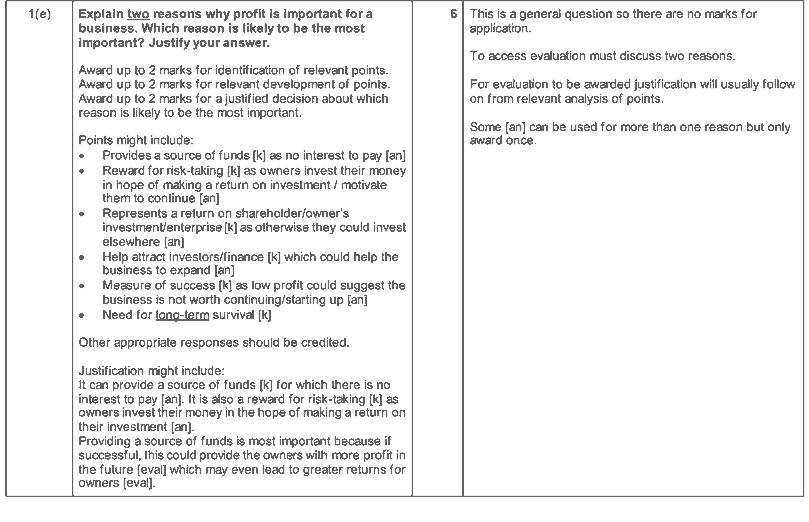
Mark scheme, 0450/13 Oct/Nov 2025 question 1(e)
Scenario

FLD is a furniture retailer. It has 460 shops and 20000 employees. Internal recruitment is used
when recruiting new shop managers. The Managing Director wants to know whether job rotation
is the best method of motivation for a large business to use. The Finance Director is reviewing
FLD’s income statement. An extract is shown in Table 2.1. She is concerned that FLD’s gross profit
is decreasing.
Table 2.1
Extract from FLD’s income statement for year ending April 2025 ($ million)
Revenue 400
Gross profit 200
Expenses 60
Profit 140

Case material
Question 2(a)May/Jun 20250450/122 marks

Define ‘profit’.

Show mark scheme

Define ‘profit’. Award 2 marks for a full definition. Award 1 mark for a partial definition.

  • (Total) income of a business (revenue) less total cost [2]
  • (Total) revenue minus total costs [2]
  • Difference between revenue and total cost [2]
  • Gross profit – expenses [2] Partial definition e.g.
  • Revenue minus costs [1] Other appropriate responses should also be credited.
Mark scheme, 0450/12 May/Jun 2025 question 2(a)
Question 2(b)May/Jun 20250450/122 marks

Identify two expenses a business might have. Expense 1: Expense 2:

Show mark scheme

Identify two expenses a business might have. Award 1 mark for each expense (max 2). Points might include:

  • Rent
  • Rates
  • Electricity/gas/heating/lighting/water/utilities
  • Insurance
  • Interest
  • Storage
  • Marketing/advertising
  • Salaries
  • Maintenance/repairs
  • Phone/internet Other appropriate responses should be credited.
Mark scheme, 0450/12 May/Jun 2025 question 2(b)
Question 2(c)May/Jun 20250450/124 marks

Outline two possible reasons why FLD’s gross profit is decreasing. Reason 1: Reason 2:

Show mark scheme

Outline two possible reasons why FLD’s gross profit is decreasing. Award 1 mark for identification of each relevant reason (max 2). Award 1 mark for each relevant reference to this business (max 2). Points might include:

  • Low/fall in amount of sales/demand/customers [k] at its 460 shops [app]
  • Change in price / increase/decrease (selling) price [k] for the retailer [app]
  • Increase in cost of sales /variable cost / increase in cost of inventory [k] so gross profit is at $200 million [app] Other appropriate responses should be credited.
Mark scheme, 0450/12 May/Jun 2025 question 2(c)

Paper 2 · Case study (1)

Case study: Tennis and Sports Equipment (TSE)

TSE is a successful multinational company. It has its head office in country P. TSE has factories in 10 countries producing its high-quality sports equipment. It sells its products in 30 countries and plans to enter a new market in another country. TSE has many stakeholder groups with different objectives. TSE uses market research in the countries where its products are sold. There are many different sports played in these 30 countries and some sports are popular in only one country. Raw materials, such as plastic and rubber, are used to make the sports equipment. These are often produced near to TSE’s factories. All purchases of raw materials are currently made by the head office in country P. However, TSE’s directors are considering whether to allow the factory managers in each country to purchase raw materials locally. TSE’s Human Resources Director knows that having a well-motivated workforce is important as it reduces absenteeism and lowers labour turnover. Most of TSE’s production employees are skilled and all work full time. Some of TSE’s factories use new technology and have an automated flow production line. However, to remain competitive TSE needs to make sure all of its factories are as efficient as possible. TSE sells 30% of its total output in country P. The directors want to increase market share in country P and plan to take over a competitor. Appendix 3 includes information about two companies TSE could take over.

Appendix 1

Appendix 2 — not directly referenced by any question in this paper

Newspaper article from Main News in country P, 1 May 2025 The country has enjoyed several years of increasing economic growth. However, country P is now moving into the recession stage of the business cycle. Businesses will be affected in either positive ways or negative ways. Unemployment is starting to rise and it is expected this will continue for the next year.

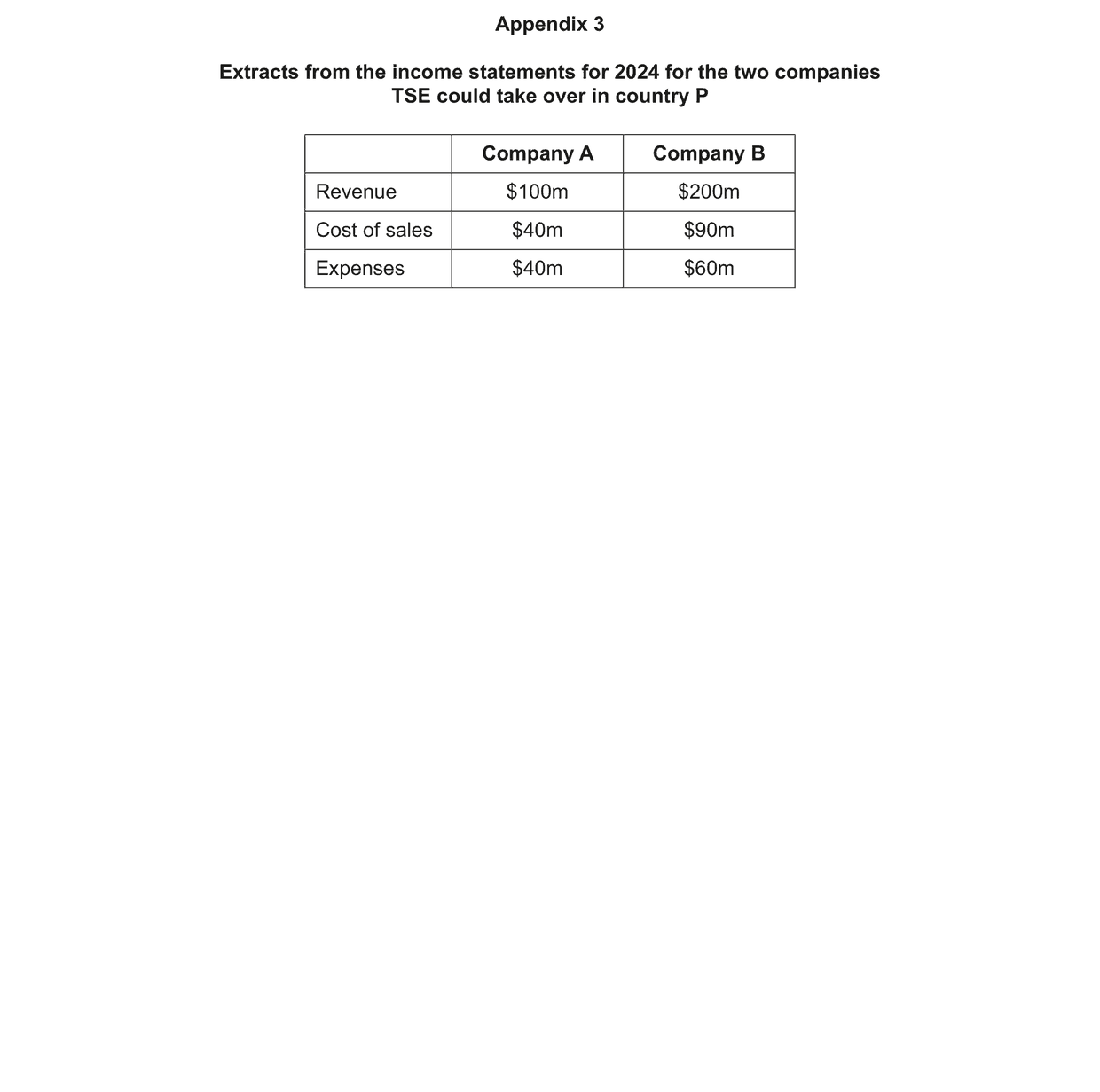
Appendix 3
Question 4(b)May/Jun 20250450/2212 marks

Using Appendix 3 and other information, consider the extracts from the income statements for the two companies in country P. Which company should TSE take over? Justify your answer using suitable calculations. Company A: Company B: Recommendation:

Show mark scheme

Using Appendix 3 and other information, consider the extracts from the 12 income statements for the two companies in country P. Which company should TSE take over? Justify your answer using suitable calculations. Level Description Marks 3 Sound application of knowledge and understanding of 9–12 relevant business concepts using appropriate terminology. Detailed discussion of both companies. Well-justified recommendation. Candidates discussing both companies in detail, in context and with a well-justified recommendation, including why the alternative company was rejected, should be rewarded with the top marks in the band. 2 Sound application of knowledge and understanding of 5–8 relevant business concepts using appropriate terminology. Detailed discussion of one company. Judgement with some justification / some evaluation of choice made. Candidates discussing at least one company in detail and applying it to the case should be rewarded with the top marks in the band. 1 Limited application of knowledge and understanding of 1–4 relevant business concepts. Limited ability to discuss the companies with little/no explanation. Simple judgement with limited justification / limited evaluation of choice made. Candidates outlining the two companies in context should be rewarded with the top marks in the band. 0 No creditable response. 0 Relevant points might include: Simple statements:

  • Company B has twice as much revenue at $200m
  • Company A has less revenue than Company B
  • Company A has less than half the cost of sales, a difference of $50m
  • Company B has higher cost of sales at $90m
  • The expenses are less than twice as much for Company B at $60m
  • Lower revenue means that Company A is probably smaller than Company B Possible calculations:
  • The gross profit of Company A is $60m
  • The gross profit margin of Company A is 60%
  • The gross profit of Company B is $110m
  • The gross profit margin of Company B is 55%
  • The profit of Company A is $20m
  • The profit margin of Company A is 20%
  • The profit of Company B is $50m
  • The profit margin of Company B is 25% Justification might include:
  • TSE should take over Company A because it has a 5% higher gross profit margin than Company B. This suggests that it is more efficient in its management of variable costs. It is a smaller competitor as its revenue is lower at $100m and therefore it could require a lower amount of capital to take over the company. It should not take over Company B as TSE may need to borrow a much higher amount of capital as the company appears to be larger.
  • TSE should take over Company B because it has much higher revenue suggesting it is a larger competitor than Company A and will better help TSE to achieve the aim of increasing its market share and it has a 5% higher profit margin than Company A.
Mark scheme, 0450/22 May/Jun 2025 question 4(b) (page 1 of 2)
Mark scheme, 0450/22 May/Jun 2025 question 4(b) (page 2 of 2)

24 more questions from 2019–2024

🔒 Unlock every Income statements question from 2019–2024

All 24 come with their mark schemes, answers and case studies, and appear in the practice tool above once you’re signed in. It’s free.

Create a free accountSign in

A few of them

  • 0450/23 · Oct/Nov 2024 · Question 4(b)Consider the two extracts from SA’s income… 🔒
  • 0450/13 · May/Jun 2024 · Question 2(a)Define… 🔒
  • 0450/22 · May/Jun 2024 · Question 3(a)Explain four reasons why profit is important… 🔒
  • 0450/11 · Oct/Nov 2023 · Question 3(e)Do you think making a profit is… 🔒
  • 0450/12 · Oct/Nov 2023 · Question 1(b)Calculate the average revenue… 🔒
  • + 19 more, by year in the table above

Questions and mark schemes are from past Cambridge papers and are reproduced for revision. Topical Vault is an independent revision resource, not affiliated with or endorsed by Cambridge Assessment International Education.

IGCSE Business questions by topic

Each topic opens this practice tool with only that topic’s questions, plus how often it comes up and every question on it in one list.

  1. Ch 1Business activity
  2. Ch 2Classification of businesses
  3. Ch 3Enterprise, business growth and size
  4. Ch 4Types of business organisation
  5. Ch 5Business objectives and stakeholder objectives
  6. Ch 6Motivating employees
  7. Ch 7Organisation and management
  8. Ch 8Recruitment, selection and training of employees
  9. Ch 9Internal and external communication
  10. Ch 10Marketing, competition and the customer
  11. Ch 11Market research
  12. Ch 12The marketing mix: product
  13. Ch 13The marketing mix: price
  14. Ch 14The marketing mix: place
  15. Ch 15The marketing mix: promotion
  16. Ch 16Technology and the marketing mix
  17. Ch 17Marketing strategy
  18. Ch 18Production of goods and services
  19. Ch 19Costs, scale of production and break-even analysis
  20. Ch 20Achieving quality production
  21. Ch 21Location decisions
  22. Ch 22Business finance: needs and sources
  23. Ch 23Cash flow forecasting and working capital
  24. Ch 24Income statements
  25. Ch 25Statement of financial position
  26. Ch 26Analysis of accounts
  27. Ch 27Economic issues
  28. Ch 28Environmental and ethical issues
  29. Ch 29Business and the international economy