← Topical Vault

Technology and the marketing mix · IGCSE Business

Cambridge 0450, Paper 1 & 2. 1,484 questions, 2019 to 2026.

Topic
Year

Every question begins with its business context — a short case for Paper 1, a full case study (shared across all four questions on that paper) for Paper 2. Mark schemes show the typed marking points alongside a cropped image of the official mark scheme page for exact wording.

About Technology and the marketing mix

How technology affects the marketing mix: e-commerce, social media and online promotion.

19 past paper questions on this topic since 2020, across 12 exam sessions.

How often it comes up

YearPaper 1Paper 2TotalChart
2026101
2025213
2024224
2023112
2022426
2021101
2020202

Every 2025–2026 question on Technology and the marketing mix

The whole topic on one page, with answers and mark schemes. Printing this page prints just this list.

Paper 1 · Short answer and structured (3)

Scenario

Amina is an entrepreneur. She plans to start up a business selling pens and paper and has collected some market research data. Amina has decided to sell her products using ecommerce. She is considering different methods of advertising to use for her pens and paper. Amina wants to know why some businesses remain small.

Question 2(b)May/Jun 20260450/122 marks

Define ‘ecommerce’.

Show mark scheme

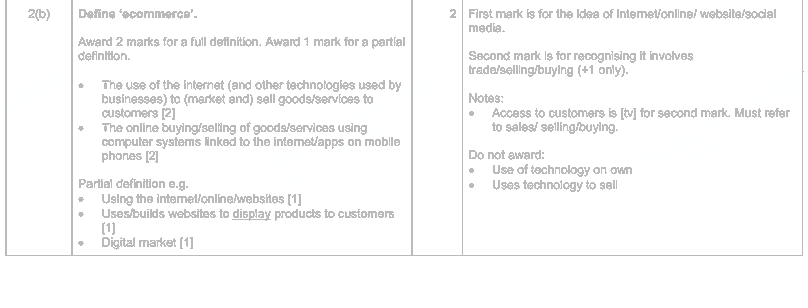
Define ‘ecommerce’. Award 2 marks for a full definition. Award 1 mark for a partial definition.

  • The use of the internet (and other technologies used by businesses) to (market and) sell goods/services to customers [2]
  • The online buying/selling of goods/services using computer systems linked to the internet/apps on mobile phones [2] Partial definition e.g.
  • Using the internet/online/websites [1]
  • Uses/builds websites to display products to customers [1]
  • Digital market [1]
Mark scheme, 0450/12 May/Jun 2026 question 2(b)
Question 2(e)Oct/Nov 20250450/126 marks

Explain two threats to a business of using ecommerce. Which threat is likely to be the most important? Justify your answer.

Show mark scheme

Explain two threats to a business of using ecommerce. Which threat is likely to be the most important? Justify your answer. Award up to 2 marks for identification of relevant points. Award up to 2 marks for relevant development of points. Award up to 2 marks for a justified decision as to which threat is likely to be most important to a business. Points might include:

  • Increased/more competition [k] so may have to set lower prices (to compete) / may have to spend more on advertising/promotion [an]
  • Need to design/build website [k] which increases costs [an]
  • Time/cost for maintenance/updating of the website [k] so may need to employ someone to do this [an]
  • No face-to-face contact with customer / suppliers / lack of personal service [k] so difficult to gain feedback [an] AND/OR may be difficult to build customer loyalty / supplier relationships / [an]
  • Need to deliver the products to customers [k] increasing transport/postage costs [an] leading to lower profit margin [an]
  • Technical problems/no power [k] so may lose potential sales [an]
  • Security threats / risk of hacking / computer viruses / data theft/fraud / scams [k] which could damage its reputation [an] AND/OR reduce customer loyalty [an]
  • Risk of bad reviews [k] lowering sales AND/OR revenue [an]
  • High level of returns [k] Other appropriate responses should be credited. Justification might include: One threat is an increase in competition [k] so may have to set lower prices (to compete) [an]. Another threat is technical problems [k] so the business may lose potential sales [an]. Technical problems are likely to be the most important threat because if customers cannot access the website setting a lower price may be ineffective [eval] so gaining any revenue could be difficult to achieve. [eval].
Mark scheme, 0450/12 Oct/Nov 2025 question 2(e)
Scenario

Max is an entrepreneur who wants to start up a business selling books. He has decided to use ecommerce. Max has been told there is government support for start-up businesses. He will use market research to help make business decisions. Max knows it is important for a new business to build customer loyalty.

Question 2(c)Oct/Nov 20250450/134 marks

Outline two opportunities for Max’s business of using ecommerce. Opportunity 1: Opportunity 2:

Show mark scheme

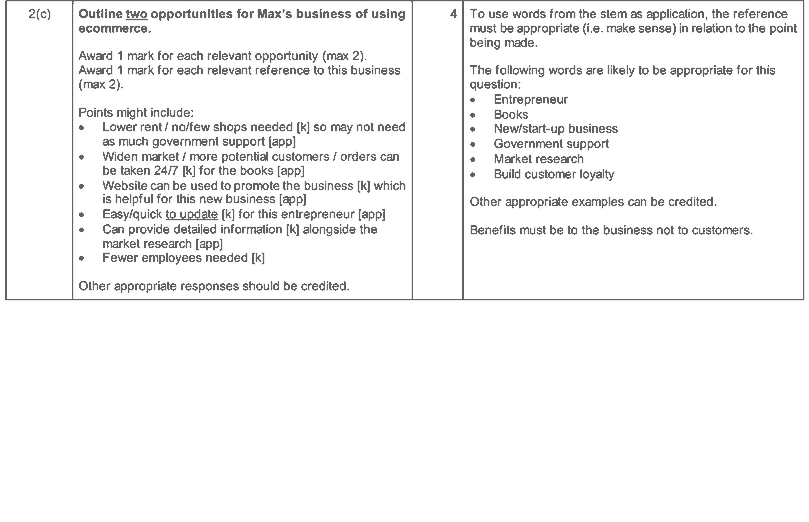
Outline two opportunities for Max’s business of using ecommerce. Award 1 mark for each relevant opportunity (max 2). Award 1 mark for each relevant reference to this business (max 2). Points might include:

  • Lower rent / no/few shops needed [k] so may not need as much government support [app]
  • Widen market / more potential customers / orders can be taken 24/7 [k] for the books [app]
  • Website can be used to promote the business [k] which is helpful for this new business [app]
  • Easy/quick to update [k] for this entrepreneur [app]
  • Can provide detailed information [k] alongside the market research [app]
  • Fewer employees needed [k] Other appropriate responses should be credited.
Mark scheme, 0450/13 Oct/Nov 2025 question 2(c)

Paper 2 · Case study (1)

Case study: Exceptional Sailing (ES)

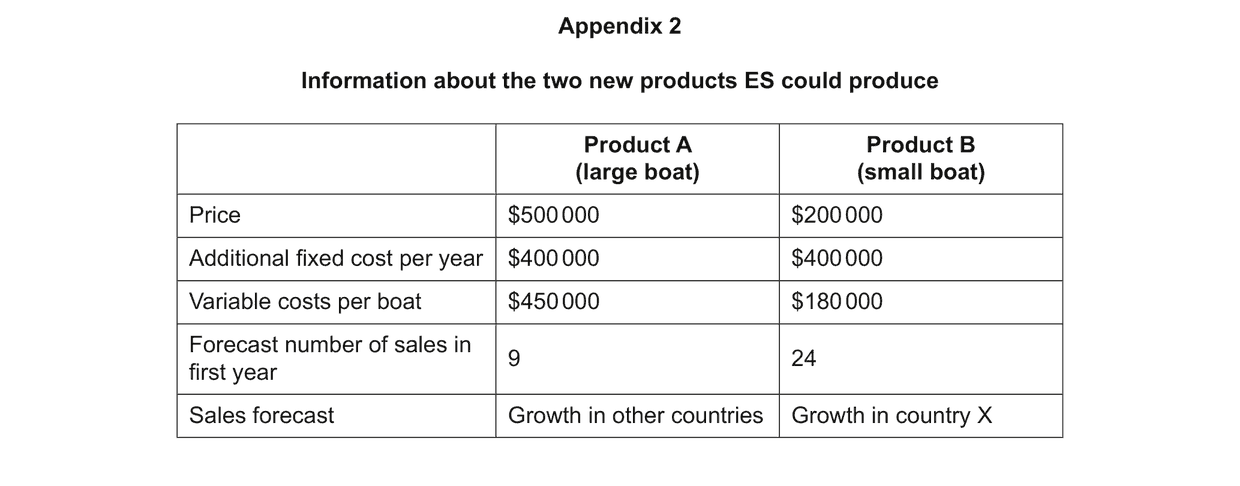
Tim worked at a large boat manufacturer in country X for 20 years. He is highly skilled in building boats. Tim decided to start his own business, called ES, 4 years ago. He currently operates as a sole trader. ES only makes and sells boats in country X. It has become established as a well-known brand with a reputation for high quality. ES has 12 skilled employees including an assistant who helps Tim to run the business. ES has a flat organisational structure with a short chain of command. ES has grown quickly and Tim plans to expand the business further by selling his boats to customers in other countries. He is aware that there are opportunities and threats of globalisation, especially as tariffs and quotas on boats and their component parts have been removed both in country X and in other countries. Tim plans to take out a bank loan to help fund the expansion. His two brothers will also invest in the business. One of his brothers has experience of financial management and the other is skilled in IT. Tim will need to decide whether ES should become a partnership or a private limited company. Tim wants to manufacture a new boat and he will need to choose between Product A and Product B. Information about the two new boats is shown in Appendix 2. ES currently promotes its boats in sailing magazines. Tim is considering using social media to promote his new boat to a wider market. Tim will need to recruit 4 new employees. These new employees will require training and Tim has to decide whether to train them at ES or send them to college two days a week.

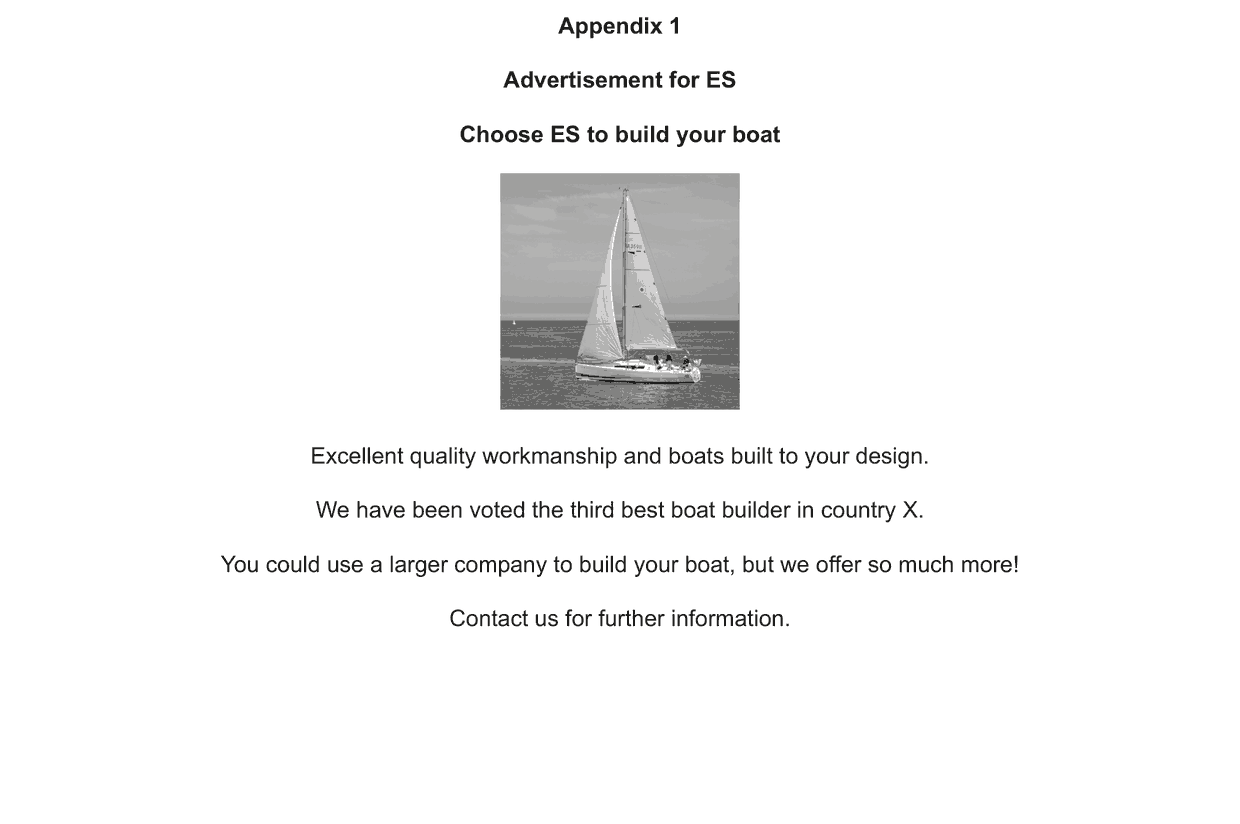
Appendix 1
Appendix 2

Appendix 3 — referenced by Q4(a)

Email from Tim to his two brothers To: My two brothers From: Tim Date: 1 October 2025 I am pleased that you have both decided to invest in the business. I know that it will be good to work together and make decisions about the growth of ES. I have included some financial information for 2024.

  • Revenue increased by 50%
  • Gross profit margin was 65%
  • Profit was $100 000
  • Current ratio was 2
  • Acid test ratio was 0.5

---

Question 3(a)Oct/Nov 20250450/238 marks

Explain four benefits to a business of using social media as its method of promotion. Benefit 1: Benefit 2: Benefit 3: Benefit 4:

Show mark scheme

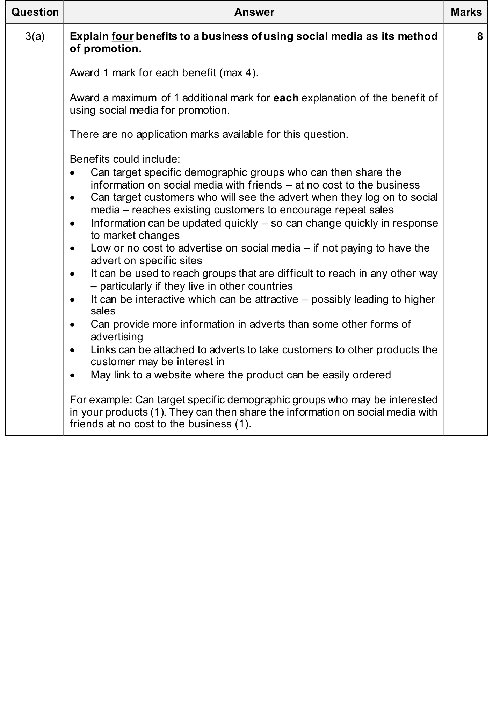
Explain four benefits to a business of using social media as its method 8 of promotion. Award 1 mark for each benefit (max 4). Award a maximum of 1 additional mark for each explanation of the benefit of using social media for promotion. There are no application marks available for this question. Benefits could include:

  • Can target specific demographic groups who can then share the information on social media with friends – at no cost to the business
  • Can target customers who will see the advert when they log on to social media – reaches existing customers to encourage repeat sales
  • Information can be updated quickly – so can change quickly in response to market changes
  • Low or no cost to advertise on social media – if not paying to have the advert on specific sites
  • It can be used to reach groups that are difficult to reach in any other way – particularly if they live in other countries
  • It can be interactive which can be attractive – possibly leading to higher sales
  • Can provide more information in adverts than some other forms of advertising
  • Links can be attached to adverts to take customers to other products the customer may be interest in
  • May link to a website where the product can be easily ordered For example: Can target specific demographic groups who may be interested in your products (1). They can then share the information on social media with friends at no cost to the business (1).
Mark scheme, 0450/23 Oct/Nov 2025 question 3(a)

15 more questions from 2020–2024

🔒 Unlock every Technology and the marketing mix question from 2020–2024

All 15 come with their mark schemes, answers and case studies, and appear in the practice tool above once you’re signed in. It’s free.

Create a free accountSign in

A few of them

  • 0450/11 · Oct/Nov 2024 · Question 2(e)Do you think the opportunities of ecommerce… 🔒
  • 0450/12 · May/Jun 2024 · Question 2(d)Explain two advantages to GTB of using… 🔒
  • 0450/21 · May/Jun 2024 · Question 2(b)Consider the following three ways EP could… 🔒
  • 0450/22 · May/Jun 2024 · Question 3(b)Consider the opportunities and threats of ecommerce… 🔒
  • 0450/11 · Oct/Nov 2023 · Question 2(e)Do you think social media is the… 🔒
  • + 10 more, by year in the table above

Questions and mark schemes are from past Cambridge papers and are reproduced for revision. Topical Vault is an independent revision resource, not affiliated with or endorsed by Cambridge Assessment International Education.

IGCSE Business questions by topic

Each topic opens this practice tool with only that topic’s questions, plus how often it comes up and every question on it in one list.

  1. Ch 1Business activity
  2. Ch 2Classification of businesses
  3. Ch 3Enterprise, business growth and size
  4. Ch 4Types of business organisation
  5. Ch 5Business objectives and stakeholder objectives
  6. Ch 6Motivating employees
  7. Ch 7Organisation and management
  8. Ch 8Recruitment, selection and training of employees
  9. Ch 9Internal and external communication
  10. Ch 10Marketing, competition and the customer
  11. Ch 11Market research
  12. Ch 12The marketing mix: product
  13. Ch 13The marketing mix: price
  14. Ch 14The marketing mix: place
  15. Ch 15The marketing mix: promotion
  16. Ch 16Technology and the marketing mix
  17. Ch 17Marketing strategy
  18. Ch 18Production of goods and services
  19. Ch 19Costs, scale of production and break-even analysis
  20. Ch 20Achieving quality production
  21. Ch 21Location decisions
  22. Ch 22Business finance: needs and sources
  23. Ch 23Cash flow forecasting and working capital
  24. Ch 24Income statements
  25. Ch 25Statement of financial position
  26. Ch 26Analysis of accounts
  27. Ch 27Economic issues
  28. Ch 28Environmental and ethical issues
  29. Ch 29Business and the international economy