← Topical Vault

The marketing mix: price · IGCSE Business

Cambridge 0450, Paper 1 & 2. 1,484 questions, 2019 to 2026.

Topic
Year

Every question begins with its business context — a short case for Paper 1, a full case study (shared across all four questions on that paper) for Paper 2. Mark schemes show the typed marking points alongside a cropped image of the official mark scheme page for exact wording.

About The marketing mix: price

Pricing methods such as cost-plus, competitive, penetration, skimming and promotional pricing, and price elasticity of demand.

24 past paper questions on this topic since 2019, across 15 exam sessions.

How often it comes up

YearPaper 1Paper 2TotalChart
2026011
2025303
2024213
2023011
2022314
2021314
2020202
2019516

Every 2025–2026 question on The marketing mix: price

The whole topic on one page, with answers and mark schemes. Printing this page prints just this list.

Paper 1 · Short answer and structured (3)

Scenario

Miguel plans to start up a gym (sports club). It will offer a range of fitness classes including yoga. The business will be a partnership with his sister. Miguel thinks the size of the business will remain small. Secondary market research will be used to help make decisions including which pricing method to use. Miguel knows it is important for a new business to select a suitable location.

Question 3(c)Oct/Nov 20250450/124 marks

Outline two pricing methods Miguel could use. Method 1: Method 2:

Show mark scheme

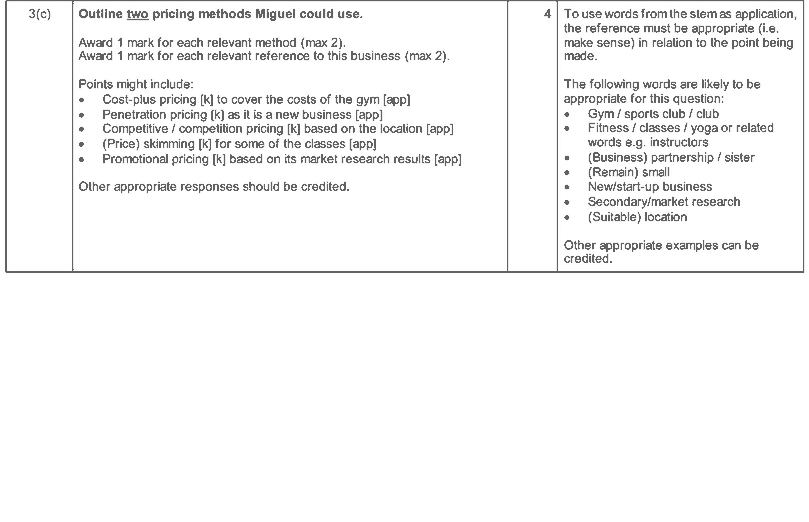
Outline two pricing methods Miguel could use. Award 1 mark for each relevant method (max 2). Award 1 mark for each relevant reference to this business (max 2). Points might include:

  • Cost-plus pricing [k] to cover the costs of the gym [app]
  • Penetration pricing [k] as it is a new business [app]
  • Competitive / competition pricing [k] based on the location [app]
  • (Price) skimming [k] for some of the classes [app]
  • Promotional pricing [k] based on its market research results [app] Other appropriate responses should be credited.
Mark scheme, 0450/12 Oct/Nov 2025 question 3(c)
Scenario

Brendan wants to be a successful entrepreneur. He plans to start up a flower shop using government support. Brendan’s brother has offered to form a business partnership with him. Brendan knows it is important for a new business to use a suitable pricing method. He has already identified ways the business can increase added value. Brendan wants to know how an economic boom might affect his business.

Question 1(e)May/Jun 20250450/116 marks

Explain two pricing methods a new business might use. Which is likely to be the best method to use? Justify your answer.

Show mark scheme

Explain two pricing methods a new business might use. Which is likely to be the best method to use? Justify your answer. Award up to 2 marks for identification of relevant points. Award up to 2 marks for relevant development of points. Award up to 2 marks for a justified decision as to which is the best pricing method for a new business to use. Points might include:

  • Cost-plus [k] by adding a percentage onto the costs of production [an] it is easy to calculate [an]
  • Penetration pricing [k] setting a lower price than competitors [an] could attract customers [an]
  • Competitive pricing [k] setting a price similar/just below competitors [an] which may not cover costs [an]
  • Price skimming [k] allows the business to recover development costs quicker [an] may lead to low sales [an]
  • Promotional pricing [k] Other appropriate responses should be credited. Justification might include: Cost-plus pricing [k] is easy to calculate [an]. Price skimming [k] allows the business to recover development costs quickly [an]. Cost-plus pricing is the best method as the business will make profit on each item sold [eval] whereas with price skimming they may not attract customers to their new business [eval].
Mark scheme, 0450/11 May/Jun 2025 question 1(e)
Scenario

MDZ manufactures a range of chocolate bars. It has 300 employees. MDZ purchases its ingredients from suppliers in the local area. Acting in an ethical way with its stakeholder groups is important. MDZ has products at different stages of the product life cycle. The business is also developing a new product. The Marketing Director needs to make decisions about the packaging and the price of the new product. She knows it is important for a business to use a suitable method of sales promotion for a new product.

Question 1(c)May/Jun 20250450/134 marks

Outline two factors MDZ’s Marketing Director should consider when deciding the price of the new product. Factor 1: Factor 2:

Show mark scheme

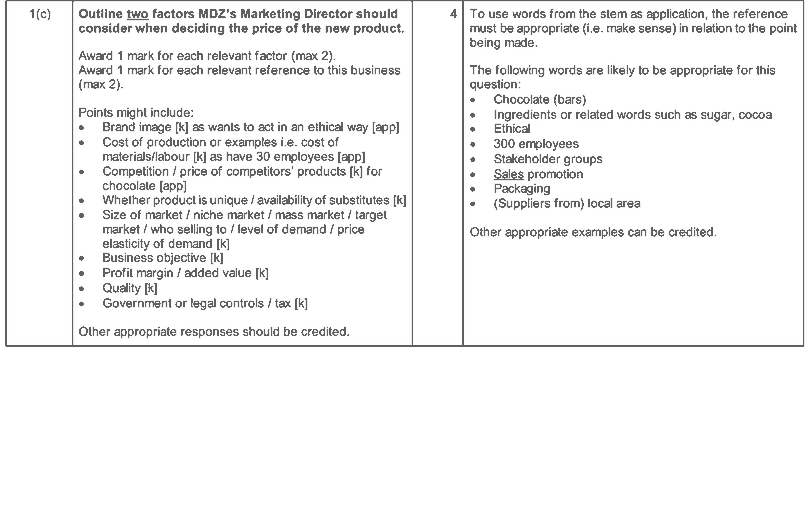
Outline two factors MDZ’s Marketing Director should consider when deciding the price of the new product. Award 1 mark for each relevant factor (max 2). Award 1 mark for each relevant reference to this business (max 2). Points might include:

  • Brand image [k] as wants to act in an ethical way [app]
  • Cost of production or examples i.e. cost of materials/labour [k] as have 30 employees [app]
  • Competition / price of competitors’ products [k] for chocolate [app]
  • Whether product is unique / availability of substitutes [k]
  • Size of market / niche market / mass market / target market / who selling to / level of demand / price elasticity of demand [k]
  • Business objective [k]
  • Profit margin / added value [k]
  • Quality [k]
  • Government or legal controls / tax [k] Other appropriate responses should be credited.
Mark scheme, 0450/13 May/Jun 2025 question 1(c)

Paper 2 · Case study (1)

Case study: Coffee, Tea and Desserts (CTD)

Nadia started CTD 4 years ago in the centre of Main City. CTD is a successful café that sells coffee, tea and desserts. Nadia operates as a sole trader. When she opened her café she wanted the business to remain small. Nadia has 3 employees serving customers in the café. CTD has a reputation for selling high-quality desserts. Nadia has 8 employees making the desserts in the café kitchen. Each worker carries out a task and then passes the part-finished product on to the next employee until the dessert is finished. Nadia knows that CTD’s good reputation could be lost if the high quality of her desserts is not maintained. Nadia is considering the best way to continue to produce high-quality desserts in her kitchen. Nadia uses cost-plus pricing for all the food and drinks CTD sells. She knows promotion is important for CTD as she wants to encourage new customers and create brand loyalty amongst her existing customers. Most of CTD’s customers are people working or shopping in the city centre who walk past the café. Nadia is now planning to expand and open a second café in Main City. Nadia is considering whether to set up a new café or to take over a competitor’s café. Nadia is recruiting a café manager for the second café whichever option she chooses. She has three applicants to choose between. Information about these applicants is shown in Appendix 3.

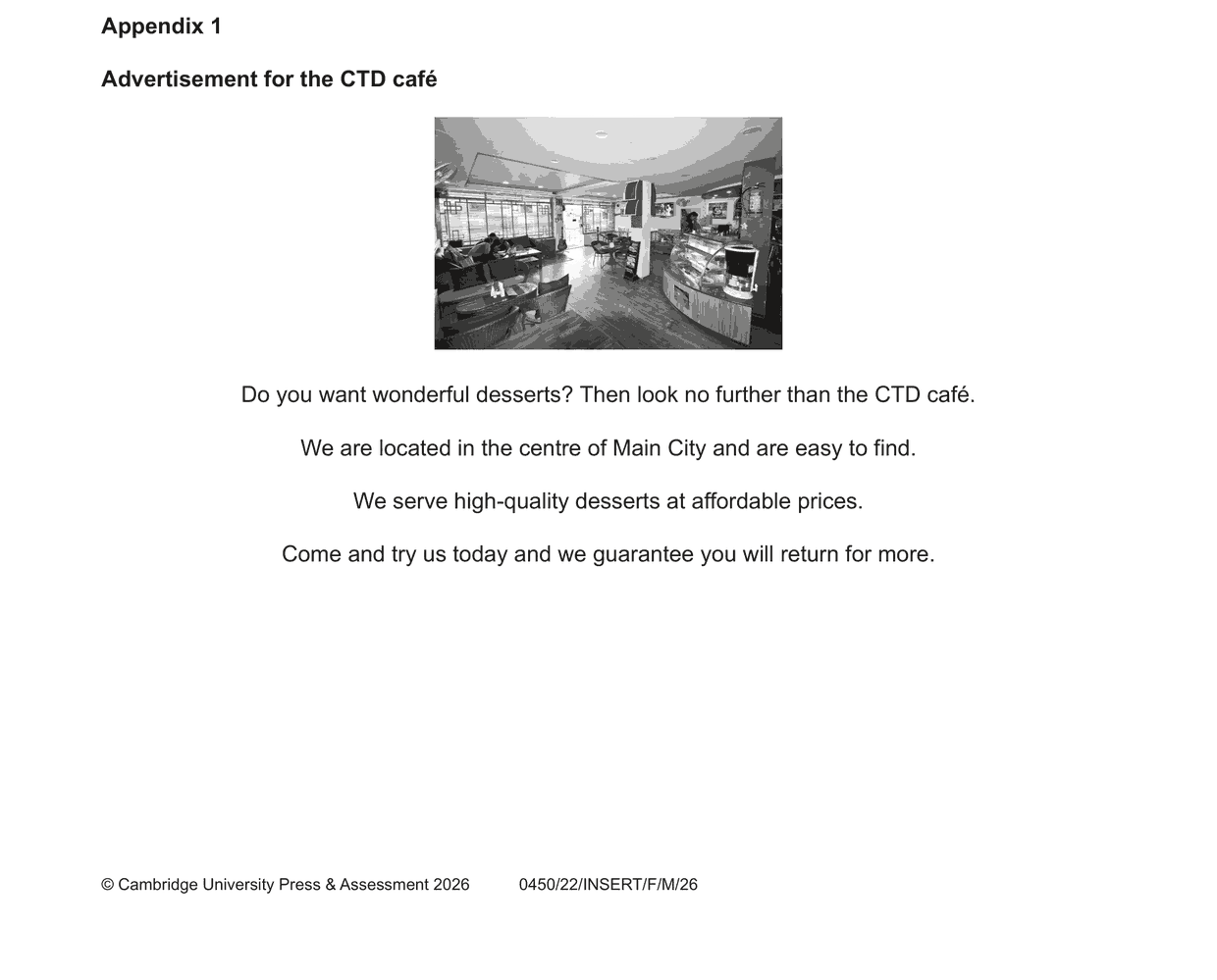
Appendix 1

Appendix 2 — not directly referenced by any question in this paper

Email from Nadia’s accountant to Nadia To: Nadia From: Nadia’s accountant Date: 1 February 2026 Hi Nadia I have reviewed CTD’s accounts and assessed the short-term and long-term financial needs of the business. I have noticed that at certain times of the year the café has a cash flow problem. You need to carefully plan when to buy ingredients for the café. Have you thought about asking for trade credit from your suppliers? I know you plan to expand the business by opening a second café in Main City. Please be aware that the government will increase interest rates from 2% to 6% in the next two months.

Appendix 3
Question 2(a)Feb/Mar 20260450/228 marks

Explain two advantages and two disadvantages for CTD of using cost-plus pricing. advantage 1 advantage 2 disadvantage 1 disadvantage 2

Show mark scheme

Explain two advantages and two disadvantages for CTD of using cost- 8 plus pricing. Award 1 mark for each advantage / disadvantage (max 4). Award a maximum of 1 additional mark for each explanation applied to the business. Advantages might include:

  • The method is easy to apply – when producing desserts
  • Different profit mark-ups can be used for different products in the café
  • Each product earns a profit for the business
  • Ensures costs are covered. Disadvantages might include:
  • Sales could be lost if the price is higher than competitors’ price – for the high-quality products
  • A total profit for the business overall will only be made if sufficient individual products are sold – by the sole trader
  • There is no incentive to reduce costs / higher costs are just passed on to the customer
  • Does not take account of market demand. For example: The method is easy to apply (1) to producing desserts (app). Application could include: café; 8 production employees; work in the kitchen; desserts; high-quality products; good reputation; food and drinks; set-up 4 years ago; tea / coffee; sole trader; 3 employees serving customers; expand to a second café; interest rates increasing from 2% to 6%; create brand loyalty.
Mark scheme, 0450/22 Feb/Mar 2026 question 2(a)

20 more questions from 2019–2024

🔒 Unlock every The marketing mix: price question from 2019–2024

All 20 come with their mark schemes, answers and case studies, and appear in the practice tool above once you’re signed in. It’s free.

Create a free accountSign in

A few of them

  • 0450/11 · Oct/Nov 2024 · Question 3(e)Do you think increasing prices is the… 🔒
  • 0450/21 · Oct/Nov 2024 · Question 4(b)Consider the following three pricing methods CC… 🔒
  • 0450/11 · May/Jun 2024 · Question 4(c)Outline one advantage and one disadvantage to… 🔒
  • 0450/23 · Oct/Nov 2023 · Question 2(b)Consider the following three pricing methods Benjy… 🔒
  • 0450/12 · Oct/Nov 2022 · Question 2(d)Explain two possible reasons why demand for… 🔒
  • + 15 more, by year in the table above

Questions and mark schemes are from past Cambridge papers and are reproduced for revision. Topical Vault is an independent revision resource, not affiliated with or endorsed by Cambridge Assessment International Education.

IGCSE Business questions by topic

Each topic opens this practice tool with only that topic’s questions, plus how often it comes up and every question on it in one list.

  1. Ch 1Business activity
  2. Ch 2Classification of businesses
  3. Ch 3Enterprise, business growth and size
  4. Ch 4Types of business organisation
  5. Ch 5Business objectives and stakeholder objectives
  6. Ch 6Motivating employees
  7. Ch 7Organisation and management
  8. Ch 8Recruitment, selection and training of employees
  9. Ch 9Internal and external communication
  10. Ch 10Marketing, competition and the customer
  11. Ch 11Market research
  12. Ch 12The marketing mix: product
  13. Ch 13The marketing mix: price
  14. Ch 14The marketing mix: place
  15. Ch 15The marketing mix: promotion
  16. Ch 16Technology and the marketing mix
  17. Ch 17Marketing strategy
  18. Ch 18Production of goods and services
  19. Ch 19Costs, scale of production and break-even analysis
  20. Ch 20Achieving quality production
  21. Ch 21Location decisions
  22. Ch 22Business finance: needs and sources
  23. Ch 23Cash flow forecasting and working capital
  24. Ch 24Income statements
  25. Ch 25Statement of financial position
  26. Ch 26Analysis of accounts
  27. Ch 27Economic issues
  28. Ch 28Environmental and ethical issues
  29. Ch 29Business and the international economy