← Topical Vault

Location decisions · IGCSE Business

Cambridge 0450, Paper 1 & 2. 1,484 questions, 2019 to 2026.

Topic
Year

Every question begins with its business context — a short case for Paper 1, a full case study (shared across all four questions on that paper) for Paper 2. Mark schemes show the typed marking points alongside a cropped image of the official mark scheme page for exact wording.

About Location decisions

Factors that influence where a business locates, nationally and internationally, and the role of legal controls on location.

33 past paper questions on this topic since 2019, across 20 exam sessions.

How often it comes up

YearPaper 1Paper 2TotalChart
2026112
2025336
2024415
2023123
2022415
2021224
2020426
2019022

Every 2025–2026 question on Location decisions

The whole topic on one page, with answers and mark schemes. Printing this page prints just this list.

Paper 1 · Short answer and structured (4)

Scenario

KYX is a public limited company. It manufactures beds in country Y. The business holds a high
level of inventory. Country Y has experienced economic growth and demand for KYX’s beds
increased by 30% last year. The operations manager is reviewing KYX’s output data as he wants
to calculate the margin of safety. An extract from KYX’s output data is shown in Table 3.1. KYX’s
managing director plans to open another factory in country Y and knows there are many location
factors to consider. She will also need to decide on an external source of finance to fund the new
factory.
Table 3.1
Extract from KYX’s output data (units)
current output 13000
break-even level of output 10000

Case material
Question 3(e)Feb/Mar 20260450/126 marks

Explain two factors a manufacturing business should consider when deciding on a suitable location for a new factory. Which factor is likely to be the most important? Justify your answer.

Show mark scheme

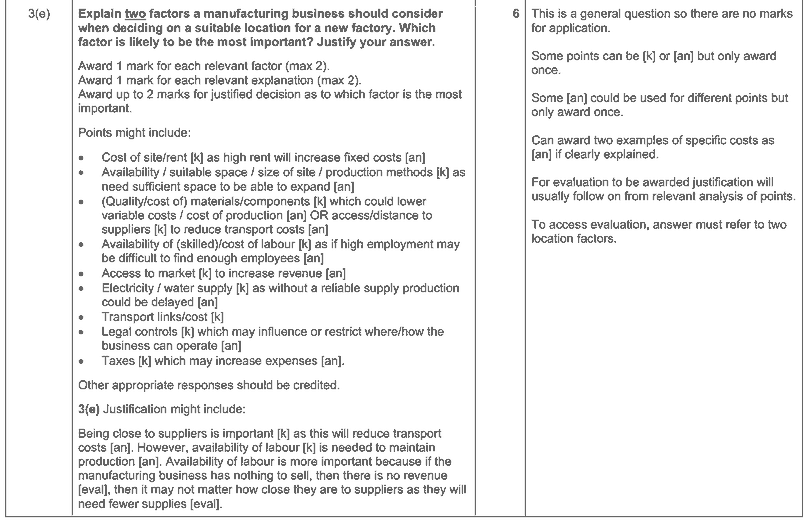
Explain two factors a manufacturing business should consider when deciding on a suitable location for a new factory. Which factor is likely to be the most important? Justify your answer. Award 1 mark for each relevant factor (max 2). Award 1 mark for each relevant explanation (max 2). Award up to 2 marks for justified decision as to which factor is the most important. Points might include:

  • Cost of site/rent [k] as high rent will increase fixed costs [an]
  • Availability / suitable space / size of site / production methods [k] as need sufficient space to be able to expand [an]
  • (Quality/cost of) materials/components [k] which could lower variable costs / cost of production [an] OR access/distance to suppliers [k] to reduce transport costs [an]
  • Availability of (skilled)/cost of labour [k] as if high employment may be difficult to find enough employees [an]
  • Access to market [k] to increase revenue [an]
  • Electricity / water supply [k] as without a reliable supply production could be delayed [an]
  • Transport links/cost [k]
  • Legal controls [k] which may influence or restrict where/how the business can operate [an]
  • Taxes [k] which may increase expenses [an]. Other appropriate responses should be credited. 3(e) Justification might include: Being close to suppliers is important [k] as this will reduce transport costs [an]. However, availability of labour [k] is needed to maintain production [an]. Availability of labour is more important because if the manufacturing business has nothing to sell, then there is no revenue [eval], then it may not matter how close they are to suppliers as they will need fewer supplies [eval].
Mark scheme, 0450/12 Feb/Mar 2026 question 3(e)
Scenario

WMH is a business which operates in the secondary sector. It makes furniture including tables and chairs. WMH’s employees are all members of a trade union. The Managing Director knows the business is likely to remain small. She is considering introducing new technology into WMH’s factory. She also knows it is important for a manufacturing business to choose a suitable location for a factory.

Question 1(e)Oct/Nov 20250450/116 marks

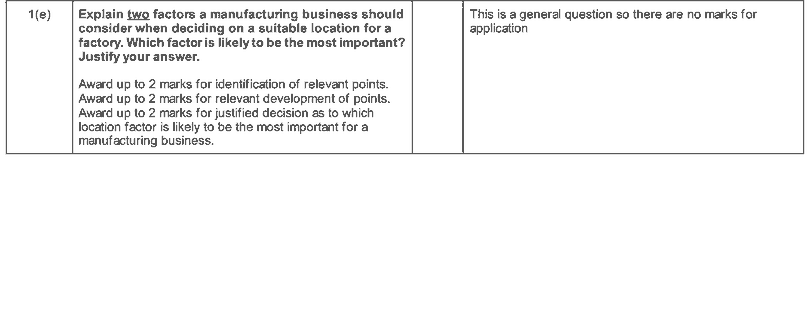
Explain two factors a manufacturing business should consider when deciding on a suitable location for a factory. Which factor is likely to be the most important? Justify your answer.

Show mark scheme

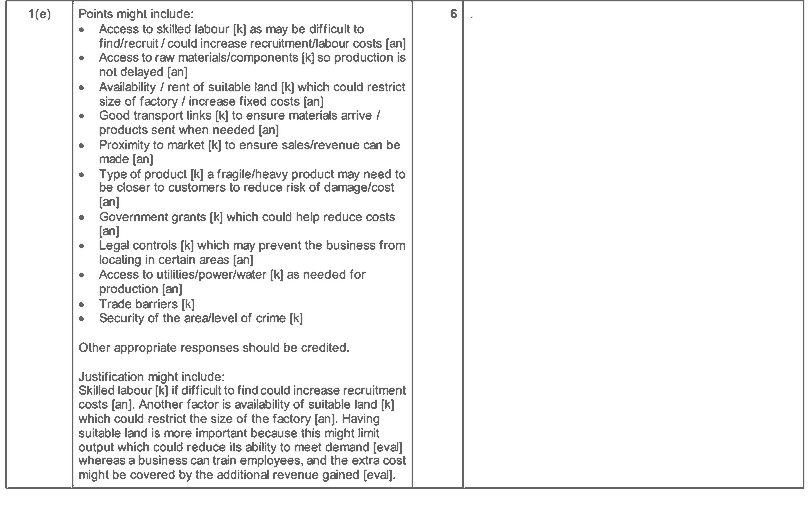
Explain two factors a manufacturing business should consider when deciding on a suitable location for a factory. Which factor is likely to be the most important? Justify your answer. Award up to 2 marks for identification of relevant points. Award up to 2 marks for relevant development of points. Award up to 2 marks for justified decision as to which location factor is likely to be the most important for a manufacturing business. Points might include:

  • Access to skilled labour [k] as may be difficult to find/recruit / could increase recruitment/labour costs [an]
  • Access to raw materials/components [k] so production is not delayed [an]
  • Availability / rent of suitable land [k] which could restrict size of factory / increase fixed costs [an]
  • Good transport links [k] to ensure materials arrive / products sent when needed [an]
  • Proximity to market [k] to ensure sales/revenue can be made [an]
  • Type of product [k] a fragile/heavy product may need to be closer to customers to reduce risk of damage/cost [an]
  • Government grants [k] which could help reduce costs [an]
  • Legal controls [k] which may prevent the business from locating in certain areas [an]
  • Access to utilities/power/water [k] as needed for production [an]
  • Trade barriers [k]
  • Security of the area/level of crime [k] Other appropriate responses should be credited. Justification might include: Skilled labour [k] if difficult to find could increase recruitment costs [an]. Another factor is availability of suitable land [k] which could restrict the size of the factory [an]. Having suitable land is more important because this might limit output which could reduce its ability to meet demand [eval] whereas a business can train employees, and the extra cost might be covered by the additional revenue gained [eval].
Mark scheme, 0450/11 Oct/Nov 2025 question 1(e) (page 1 of 2)
Mark scheme, 0450/11 Oct/Nov 2025 question 1(e) (page 2 of 2)
Scenario

Miguel plans to start up a gym (sports club). It will offer a range of fitness classes including yoga. The business will be a partnership with his sister. Miguel thinks the size of the business will remain small. Secondary market research will be used to help make decisions including which pricing method to use. Miguel knows it is important for a new business to select a suitable location.

Question 3(e)Oct/Nov 20250450/126 marks

Do you think access to employees is the most important factor for a new business to consider when deciding on a suitable location? Justify your answer.

Show mark scheme

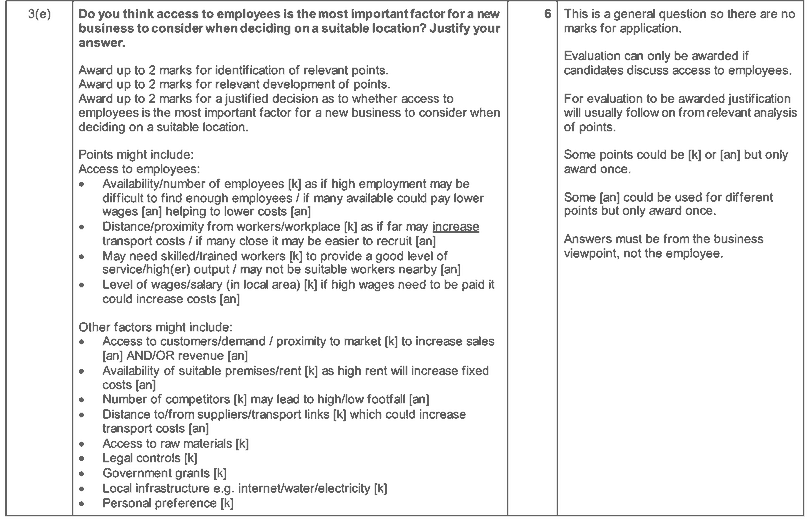
Do you think access to employees is the most important factor for a new business to consider when deciding on a suitable location? Justify your answer. Award up to 2 marks for identification of relevant points. Award up to 2 marks for relevant development of points. Award up to 2 marks for a justified decision as to whether access to employees is the most important factor for a new business to consider when deciding on a suitable location. Points might include: Access to employees:

  • Availability/number of employees [k] as if high employment may be difficult to find enough employees / if many available could pay lower wages [an] helping to lower costs [an]
  • Distance/proximity from workers/workplace [k] as if far may increase transport costs / if many close it may be easier to recruit [an]
  • May need skilled/trained workers [k] to provide a good level of service/high(er) output / may not be suitable workers nearby [an]
  • Level of wages/salary (in local area) [k] if high wages need to be paid it could increase costs [an] Other factors might include:
  • Access to customers/demand / proximity to market [k] to increase sales [an] AND/OR revenue [an]
  • Availability of suitable premises/rent [k] as high rent will increase fixed costs [an]
  • Number of competitors [k] may lead to high/low footfall [an]
  • Distance to/from suppliers/transport links [k] which could increase transport costs [an]
  • Access to raw materials [k]
  • Legal controls [k]
  • Government grants [k]
  • Local infrastructure e.g. internet/water/electricity [k]
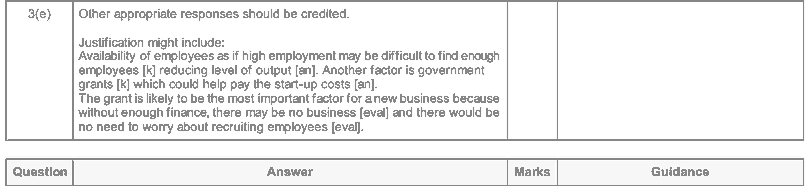
  • Personal preference [k] Other appropriate responses should be credited. Justification might include: Availability of employees as if high employment may be difficult to find enough employees [k] reducing level of output [an]. Another factor is government grants [k] which could help pay the start-up costs [an]. The grant is likely to be the most important factor for a new business because without enough finance, there may be no business [eval] and there would be no need to worry about recruiting employees [eval]. Answer
Mark scheme, 0450/12 Oct/Nov 2025 question 3(e) (page 1 of 2)
Mark scheme, 0450/12 Oct/Nov 2025 question 3(e) (page 2 of 2)
Scenario

GAE is a multinational company. It manufactures steel. GAE has 2400 employees and has factories in 4 countries. The business regularly introduces new technology. Holding inventory is important. GAE’s directors are planning to build a new factory and want to know how legal controls over location might affect this decision. The Managing Director said, ‘The new factory will create many external benefits.’

Question 3(b)May/Jun 20250450/132 marks

Identify two ways legal controls over location might affect a business. Way 1: Way 2:

Show mark scheme

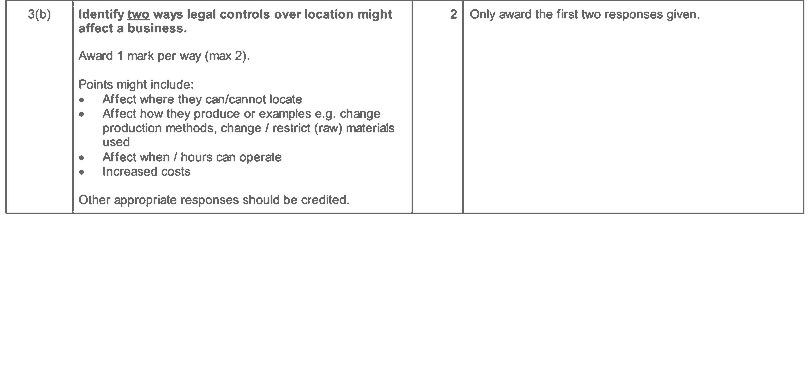
Identify two ways legal controls over location might affect a business. Award 1 mark per way (max 2). Points might include:

  • Affect where they can/cannot locate
  • Affect how they produce or examples e.g. change production methods, change / restrict (raw) materials used
  • Affect when / hours can operate
  • Increased costs Other appropriate responses should be credited.
Mark scheme, 0450/13 May/Jun 2025 question 3(b)

Paper 2 · Case study (4)

Case study: KE (Kitchen Equipment)

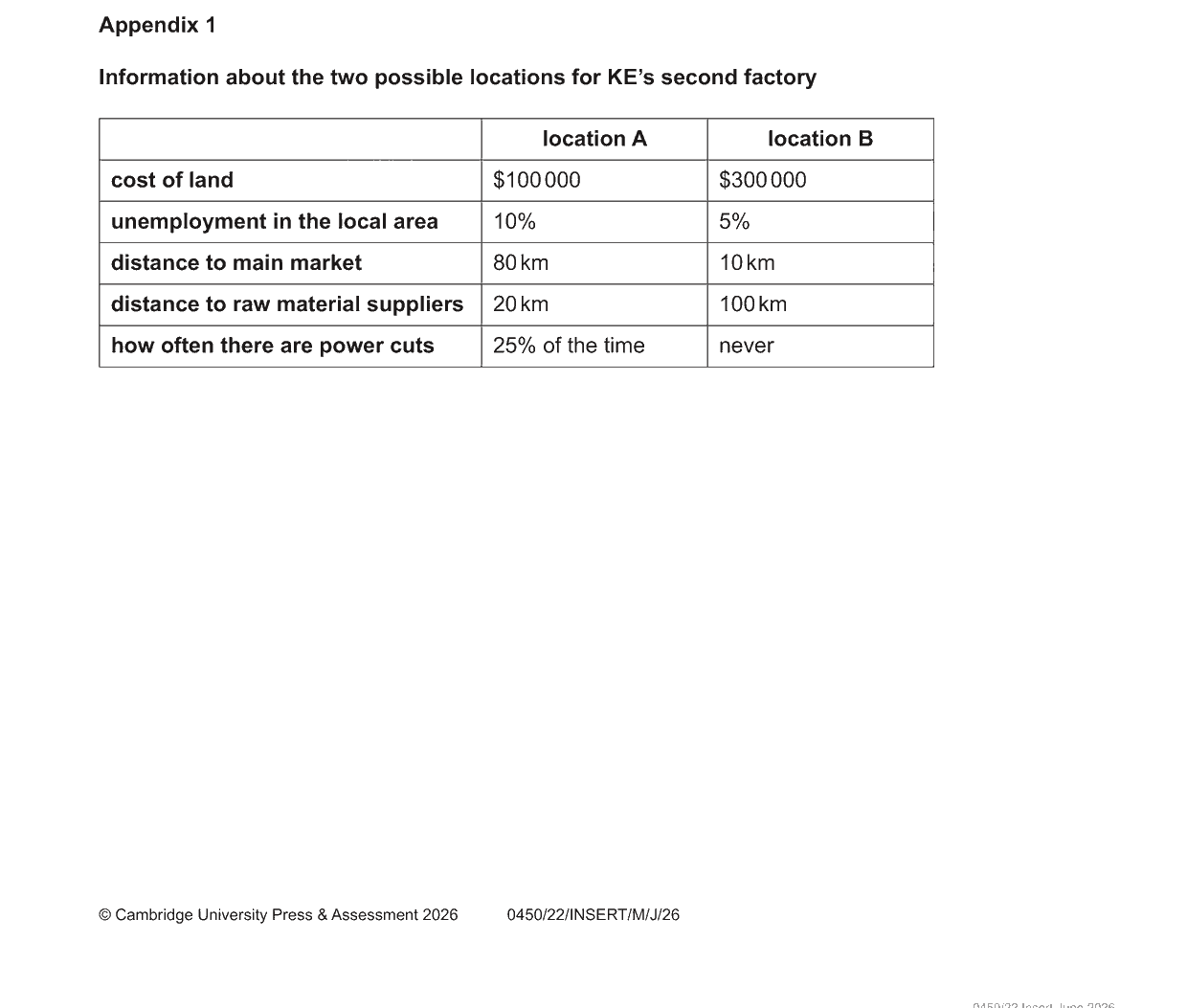
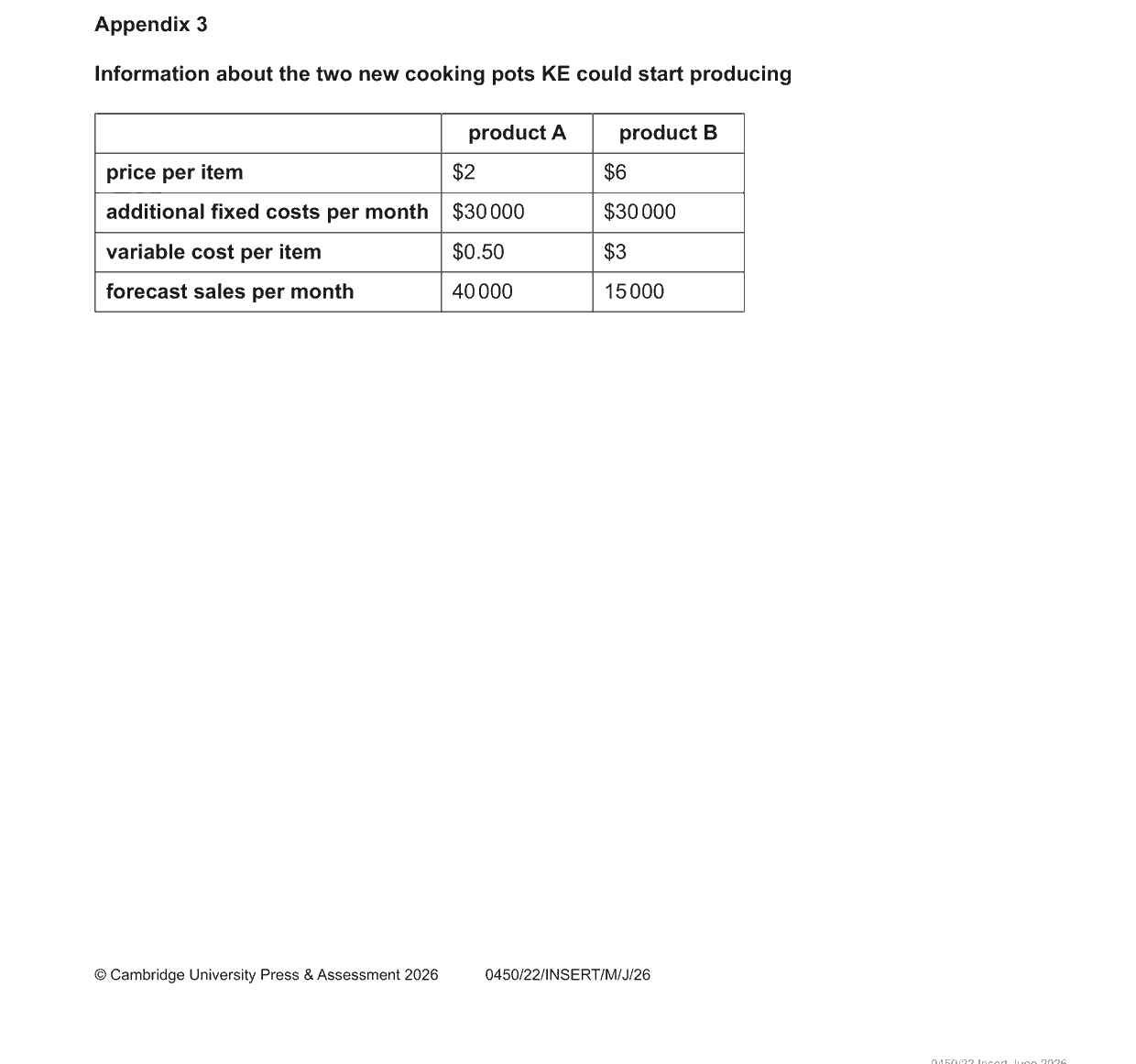
KE is a public limited company in country X. It has 10 000 employees. KE manufactures cooking equipment such as cooking pots, which it sells at low prices. KE produces 20 million cooking pots per year in its factory, and sells its products in country X. The market for cooking pots is very competitive. KE uses simple packaging to help keep costs low. KE is planning to build a second factory. The existing factory is working at maximum output and is unable to meet growing demand. The second factory will allow KE to increase sales from $90 million to $180 million per year. KE needs to choose between two possible locations for the second factory. Information about the two locations is shown in Appendix 1. KE does not currently use lean production. The operations director plans to introduce lean production in both the existing factory and the second factory. Training for all employees is important for KE. KE is planning to produce a new cooking pot when it opens the second factory. The marketing director will use primary market research to help decide whether to produce product A or product B. Information about the two new cooking pots in shown in Appendix 3. KE wants to choose the cooking pot with the highest potential revenue and profit.

Appendix 1
Appendix 2
Appendix 3
Question 2(b)May/Jun 20260450/2212 marks

Using Appendix 1 and other information, consider the following two possible locations for KE’s second factory. Which location should KE choose? Justify your answer.

  • location A
  • location B location A location B recommendation
Show mark scheme

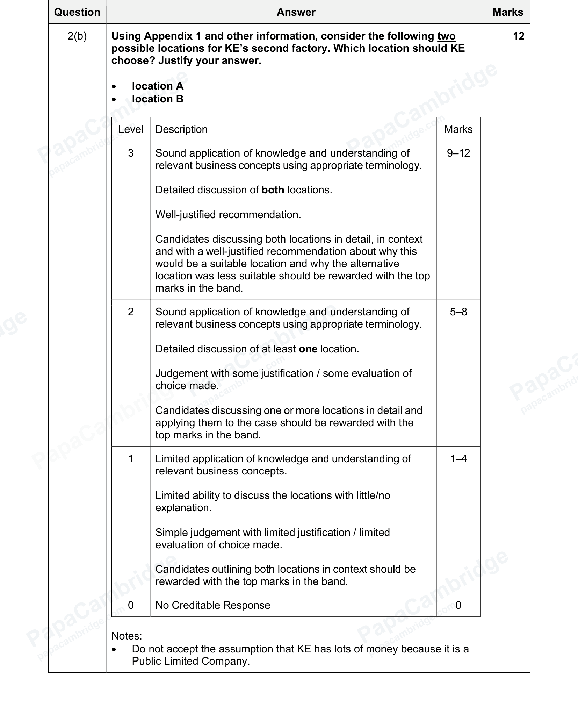
Using Appendix 1 and other information, consider the following two 12 possible locations for KE’s second factory. Which location should KE choose? Justify your answer.

  • location A
  • location B Level Description Marks 3 Sound application of knowledge and understanding of 9–12 relevant business concepts using appropriate terminology. Detailed discussion of both locations. Well-justified recommendation. Candidates discussing both locations in detail, in context and with a well-justified recommendation about why this would be a suitable location and why the alternative location was less suitable should be rewarded with the top marks in the band. 2 Sound application of knowledge and understanding of 5–8 relevant business concepts using appropriate terminology. Detailed discussion of at least one location. Judgement with some justification / some evaluation of choice made. Candidates discussing one or more locations in detail and applying them to the case should be rewarded with the top marks in the band. 1 Limited application of knowledge and understanding of 1–4 relevant business concepts. Limited ability to discuss the locations with little/no explanation. Simple judgement with limited justification / limited evaluation of choice made. Candidates outlining both locations in context should be rewarded with the top marks in the band. 0 No Creditable Response 0 Notes:
  • Do not accept the assumption that KE has lots of money because it is a Public Limited Company. Relevant points might include: Advantages Disadvantages Location A • Is much cheaper to • Is further way from buy than Location B the main market at as it costs $100 000 80 km – which is instead of $300 000 70 km further than
  • Unemployment is location B – is likely higher – so it may be to increase easier to recruit the distribution costs labour for the new • Regularly has power factory cuts so production is
  • As unemployment is likely to be higher at 10% then interrupted – causing wages paid may be output to be lower – lower – leading to unable to meet lower costs – may be orders able to lower prices or increase profits
  • Much nearer to raw material supplier – reducing transport costs of delivery – making deliveries quicker if raw materials are needed urgently Location B • Unemployment is • Much higher cost to lower at 5% – so buy the land at may mean that $300 000 – this is a people in the area high initial cost to have higher incomes build the factory and will be more • Raw materials are likely to buy KE’s much further away at products – higher 100 km – which is sales locally 80 km further to go
  • Is much closer to the than location A – main markets – so higher transport lower distribution costs – increasing costs – may make total costs on a deliveries of cooking regular basis and not equipment quicker just initial costs
  • Never has a problem • The distance is not with power cuts – so ideal when they are production can considering lean continue and not be production – as this interrupted – relies on quick meaning orders replenishment by should be fulfilled on suppliers time Recommendation Justification might include:
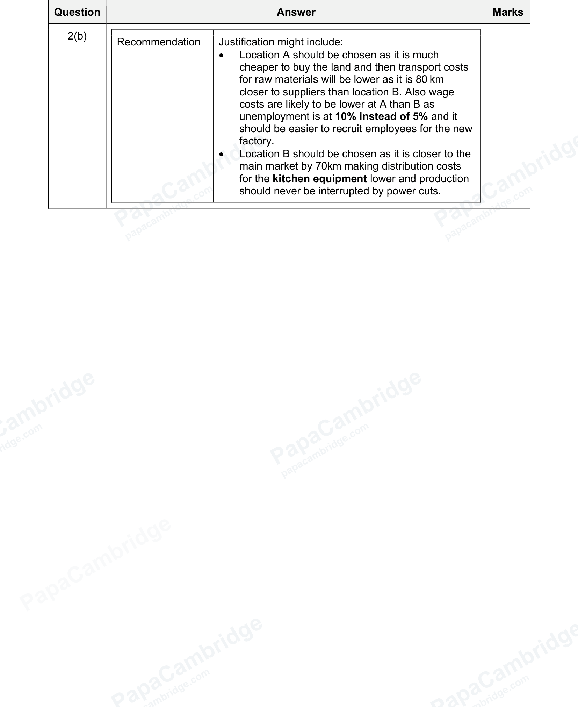
  • Location A should be chosen as it is much cheaper to buy the land and then transport costs for raw materials will be lower as it is 80 km closer to suppliers than location B. Also wage costs are likely to be lower at A than B as unemployment is at 10% instead of 5% and it should be easier to recruit employees for the new factory.
  • Location B should be chosen as it is closer to the main market by 70km making distribution costs for the kitchen equipment lower and production should never be interrupted by power cuts.
Mark scheme, 0450/22 May/Jun 2026 question 2(b) (page 1 of 3)
Mark scheme, 0450/22 May/Jun 2026 question 2(b) (page 2 of 3)
Mark scheme, 0450/22 May/Jun 2026 question 2(b) (page 3 of 3)
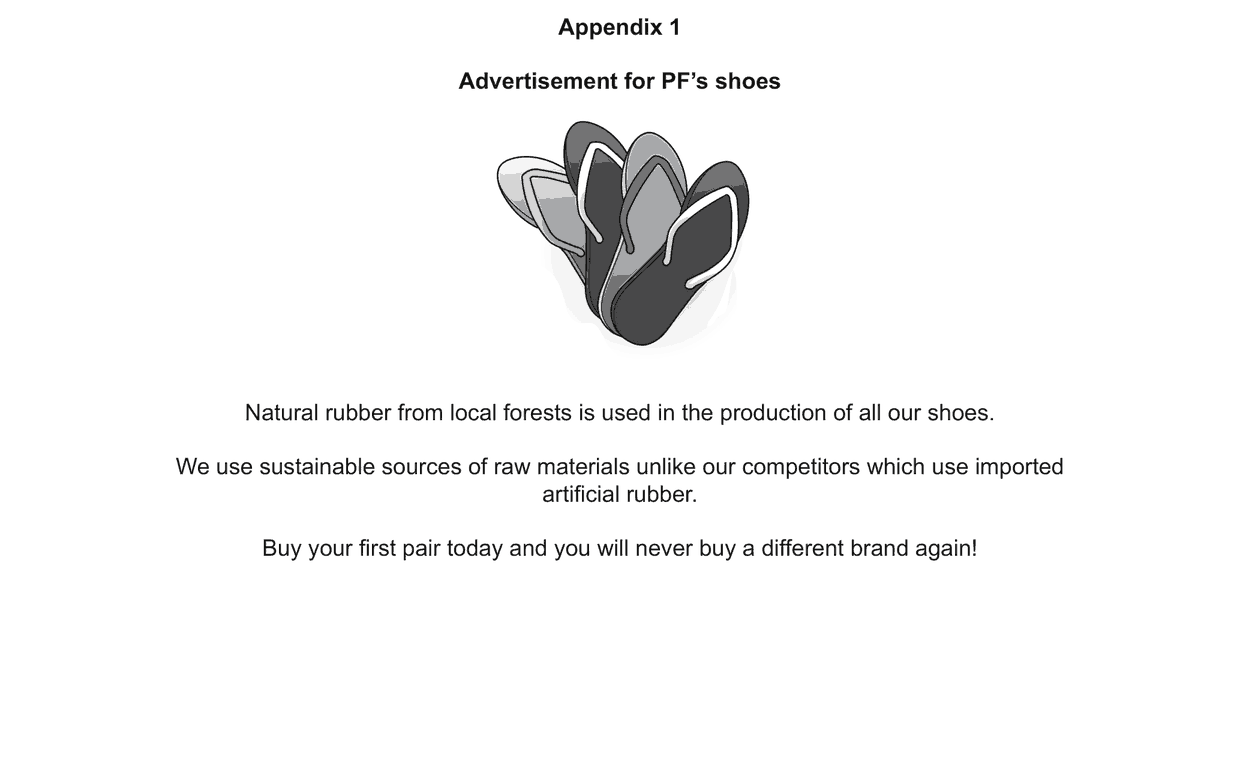
Case study: Philip Flop (PF)

Philip started PF 10 years ago as a sole trader in country X. PF makes shoes out of natural rubber. Philip used $100 000 of his own money to start up PF. The business has been very successful. Last year Philip changed PF from a sole trader business to a private limited company because he wanted to grow the business. PF employs 20 workers to make the shoes. They are paid a weekly wage based on the number of hours worked. Philip often has to recruit new production workers as the jobs are boring. Other local businesses pay a higher wage for similar work. Philip needs to improve the motivation of PF’s employees and has to decide the best way to do this. Philip wants to build a new factory. This factory will produce a new range of shoes. PF’s products will still be made from natural rubber which is grown in the local area. The bank has agreed to provide a loan to finance the building of the new factory. Philip needs to choose a suitable location for the new factory and is considering the following factors:

  • availability of raw materials
  • transport links
  • government influence. PF operates in a very competitive market. Philip will need to make a decision about how to promote the new range of shoes in a mass market. Philip’s sister is a successful entrepreneur and is considering investing in PF. She is using the extracts from PF’s statements of financial position, shown in Appendix 3, to help her decide.
Appendix 1

Appendix 2 — referenced by Q4(a)

Newspaper article from Main News in country X, 2 April 2025 The government is increasing tax rates on people’s incomes and on business profits. The tax on people’s incomes will increase by 2% and the tax on profits made by businesses will increase by 4%. These increases will be introduced next month. No further tax increases are planned.

Appendix 3
Question 2(b)May/Jun 20250450/2112 marks

Consider the following three factors that may influence the location of PF’s new factory. Which factor is likely to be the most important when deciding on the location? Justify your answer.

  • Availability of raw materials
  • Transport links
  • Government influence Availability of raw materials: Transport links: Government influence: Conclusion:
Show mark scheme

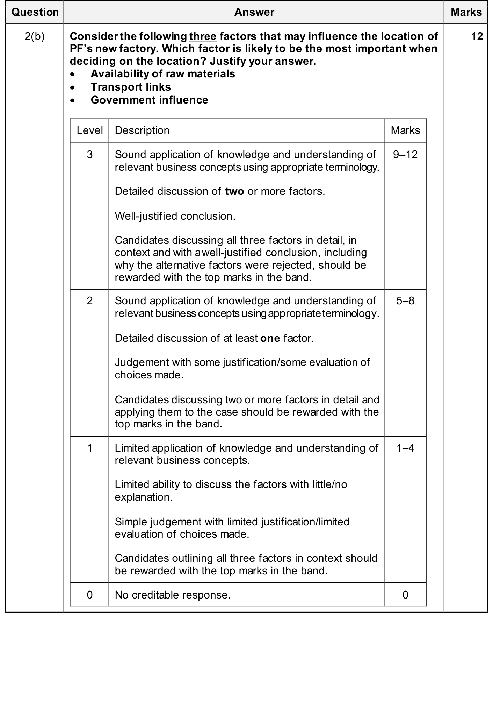
Consider the following three factors that may influence the location of 12 PF’s new factory. Which factor is likely to be the most important when deciding on the location? Justify your answer.

  • Availability of raw materials
  • Transport links
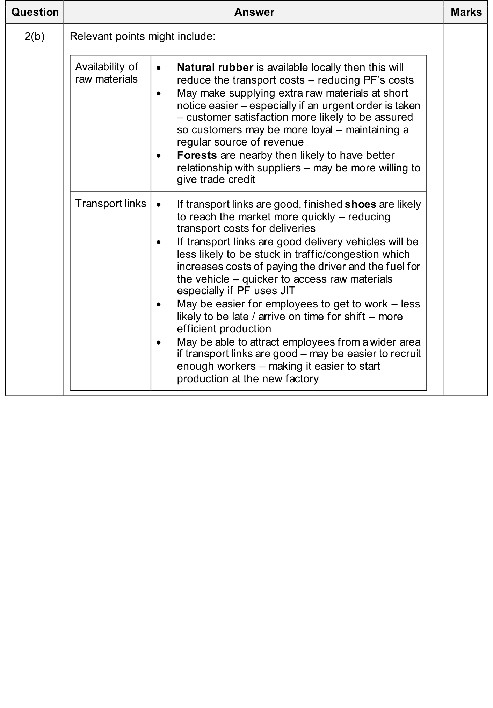
  • Government influence Level Description Marks 3 Sound application of knowledge and understanding of 9–12 relevant business concepts using appropriate terminology. Detailed discussion of two or more factors. Well-justified conclusion. Candidates discussing all three factors in detail, in context and with a well-justified conclusion, including why the alternative factors were rejected, should be rewarded with the top marks in the band. 2 Sound application of knowledge and understanding of 5–8 relevant business concepts using appropriate terminology. Detailed discussion of at least one factor. Judgement with some justification/some evaluation of choices made. Candidates discussing two or more factors in detail and applying them to the case should be rewarded with the top marks in the band. 1 Limited application of knowledge and understanding of 1–4 relevant business concepts. Limited ability to discuss the factors with little/no explanation. Simple judgement with limited justification/limited evaluation of choices made. Candidates outlining all three factors in context should be rewarded with the top marks in the band. 0 No creditable response. 0 Relevant points might include: Availability of • Natural rubber is available locally then this will raw materials reduce the transport costs – reducing PF’s costs
  • May make supplying extra raw materials at short notice easier – especially if an urgent order is taken – customer satisfaction more likely to be assured so customers may be more loyal – maintaining a regular source of revenue
  • Forests are nearby then likely to have better relationship with suppliers – may be more willing to give trade credit Transport links • If transport links are good, finished shoes are likely to reach the market more quickly – reducing transport costs for deliveries
  • If transport links are good delivery vehicles will be less likely to be stuck in traffic/congestion which increases costs of paying the driver and the fuel for the vehicle – quicker to access raw materials especially if PF uses JIT
  • May be easier for employees to get to work – less likely to be late / arrive on time for shift – more efficient production
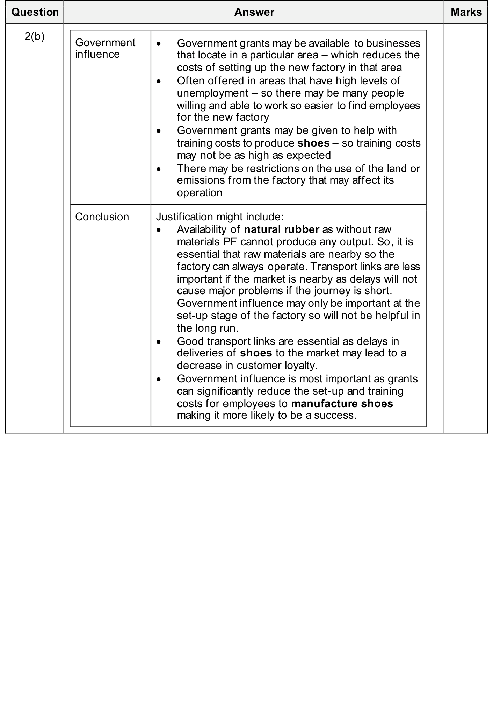
  • May be able to attract employees from a wider area if transport links are good – may be easier to recruit enough workers – making it easier to start production at the new factory Government • Government grants may be available to businesses influence that locate in a particular area – which reduces the costs of setting up the new factory in that area
  • Often offered in areas that have high levels of unemployment – so there may be many people willing and able to work so easier to find employees for the new factory
  • Government grants may be given to help with training costs to produce shoes – so training costs may not be as high as expected
  • There may be restrictions on the use of the land or emissions from the factory that may affect its operation Conclusion Justification might include:
  • Availability of natural rubber as without raw materials PF cannot produce any output. So, it is essential that raw materials are nearby so the factory can always operate. Transport links are less important if the market is nearby as delays will not cause major problems if the journey is short. Government influence may only be important at the set-up stage of the factory so will not be helpful in the long run.
  • Good transport links are essential as delays in deliveries of shoes to the market may lead to a decrease in customer loyalty.
  • Government influence is most important as grants can significantly reduce the set-up and training costs for employees to manufacture shoes making it more likely to be a success.
Mark scheme, 0450/21 May/Jun 2025 question 2(b) (page 1 of 3)
Mark scheme, 0450/21 May/Jun 2025 question 2(b) (page 2 of 3)
Mark scheme, 0450/21 May/Jun 2025 question 2(b) (page 3 of 3)
Case study: Vegan Veg (VV)

Jemi has always wanted to own a business. She is planning to buy a franchise called VV, a restaurant brand that only serves vegan meals. The meals do not contain any ingredients made from animal products. Market segmentation is important to VV. There has been an increasing trend for people to eat vegan meals. Jemi will need to decide the best location for her restaurant. There are three possible locations outlined in Appendix 2. The restaurant will serve a wide range of vegan meals and Jemi will purchase ingredients, including fruit and vegetables, directly from local suppliers. Jemi will employ a chef to cook the meals. The chef will be expected to work 40 hours a week. Jemi has identified the two best applicants. Their details are shown in Appendix 1. As well as a chef, Jemi plans to employ another 3 people to help in the kitchen and 8 people to serve customers in the restaurant. Jemi knows that keeping these employees motivated will be important. She is considering using job enrichment or giving a discount on meals in the restaurant to keep her employees motivated. Jemi is going to use her own capital of $50 000 to buy the franchise, but she will also need a source of external finance to help set up the business. Jemi knows that the profitability and liquidity ratios for her restaurant will be important for the success of her business.

Appendix 1
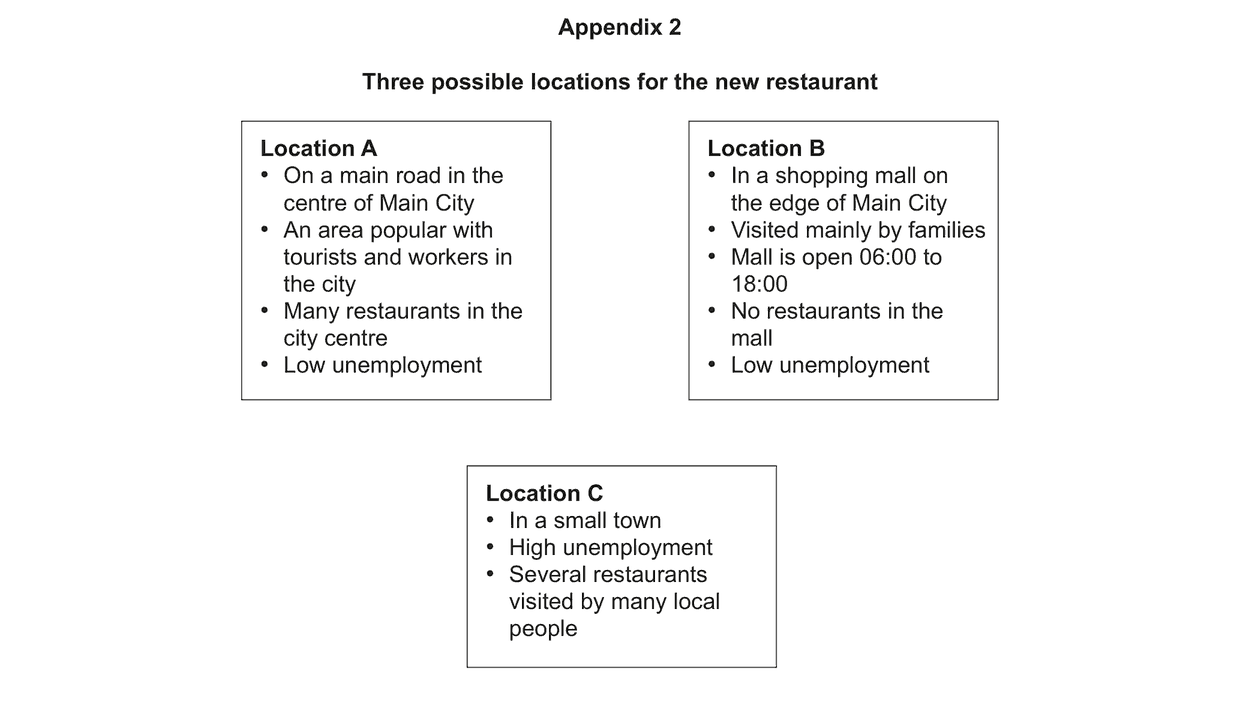
Appendix 2

Appendix 3 — referenced by Q4(a)

Newspaper article from Main News, 3 May 2025 A recent government report said that everyone should be eating more fruit and vegetables. It found that this is particularly important to help keep children healthy and to live a long life. Eating less meat is also good for the environment. Five years ago, only 10% of the population ate vegan meals but this percentage has increased to 25%. It is forecast that this trend will continue. Many well-known restaurants are adding vegan meals to their menus. There are also new vegan restaurants being opened. However, it is getting more difficult to find reliable suppliers of fruit and vegetables. Restaurants are now having to buy from suppliers that are further away.

---

Question 2(b)May/Jun 20250450/2312 marks

Using Appendix 2 and other information, consider the following three possible locations for Jemi’s new restaurant. Which location should Jemi choose? Justify your answer.

  • Location A
  • Location B
  • Location C Location A: Location B: Location C: Recommendation:
Show mark scheme

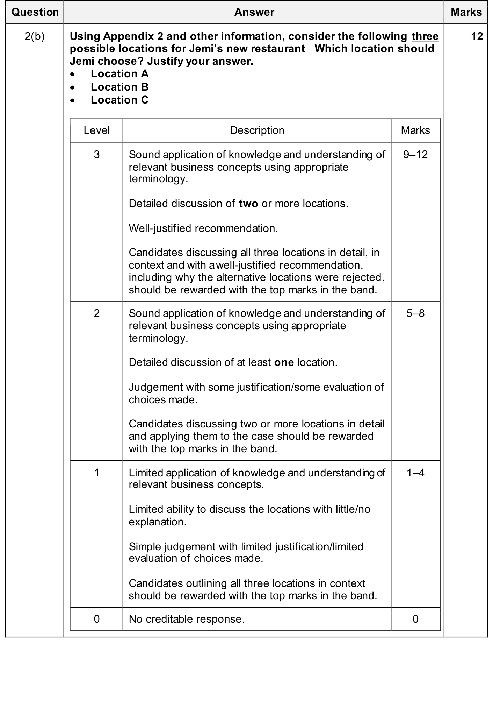
Using Appendix 2 and other information, consider the following three 12 possible locations for Jemi’s new restaurant Which location should Jemi choose? Justify your answer.

  • Location A
  • Location B
  • Location C Level Description Marks 3 Sound application of knowledge and understanding of 9–12 relevant business concepts using appropriate terminology. Detailed discussion of two or more locations. Well-justified recommendation. Candidates discussing all three locations in detail, in context and with a well-justified recommendation, including why the alternative locations were rejected, should be rewarded with the top marks in the band. 2 Sound application of knowledge and understanding of 5–8 relevant business concepts using appropriate terminology. Detailed discussion of at least one location. Judgement with some justification/some evaluation of choices made. Candidates discussing two or more locations in detail and applying them to the case should be rewarded with the top marks in the band. 1 Limited application of knowledge and understanding of 1–4 relevant business concepts. Limited ability to discuss the locations with little/no explanation. Simple judgement with limited justification/limited evaluation of choices made. Candidates outlining all three locations in context should be rewarded with the top marks in the band. 0 No creditable response. 0 Relevant points might include: Advantages Disadvantages Location A • May be able to charge • May be seasonal a higher price for demand from tourists meals – area visited – high revenue at by large number of certain times of the tourists – higher year but lower at other revenue times of the year –
  • On a main road in the may cause cash flow city centre makes it problems easily accessible – • High rent in city centre likely to have good leads to higher costs transport links may • High competition in enable a wider range the area so may have of potential to keep prices lower – employees as can could reduce revenue easily get to the and increased costs restaurant may mean this is a
  • May attract workers less profitable location in the city – as in the • Low unemployment centre which makes it – may make it more easily accessible as difficult to recruit near to where they employees work Location B • No other restaurants • Only open 06:00 to in the mall so no 18:00 each day so competition – may be limited opening hours able to charge higher for the restaurant – prices – leading to may reduce revenue higher revenue as fewer customers
  • Many families visit • No restaurants in the the shopping mall mall so people may leading to many not expect to eat there potential customers – larger groups increasing revenue
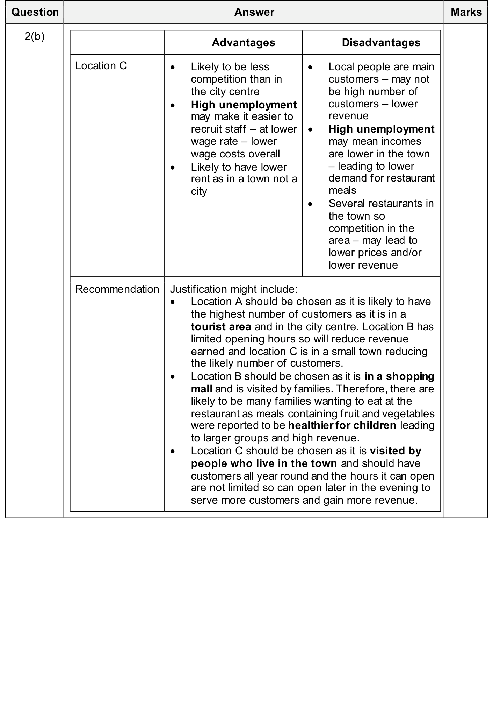
  • Low unemployment – people have more income to spend – increases demand for meals in restaurants Advantages Disadvantages Location C • Likely to be less • Local people are main competition than in customers – may not the city centre be high number of
  • High unemployment customers – lower may make it easier to revenue recruit staff – at lower • High unemployment wage rate – lower may mean incomes wage costs overall are lower in the town
  • Likely to have lower – leading to lower rent as in a town not a demand for restaurant city meals
  • Several restaurants in the town so competition in the area – may lead to lower prices and/or lower revenue Recommendation Justification might include:
  • Location A should be chosen as it is likely to have the highest number of customers as it is in a tourist area and in the city centre. Location B has limited opening hours so will reduce revenue earned and location C is in a small town reducing the likely number of customers.
  • Location B should be chosen as it is in a shopping mall and is visited by families. Therefore, there are likely to be many families wanting to eat at the restaurant as meals containing fruit and vegetables were reported to be healthier for children leading to larger groups and high revenue.
  • Location C should be chosen as it is visited by people who live in the town and should have customers all year round and the hours it can open are not limited so can open later in the evening to serve more customers and gain more revenue.
Mark scheme, 0450/23 May/Jun 2025 question 2(b) (page 1 of 3)
Mark scheme, 0450/23 May/Jun 2025 question 2(b) (page 2 of 3)
Mark scheme, 0450/23 May/Jun 2025 question 2(b) (page 3 of 3)
Case study: Comfy Rugs (CR)

Charly has worked for a large rug manufacturer in country P for 10 years. She is planning to leave and set up her own business later this year. It will be called CR and will make luxury rugs. She knows that new businesses are at a greater risk of failing than existing businesses. Charly has $10 000 of her own money to invest in a factory to make the rugs. She will also need to apply for a $20 000 bank loan. Charly has to decide which type of business organisation to choose for her new business. She could be a sole trader or set up CR as a private limited company. Charly will need to understand the functions of management required to operate CR whichever type of business organisation she chooses. Charly needs to choose a location for her new factory. Appendix 2 has information about two possible locations. She will have to decide the best location to produce her rugs. Charly forecasts that demand for her rugs will be 20 rugs per week in the first year. Charly must decide the best way to sell her luxury rugs when she starts producing them. The three options for CR are as follows:

  • selling through CR’s own shop
  • selling online by setting up a website
  • selling to a wholesaler which sells rugs to many retailers in country P.

Appendix 1 — not directly referenced by any question in this paper

Email from Charly to her accountant To: Accountant From: Charly Date: 1 February 2025 I have been told that I need to produce a cash flow forecast. This will be important because the rugs are expensive to produce. I will need to hold inventory of raw materials as well as finished rugs before they are sold. Please tell me what to include in the cash inflows and cash outflows in the cash flow forecast. I do not want to run out of cash and have to apply for an overdraft. I already plan to take out a bank loan to set up the factory.

Appendix 2

Appendix 3 — referenced by Q4(b)

Newspaper article in Main News, 3 January 2025 The government in country P reduced taxes last year to help the economy to grow. For example, the taxes on people’s incomes decreased by 5% and the taxes on business profits decreased by 2%. The government is concerned that the economy is starting to grow too fast. Banks are increasing their interest rates from 4% to 7%. This will have different effects on different businesses in country P.

---

Question 2(b)Feb/Mar 20250450/2212 marks

Using Appendix 2 and other information, consider the following two possible locations for CR’s new factory. Which location should Charly choose? Justify your answer.

  • Location A
  • Location B Location A: Location B: Recommendation:
Show mark scheme

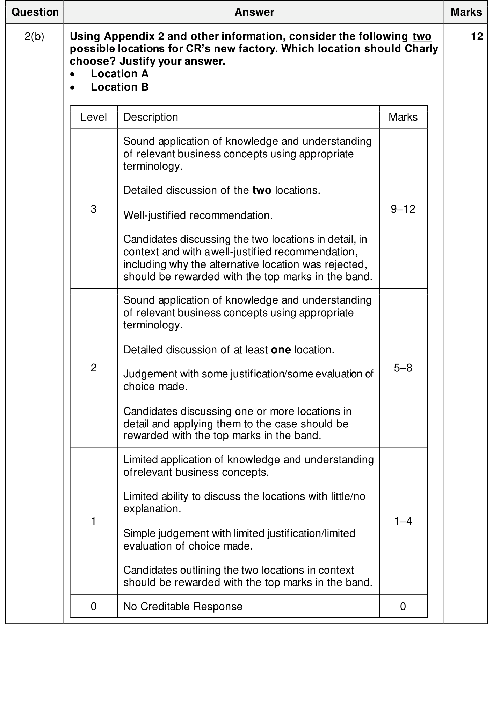
Using Appendix 2 and other information, consider the following two 12 possible locations for CR’s new factory. Which location should Charly choose? Justify your answer.

  • Location A
  • Location B Level Description Marks Sound application of knowledge and understanding of relevant business concepts using appropriate terminology. Detailed discussion of the two locations. 3 9–12 Well-justified recommendation. Candidates discussing the two locations in detail, in context and with a well-justified recommendation, including why the alternative location was rejected, should be rewarded with the top marks in the band. Sound application of knowledge and understanding of relevant business concepts using appropriate terminology. Detailed discussion of at least one location. 2 5–8 Judgement with some justification/some evaluation of choice made. Candidates discussing one or more locations in detail and applying them to the case should be rewarded with the top marks in the band. Limited application of knowledge and understanding of relevant business concepts. Limited ability to discuss the locations with little/no explanation. 1 1–4 Simple judgement with limited justification/limited evaluation of choice made. Candidates outlining the two locations in context should be rewarded with the top marks in the band. 0 No Creditable Response 0 Relevant points might include: Location A: • Rent and other costs are much lower at $400 per week – helping to reduce total costs to $1000 per week – may mean CR can charge a lower price for each rug – may be more competitive
  • Total costs may be less than half Location B even though output is half at 40 rugs per week – may not need to borrow $20 000 bank loan reducing interest payments in the future – less likely to have a cash flow problem
  • Total costs for Location A are $1000 whereas total costs for Location B are $2200
  • Average cost per rug for Location A if operating at maximum output is $50 but rises to $62.50 if there is disruption to output – a lower increase of $12.50 than Location B which is $18.33 more for each rug produced
  • If there are power cuts, then they can only produce 16 rugs a week – demand is likely to be 20 – so they could be letting customers down and gain a poor reputation Location B: • Can produce double the output at 40 rugs each week – increases revenue if all the rugs are sold
  • Has 5% more impact on output if there are power cuts than Location A – reducing the number of rugs for sale to 30 – reducing possible revenue
  • Total costs are more than twice as much at $2200 per week – may lead to higher prices
  • Average cost to produce each rug is $55 if no power cuts but it rises to $73.33 if 25% output lost due to power cuts – this is a much higher increase than for Location A
  • Sales in the future could increase to 40 rugs per week so will be easier to meet this demand without needing to move to a larger factory or open another factory Recommendation Justification might include:
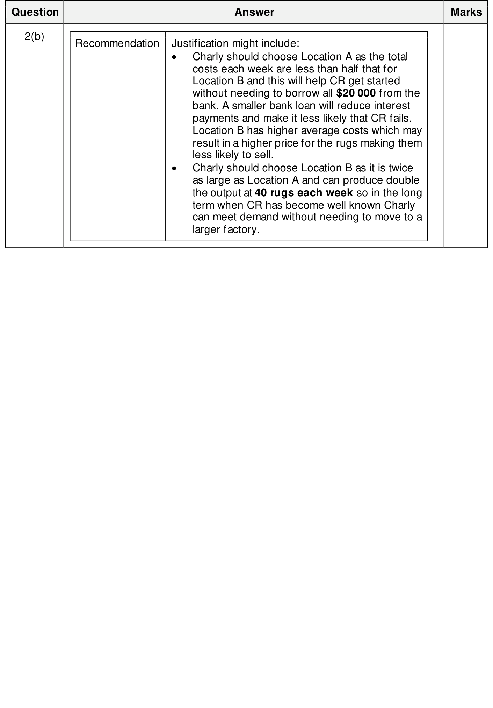
  • Charly should choose Location A as the total costs each week are less than half that for Location B and this will help CR get started without needing to borrow all $20 000 from the bank. A smaller bank loan will reduce interest payments and make it less likely that CR fails. Location B has higher average costs which may result in a higher price for the rugs making them less likely to sell.
  • Charly should choose Location B as it is twice as large as Location A and can produce double the output at 40 rugs each week so in the long term when CR has become well known Charly can meet demand without needing to move to a larger factory.
Mark scheme, 0450/22 Feb/Mar 2025 question 2(b) (page 1 of 3)
Mark scheme, 0450/22 Feb/Mar 2025 question 2(b) (page 2 of 3)
Mark scheme, 0450/22 Feb/Mar 2025 question 2(b) (page 3 of 3)

25 more questions from 2019–2024

🔒 Unlock every Location decisions question from 2019–2024

All 25 come with their mark schemes, answers and case studies, and appear in the practice tool above once you’re signed in. It’s free.

Create a free accountSign in

A few of them

  • 0450/11 · Oct/Nov 2024 · Question 1(e)Explain two factors a manufacturing business should… 🔒
  • 0450/22 · Oct/Nov 2024 · Question 3(b)Using Appendix 2 and other information, consider… 🔒
  • 0450/12 · May/Jun 2024 · Question 4(d)Explain one reason why DLT needs to… 🔒
  • 0450/13 · May/Jun 2024 · Question 3(e)Explain two factors a business should consider… 🔒
  • 0450/12 · Feb/Mar 2024 · Question 4(d)Explain two factors Suliman should consider when… 🔒
  • + 20 more, by year in the table above

Questions and mark schemes are from past Cambridge papers and are reproduced for revision. Topical Vault is an independent revision resource, not affiliated with or endorsed by Cambridge Assessment International Education.

IGCSE Business questions by topic

Each topic opens this practice tool with only that topic’s questions, plus how often it comes up and every question on it in one list.

  1. Ch 1Business activity
  2. Ch 2Classification of businesses
  3. Ch 3Enterprise, business growth and size
  4. Ch 4Types of business organisation
  5. Ch 5Business objectives and stakeholder objectives
  6. Ch 6Motivating employees
  7. Ch 7Organisation and management
  8. Ch 8Recruitment, selection and training of employees
  9. Ch 9Internal and external communication
  10. Ch 10Marketing, competition and the customer
  11. Ch 11Market research
  12. Ch 12The marketing mix: product
  13. Ch 13The marketing mix: price
  14. Ch 14The marketing mix: place
  15. Ch 15The marketing mix: promotion
  16. Ch 16Technology and the marketing mix
  17. Ch 17Marketing strategy
  18. Ch 18Production of goods and services
  19. Ch 19Costs, scale of production and break-even analysis
  20. Ch 20Achieving quality production
  21. Ch 21Location decisions
  22. Ch 22Business finance: needs and sources
  23. Ch 23Cash flow forecasting and working capital
  24. Ch 24Income statements
  25. Ch 25Statement of financial position
  26. Ch 26Analysis of accounts
  27. Ch 27Economic issues
  28. Ch 28Environmental and ethical issues
  29. Ch 29Business and the international economy