Question 2Oct/Nov 20259609/328 marks
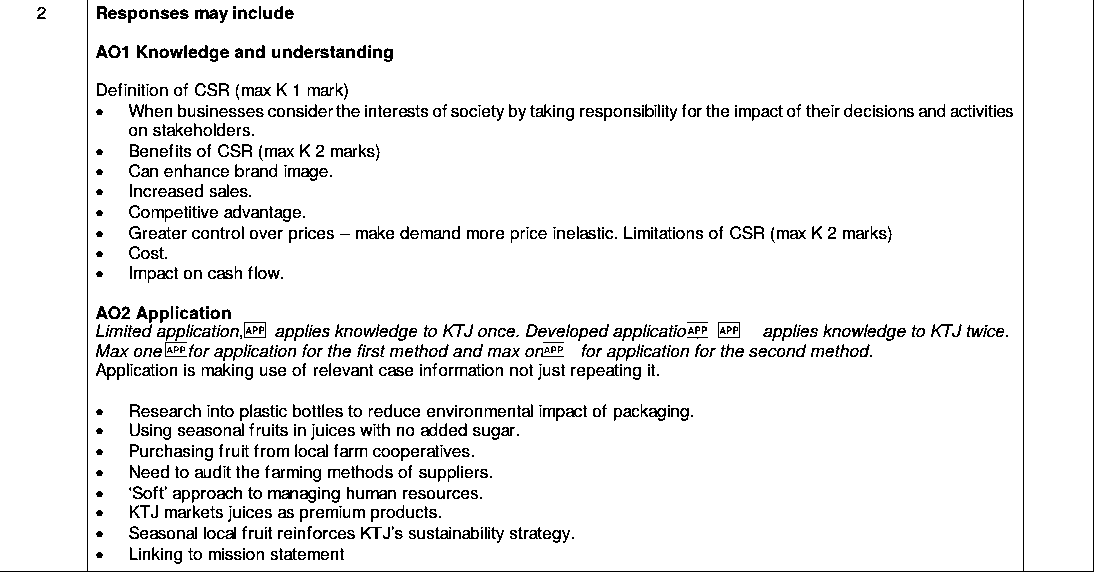
Analyse two impacts on KTJ of its commitment towards corporate social responsibility (CSR). •. [8 marks]
Show mark scheme


Cambridge 9609, Paper 3 & 4. 330 questions, 2020 to 2026.
Case studies and questions retyped from the original Cambridge material; Paper 3 mark schemes are cropped from the official mark scheme PDFs, Paper 4 mark schemes are retyped as text. A few 2020–2022 Paper 3 case studies were recovered by OCR from a damaged source file — those are marked where it applies.
Questions on business objectives: social and ethical objectives, corporate social responsibility and how it affects a business's costs, revenue and decisions.
8 past paper questions on this topic since 2020, across 6 exam sessions.
| Year | Paper 3 | Total | Chart |
|---|---|---|---|
| 2025 | 1 | 1 | |
| 2024 | 1 | 1 | |
| 2022 | 3 | 3 | |
| 2020 | 3 | 3 |
The whole topic on one page, with answers and mark schemes. Printing this page prints just this list.
KTJ is a private limited company based in country B in Africa. It was set up in 2014 by Ada Hadebe who is the majority shareholder and Managing Director. KTJ specialises in producing tropical fruit juices. KTJ’s mission statement is ‘to bring the tropical taste of Africa to the world through ethical relationships with farmers by focusing on sustainability throughout the supply chain’.
KTJ’s range of tropical fruit juices includes baobab, papaya and pineapple. Juices are produced from seasonal fruits without added sugar or colourings. Most fruits are sourced from local farm cooperatives in country B. The farms are chosen for their sustainable farming methods which KTJ has to regularly audit. Some fruits, not grown in country B, are imported from other countries in Africa.
KTJ has a flat organisational structure. Ada encourages a ‘soft’ approach to human resource management (HRM) and believes in the benefits of delegation. Ada is proud that KTJ has won awards in country B for its substantial investment in employee training and development.
Recently, one of KTJ’s operations managers commissioned research into KTJ’s use of plastic bottles for its fruit juices. After six months of research the final report recommended that KTJ should in future only use plastic bottles made entirely from recycled materials. Ada is considering whether to implement this change.
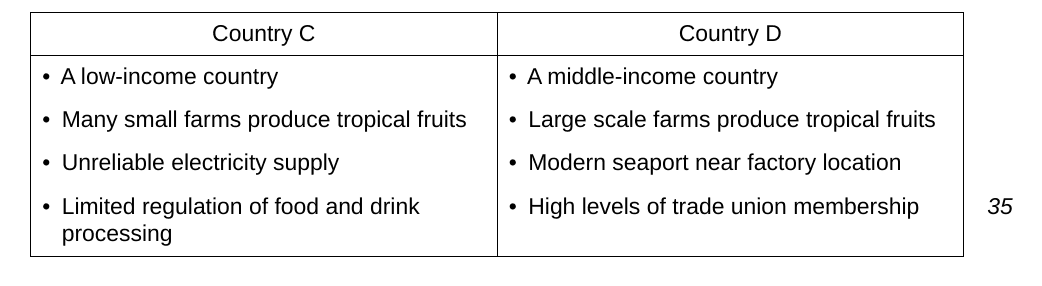
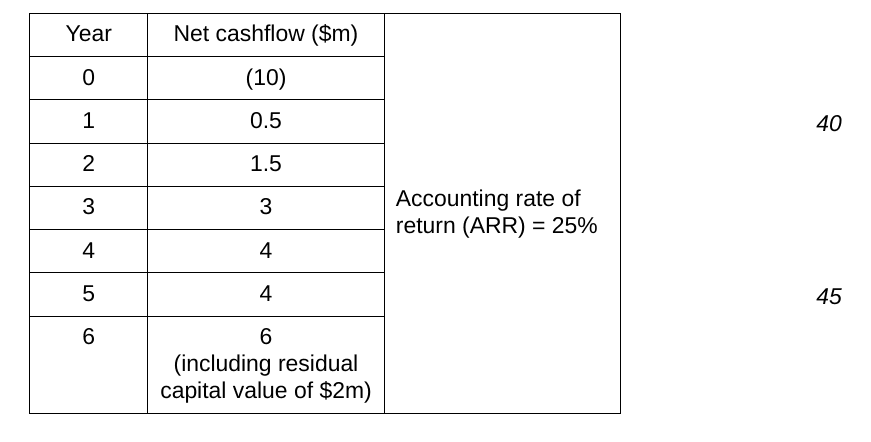
KTJ has an excellent reputation for the quality of its tropical fruit juices which are marketed as premium products. Export demand has increased significantly during the past two years, especially from other African countries. KTJ’s factory in country B is nearing full capacity. Ada thinks that KTJ should expand by processing tropical fruit in a location outside of country B. Ada authorised Gudaf, a junior market analyst, to prepare a report identifying the two best locations for the additional new factory. Gudaf visited multiple locations and prepared an investment appraisal. Gudaf will present the report to the Board of Directors next week recommending a location in either country C or country D.
Extracts from Gudaf’s report are in Table 1.1, Table 1.2 and Table 1.3.
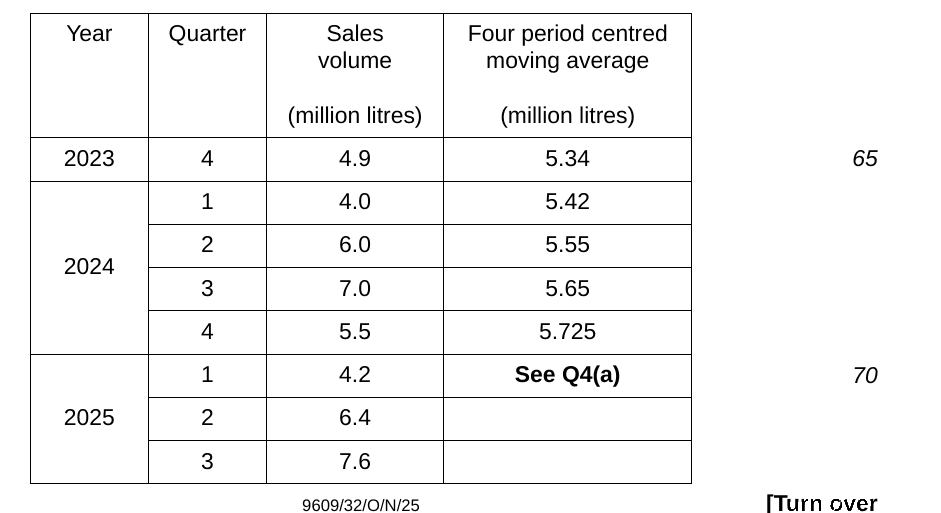
Since 2018, KTJ has exported tropical fruit juices to the US. The US is one of the world’s most competitive markets for food and drink products. Sales are increasing and have met targets. Ada believes that KTJ can increase its market share significantly. Ada instructed the US marketing manager to carry out a market analysis and then develop a new marketing plan. The marketing manager is using time series analysis to help make business decisions. Table 1.4 is an extract of KTJ sales data in the US.
Ada monitors the external environment carefully to identify changes that will impact KTJ. There have been fluctuations in the exchange rate of country B’s currency in recent years. At the last 75 Board Meeting Ada commented ‘financial markets have been unsettled by the recent change of government in country B. This has led to an average 20% depreciation in the value of country B’s currency. This presents both an opportunity for, and a threat to, KTJ.’

Analyse two impacts on KTJ of its commitment towards corporate social responsibility (CSR). •. [8 marks]
🔒 Unlock every Business objectives question from 2020–2024
All 7 come with their mark schemes, answers and case studies, and appear in the practice tool above once you’re signed in. It’s free.
Questions and mark schemes are from past Cambridge papers and are reproduced for revision. Topical Vault is an independent revision resource, not affiliated with or endorsed by Cambridge Assessment International Education.
Each topic opens this practice tool with only that topic’s questions, plus how often it comes up and every question on it in one list.