Question 2May/Jun 20269609/318 marks
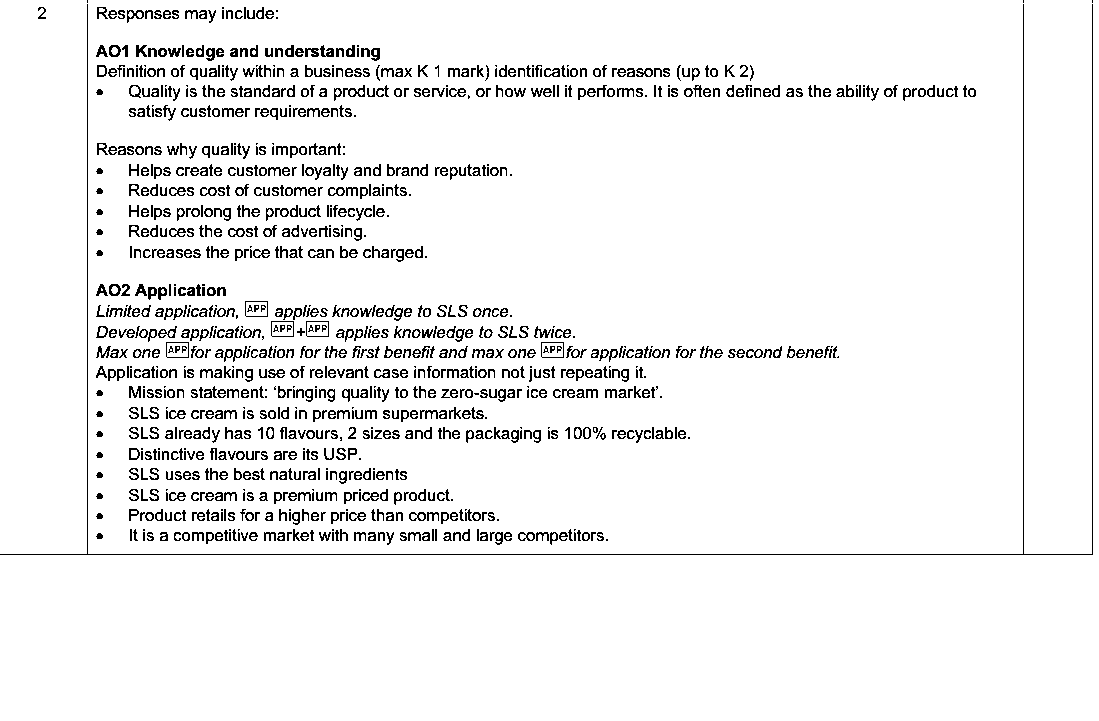
Analyse two reasons why quality is important to SLS. [8 marks]
Show mark scheme


Cambridge 9609, Paper 3 & 4. 330 questions, 2020 to 2026.
Case studies and questions retyped from the original Cambridge material; Paper 3 mark schemes are cropped from the official mark scheme PDFs, Paper 4 mark schemes are retyped as text. A few 2020–2022 Paper 3 case studies were recovered by OCR from a damaged source file — those are marked where it applies.
Questions on quality management: quality control and quality assurance, total quality management (TQM), and benchmarking.
12 past paper questions on this topic since 2020, across 9 exam sessions.
| Year | Paper 3 | Total | Chart |
|---|---|---|---|
| 2026 | 1 | 1 | |
| 2025 | 2 | 2 | |
| 2024 | 3 | 3 | |
| 2023 | 2 | 2 | |
| 2021 | 3 | 3 | |
| 2020 | 1 | 1 |
The whole topic on one page, with answers and mark schemes. Printing this page prints just this list.
SLS was set up in country A in 2024 by Cali and Faiza as a private limited company. Cali and Faiza own 52% of the shares and two venture capitalists own 48% of the shares. Cali and Faiza identified a market for an alternative to high-sugar ice cream demanded by health-conscious consumers.
SLS manufactures zero-sugar ice creams. Its unique selling point (USP) is the distinctive flavours of its zero-sugar ice creams. SLS’s ice cream retails for a higher price than its competitors. SLS has a mission statement of ‘bringing quality to the zero-sugar ice cream market’.
Cali and Faiza invested a significant proportion of their start-up finance in market research. The research showed:
SLS decided to manufacture 10 flavours of zero-sugar ice cream in individual and share size cartons using packaging that is 100% recyclable. SLS is proud to only use the best natural ingredients. SLS started selling its products in a selection of premium supermarkets in country A.
The zero-sugar ice cream market is supported by the government of country A who are concerned about health problems within the country. The government has identified diets high in sugar as one of the leading causes of these health problems. This has increased the demand for zero-sugar ice cream.
There are high levels of competition in the zero-sugar ice cream market within country A, with many new businesses offering similar products. There are currently five large businesses which control 60% of this market. The remaining 40% of the market is made up of many small businesses. SLS has developed a strong brand through social media marketing and free trials at some supermarkets. SLS has a 5% market share in country A.
The average monthly income in country A has increased from $500 to $510. This has resulted in the market for zero-sugar ice cream in country A increasing by 4%. However, SLS’s sales to retailers have increased by 8%. There have been no other changes.
Cali wants to increase profitability by increasing the price of each individual carton from $3.50 to $4.00. Faiza’s research has shown that this will result in a reduction of 20% in the quantity demanded.
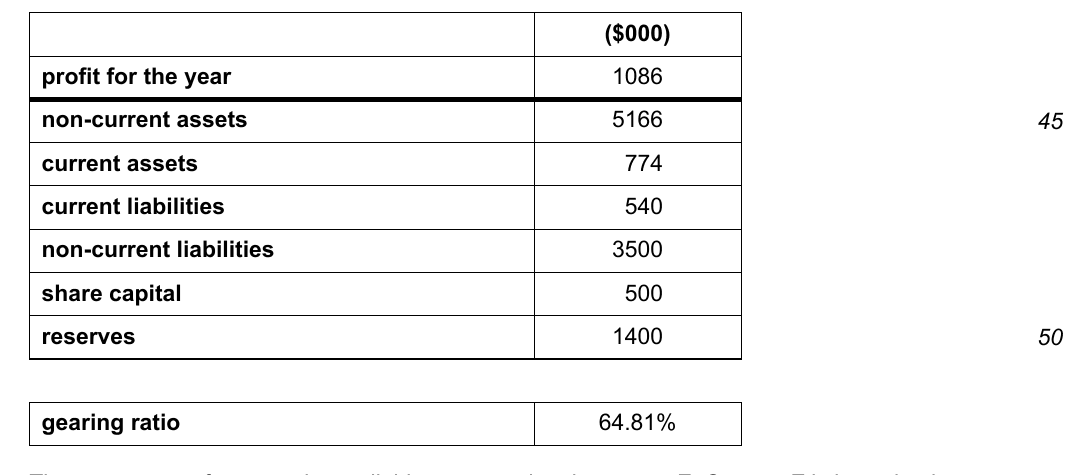
Market research carried out by Cali and Faiza on country Z has identified the country as an excellent manufacturing base as well as a potential new market. Country Z is located a long distance away from country A. There is limited recognition of the SLS brand in country Z. To expand into country Z, SLS will need long-term borrowing of $3 million to open a factory and a regional office. Table 1.1 contains further financial information for SLS.
There are empty factory units available to rent or buy in country Z. Country Z is investing in infrastructure for high speed WIFI and an improvement to the road system.
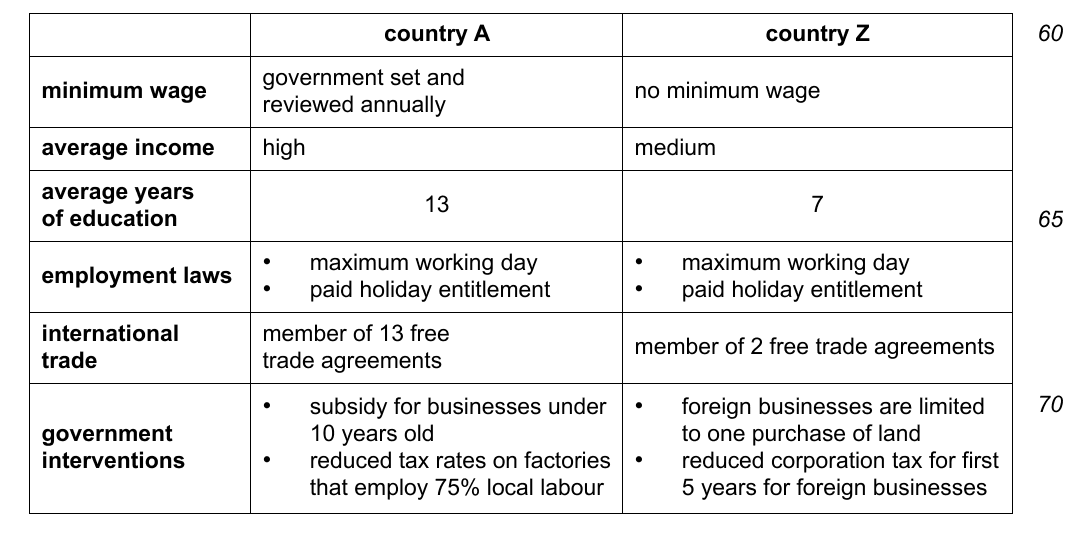
There are differences between country A and country Z, see Table 1.2. There are also social and demographic differences between consumers in the two countries. Cali and Faiza think that passing power to a regional office in country Z would be the most effective way of SLS responding to these differences. The new regional office would have responsibility for production, distribution and marketing of SLS’s ice cream in country Z.
Analyse two reasons why quality is important to SLS. [8 marks]
Pedro left school without any formal qualifications. Pedro was given the opportunity to work in a pie factory. This was owned by an entrepreneur who wanted to help unqualified young people.
Pedro spent six years working at the factory. He was quickly promoted because he was conscientious and showed initiative. When the business owner retired, she offered Pedro the chance to buy the business. Pedro raised capital from his savings, friends and family and bought the business. PPP became a private limited company, with Pedro as Managing Director. PPP is based in country A.
PPP manufactures a wide range of pies in its factory. The pies are sold to retailers in country A and other countries in the region.
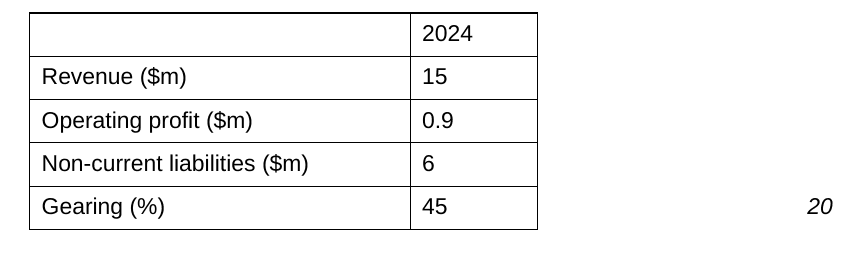
PPP has grown steadily over the last few years. Its revenue and profits have increased by an average of 8% per year. Production capacity has been increased to keep up with demand. Growth has been financed by retained earnings and bank loans. Recent accounting data is shown in Table 1.1.
Real incomes in country A and other countries in the region have been falling due to high inflation and low economic growth. Trade between country A and other countries in the region has become more difficult, due to country A leaving an international trade agreement. Consumers are changing their eating habits, and many people are eating less meat.
When Pedro bought the business, he identified an opportunity to develop a premium product. Pedro asked the marketing team to carry out market research. The results of this established that there was a market for high quality, higher priced pies. Pedro discussed this new product development with all of his marketing team because he valued their opinions.
Once the premium pies were launched, PPP branded its products as either classic or premium pies. Most pies PPP produces still contain meat. However, a newly developed premium no‑meat vegan pie has started to sell very well. PPP is also planning to launch a new classic pie with a cheese filling especially for the export market.
Due to higher production costs PPP has increased its prices. Pedro has analysed some elasticity data for one type of classic pie and one type of premium pie, see Table 1.2.
Pedro has always been a self‑confident innovator, both in terms of new product ideas and the way that PPP is organised and led. He is known for his social skills and is respected and trusted by his employees.
Pedro is also keen to help young unemployed people, in the same way as he was helped. PPP offers training apprenticeships in all areas of the factory. Trainees attend local colleges one day each week and are supervised by the department managers.
Pedro thinks employees are PPP’s greatest asset. As well as training apprentices, he offers competitive wages and all employees have opportunities for career development and promotion within PPP. Pedro is also socially aware as he rewards employees for good ideas from weekly kaizen group discussions. Many employees have been with the company for more than five years.
PPP’s current production process is labour intensive and pies are produced using batch production. All employees accept responsibility for product quality and are trained in quality assurance methods.
Pedro is considering investing in a new computer‑controlled pie‑making machine, see Table 1.3. This would increase production capacity in the factory. Factory employees would still need to complete the production process by adding the PPP pastry logo to the pies.
Pedro is undecided about increasing the use of machinery, especially as PPP will have to borrow the finance to purchase it.

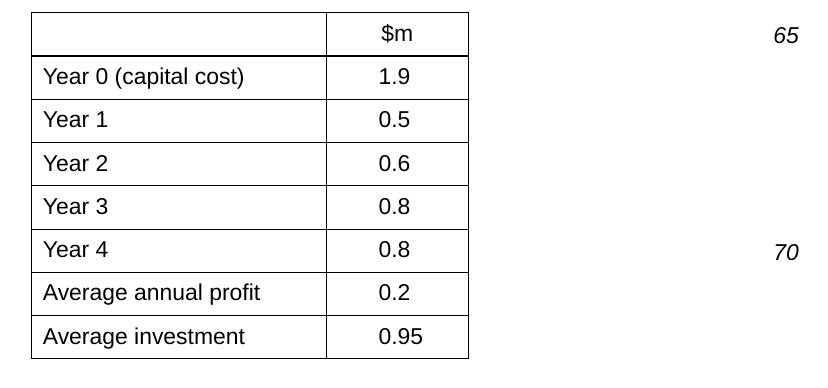
Analyse two benefits to PPP of using quality assurance. [8 marks]



WS is a public limited company. WS manufactures leather shoes for adults. It sells to major shoe retailers and to small independent shoe shops. WS products are targeted at three constantly changing markets: fashion, leisure and work. Its sales employees are reporting that small independent shoe shops have experienced an increasing demand for non-leather and recyclable shoes. There is a growing consumer awareness that resources used in production need to be sustainable. Jon, the Marketing Director, is very keen for WS to carry out an environmental audit.
Enterprise resource planning (ERP) WS uses different IT systems for managing production, marketing and human resources. Keri, the Operations Director, thinks that the processes needed to produce and market shoes could be more integrated. Greater integration could help to improve the efficiency of WS. Keri has begun to research ERP as a means of achieving this integration. She knows that ERP is very expensive and takes time to implement but she is convinced that it could offer WS substantial efficiency benefits.
WS uses batch production to produce different styles of shoes. The production employees at WS are:
Milo, the Human Resources Director, and Keri are concerned that the performance of production employees is declining. Table 1.1 gives data about production and production employees.
WS sells its shoes into three markets: fashion, leisure and work. Each market has its own characteristics. WS shoes are medium to high price in each market. Research shows that consumers consider WS shoes are good quality for the prices charged.
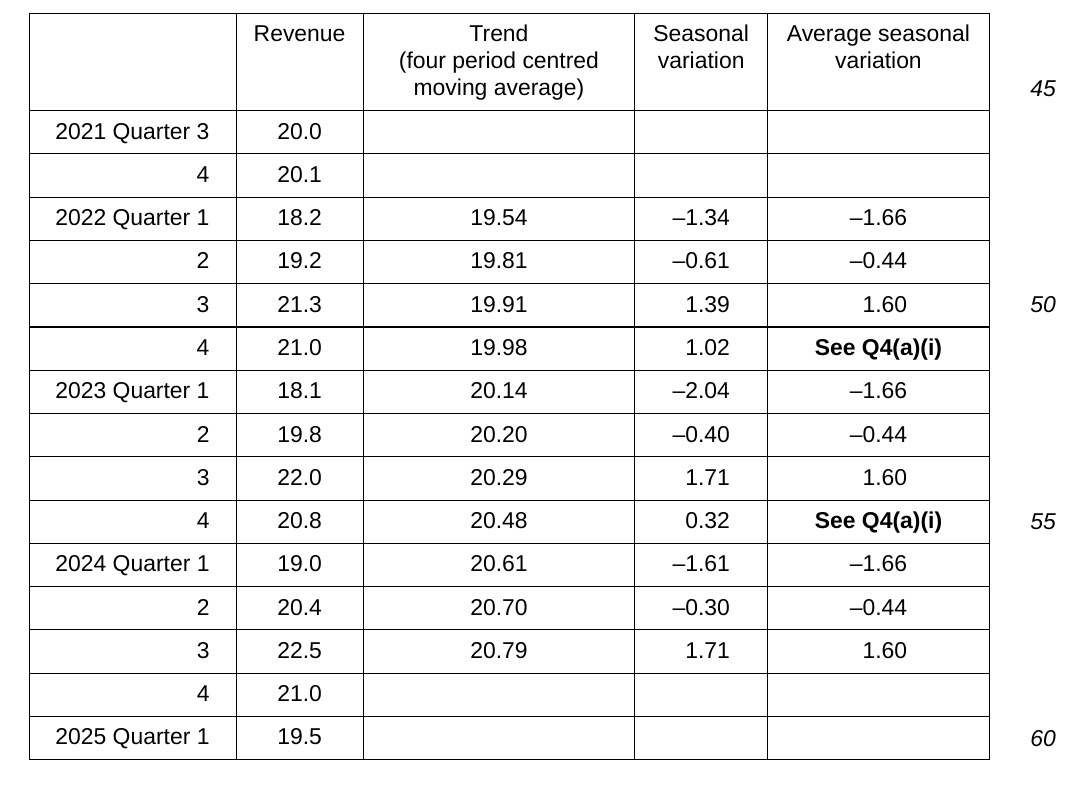
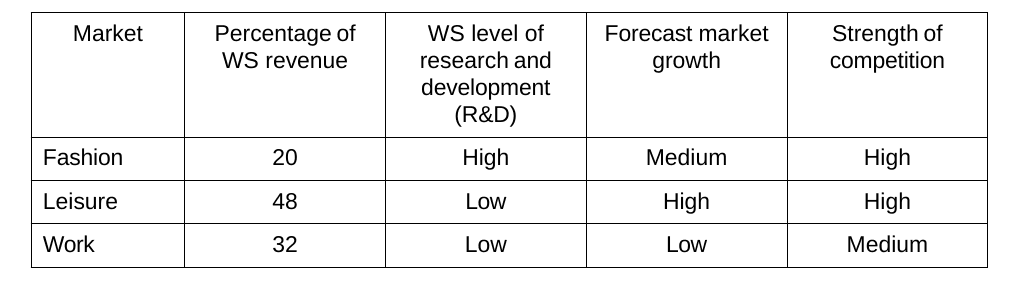
Jon is preparing a marketing plan with the objective of increasing annual sales by 5% without entering any new markets. Table 1.2 shows time series analysis sales data Jon is using. Jon considers that time series analysis will help him make decisions to achieve WS’s marketing objective. Table 1.3 gives additional information about the markets WS sells to.
In recent years, the directors of WS have made long-term investment a priority rather than short-term increases in dividends.
The main shareholders in WS take an active interest in the business. At the next company Annual General Meeting (AGM) these shareholders intend to ask the directors to explain their method to increase investor returns. These shareholders will be looking for an effective method to achieve an increase in their return. Table 1.4 shows changes in key investment indicators and ratios.
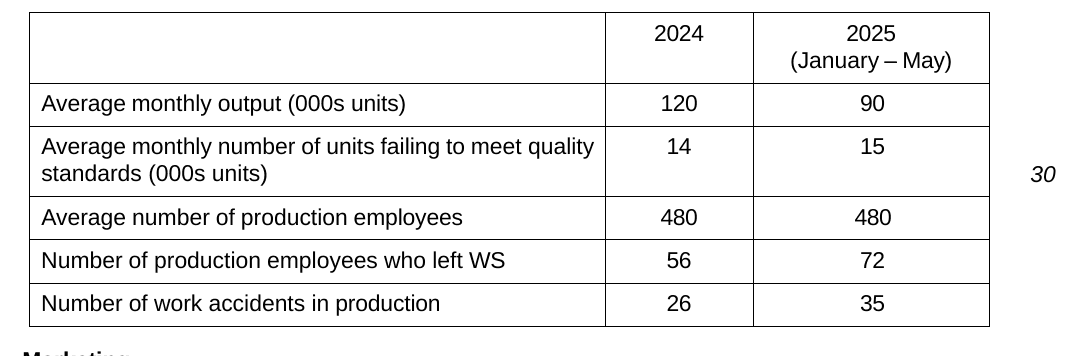

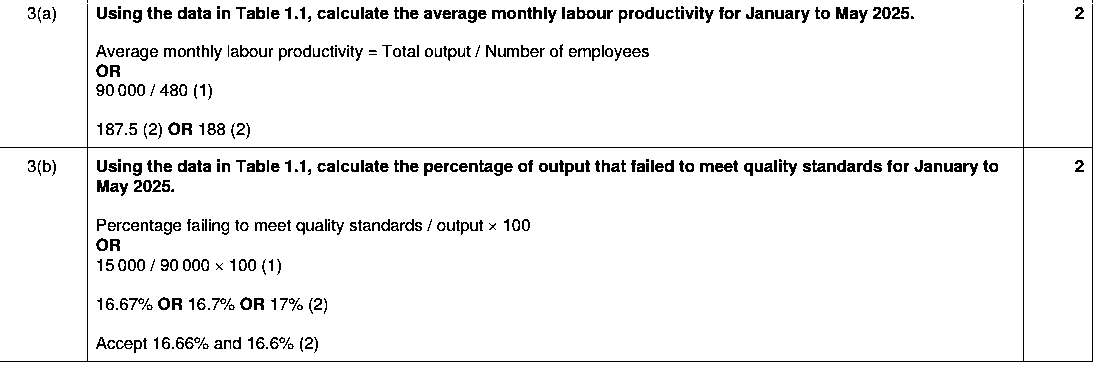
(a) Using the data in Table 1.1, calculate the average monthly labour productivity for January to May 2025. Average monthly labour productivity = Total output / Number of employees OR 90 000 / 480 (1) 187.5 (2) OR 188 (2). [2 marks]
(b) Using the data in Table 1.1, calculate the percentage of output that failed to meet quality standards for January to May 2025. Percentage failing to meet quality standards / output × 100 OR 15 000 / 90 000 × 100 (1) 16.67% OR 16.7% OR 17% (2). [2 marks]
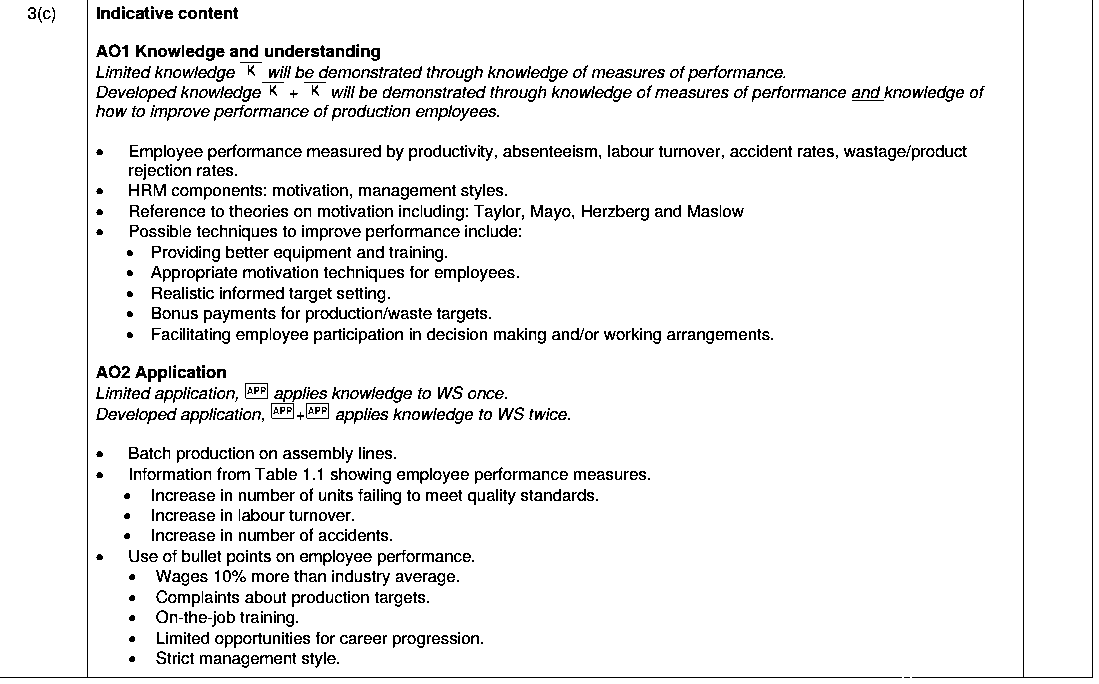
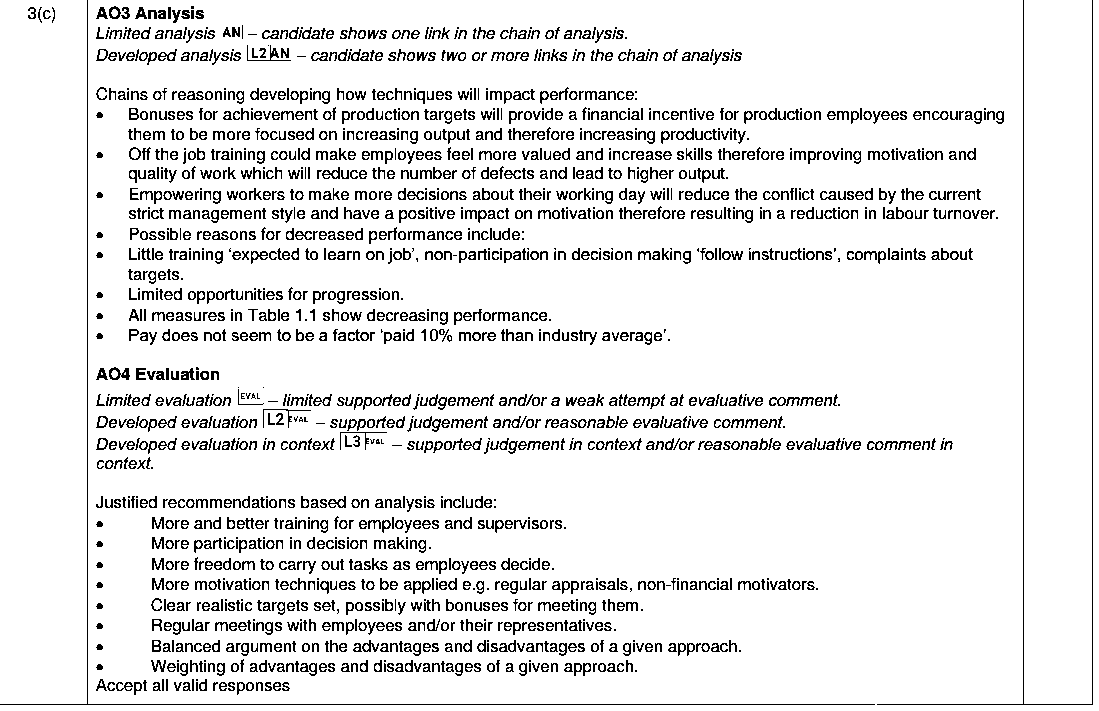
(c) Evaluate the best approach for WS to improve the performance of its production employees. [12 marks]

🔒 Unlock every Quality management question from 2020–2024
All 9 come with their mark schemes, answers and case studies, and appear in the practice tool above once you’re signed in. It’s free.
Questions and mark schemes are from past Cambridge papers and are reproduced for revision. Topical Vault is an independent revision resource, not affiliated with or endorsed by Cambridge Assessment International Education.
Each topic opens this practice tool with only that topic’s questions, plus how often it comes up and every question on it in one list.