Cambridge 9609, Paper 3 & 4. 330 questions, 2020 to 2026.
Topic
Year
Case studies and questions retyped from the original Cambridge material; Paper 3 mark
schemes are cropped from the official mark scheme PDFs, Paper 4 mark schemes are retyped as text.
A few 2020–2022 Paper 3 case studies were recovered by OCR from a damaged source file —
those are marked where it applies.
About Marketing strategy
Questions on marketing strategy: marketing planning, a coordinated and consistent marketing strategy, the role of IT and AI in marketing, and how to enter international markets.
29 past paper questions on this topic since 2020, across 15 exam sessions.
How often it comes up
Year
Paper 3
Paper 4
Total
Chart
2026
0
1
1
2025
1
4
5
2024
2
1
3
2023
3
4
7
2022
5
0
5
2021
4
0
4
2020
4
0
4
Every 2025–2026 question on Marketing strategy
The whole topic on one page, with answers and mark schemes. Printing this page prints just this list.
Paper 3 · Business decision-making (case study) (1)
Case study: We Care Products (WCP)
WCP was started in 2015 in Australia by Aldin. He wanted to use his enterprise skills for the benefit of society. Aldin persuaded several of his friends and family to invest and WCP was set up as a private limited company. WCP manufactures toilet paper using sustainable resources. Aldin wants WCP to be a profitable company, selling its toilet paper in high income countries. Aldin also has important social objectives for WCP. WCP donates fifty percent of all profits after tax to its own charity that works in low-income countries to provide better toilets and improve sanitation.
External influences
Inflation has been rising and economic growth is slow in all the main countries where WCP sells its products. Governments in these countries have increased interest rates.
There is increasing environmental awareness and higher income earners continue to buy ethically sourced and produced products.
Marketing
All WCP sales of its toilet paper are currently made through its website. The toilet paper is sent directly to customers from distribution centres in the US, Europe and Australia.
Customers have to order toilet paper in large quantities. WCP has a loyal customer base of ethically-minded customers who are prepared to pay premium prices for its toilet paper.
WCP’s toilet paper is presented in distinctive packaging. The packaging is brightly coloured and recyclable, displaying the WCP company logo and its slogan ‘We Care’. Effective customer relationship marketing ensures that customers are reminded to reorder toilet paper and are also kept up-to-date with the WCP charity’s projects worldwide.
Aldin wants to start selling WCP toilet paper in supermarkets in Europe. WCP need to decide on an appropriate integrated marketing plan to sell its toilet paper through supermarkets.
Elasticities
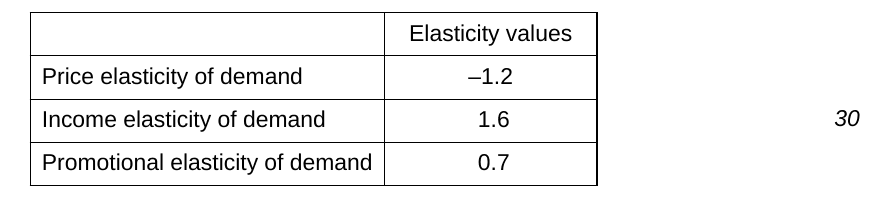
Using sales figures from the last two years, Aldin has estimated the elasticity data for online sales of the WCP toilet paper product. These estimates are shown in Table 1.1.
Table 1.1 Elasticity data for online sales of WCP toilet paper
Possible takeover
Aldin is always considering ways to expand WCP. WCP has the opportunity to take over GC, a successful company based in the US that manufactures eco-friendly paper products. Aldin thinks that this takeover would be an effective way for WCP to increase its scale of operations. Aldin is trying to raise the finance for the $8 million required to take over GC. He is considering raising this through long-term bank loans. However, WCP’s Finance Director has suggested that they
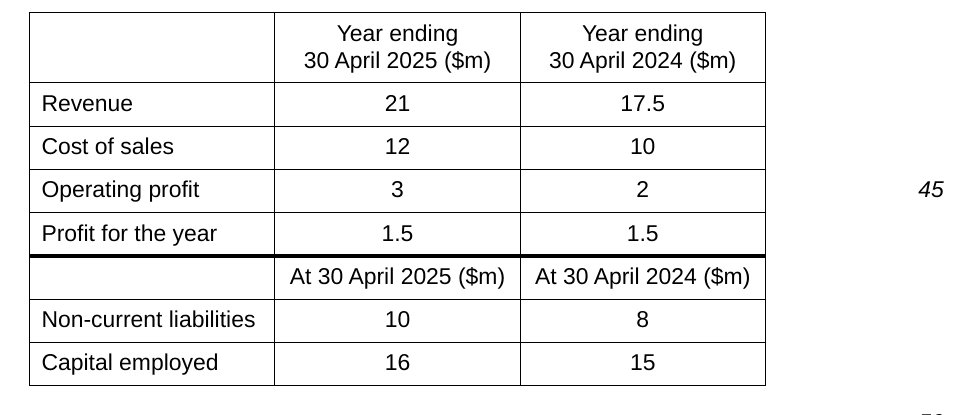
might convert WCP to a public limited company and raise the finance required through a share flotation. Table 1.2 shows extracts from WCP’s financial statements.
Table 1.2 Extracts from WCP’s financial statements
Human resources
Aldin supports creativity in WCP employees and rewards innovative ideas. All WCP employees have full-time permanent contracts and are paid above average salaries. Employee requests for flexi-time are granted whenever possible, as Aldin believes that work-life balance is important. Employees are offered relevant training to help develop their careers with promotion opportunities. Labour turnover is low and WCP has gained a reputation as an ethical employer.
The human resources management (HRM) approach at GC is quite different to WCP. The aim of GC’s approach is to minimise unit labour costs. Production line employees are paid the national minimum hourly wage and most have part-time or zero hours contracts. Team leaders on each production line are set daily targets and monitor employees’ work to ensure these are achieved. Labour turnover is high and employees complain about boring jobs and low pay.
If the takeover goes ahead, Aldin will consider whether to change the HRM approach at GC to be the same as the current HRM approach at WCP.
Question 4May/Jun 20259609/3316 marks
(a) Use the data in Table 1.1 and Table 1.2 and assume no other changes. [4 marks]
(b) Evaluate the most important element of a new marketing plan for WCP to sell its toilet paper through supermarkets. [12 marks]
Show mark scheme
Paper 4 · Business strategy (case study) (5)
Case study: App Hazard (AH)
AH is a private limited company. It is a software business that specialises in messaging apps for smartphones. AH’s most popular app is called Rotate which is free to download and use. AH makes revenue by selling advertising space on Rotate to businesses. AH releases new software updates for Rotate regularly.
Timeline of AH
2025 July AH’s managing director presents a SWOT analysis (see Appendix 1) at the annual general meeting (AGM). AH develops a new version of Rotate, version 5.0. This is the biggest change to the software since it was launched. It contains a critical security update. Rotate version 5.0 passes AH’s quality control.
2025 August AH releases Rotate version 5.0 on 1 August. Many complaints are received (see Appendix 2). Rotate becomes a major news story. The board of directors eventually calls an emergency board meeting on 15 August. The operations director assures the board that version 5.1 will be released within five days to resolve the issues. The board agrees to inform customers and the media about version 5.1 and to increase the number of customer service advisors. The marketing director believes that AH should issue a public apology. Rotate version 5.1 is released and solves the issues. 2025 September Many news agencies continue to contact AH about Rotate 5.0. The marketing director resigns from her job and gives an interview to a global news agency (see Appendix 3).
2025 October A number of industry experts advise customers to delete Rotate from their smartphone. One of AH’s main competitors advertises their messaging app as ‘safer than Rotate’. Advertising revenue from Rotate falls by 50%. Use of Rotate falls for the first time since its launch. 2025 November The board of directors dismisses the managing director and operations director from AH.
2025 December A new managing director is recruited and is interviewed by a technology magazine (see Appendix 4).
2026 January Rotate is removed from online stores and will no longer be supported by AH.
Developing a marketing strategy
AH has developed a new messaging app called Candlestick. Candlestick has more features than any of AH’s competitor products and testing has been very positive. The new marketing director has been told to develop an appropriate marketing strategy to successfully launch the Candlestick app.
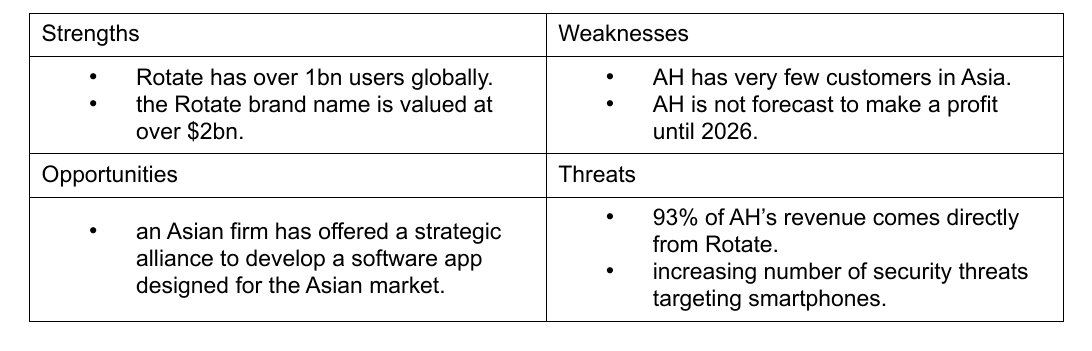
Appendix 1: SWOT analysis of AH in July 2025
Appendix 2: data about complaints received after Rotate version 5.0 is released in August 2025
The number of complaints received by AH increases by 500%.
Main issues involve: Data security – contact and banking data is being stolen from smartphones. Rotate stops working and forces the smartphone to power down. Messages being sent to the wrong person.
AH’s customer service advisors are overwhelmed and customer waiting times increase from 8 minutes to 3 hours.
Appendix 3: extract from an interview given by former marketing director of AH in September 2025
‘It was a disaster waiting to happen. I tried to make the managing director aware of the problems, but he would not listen and that is why I had to resign.
I have no confidence in the future of the business.’
Appendix 4: extract from an interview with the new managing director in December 2025
‘AH apologises for the disruption caused by Rotate 5.0. We have decided to remove the Rotate app from all online stores in 30 days and will be releasing our new messaging app next year.’
Question 2May/Jun 20269609/4120 marks
Advise AH on an appropriate marketing strategy to successfully launch the Candlestick app. [20 marks]
Show mark scheme
AO1 Knowledge and understanding
Knowledge (max 1 mark) can be awarded for any relevant business knowledge about business strategy, marketing; elements of marketing, including:
Responses may include:
The elements of a marketing strategy, including:
The nature of marketing
The purpose of marketing
Market research
The marketing mix
Product – USP, quality, features of
Price – and pricing strategies
Promotion – advertising, social media
Place – New Asian market – target segmentation new market targeting
Pan-global marketing
Elasticity
Product development (including R&D)
Sales forecasting
Marketing strategy
Marketing plan (objectives, resources, research, marketing mix)
Marketing planning
Consistency with the business, product, market
Coordinated marketing strategy
Ansoff Matrix (use of to help with decision making)
Marketing objectives
IT and AI in marketing Do not accept discussion of Blue Ocean or Red Ocean, PESTLE, SWOT, Porters 5 Forces or other strategic business tools.
Award for any explanation of relevant business knowledge, up to a max of 2 marks.
AH can use the Marketing mix to design a marketing strategy. Some basic knowledge about marketing, so only K.
AH can use the Marketing mix to design a marketing strategy, for example they can 1 K for identification and focus on the Product and ensure adequate R&D is completed to ensure there are no bugs 1 DEV for a point of. explanation AH can use the Marketing mix to design a marketing strategy, for example they can 1 K for identification and focus on the Product and ensure adequate R&D is completed to ensure there are no bugs 2 DEVs for two points of and that the additional features really do work before using this aspect in their explanation Promotional campaign.
No other AO2, AO3 OR AO4 marks can be awarded without AO1.
AO2 Application
Appendix 1 – SWOT analysis
Over 1 bn users globally
Brand valued at over $2 bn
Few customers in Asia
No profit until 2026 (forecast)
Purchase offer from major social media platform
Strategic alliance to enter Asia under consideration
93 per cent of AH revenue from Rotary
Increased risk of security threats (hacks)
Rotary v5 released in August 2025
Immediate complaints received (Appendix 2)
Complaints increased by 500%
Contact and banking data being stolen
Forces smartphone to power down
Messages being sent to wrong people
Customer waiting times from 8 minutes to 3 hours#
V 5.1 to be sent within five days.
Marketing Director believes AH should apologise publicly
Rotary 5.1 is released in August and solves issues of v5.0
News agencies continue to contact AH in September
Marketing Manager resigns and gives interview
No contingency plans in place
‘Disaster waiting to happen’
MD did not listen to Marketing Director
Has ‘no confidence’ in the future of the business
Experts advise AH customers to delete Rotary from smartphones
Competitor advertises as being ‘safer than Rotary’
Use of Rotary falls for first time since launch
Managing Director and Operations Director dismissed in November 2025
New Managing Director is recruited in December 2025
Issues apology for Rotary v5.0
Removes Rotary app from all online stores
New messaging app will be released next year
Rotary app removed from online stores in January 2026
Rotary no longer supported from January 2026
AO3 Analysis
(L1 Analysis – limited analysis of element(s) of a marketing strategy, L2 Analysis – good analysis of element(s) of a marketing strategy, L3 Analysis – this then needs to be counterbalanced to get to L3. If a candidate does this twice, they will gain 8 marks.
Analysis is likely to be based on the marketing strategies AH could use to launch the new product ( and and ), including:
Setting marketing objectives; gives focus for the other elements of a marketing strategy – likely to lead to a more coordinated marketing strategy – better chance of success.
Resources – AH has experience of selling and maintaining Rotate which may mean that the business has appropriate resources to launch Candlestick – however, due to the poor reputation of Rotate, AH may need to significantly change the way they operate to not be associated with Rotate anymore.
Research – will AH’s previous (assumed) research still be relevant. If not then they may need to spend significant money to research Candlestick, especially with a global market, in a dynamic environment – however, Rotate was being sold up to November 2025 and AH may have good research for the majority of the past – less cost than a new business in the market.
Product – AH may be able to use many aspects from Rotate – reducing development costs – however, this may tarnish Candlestick’s reputation from being associated with Rotate – reduced uptake of new app – lower revenue opportunities.
Price – Rotate was free to download and use – so Candlestick could be released for free – increased number of users
increased advertising revenue.
However if Candlestick has to be paid for this might give customers some confidence of the level of quality – also increase AH’s revenue – however, less users may lead to less advertising revenue.
Promotion – Many apps are advertised on TV (especially games apps) and for a global product, such as Candlestick, mass media is likely to be seen by a large number of potential customers – increasing revenue – however the cost of globally advertising Candlestick would be very high and likely to be unaffordable for AH, especially after the crisis of Rotate.
Many apps are promoted in combination with other apps. AH may consider a joint venture with another business who have complimentary goods. Cross promotion may allow AH to target specific market segments – lower cost than mass media advertising – however likely to take longer to engage enough customers.
•
Place – most apps are ‘sold’ on the Apple app store or Google play store (online shops) – wide audience – more likely to attract a large number of customers – however likely to be expensive and reduce AH opportunity to meet their profit forecast for 2026.
AO4 Evaluation
Evaluation ( and and ) including:
Candidates MUST answer the question –.what strategies will help improve performance at AH. The development and support of this judgement will help them to move through L2 and L3.
To award L3 the answer must be in context and draw upon the previous analysis.
A judgement over the appropriateness of the chosen marketing strategy.
A judgement over the likely success of the chosen marketing strategy.
A judgement over the best marketing strategy.
What the judgement(s) may depend upon; the reactions of competitors, the dynamism of the external environment, the likely development of technology, the reactions of customers to the failure of Rotate etc.
Weighing up of the likely success of the marketing strategy for the future success of Candlestick.
No credit (limited supporting evidence) with context) supporting evidence) AH should AH should focus AH should focus on the quality and AH should focus on the quality and features focus on the on the quality and features of the new product in their of the new product in their strategy as this is Product in features of the strategy as this is the most the most important aspect when launch this their strategy new product in important aspect when launch this type of product. As they lost 50 per cent of their strategy as type of product. This will help their customers through the inadequate this is the most support with regaining customers product development of Rotate 5.0. This will important aspect confidence. help support with regaining customers when launch this confidence type of product.
Accept all valid responses.
Case study: Fashion Market (FM)
FM is a retailer of low-price clothing. It opened its first store in country X in 1978. FM became a public limited company in 2010 with 150 stores in country X.
Fashion changes very frequently and so there is a fast changeover of clothing designs. FM’s customers are often unsure how long clothing designs will be in store. This encourages FM’s customers to purchase items as soon as they are available. Until 2020, FM’s promotion relied mainly on customers telling their friends and family about the clothing designs available in store.
FM’s marketing objective is to grow revenue faster than its competitors in all markets it operates in.
Timeline for FM
2020A new Chief Executive Officer (CEO) is appointed. The CEO wants to make major changes to FM’s marketing strategy.2021The CEO convinces FM’s board of directors to start an ambitious international distribution plan (see Appendix 1).2022FM launches a range of sustainable clothing. This causes problems for FM and its pricing policy (see Appendix 2).2023Digital promotion campaign launched across stores. Digital in-store displays and a social media campaign using #fashionmania to advertise clothing and attract customers to FM’s new website (see Appendix 3).2024The directors review the performance of FM and the recent changes to its marketing strategy under the current CEO (see Appendix 4). Development of a new business strategy FM wants to achieve global growth as well as ensure profitability for its shareholders. Some directors think a blue ocean strategy approach should be used to develop a future business strategy. However, other directors think approaches focusing on the external environment would be more appropriate for FM. -
Appendix 1: Extract from CEO’s international distribution plan (2021)
To open 25 stores across 7 high-income countries.
Market research into potential new international locations for stores will cost $10m.
New distribution warehouse to be built at a cost of $30m.
Pan-global marketing to be used to target customers.
Forecasted annual international sales of $180m.
Appendix 2: Operations Director’s report on the impact of the sustainable clothing range (2022)
Average fabric costs 35% higher for this range than existing clothing ranges.
Average prices 25% higher for this range than existing clothing ranges.
FM blamed for using suppliers who have been discovered to use unethical practices, FM’s public relations costs tripled to deal with this.
21% of total sales volume from new sustainable clothing range.
FM accused of misleading customers who question the sustainability of a $2 t-shirt.
Appendix 3: #fashionmania campaign plan (2023)
Boost sales after the closure of stores during the global pandemic.
Use of #fashionmania to collate online images from social media to promote clothes.
Create areas in store where bloggers can take pictures of themselves in FM’s new clothes to post online.
Use website as a medium to show new clothing designs and customers’ #fashionmania pictures.
Sponsor a reality TV programme to promote clothing ranges.
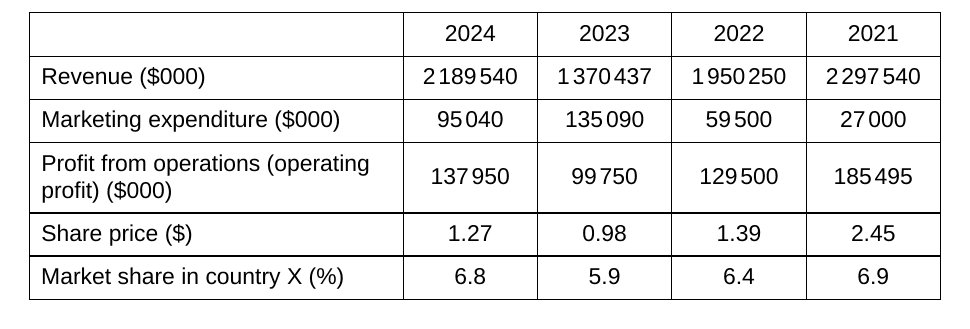
Appendix 4: Selected financial and marketing data for FM
Question 1Oct/Nov 20259609/4120 marks
Evaluate FM’s marketing strategy between 2021 and 2024. [20 marks]
Show mark scheme
Responses may include:
AO1 Knowledge and understanding
The elements of a marketing strategy
objectives
resources/budget
research
marketing mix
product – product life cycle, Ansoff matrix
price
promotions
place, use of international distribution channels
marketing planning
need for co-ordinated planning of marketing strategy
international marketing, including developing an international market through pan-global marketing or maintaining local differences
the changing role of Information Technology (IT) and Artificial Intelligence (AI) in marketing Award for any explanation of an element of marketing strategy, up to a max of 2 marks Product Identification of an element of marketing strategy, so only K. a product that is sold,.
Product, involves the design, quality and uses of 1 K for identification and 2 DEVs for two points of a product that is sold,. Product can also involve explanation after-sales service, so customers can return faulty goods.
Note – candidates can gain full marks for AO1 from one term that is explained ( + + ) or from two terms partially explained ( + and + ).
No other AO2, AO3 OR AO4 marks can be awarded without AO1.
AO2 Application
Application (max 2 marks) can be awarded for applying knowledge, analysis or evaluation of FM marketing strategy including:
Candidates must apply their answers to marketing and marketing strategy.
traditional word of mouth advertising
low investment in advertising pre-2020
sustainable clothing range marketing investment almost double (App2)
PR spend up in 2022 – overall marketing increases by $70K - use of annual figures (App4)
social media usage is changing approach
digital in-store displays
digital promotion campaign
use of new website
marketing spend is starting to fall but more than three times bigger than 2021
elements of #fashionmania strategy – social media/sponsorship of TV programme
retailer of low-priced clothing
fast changeover of clothing designs
use of market research into potential new international locations for stores – cost $10
to open 25 stores across 7 high income countries
Note: this list is not exhaustive, any marketing context used from the appendices can be rewarded if used correctly
AO3 Analysis
Candidates need to identify an element of the marketing strategy and provide developed analysis to get to L2, this then needs to be counterbalanced to get to L3. If a candidate does this twice, they will gain 8 marks. ( and and )
Low pricing is part of their unique selling point and has been their ‘Blue Ocean Strategy’ from the start and served them and their market well
PR costs have tripled – not really part of the advertising but is part of media image that has been managed by the expose of FM to unethical suppliers. This increase in costs may have contributed to 25% increase in price. This could lead to customers no longer seeing FM as good value either because prices have risen or because of unethical suppliers.
#fashionmania driven by customers and still allows FM to gain free advertising
Above the line spend is still low but the #fashinmania strategy requires advertising materials in store which costs money.
Product has essentially stayed the same throughout, with low price point as driving factor. Keeps market share of existing customers who are now sharing their finds on social media.
Note – analysis can only be awarded for the marketing strategy between 2021 and 2024 and not what they should/can do in the future.
AO4 Evaluation
Candidates MUST answer the question – a judgement on the strategy between 2021 and 2024. The development and support of this judgement will help them to move through L2 and L3. Evaluation ( and and ) including:
To award L3 the answer must be in context and draw upon the previous analysis.
Evaluation will depend on what points have been made about the marketing strategy FM have used.
A judgement over how much of the word of mouth is still being used? They were spending £27m in 2021 so must be undertaking more than word of mouth advertising. Is this marketing responsible for recent success?
A judgement over how launch of any programme would require more marketing/PR to ensure that new direction of the business is clear to all stakeholders so there should be an increase in marketing spend.
A judgement over how marketing has been successful as while sales dropped – potentially from ethical exposure – they have soon recovered, and customers seem to have forgiven them for the 25% increase in price.
A judgement over how marketing has been successful in recovery of the programme, but it also exposed them in the first place – has the sustainability program helped the company improve its market share? Has it caused more bad publicity for FM than they brought in revenue?
A judgement over how #fashionmania strategy still costs money in store – how much compared to advertising? Is this more cost effective? TV sponsorship is first real entry into big above the line promotion, will this add to cost and ultimately price? What effect will this have on demand?
A judgement over how CEO’s decisions have caused the increase in marketing– could FM refocus on their core values and approach for their future expansion and abandon – fast cheap fashion?
A judgement over how success may be dependent on how much they have recovered from the ethical scandals including the recovery in revenue.
Accept all valid responses.
No Credit L1 including: (limited L2 including: (developed L3 (developed supporting supporting evidence) supporting evidence) evidence with context) FM FM marketing strategy was FM marketing strategy was FM marketing strategy was marketing successful between 2021 and successful between 2021 and successful between 2021 and strategy 2024 because it has regained its 2024 because it has regained its 2024 because it has regained its was market share market share. This demonstrates market share where it dropped to successful their marketing strategy have 5.9% in 2023 and regained to supported them in recovering 6.8% in 2024. This demonstrates from the ethical scandal their more recent marketing strategy has supported them in recovering from the ethical scandal in 2022.
FM FM marketing strategy was not FM marketing strategy was not FM marketing strategy was not Marketing successful because the increased successful because the increased successful because the increased strategy marketing expenditure was not marketing expenditure was not marketing expenditure $27m to was not reflected in increase revenue reflected in increase revenue. $95.04m was not reflected in successful This shows that they have not increase revenue (decreased recovered well from their ethical from$2297.540m to $2189.54m. scandal and have been unable to This shows that they have not meet their objectives set in 2022. recovered well from their ethical scandal and have been unable to meet their objectives set in 2022.
Case study: Sarah’s Headsets (SH)
SH designs and manufactures a range of gaming headsets. SH is a private limited company based in country D. It employs leading technology specialists to develop innovative products. SH’s gaming headsets are sold through specialist computer game stores across country D. SH’s competitive advantage is innovation.
SH was set up by Sarah 20 years ago. She started the business with five employees. By 2017 SH employed over 520 people and had customers throughout country D.
Timeline of SH
2017Sarah develops a marketing strategy to support SH’s growth aim (see Appendix 1). The strategy focuses on technical innovation to offer customers a clear sound quality. There is rapid economic growth in country D.2019One of SH’s products is voted the ‘Best Gaming Headset in country D’ in a leading consumer survey. SH gains much media coverage, which helps to boost its brand image.2021Annual revenue peaks (see Appendix 2). SH has a 45% share of the gaming headset market in country D and is the market leader.2023NHT is a major international gaming headset manufacturer. NHT launches a range of gaming headsets in country D in competition with SH. Sarah considers that SH’s gaming headsets are more technologically advanced than NHT’s. Country D’s economy goes into a recession.2025SH’s market share in country D is falling and NHT is forecast to become the market leader. NHT’s products are half the price of SH products. Sarah produces an analysis of the financial data (see Appendix 3).
Developing a new business strategy
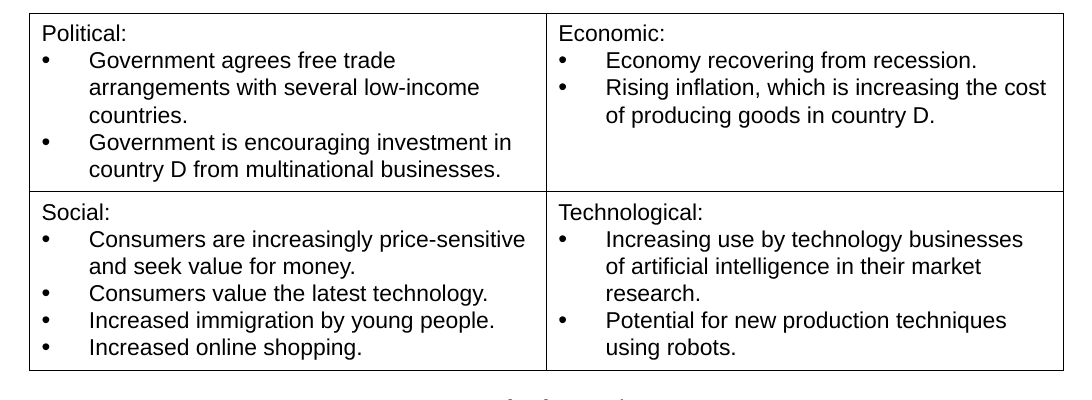
Sarah was concerned about the reduction in SH’s profitability. She asked an external management consultant to produce a PEST analysis (see Appendix 4) that she could use to develop a new business strategy to enable SH to return to profitability.
Appendix 1: Summary of Sarah’s 2017 marketing strategy for SH
Objective – to become market leader for gaming headsets in country D by 2025.
Primary market research:
70% of all gaming headsets sold in country D are purchased by consumers under 30 years old.
65% of people said that range of features was the most important consideration when buying a new gaming headset, with price coming second.
Planned marketing mix:
Product – continual upgrading of gaming headsets to include the latest technological features.
Price – price skimming for all headsets in the SH range.
Promotion – extensive advertising on digital platforms and television/billboard campaigns. Product endorsement with a popular celebrity.
Place – gaming headsets sold in specialist computer game stores throughout country D.
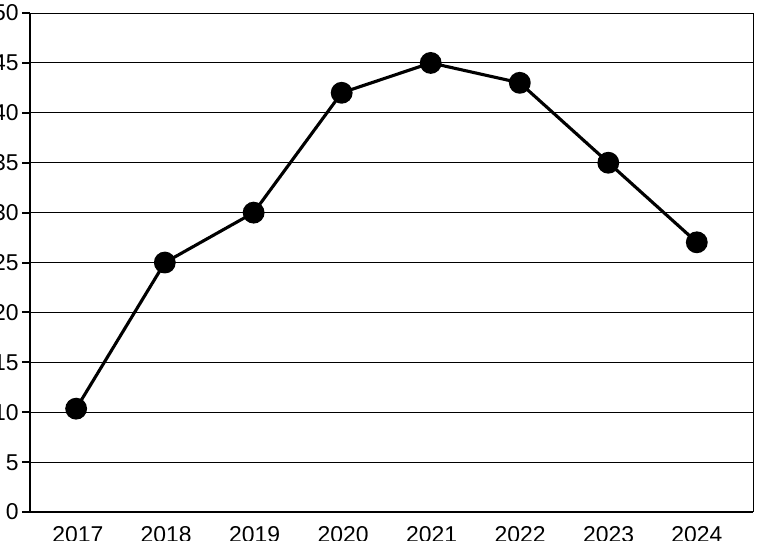
Appendix 2: SH’s annual revenue data between 2017 and 2024
2017 2018 2019 2020 2021 2022 2023 2024 Year
Appendix 3: Analysis of SH’s financial data between 2017 and 2025
Appendix 4: Summary of consultant’s PEST analysis (2025)
Question 1Oct/Nov 20259609/4320 marks
Evaluate the effectiveness of SH’s marketing strategy between 2017 and 2025. [20 marks]
Show mark scheme
Responses may include:
AO1 Knowledge and understanding
Knowledge (max 1 mark) can be awarded for knowledge about marketing strategy, can be awarded for understanding of the operations strategy up to two marks including:
Planning the marketing strategy (a) the contents of a marketing plan: objectives, resources, research, marketing mix (b) the benefits and limitations of marketing planning
Approaches to marketing strategy (a) the need for the marketing strategy to be consistent with the business, the product and the market (b) the need for and development of a coordinated marketing strategy (c) the development of marketing strategies that are focused towards achieving specific marketing objectives (d) the changing role of Information Technology (IT) and Artificial Intelligence (AI) in marketing
Strategies for international marketing (a) the implications for marketing of increased globalisation and economic collaboration (b) the importance of international marketing for a business (c) international markets – identification, selection and entry (d) whether a business in a given situation should develop an international market through pan -global marketing or maintain local differences (e) choosing a strategy, in a given situation, to develop a global market (f) the factors influencing the method of entry into international markets
Knowledge of how to plan a marketing strategy (do not reward repetition of the contents of Appendix 1, but further knowledge of the elements is rewardable) Marketing strategy involves the marketing mix. Some basic knowledge about Marketing strategy involves the marketing mix. Which includes the 4 Ps Price, 1 K for identification and 1 DEV Marketing strategy involves the marketing mix. Which includes Price, Product, 1 K for identification and 2 DEVs
Note: – Candidates can gain full marks for AO1 from one term that is explained ( + + ) or from two terms partially explained ( + and + ).
No other AO2, AO3 OR AO4 marks can be awarded without AO1.
AO2 Application
Application (max 2 marks) can be awarded for applying knowledge, analysis or evaluation of marketing strategy to SH between 2015 and 2025, including:
SH was set up by Sarah 20 years ago
Employs technology specialists to develop innovative products
Innovation is the company’s competitive advantage
Rapid growth from 5 to 520 employees in 20 years
Private limited company
Products sold via a specialist computer game stores
Created marketing strategy in 2017
Aim of marketing strategy is to become market leader for gaming headsets in country D by 2025
Economic boom in 2017
SH’s product is voted ‘Best Gaming Headset in country D’ in leading consumer survey in 2019
Annual revenue peaks in 2021
45% share of gaming headset market in 2021 – SH was market leader
Economic recession in 2023
NHT launched a competing range of gaming headsets in 2023
SH’s products are more technologically advanced than NHT’s
NHT’s products are half the price of SH’s headsets
SH’s market share falls in 2025 and NHT becomes the market leader
AO3 Analysis ( and and );
Analysis is likely to be based on SH’s objective in 2017 to become the market leader for gaming headsets in country D (Appendix 1).
Analysis of the objective. The marketing strategy is focused on internal factors, e.g. technological innovation. Does it consider the impact of changes in the external operating environment?
Price skimming strategy – helps to recoup the initial investment into developing the technology but may not work in an economic recession and/or with competition from a rival selling cheaper products.
Focus on digital marketing and television/billboard advertising. Also product endorsement with a popular celebrity.
Headsets sold through specialist computer game stores – no online retail options.
Market research shows that consumers value technological advancements when choosing a gaming headset. Price is second most important consideration. However does the economic climate affect the priorities?
70% of gaming headsets are bought by consumers under 30 years old – how does this affect the marketing strategy?
Candidates’ analysis must be business facing. They may identify an element of marketing strategy and provide developed analysis to get to L2, this then needs to be counterbalanced to get to L3. If a candidate does this twice, they will gain 8 marks.
A clear multi strand answer is accepted showing a connection between a developed L2 Analysis with another developed L2 analysis.
AO4 Evaluation
Evaluation ( and and ) including:
Candidates MUST answer the question – how effective was SH’s marketing strategy between 2015 and 2025. The development and support of this judgement will help them to move through L2 and L3. To award L3 the answer must be in context and draw upon the previous analysis.
Evaluation will largely depend on the points raised in the analysis.
A judgement on the success of the marketing strategy between 2017 and 2025.
Discussion over how the success of the marketing strategy can be judged and what that judgement could depend upon; link to the marketing objective in 2017, other measures of success for a private limited company (profitability, profit, shareholder’s objectives, measures of size).
The marketing strategy should develop over time. The strategy was developed in 2017 – should it be revisited more often than after eight years?
The extent to which the success of SH between 2017 and 2025 is based on the marketing strategy or other factors.
Other external influences on SH between 2017 and 2025 other than the marketing strategy (e.g. the state of the economy; economic growth) social factors (e.g. interest in the latest technology amongst consumers), technological factors (e.g. increased time to play computer games in 2020/2021 due to the pandemic), lack of competition.
Accept all valid responses.
No credit
L1 including: L2 including: (developed L3 (developed supporting (limited supporting evidence) evidence with context) supporting evidence) SH’s marketing SH’s marketing SH’s marketing strategy was not SH’s marketing strategy was not strategy was not strategy was not effective because it is not effective because it is not achieving effective effective because it achieving its objective of becoming its objective of becoming the market is not achieving its the market leader as the annual leader as the annual total revenue objective of total revenue is falling is falling to 26 million dollars and becoming the NHT is forecasted to be the market market leader leader instead leading to SH losing market share.
The effectiveness The effectiveness of The effectiveness of the marketing The effectiveness of the marketing of the marketing the marketing strategy depends upon the strategy depends upon the external strategy depends strategy depends external market environment SH is market environment SH is in. If the upon the market upon the external in. If the environment is overall not environment is overall not market environment performing well then, we would performing well then, we would SH is in. expect that the marketing strategy expect that the marketing strategy might not be as effective because might not be as effective because of of external factors that negatively external factors that negatively affect it affect it. In 2024 Country Ds economy was in recession so NHT the competitor was performing better as their prices are half of SH’s prices.
Case study: Questions Answered (QA)
QA is a technology business located in country A. It sells Artificial Intelligence (AI) devices that answer questions in consumers’ homes. These devices are called ‘smart speakers’. Consumers can link the device to other smart technology in their homes, such as fridges and televisions. Consumers can ask the device questions and it uses an internet connection to find the answers.
QA started trading in 2016 and demand for its first device QA1 was high. However, after the pandemic in 2021, the owners decided to sell the business. It was bought by QA’s senior management team.
Timeline of QA
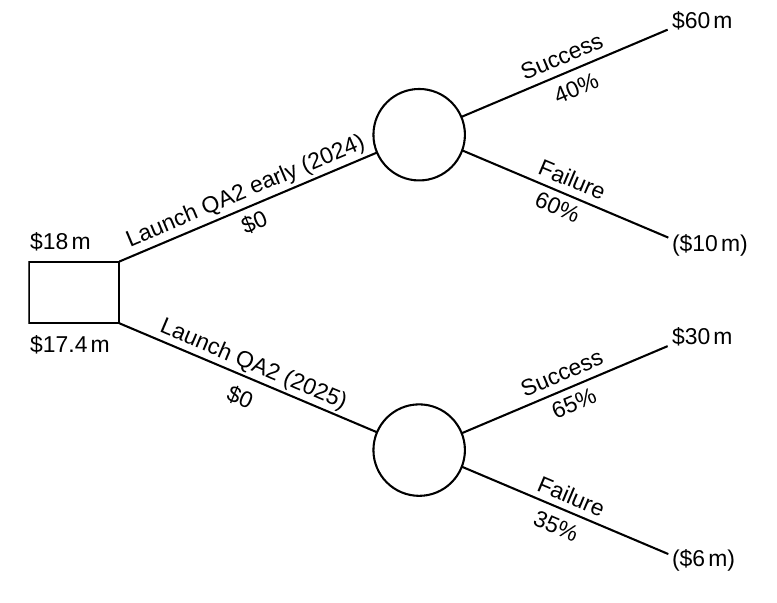
2021Senior management team purchases QA for $20m. It becomes a private limited company owned by eight senior managers. They are now the directors of the company. Shares are equally split. Directors complete a SWOT analysis of the business (see Appendix 1).2022The Marketing Director uses the Ansoff matrix as a basis for recommending that QA focuses on product development. QA starts to develop QA2, a next generation smart speaker with many unique functions.2023Sales of QA1 enter the decline stage of product life cycle. QA makes a loss for the first time. The directors use a decision tree to help them decide whether to launch the QA2 early in 2024 or wait until the planned launch in 2025 after more testing (see Appendix 2). The decision is made to launch the QA2 early.2024QA2 is launched. Sales are higher than expected as QA is the first to market with a next generation device. This leads to excess demand. QA is unable to increase supply. QA launch a website to show inventory availability at retail outlets. Complaints from customers about QA2. Research is commissioned about QA2 (see Appendix 3). QA makes a public apology.
Developing a marketing strategy
Sales of QA1 are in decline and there is poor public perception of QA as a business. The QA2 device has now been more fully tested and improved and needs to be relaunched. The business needs to develop a coordinated marketing strategy to achieve success with QA2.
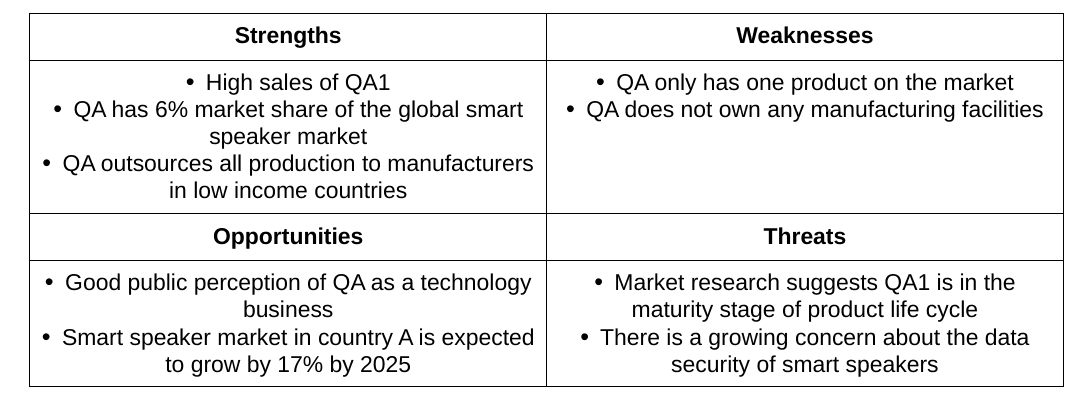
Appendix 1: Extract from SWOT analysis of QA in 2021
Appendix 2: Decision tree for the launch of QA2
Appendix 3: Market research of QA2 in 2024
18% of QA2 devices were returned as faulty. All customers were given a free replacement product.
72% of customers thought the price was too high.
An estimated 4m potential customers were unable to purchase a QA2 due to a lack of supply.
65% of customers would not recommend the QA2 to someone else. The main concerns were: poor product quality high price did not meet expectations given in promotional materials.
Question 2May/Jun 20259609/4220 marks
Advise QA on a coordinated marketing strategy for the future success of QA2. [20 marks]
Show mark scheme
AO1 Knowledge and understanding
The elements of a coordinated marketing strategy:
Objectives
Resources / budget
Research
Marketing mix
Product – product life cycle, Boston matrix
Price
Promotion
Place
Physical evidence
Process
People Marketing strategy may also include:
the changing role of Information Technology (IT) and Artificial Intelligence (AI) in marketing
International marketing, including developing an international market through pan-global marketing or maintain local differences.
Award for any explanation of an element of marketing strategy, up to a max of 2 marks.
Product Identification of an element of Product, involves the design, quality and uses of a product that is sold. 1 K for identification and 1 DEV Product, involves the design, quality and uses of a product that is sold. 1 K for identification and 2 DEVs goods.
Note: Candidates can gain full marks for AO1 from one term that is explained ( + + ) or from two terms partially explained ( + and + ).
AO2 Application
Application (max 2 marks) can be awarded for applying knowledge, analysis or evaluation of a coordinated marketing strategy, to QA, including:
Technology business located in country A
Sells AI smart speakers
2016 first device (QA1) had high demand
Management buyout (for $20m) in 2012
2021 – QA becomes a private limited company
Use of Appendix 1 – SWOT analysis
Eight senior managers become directors with equal share split
2022 – Ansoff matrix used – product development (new product, existing market)
2022 – QA2 in development – next generation speaker with improved functionality
2023 – sales of QA1 enter decline stage of product life cycle
2023 – QA makes a loss for the first time
Use of Appendix 2 – Decision tree
2023 – decision made to launch the QA2 early
2024 – launch of QA2 (early)
2024 – sales higher than expected
2024 – excess demand, QA unable to increase supply
2024 – QA launch a website to show inventory availability at retail outlets
2024 – complaints from customers about QA2
2024 – QA makes a public apology about the QA2.
AO3 Analysis
Analysis is likely to be based on how a coordinated marketing strategy may affect the success of QA ( and and ), including:
Objectives – could include increasing market share, increasing sales, profit maximisation. Sales maximisation, satisficing etc.
Resources – outsourcing of manufacturing, previous positive brand image from QA1 (although damaged by early release of QA2), possibility of selling more shares to realise capital in QA etc.
Research – use of Appendix 3, future market research into elements of the marketing mix (when decided).
Product – QA2 – next generation smart speaker – new features that may be suggested.
Price – feedback suggests too high, so opportunity to decrease price to increase customer sales/reputation. However, may irritate customers who have previously purchased the QA2.
Promotion – competitors (Google, Apple etc) likely to have very high marketing budgets for promotion with the backing of well-known brands. QA is unlikely to be able to afford a level of promotion to battle these companies head on.
Promotion may need to be combined with other elements, such as a product feature which is unique to QA2.
Place – currently retail stores, which is a common distribution channel for smart speakers and technology. Shared shelf space with competitors may make product differentiation difficult. QA could use their own website, which may reduce the cost of intermediaries and allow for lower prices and/or higher profit margin. However, no data as to the best distribution strategy – may need to be combined with research.
AO4 Evaluation
Evaluation ( and and ) including:
Evaluation will largely depend on the points raised in the analysis.
A judgement over the likely success of the chosen marketing strategy.
A judgement over the likely coordination of the chosen marketing strategy.
A judgement over the best marketing strategy.
What the judgement(s) may depend upon; the reactions of competitors, the dynamism of the external environment, the likely development of smart speaker technology beyond 2025, the reactions of customers to the failed launch of the QA2 etc.
Weighing up of the likely success of the marketing strategy for the future success of the QA2.
Accept all valid responses.
No credit
L1 including: L2 including: (developed L3 including: (developed (limited supporting evidence) supporting evidence with supporting context) evidence) QA have to QA have to change QA have to change their promotion QA have to change their promotion change their their promotion to to succeed because of the to succeed because of the promotion to succeed because of complaints. Promotion is the best complaints with 18% of faulty succeed. the complaints. way to change the public products. Promotion is the best way perception and encourage sales. to change the public perception and encourage sales.
I advise QA to I advise QA to I advise QA to change its price I advise QA to change its price change its price. change its price because it is the first thing because it is one of the main because it is the customers look at, so that they can complaints from 65% of customers, first thing customers compare competitors’ products so that they can compare competitors’ products with QA and look at. with QA and this is likely to be the main factor affecting QA’s this is likely to be the main factor success. affecting QA’s success.
Case study: Daniel & Carl for Education (DCE)
Daniel and Carl started a company for online teaching, Daniel & Carl for Education (DCE). DCE provides online tutors who work with students to help them pass their examinations.
Timeline of DCE
2019DCE sets up as a private limited company with Daniel as the Managing Director and Carl as the Marketing Director. Carl creates a website and social media accounts. DCE’s marketing objective is to provide a premium quality service. This allows it to use price skimming.2020Revenue grows and employee numbers rise. Daniel outlines DCE’s approach to quality (see Appendix 1). Social media subscribers increase rapidly. DCE relies on word-of-mouth promotion.2021Competition increases when new businesses enter the online teaching market. Dynamic pricing is used by DCE.2022Revenue declines as students find more affordable options. Carl recommends changes to DCE’s promotion (see Appendix 2). DCE revises its marketing objectives (see Appendix 3).2023Daniel and Carl collect market research data (see Appendix 4).2024DCE offers face-to-face revision workshops in response to a fall in revenue from online tutoring.
What is next for DCE?
Competition is increasing but Daniel and Carl do not want to compromise on the quality of the service the business provides. However, they are both aware that DCE needs to change if it is to survive. Carl thinks that transformational leadership is the key to survival, but Daniel remains uncertain.
Appendix 1: DCE’s approach to quality in 2020
As a service-based business, DCE believes its employees are central to its success. All tutors are qualified teachers with at least three years teaching experience.
Students are encouraged to provide feedback which is used to adapt the service offered. In 2020, 86% of students stated that they would recommend DCE to a friend.
Appendix 2: proposed changes to DCE’s promotion in 2022
Artificial intelligence (AI) to be used to:
analyse customer searches
optimise digital promotion
target social media messages to students and parents.
Sales promotion:
DCE loyalty scheme to reward returning customers
one free lesson for every friend referred.
Appendix 3: DCE’s revised marketing objectives in 2022
1. Develop new services to increase revenue by 10% by the end of 2024 2. Maintain a strong brand identity
Appendix 4: Summary of market research data in 2023
Question 1Feb/Mar 20259609/4220 marks
Evaluate DCE’s marketing strategy between 2019 and 2024. [20 marks]
Show mark scheme
AO1 Knowledge and understanding
Knowledge (max 1 mark) can be awarded for any relevant business knowledge about marketing, including:
Marketing objectives
Demand and supply
Markets (consumer, industrial, local, national and international)
Mass and niche marketing
Market segmentation
Customer relationship marketing
Market research (primary and secondary) and sampling
The marketing mix (product, price, place, promotion)
Elasticity (price, income and promotional)
Product development, including R&D
Sales forecasting
The need for the marketing strategy to be consistent with the business, the product and the market
The need for and development of a coordinated marketing strategy
The development of marketing strategies that are focused towards achieving specific marketing objectives
The changing role of Information Technology (IT) and Artificial Intelligence (AI) in marketing
The contents of a marketing plan: objectives, resources, research, marketing mix
The benefits and limitations of marketing planning Award for any explanation of relevant business knowledge, up to a max of 2 marks.
Marketing strategy is when a business plans to meet their marketing objectives. 1 K for identification and 1 Marketing objectives may include sales maximisation and increasing market share. DEV for a point of explanation Promotion is the communication from the business to the customer. It includes 1 K for identification and 2 advertising, sales and direct promotion. The aim of promotion is often to increase DEVs for two points of explanation awareness of a product.
AO2 Application
Application (max 2 marks) can be awarded for applying knowledge, analysis or evaluation of marketing to DCE between 2019 and 2024.
DCE goal is to have high quality services which means they will have a premium brand image
Social media accounts to promote the business can be used to evaluate the marketing mix
Any use of the Market research information in context
Social media subscribers increase rapidly
DCE’s sales promotion techniques: loyalty scheme and free lessons for referrals
The use of pricing methods in context such as price skimming
10% increase in revenue objective
Use of AI
Any use of the case content in context between 2019 and 2024.
AO3 Analysis ( and and )
Analysis is likely to be based on the different marketing activities and the impact on DCE, including:
Social media allows students to access the business which will increase brand recognition as seen by the increase in subscribers this will bring in more customers and sales. However, they may be missing customers that are in different platforms therefore losing on potential sales.
The use of social media would allow the business to find out what customers want especially parents as they would be looking for online teaching business. This would allow the business to have a USP and beat the intense competition.
However, while social media can be effective has it reached the target customers effectively?
The marketing strategy failed as DCE did not achieve the goal of increased revenue by 10% as in 2022 revenue starts to decrease which would lead to less retained earnings and less ability for the business to expand. However, maintaining quality will allow them to stand out and possibly profits can start to rise.
DCE goal is to have high quality which means they will have a premium brand image this would allow them to charge premium prices increasing revenue and profits. However, the competitors have other USP that may take away customers especially if they care about affordability.
AO4 Evaluation ( and and ).
Evaluation will depend upon which element/s of marketing have been discussed previously:
DCE’s marketing strategy was successful as they were able to increase sales rapidly in the beginning specifically 2020 and have more subscribers this means they would be able to eventually achieve their 10% revenue increase. However, this depends on the intensity of competition and their ability to keep innovating to beat any external factors they may face.
DCE’s marketing strategy was not successful as the revenue decreased which means they may be struggling to have retained profits and repay any debts this would lead them to fail.
DCE’s marketing strategy was not successful as revenue decreased leading to lower profits which means they will need to apply new services and follow the new proposed marketing objectives for success. However, this success is dependent on how well they apply their upcoming product development and maintaining brand identity.
Accept all valid responses.
23 more questions from 2020–2024
🔒 Unlock every Marketing strategy question from 2020–2024
All 23 come with their mark schemes, answers and case studies, and appear in the practice tool above once you’re signed in. It’s free.
9609/42 · Feb/Mar 2024 · Question 1Evaluate the effectiveness of CC’s marketing strategy… 🔒
9609/31 · Oct/Nov 2023 · Question 5Evaluate which method CP should use to… 🔒
9609/33 · Oct/Nov 2023 · Question 2Analyse two benefits to HP of its… 🔒
+ 18 more, by year in the table above
Questions and mark schemes are from past Cambridge papers and are reproduced for revision. Topical Vault is an independent revision resource, not affiliated with or endorsed by Cambridge Assessment International Education.
A Level Business questions by topic
Each topic opens this practice tool with only that topic’s questions, plus how often it comes up and every question on it in one list.
Pick a paper, sub-topics and years to draw from (leave any blank for "all"), choose
how many questions you want, and we'll open a new worksheet page with a random set for you to review
and download.