Question 1May/Jun 20269609/328 marks
Analyse two factors that may have determined the site for the relocation of CC’s showroom. [8 marks]
Show mark scheme



Cambridge 9609, Paper 3 & 4. 330 questions, 2020 to 2026.
Case studies and questions retyped from the original Cambridge material; Paper 3 mark schemes are cropped from the official mark scheme PDFs, Paper 4 mark schemes are retyped as text. A few 2020–2022 Paper 3 case studies were recovered by OCR from a damaged source file — those are marked where it applies.
Questions on location and scale: factors in location and relocation decisions, international location, and economies and diseconomies of scale.
7 past paper questions on this topic since 2020, across 7 exam sessions.
| Year | Paper 3 | Total | Chart |
|---|---|---|---|
| 2026 | 1 | 1 | |
| 2025 | 2 | 2 | |
| 2024 | 2 | 2 | |
| 2023 | 1 | 1 | |
| 2020 | 1 | 1 |
The whole topic on one page, with answers and mark schemes. Printing this page prints just this list.
CC is a private limited company, based in country W, that sells cars. Gross domestic product (GDP) in country W has increased significantly in the last five years.
CC was set up in 2022 and for two years it traded online and from a small showroom in the centre of city A.
CC does not manufacture cars. The business buys cars directly from manufacturers and then sells these from its showroom and on its website.
In March 2024, CC purchased a large plot of land on a busy road in country W. It built a large showroom so that customers can view the cars and take them for a test drive. This investment was financed by a bank loan. In August 2024, CC relocated to the new showroom.
The new showroom building also has offices for the directors and managers and an area for internet sales. Figure 1.1 shows some data about the showroom relocation.
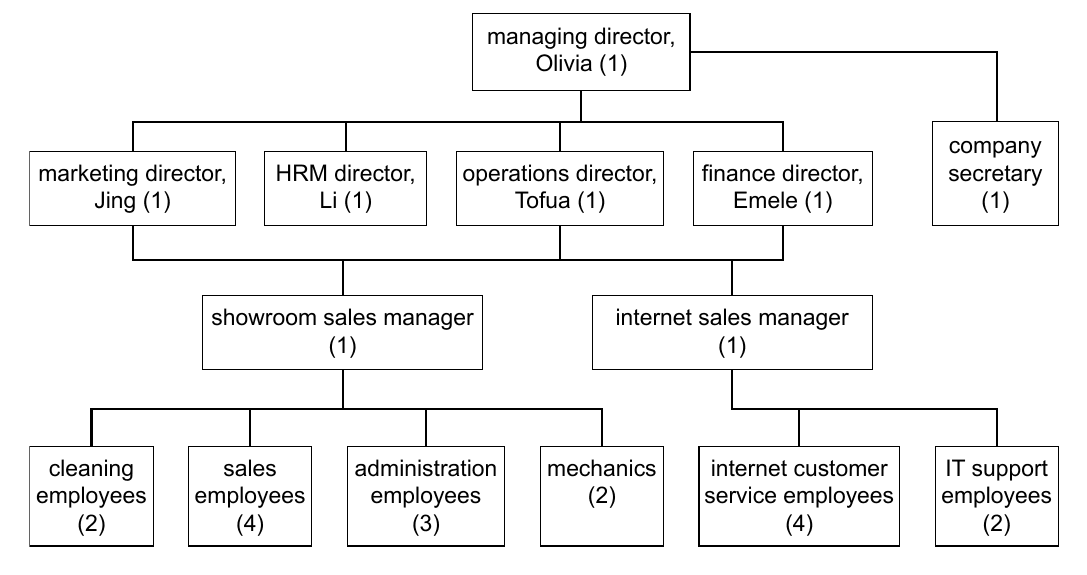
At a recent meeting of the board of directors, the efficiency of CC was discussed. Figure 1.2 shows the current organisational structure for CC in 2026. The number in brackets in each box shows the number of employees in that role.
CC’s finance director, Emele, thinks that the business has too many levels of hierarchy. She has proposed that CC delayers the company by making the showroom sales manager and the internet sales manager redundant. She has proposed that CC should invest in an Enterprise Resource Planning (ERP) programme which would take over most of the managerial functions currently carried out by the two managers.
The showroom sales employees are paid using commission based on achieving sales targets. The cleaners are paid country W’s minimum wage, and the other employees are paid a salary. The mechanics are paid a relatively high salary due to a skills shortage in country W. ERP investment appraisal
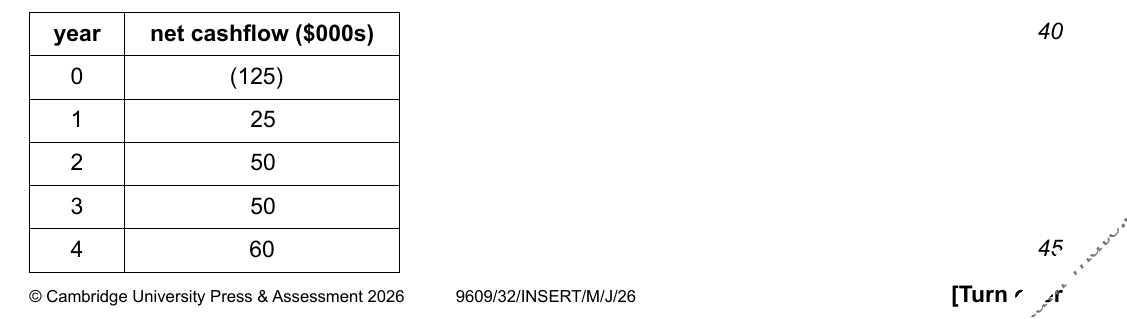
Emele has carried out an investment appraisal for the proposed ERP programme (see Table 1.1). There is no residual value for this investment at the end of its four-year life.
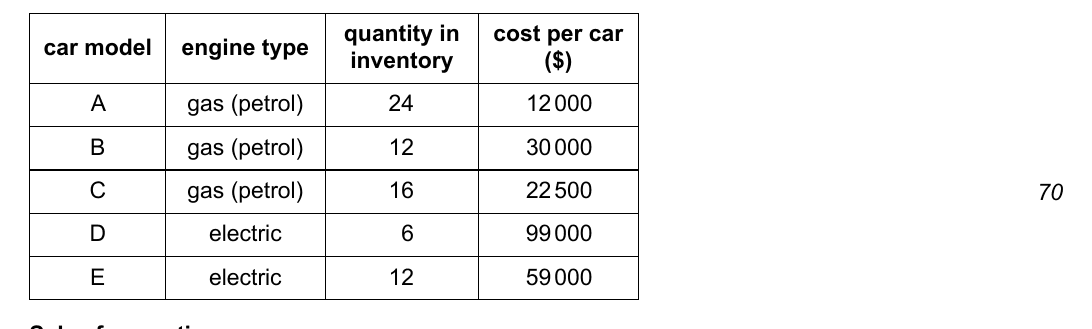
The operations director, Tofua, is more concerned about the inventory held by CC. ‘When we were located at the old showroom, we held very little inventory’ said Tofua, ‘and it worked well for us. However, since opening the new showroom, we have been holding more and more inventory, and it is causing significant opportunity costs.’ Table 1.2 shows inventory and cost data for CC.
The managing director, Olivia, thinks that reducing the inventory level in the showroom would be an inappropriate decision. She knows that many customers expect to be able to see and test drive a car before they agree to purchase it. Without inventory of the different car models CC sells, she worries that demand will decrease, especially with the current high inflation rate in country W.
Tofua has prepared a summary report of CC’s current inventory (see Table 1.3).
At a recent board meeting, Jing, the marketing director, presented the quarterly sales forecast. An extract from the quarter 3 (July to September) 2026 forecast is shown in Figure 1.3.
July and August – low sales due to customers prioritising vacations.
September – manufacturers launch new car models – high sales expected.
market trends – 35% increase in demand for electric vehicles.
Olivia, the managing director, is concerned that Jing’s forecast does not include more qualitative sales forecasting.

Analyse two factors that may have determined the site for the relocation of CC’s showroom. [8 marks]
KTJ is a private limited company based in country B in Africa. It was set up in 2014 by Ada Hadebe who is the majority shareholder and Managing Director. KTJ specialises in producing tropical fruit juices. KTJ’s mission statement is ‘to bring the tropical taste of Africa to the world through ethical relationships with farmers by focusing on sustainability throughout the supply chain’.
KTJ’s range of tropical fruit juices includes baobab, papaya and pineapple. Juices are produced from seasonal fruits without added sugar or colourings. Most fruits are sourced from local farm cooperatives in country B. The farms are chosen for their sustainable farming methods which KTJ has to regularly audit. Some fruits, not grown in country B, are imported from other countries in Africa.
KTJ has a flat organisational structure. Ada encourages a ‘soft’ approach to human resource management (HRM) and believes in the benefits of delegation. Ada is proud that KTJ has won awards in country B for its substantial investment in employee training and development.
Recently, one of KTJ’s operations managers commissioned research into KTJ’s use of plastic bottles for its fruit juices. After six months of research the final report recommended that KTJ should in future only use plastic bottles made entirely from recycled materials. Ada is considering whether to implement this change.
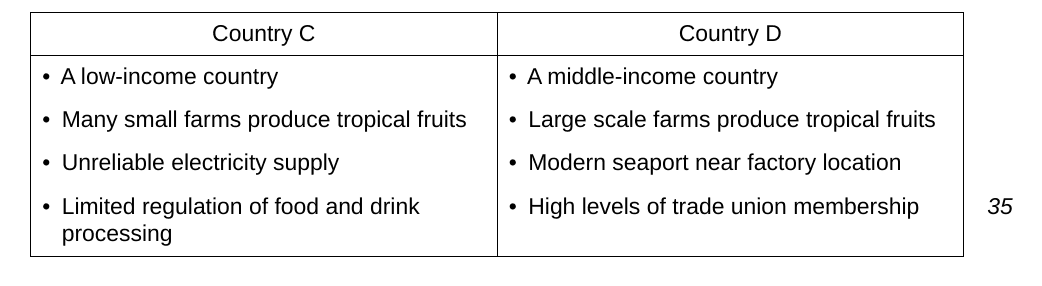
KTJ has an excellent reputation for the quality of its tropical fruit juices which are marketed as premium products. Export demand has increased significantly during the past two years, especially from other African countries. KTJ’s factory in country B is nearing full capacity. Ada thinks that KTJ should expand by processing tropical fruit in a location outside of country B. Ada authorised Gudaf, a junior market analyst, to prepare a report identifying the two best locations for the additional new factory. Gudaf visited multiple locations and prepared an investment appraisal. Gudaf will present the report to the Board of Directors next week recommending a location in either country C or country D.
Extracts from Gudaf’s report are in Table 1.1, Table 1.2 and Table 1.3.
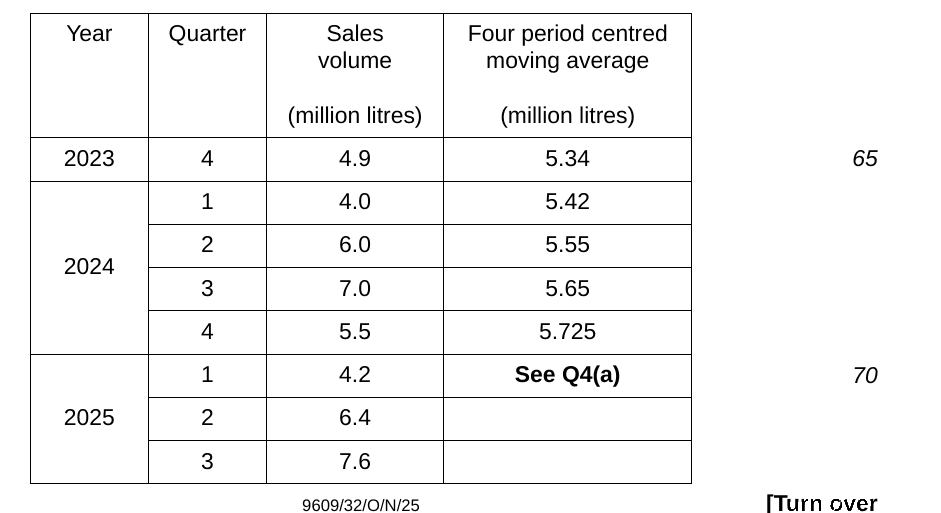
Since 2018, KTJ has exported tropical fruit juices to the US. The US is one of the world’s most competitive markets for food and drink products. Sales are increasing and have met targets. Ada believes that KTJ can increase its market share significantly. Ada instructed the US marketing manager to carry out a market analysis and then develop a new marketing plan. The marketing manager is using time series analysis to help make business decisions. Table 1.4 is an extract of KTJ sales data in the US.
Ada monitors the external environment carefully to identify changes that will impact KTJ. There have been fluctuations in the exchange rate of country B’s currency in recent years. At the last 75 Board Meeting Ada commented ‘financial markets have been unsettled by the recent change of government in country B. This has led to an average 20% depreciation in the value of country B’s currency. This presents both an opportunity for, and a threat to, KTJ.’
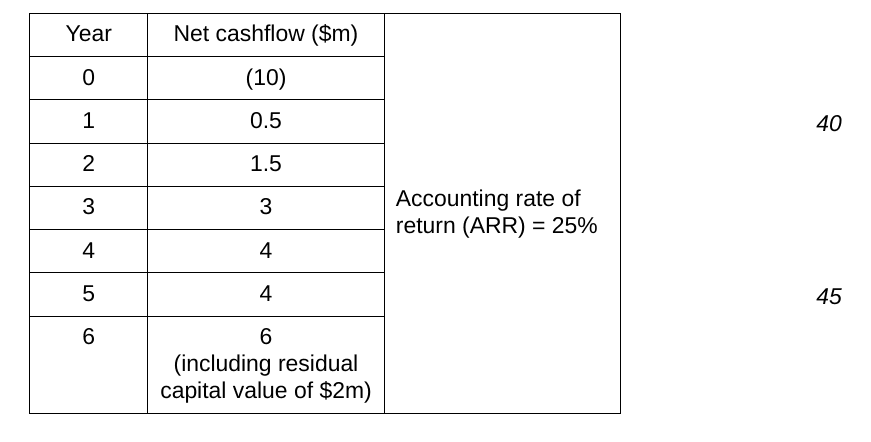
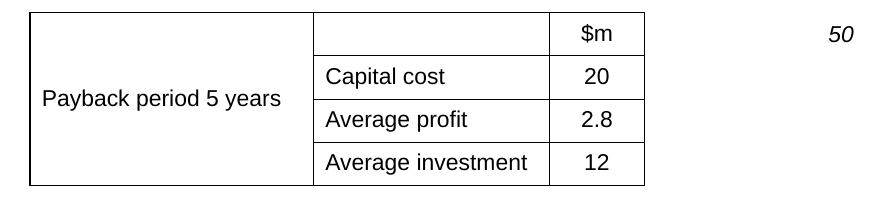
(a) Using the data in Table 1.2, calculate the payback of the country C location. [2 marks]
(b) Using the data in Table 1.3, calculate the accounting rate of return (ARR) of the country D location. [2 marks]
(c) Evaluate which location KTJ should choose for its new factory. [12 marks]


WCP was started in 2015 in Australia by Aldin. He wanted to use his enterprise skills for the benefit of society. Aldin persuaded several of his friends and family to invest and WCP was set up as a private limited company. WCP manufactures toilet paper using sustainable resources. Aldin wants WCP to be a profitable company, selling its toilet paper in high income countries. Aldin also has important social objectives for WCP. WCP donates fifty percent of all profits after tax to its own charity that works in low-income countries to provide better toilets and improve sanitation.
Inflation has been rising and economic growth is slow in all the main countries where WCP sells its products. Governments in these countries have increased interest rates.
There is increasing environmental awareness and higher income earners continue to buy ethically sourced and produced products.
All WCP sales of its toilet paper are currently made through its website. The toilet paper is sent directly to customers from distribution centres in the US, Europe and Australia.
Customers have to order toilet paper in large quantities. WCP has a loyal customer base of ethically-minded customers who are prepared to pay premium prices for its toilet paper.
WCP’s toilet paper is presented in distinctive packaging. The packaging is brightly coloured and recyclable, displaying the WCP company logo and its slogan ‘We Care’. Effective customer relationship marketing ensures that customers are reminded to reorder toilet paper and are also kept up-to-date with the WCP charity’s projects worldwide.
Aldin wants to start selling WCP toilet paper in supermarkets in Europe. WCP need to decide on an appropriate integrated marketing plan to sell its toilet paper through supermarkets.
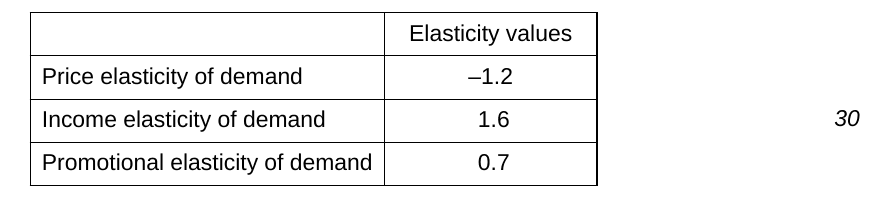
Using sales figures from the last two years, Aldin has estimated the elasticity data for online sales of the WCP toilet paper product. These estimates are shown in Table 1.1.
Aldin is always considering ways to expand WCP. WCP has the opportunity to take over GC, a successful company based in the US that manufactures eco-friendly paper products. Aldin thinks that this takeover would be an effective way for WCP to increase its scale of operations. Aldin is trying to raise the finance for the $8 million required to take over GC. He is considering raising this through long-term bank loans. However, WCP’s Finance Director has suggested that they
might convert WCP to a public limited company and raise the finance required through a share flotation. Table 1.2 shows extracts from WCP’s financial statements.
Aldin supports creativity in WCP employees and rewards innovative ideas. All WCP employees have full-time permanent contracts and are paid above average salaries. Employee requests for flexi-time are granted whenever possible, as Aldin believes that work-life balance is important. Employees are offered relevant training to help develop their careers with promotion opportunities. Labour turnover is low and WCP has gained a reputation as an ethical employer.
The human resources management (HRM) approach at GC is quite different to WCP. The aim of GC’s approach is to minimise unit labour costs. Production line employees are paid the national minimum hourly wage and most have part-time or zero hours contracts. Team leaders on each production line are set daily targets and monitor employees’ work to ensure these are achieved. Labour turnover is high and employees complain about boring jobs and low pay.
If the takeover goes ahead, Aldin will consider whether to change the HRM approach at GC to be the same as the current HRM approach at WCP.
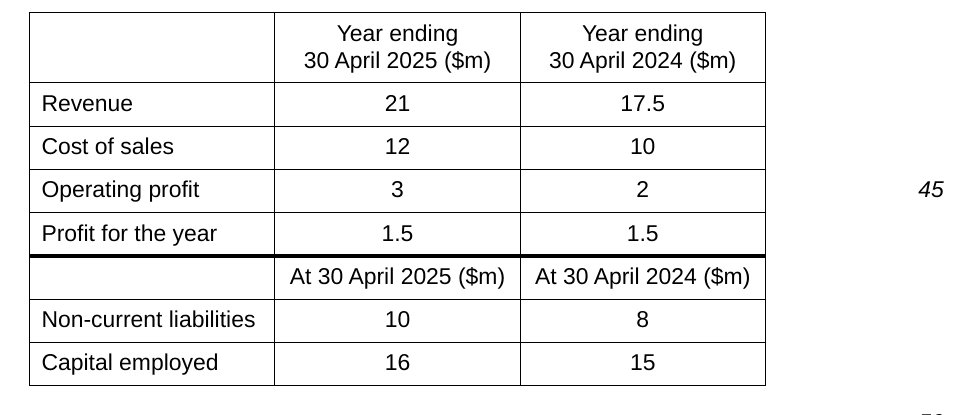
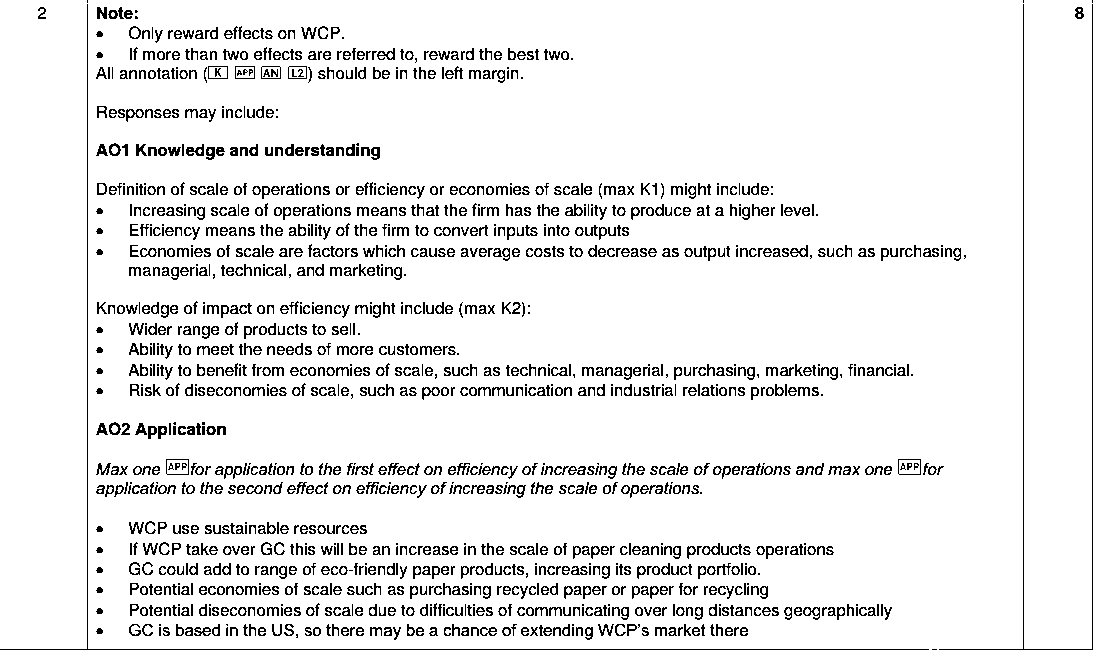
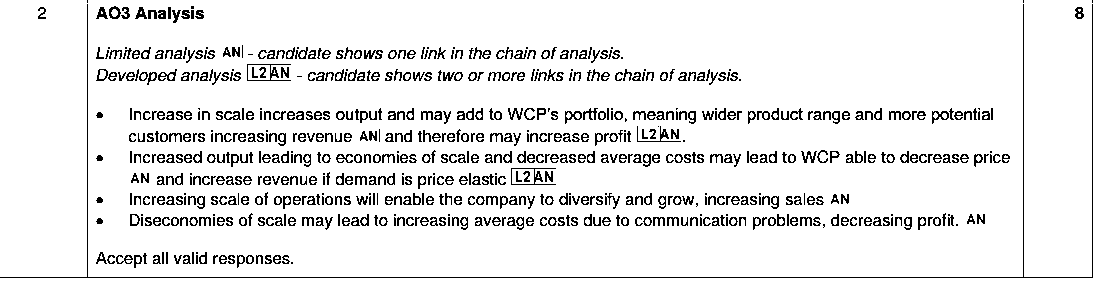
Analyse two possible effects on WCP’s efficiency of an increase in its scale of operations. [8 marks]

🔒 Unlock every Location and scale question from 2020–2024
All 4 come with their mark schemes, answers and case studies, and appear in the practice tool above once you’re signed in. It’s free.
Questions and mark schemes are from past Cambridge papers and are reproduced for revision. Topical Vault is an independent revision resource, not affiliated with or endorsed by Cambridge Assessment International Education.
Each topic opens this practice tool with only that topic’s questions, plus how often it comes up and every question on it in one list.