← Topical Vault

Economic methodology · AS Level Economics

Cambridge 9708, Paper 1 & 2. 2,092 questions, 2020 to 2026.

Topic
Year

Paper 1 multiple-choice questions and Paper 2 data-response/essay questions, from the original Cambridge material. Paper 2 mark schemes and case studies are reproduced as images of the official pages rather than retyped, so nothing is lost or paraphrased; a question tagged under more than one topic appears under each. Tick “Add to my paper” on any question to build a custom practice PDF from the tray in the corner.

About Economic methodology

Questions on how economists work: positive and normative statements, ceteris paribus, models and assumptions, and the short run, long run and very long run.

35 past paper questions on this topic since 2020, across 17 exam sessions.

How often it comes up

YearPaper 1TotalChart
202633
202588
202444
202322
202255
202177
202066

Every 2025–2026 question on Economic methodology

The whole topic on one page, with answers. Printing this page prints just this list.

Paper 1 · Multiple choice (11)

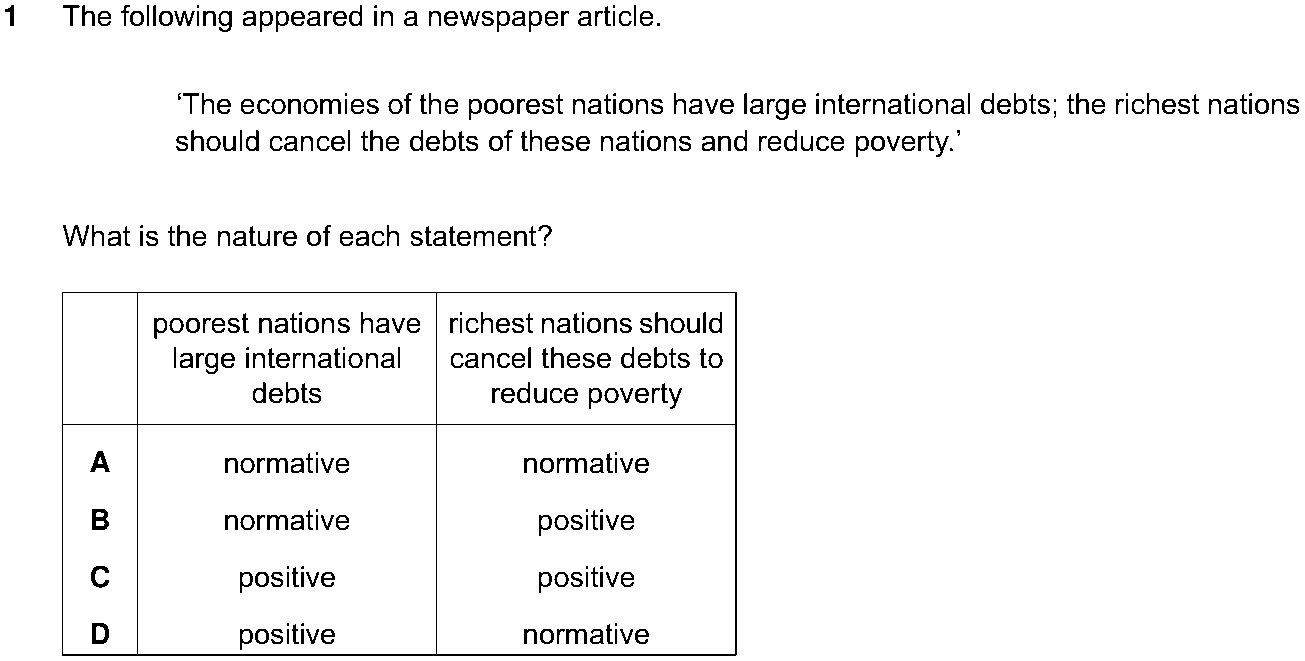
Question 4June 20269708/111 mark
9708/11 June 2026 question 4
Show answer

ACorrect answer

Question 5June 20269708/121 mark

Which statement about economics is not correct?

  • AEconomic actions can produce unexpected side effects.
  • BEconomic thinking is usually based on logical reasoning at the margin.
  • CThe use of scarce resources to produce a good always has a cost.
  • DThe value of a good or service involves a purely objective judgement.
Show answer

DCorrect answer

Question 2June 20269708/131 mark
9708/13 June 2026 question 2
Show answer

DCorrect answer

Question 1November 20259708/111 mark

What is an example of a normative statement?

  • AIndirect taxes are cheap to collect.
  • BIndirect taxes are taxes on income.
  • CIndirect taxes are unfair.
  • DIndirect taxes increase inequality.
Show answer

CCorrect answer

Question 1November 20259708/121 mark

What is an example of a normative statement?

  • AGovernment expenditure is an injection into the circular flow of income.
  • BGovernment expenditure in India in 2022 was 29% of gross domestic product.
  • CThe best policy measure to reduce inflation is a reduction in government expenditure.
  • DThe United States of America is the country with the highest military expenditure.
Show answer

CCorrect answer

Question 1November 20259708/131 mark
9708/13 November 2025 question 1
Show answer

DCorrect answer

Question 5November 20259708/141 mark

Which statement about factors of production is correct?

  • AIn the short run all factors are fixed; in the long run all factors are varied.
  • BIn the short run at least one factor is fixed; in the long run all factors can be varied.
  • CIn the short run at least one factor is varied; in the long run all factors are fixed.
  • DIn the short run at least one factor is varied; in the long run at least one factor is fixed.
Show answer

BCorrect answer

Question 1June 20259708/111 mark

Which statement about a free vaccination programme is normative?

  • AIt will help raise life expectancy.
  • BIt is likely to improve the welfare of society.
  • CIt will result in lower spending on other medical services.
  • DTax revenues generated through improved economic activity will exceed the spending on vaccination.
Show answer

BCorrect answer

Question 1June 20259708/121 mark
9708/12 June 2025 question 1
Show answer

ACorrect answer

Question 1June 20259708/141 mark

, , 1 What is a common criticism of economics?

  • AIt fails to establish theories of economic behaviour.
  • BIt is unable to construct models of how an economy might work.
  • CIt lacks the ability to use and apply mathematics.
  • DIt is very difficult to undertake laboratory experiments in economics.
Show answer

DCorrect answer

Question 2March 20259708/121 mark

To increase production, a firm in industry X needs to install capital equipment, while a firm in industry Y needs to research and introduce a new technology.

What time periods are illustrated by these cases?

industry X industry Y

  • Ashort run long run
  • Blong run long run
  • Clong run very long run
  • Dvery long run very long run
Show answer

CCorrect answer

24 more questions from 2020–2024

🔒 Unlock every Economic methodology question from 2020–2024

All 24 come with their mark schemes, answers and case studies, and appear in the practice tool above once you’re signed in. It’s free.

Create a free accountSign in

A few of them

  • 9708/11 · November 2024 · Question 1Which statement is a… 🔒
  • 9708/12 · November 2024 · Question 4Which statement… 🔒
  • 9708/11 · June 2024 · Question 14Governments in market economies give different reasons… 🔒
  • 9708/12 · March 2024 · Question 2Which statement is a… 🔒
  • 9708/12 · March 2023 · Question 2What is the definition of… 🔒
  • + 19 more, by year in the table above

Questions and mark schemes are from past Cambridge papers and are reproduced for revision. Topical Vault is an independent revision resource, not affiliated with or endorsed by Cambridge Assessment International Education.

AS Level Economics questions by topic

Each topic opens this practice tool with only that topic’s questions, plus how often it comes up and every question on it in one list.

  1. Unit 1Basic economic ideas and resource allocation
  2. Ch 1Scarcity, choice and opportunity cost
  3. Ch 2Economic methodology
  4. Ch 3Factors of production
  5. Ch 4Resource allocation in different economic systems
  6. Ch 5Production possibility curves
  7. Ch 6Classification of goods and services
  8. Unit 2The price system and the microeconomy
  9. Ch 7Demand and supply curves
  10. Ch 8Price elasticity, income elasticity and cross elasticity of demand
  11. Ch 9Price elasticity of supply
  12. Ch 10The interaction of demand and supply
  13. Ch 11Consumer and producer surplus
  14. Unit 3Government microeconomic intervention
  15. Ch 12Reasons for government intervention in markets
  16. Ch 13Methods and effects of government intervention in markets
  17. Ch 14Addressing income and wealth inequality
  18. Unit 4The macroeconomy
  19. Ch 15National income statistics
  20. Ch 16Introduction to the circular flow of income
  21. Ch 17Aggregate demand and aggregate supply analysis
  22. Ch 18Economic growth
  23. Ch 19Unemployment
  24. Ch 20Price stability
  25. Unit 5Government macroeconomic intervention
  26. Ch 21Government macroeconomic policy objectives
  27. Ch 22Fiscal policy
  28. Ch 23Monetary policy
  29. Ch 24Supply-side policy
  30. Unit 6International economic issues
  31. Ch 25The reasons for international trade
  32. Ch 26Protectionism
  33. Ch 27Current account of the balance of payments
  34. Ch 28Exchange rates
  35. Ch 29Policies to correct imbalances in the current account of the balance of payments