← Topical Vault

Price elasticity of supply · AS Level Economics

Cambridge 9708, Paper 1 & 2. 2,092 questions, 2020 to 2026.

Topic
Year

Paper 1 multiple-choice questions and Paper 2 data-response/essay questions, from the original Cambridge material. Paper 2 mark schemes and case studies are reproduced as images of the official pages rather than retyped, so nothing is lost or paraphrased; a question tagged under more than one topic appears under each. Tick “Add to my paper” on any question to build a custom practice PDF from the tray in the corner.

About Price elasticity of supply

Questions on price elasticity of supply: calculating it, reading it from supply curves, and how time, spare capacity and stocks affect how far supply responds to price.

91 past paper questions on this topic since 2020, across 20 exam sessions.

How often it comes up

YearPaper 1Paper 2TotalChart
2026516
20258614
202410515
202312214
202213316
202110111
202011415

Every 2025–2026 question on Price elasticity of supply

The whole topic on one page, with answers and mark schemes. Printing this page prints just this list.

Paper 1 · Multiple choice (13)

Question 9June 20269708/111 mark

What is not a factor affecting price elasticity of supply?

  • Alevel of spare capacity
  • Bprice of complementary products
  • Cresources available
  • Dtime period over which elasticity is measured
Show answer

BCorrect answer

Question 6June 20269708/121 mark

If the price elasticity of supply for a good is three and the price of the good increases by 10%, what is the increase in quantity supplied?

  • A3%
  • B7%
  • C30%
  • D33.3%
Show answer

CCorrect answer

Question 8June 20269708/131 mark
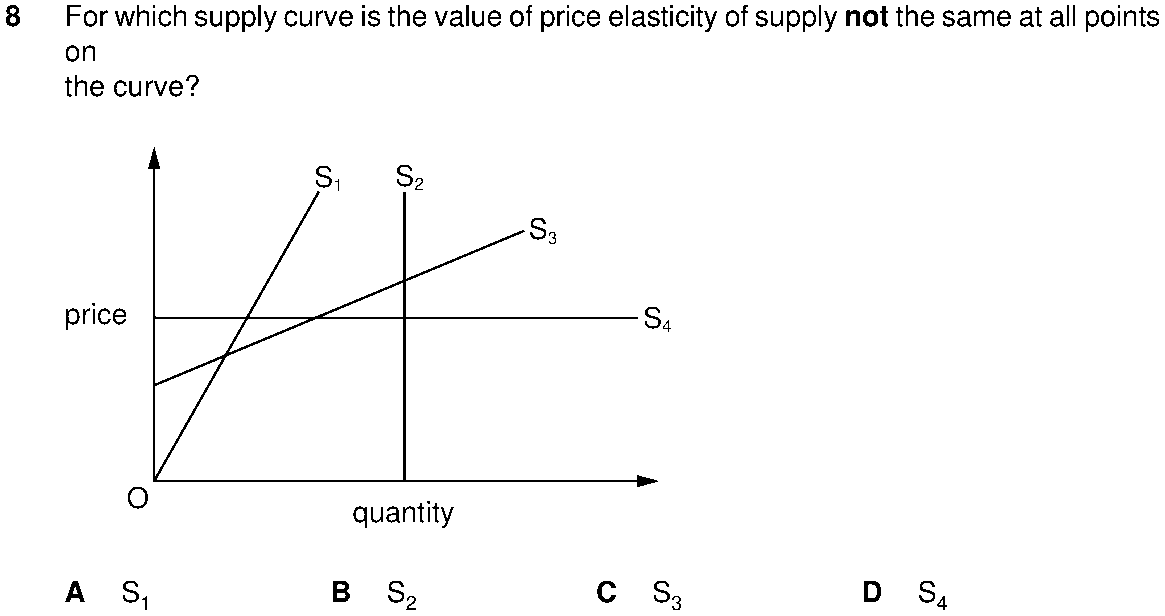
9708/13 June 2026 question 8
Show answer

CCorrect answer

Question 6June 20269708/141 mark

A good has a price elasticity of supply of 2.0. The current quantity supplied is 300 units per week at a market price of $20 per unit.

The firm raises the price to $25 per unit.

What will the new quantity supplied be per week?

  • A150 units
  • B375 units
  • C400 units
  • D450 units
Show answer

DCorrect answer

Question 9March 20269708/121 mark

How might a firm raise the value of the price elasticity of supply for its product?

  • Adecrease the amount of labour that it employs
  • Bemploy new technology to increase its productive capacity
  • Cincrease advertising expenditure to generate more revenue
  • Dreduce the level of stocks in order to cut costs
Show answer

BCorrect answer

Question 10November 20259708/131 mark

Four firms produce furniture. The table shows the price elasticity of supply (PES) for each firm.

If the price of furniture rises by 5% which firm would experience an increase in quantity supplied of 2.5%?

PES for firm furniture

  • A2.5
  • B2.0
  • C0.6
  • D0.5
Show answer

DCorrect answer

Question 6November 20259708/141 mark

Which factor affects the price elasticity of supply of a product?

  • Aavailability of stocks
  • Bpercentage of income spent on the product
  • Cprice of substitutes
  • Dwage rate
Show answer

ACorrect answer

Question 8June 20259708/111 mark
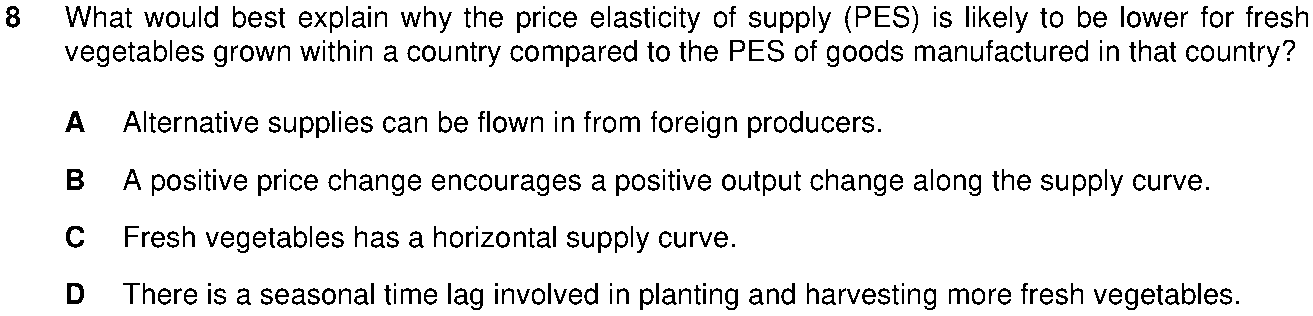
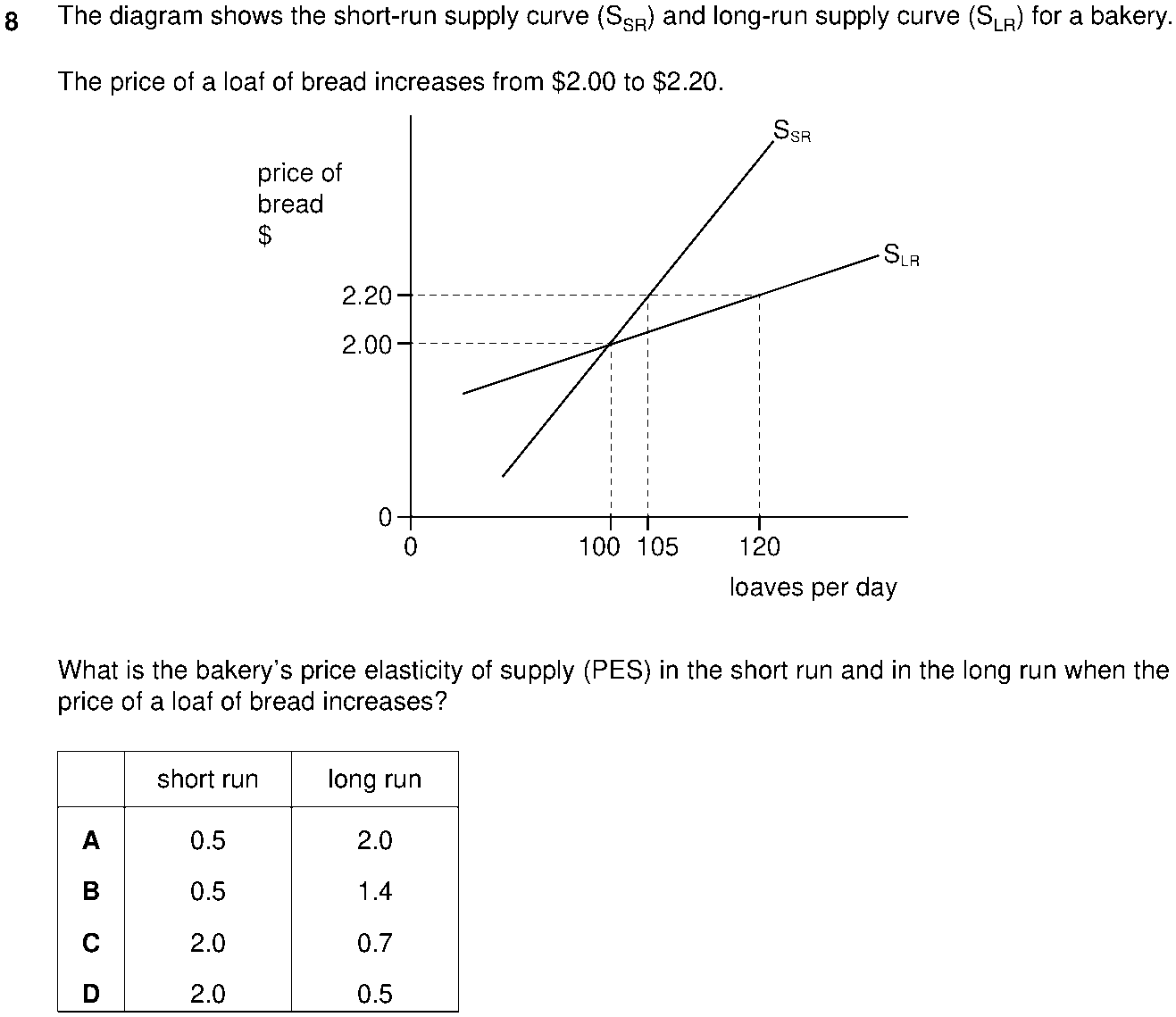
9708/11 June 2025 question 8
Show answer

DCorrect answer

Question 8June 20259708/121 mark
9708/12 June 2025 question 8
Show answer

ACorrect answer

Question 6June 20259708/131 mark

A theatre has a fixed number of tickets to sell for each performance.

What is the price elasticity of supply?

  • Aperfectly elastic
  • Bperfectly inelastic
  • Cunit elastic and negative
  • Dunit elastic and positive
Show answer

BCorrect answer

Question 11June 20259708/131 mark

A construction firm estimates that the price elasticity of supply in building a nuclear power plant is +0.1.

What might explain this?

  • AThe firm can easily find new land as required.
  • BThe firm is competing with many other construction firms.
  • CThe firm needs time to hire the highly skilled labour required.
  • DThere is a lack of close substitutes for nuclear power.
Show answer

CCorrect answer

Question 9June 20259708/141 mark

What is the likely nature of the price elasticity of supply of a crop such as rice?

  • Ahighly elastic in both the short and the long run as rice is an essential product
  • Bhighly elastic in the short run and more inelastic in the long run as production methods improve
  • Chighly inelastic in both the short and the long run as the land area of a country is fixed
  • Dhighly inelastic in the short run and more elastic in the long run as it takes time to plant rice
Show answer

DCorrect answer

Question 6March 20259708/121 mark

What will influence the value of the price elasticity of supply of a good?

  • Athe level of producer surplus
  • Bthe time period under consideration
  • Cthe total income spent on the good
  • Dwhether the good is a necessity
Show answer

BCorrect answer

Paper 2 · Data response and essays (7)

Question 2(b)June 20269708/2312 marks

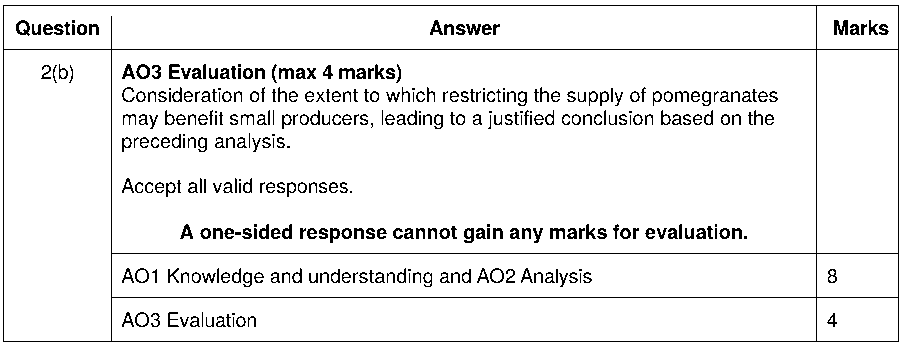
Assess the extent to which restricting the supply of pomegranates may benefit small producers. [12]

Show mark scheme
Mark scheme, 9708/23 June 2026 question 2(b) (page 1 of 2)
Mark scheme, 9708/23 June 2026 question 2(b) (page 2 of 2)
Question 2(b)November 20259708/2312 marks

Assess the ways in which producers of root ginger might be able to stabilise their incomes. [12]

Show mark scheme
Mark scheme, 9708/23 November 2025 question 2(b)
Question 3(a)November 20259708/248 marks

Explain what determines elastic and inelastic price elasticity of supply (PES) and consider the extent to which the value of PES may differ between an agricultural good and a manufactured good. [8]

Show mark scheme
Mark scheme, 9708/24 November 2025 question 3(a)
Question 3(b)June 20259708/2212 marks

Assess the extent to which knowledge of a product’s price elasticity of supply is the most useful measure of elasticity to a firm needing to react quickly to changes in its market. [12]

Show mark scheme
Mark scheme, 9708/22 June 2025 question 3(b)
Case study: How onions became a luxury good in the Philippines
Question 1(b)June 20259708/232 marks

Is the short-run price elasticity of supply of red onions elastic or inelastic? Justify your answer. [2]

Show mark scheme
Mark scheme, 9708/23 June 2025 question 1(b)
Question 2(a)June 20259708/238 marks

Semi-conductors are widely used in the production of many types of electronic goods such as smartphones. It has been estimated that the price elasticity of supply for semi-conductors is 0.2 in the short run and 0.8 in the long run.

Explain what these estimates mean for producers of smartphones that use semi-conductors and consider the significance of the long-run estimate. [8]

Show mark scheme
Mark scheme, 9708/23 June 2025 question 2(a)
Question 2(b)June 20259708/2312 marks

Semi-conductors are widely used in the production of many types of electronic goods such as smartphones. It has been estimated that the price elasticity of supply for semi-conductors is 0.2 in the short run and 0.8 in the long run.

Assess the likely effects on resource allocation of a continuing increase in demand for semi-conductors. [12]

Show mark scheme
Mark scheme, 9708/23 June 2025 question 2(b)

71 more questions from 2020–2024

🔒 Unlock every Price elasticity of supply question from 2020–2024

All 71 come with their mark schemes, answers and case studies, and appear in the practice tool above once you’re signed in. It’s free.

Create a free accountSign in

A few of them

  • 9708/11 · November 2024 · Question 10Which elasticity would a shortage of skilled… 🔒
  • 9708/11 · November 2024 · Question 13A specific tax is imposed on a… 🔒
  • 9708/12 · November 2024 · Question 7A firm produces a good using a… 🔒
  • 9708/13 · November 2024 · Question 8The supply, S, of a product is… 🔒
  • 9708/21 · November 2024 · Question 2(b)Assess whether the supply of agricultural products… 🔒
  • + 66 more, by year in the table above

Questions and mark schemes are from past Cambridge papers and are reproduced for revision. Topical Vault is an independent revision resource, not affiliated with or endorsed by Cambridge Assessment International Education.

AS Level Economics questions by topic

Each topic opens this practice tool with only that topic’s questions, plus how often it comes up and every question on it in one list.

  1. Unit 1Basic economic ideas and resource allocation
  2. Ch 1Scarcity, choice and opportunity cost
  3. Ch 2Economic methodology
  4. Ch 3Factors of production
  5. Ch 4Resource allocation in different economic systems
  6. Ch 5Production possibility curves
  7. Ch 6Classification of goods and services
  8. Unit 2The price system and the microeconomy
  9. Ch 7Demand and supply curves
  10. Ch 8Price elasticity, income elasticity and cross elasticity of demand
  11. Ch 9Price elasticity of supply
  12. Ch 10The interaction of demand and supply
  13. Ch 11Consumer and producer surplus
  14. Unit 3Government microeconomic intervention
  15. Ch 12Reasons for government intervention in markets
  16. Ch 13Methods and effects of government intervention in markets
  17. Ch 14Addressing income and wealth inequality
  18. Unit 4The macroeconomy
  19. Ch 15National income statistics
  20. Ch 16Introduction to the circular flow of income
  21. Ch 17Aggregate demand and aggregate supply analysis
  22. Ch 18Economic growth
  23. Ch 19Unemployment
  24. Ch 20Price stability
  25. Unit 5Government macroeconomic intervention
  26. Ch 21Government macroeconomic policy objectives
  27. Ch 22Fiscal policy
  28. Ch 23Monetary policy
  29. Ch 24Supply-side policy
  30. Unit 6International economic issues
  31. Ch 25The reasons for international trade
  32. Ch 26Protectionism
  33. Ch 27Current account of the balance of payments
  34. Ch 28Exchange rates
  35. Ch 29Policies to correct imbalances in the current account of the balance of payments