← Topical Vault

Policies to correct imbalances in the current account of the balance of payments · AS Level Economics

Cambridge 9708, Paper 1 & 2. 2,092 questions, 2020 to 2026.

Topic
Year

Paper 1 multiple-choice questions and Paper 2 data-response/essay questions, from the original Cambridge material. Paper 2 mark schemes and case studies are reproduced as images of the official pages rather than retyped, so nothing is lost or paraphrased; a question tagged under more than one topic appears under each. Tick “Add to my paper” on any question to build a custom practice PDF from the tray in the corner.

About Policies to correct imbalances in the current account of the balance of payments

Questions on correcting current account imbalances: expenditure-switching and expenditure-reducing policies, devaluation, and the side effects of each approach.

56 past paper questions on this topic since 2020, across 18 exam sessions.

How often it comes up

YearPaper 1Paper 2TotalChart
2026202
2025426
2024448
2023437
20229312
20219211
20209110

Every 2025–2026 question on Policies to correct imbalances in the current account of the balance of payments

The whole topic on one page, with answers and mark schemes. Printing this page prints just this list.

Paper 1 · Multiple choice (6)

Question 29June 20269708/121 mark

Which policy will lead to a fall in the volume of goods imported?

  • Aa cut in income tax rates
  • Ba cut in interest rates
  • Can increase in import tariffs
  • Dan increase in spending on training workers in domestic tourism
Show answer

CCorrect answer

Question 27June 20269708/141 mark

Which policy is not likely to help reduce a current account deficit on the balance of payments?

  • Aan increase in expenditure promoting locally produced goods
  • Ban increase in the quota on cheap imports
  • Can increase in the restrictions on foreign exchange
  • Dan increase in the subsidies to exporting industries
Show answer

BCorrect answer

Question 30November 20259708/111 mark

A country has a current account deficit on its balance of payments. The government also has a budget deficit.

Which measure to reduce the current account deficit will increase the budget deficit?

  • Adepreciating the exchange rate
  • Bintroducing quotas on imports
  • Craising tariffs on imports
  • Dsubsidising exports
Show answer

DCorrect answer

Question 28June 20259708/111 mark

A country has a persistent deficit on the current account of its balance of payments.

What is most likely to improve the situation in the long run?

  • Aa lowering of the level of import duties
  • Ba reduction in the level of income tax
  • Cthe introduction of expansionary monetary policy
  • Dthe use of grants to encourage new investment by firms
Show answer

DCorrect answer

Question 29June 20259708/121 mark

A country is experiencing a deficit on the current account of its balance of payments.

Which policy decision could reduce the deficit?

  • Adecrease in income tax rates
  • Bincrease in exchange rates
  • Cincrease in government spending
  • Dincrease in import tariffs
Show answer

DCorrect answer

Question 30June 20259708/141 mark

, , 30 A country has a current account deficit.

What would be classified as a protectionist measure to restore the current account to equilibrium?

  • Aallow the exchange rate to appreciate
  • Bincrease income tax
  • Cincrease import tariffs
  • Dincrease the rate of interest
Show answer

CCorrect answer

Paper 2 · Data response and essays (2)

Question 4(b)November 20259708/2212 marks

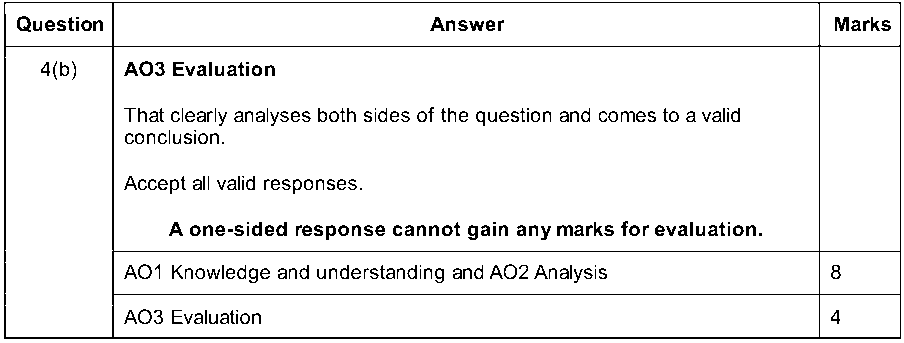
Assess the extent to which the use of supply-side policy would be the best way to reduce a deficit on the current account of the balance of payments. [12]

Show mark scheme
Mark scheme, 9708/22 November 2025 question 4(b) (page 1 of 2)
Mark scheme, 9708/22 November 2025 question 4(b) (page 2 of 2)
Question 5(b)November 20259708/2312 marks

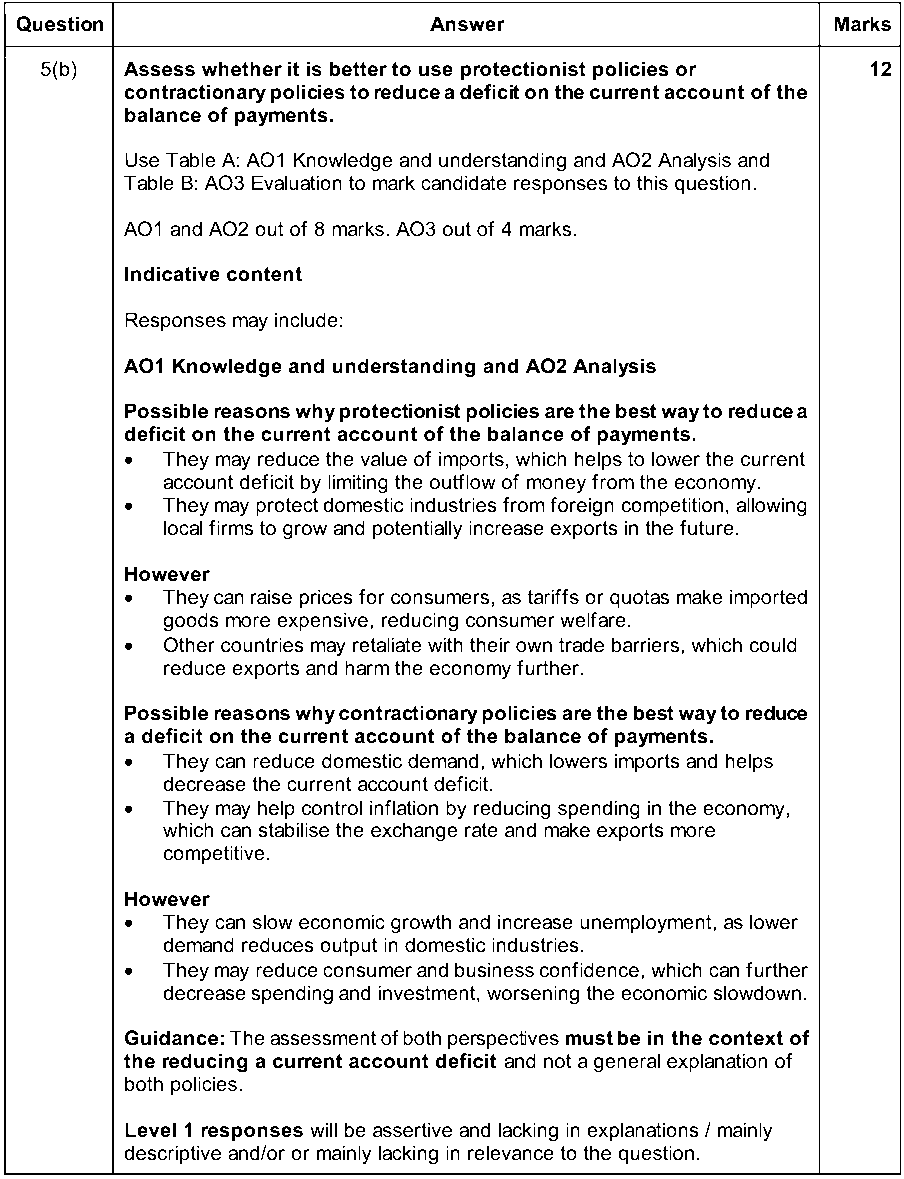
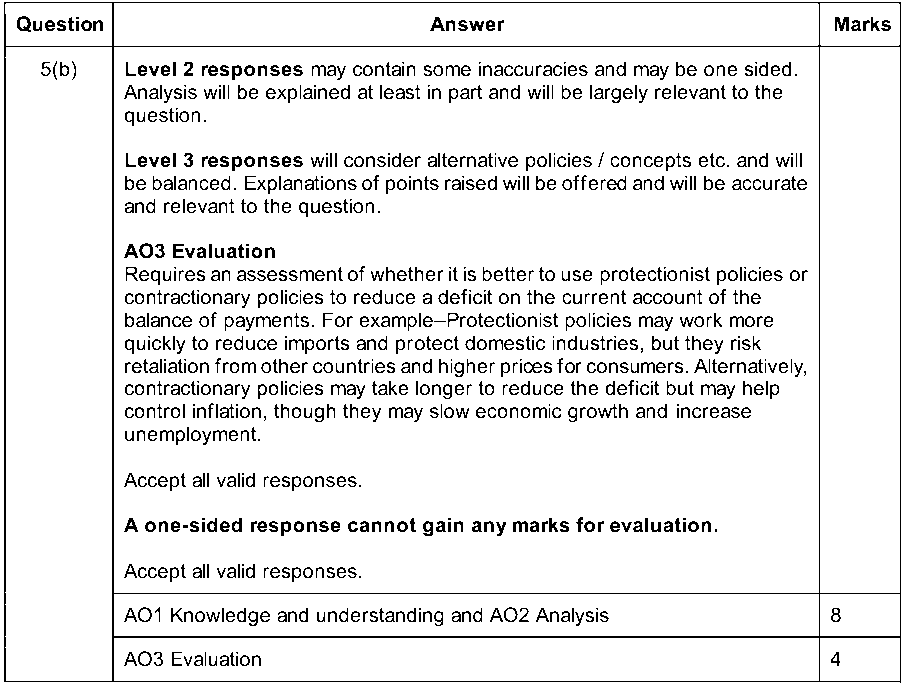
Assess whether it is better to use protectionist policies or contractionary policies to reduce a deficit on the current account of the balance of payments. [12]
Show mark scheme
Mark scheme, 9708/23 November 2025 question 5(b) (page 1 of 2)
Mark scheme, 9708/23 November 2025 question 5(b) (page 2 of 2)

48 more questions from 2020–2024

🔒 Unlock every Policies to correct imbalances in the current account of the balance of payments question from 2020–2024

All 48 come with their mark schemes, answers and case studies, and appear in the practice tool above once you’re signed in. It’s free.

Create a free accountSign in

A few of them

  • 9708/12 · November 2024 · Question 26Which policy is most likely to reduce… 🔒
  • 9708/22 · November 2024 · Question 1(b)Consider the likely success of one policy… 🔒
  • 9708/23 · November 2024 · Question 5(b)Assess whether protectionism is always the best… 🔒
  • 9708/12 · June 2024 · Question 24What would be the best policy for… 🔒
  • 9708/13 · June 2024 · Question 24The demand for a country’s exports is… 🔒
  • + 43 more, by year in the table above

Questions and mark schemes are from past Cambridge papers and are reproduced for revision. Topical Vault is an independent revision resource, not affiliated with or endorsed by Cambridge Assessment International Education.

AS Level Economics questions by topic

Each topic opens this practice tool with only that topic’s questions, plus how often it comes up and every question on it in one list.

  1. Unit 1Basic economic ideas and resource allocation
  2. Ch 1Scarcity, choice and opportunity cost
  3. Ch 2Economic methodology
  4. Ch 3Factors of production
  5. Ch 4Resource allocation in different economic systems
  6. Ch 5Production possibility curves
  7. Ch 6Classification of goods and services
  8. Unit 2The price system and the microeconomy
  9. Ch 7Demand and supply curves
  10. Ch 8Price elasticity, income elasticity and cross elasticity of demand
  11. Ch 9Price elasticity of supply
  12. Ch 10The interaction of demand and supply
  13. Ch 11Consumer and producer surplus
  14. Unit 3Government microeconomic intervention
  15. Ch 12Reasons for government intervention in markets
  16. Ch 13Methods and effects of government intervention in markets
  17. Ch 14Addressing income and wealth inequality
  18. Unit 4The macroeconomy
  19. Ch 15National income statistics
  20. Ch 16Introduction to the circular flow of income
  21. Ch 17Aggregate demand and aggregate supply analysis
  22. Ch 18Economic growth
  23. Ch 19Unemployment
  24. Ch 20Price stability
  25. Unit 5Government macroeconomic intervention
  26. Ch 21Government macroeconomic policy objectives
  27. Ch 22Fiscal policy
  28. Ch 23Monetary policy
  29. Ch 24Supply-side policy
  30. Unit 6International economic issues
  31. Ch 25The reasons for international trade
  32. Ch 26Protectionism
  33. Ch 27Current account of the balance of payments
  34. Ch 28Exchange rates
  35. Ch 29Policies to correct imbalances in the current account of the balance of payments