← Topical Vault

Price elasticity, income elasticity and cross elasticity of demand · AS Level Economics

Cambridge 9708, Paper 1 & 2. 2,092 questions, 2020 to 2026.

Topic
Year

Paper 1 multiple-choice questions and Paper 2 data-response/essay questions, from the original Cambridge material. Paper 2 mark schemes and case studies are reproduced as images of the official pages rather than retyped, so nothing is lost or paraphrased; a question tagged under more than one topic appears under each. Tick “Add to my paper” on any question to build a custom practice PDF from the tray in the corner.

About Price elasticity, income elasticity and cross elasticity of demand

Questions on price, income and cross elasticity of demand: calculating each, interpreting the values, what determines them, and how firms and governments use them.

151 past paper questions on this topic since 2020, across 20 exam sessions.

How often it comes up

YearPaper 1Paper 2TotalChart
20267613
202517926
202410717
202316824
202216521
2021171229
202015621

Every 2025–2026 question on Price elasticity, income elasticity and cross elasticity of demand

The whole topic on one page, with answers and mark schemes. Printing this page prints just this list.

Paper 1 · Multiple choice (24)

Question 8June 20269708/111 mark

Which statement defines the income elasticity of demand?

  • AIt measures the responsiveness of income to a change in quantity demanded.
  • BIt measures the responsiveness of income to a change in price.
  • CIt measures the responsiveness of quantity demanded to a change in income.
  • DIt measures the responsiveness of quantity demanded to a change in price.
Show answer

CCorrect answer

Question 11June 20269708/111 mark

Doctors are concerned about the negative health effects of sugary drinks.

When would a tax on sugary drinks be least effective in improving health?

  • Awhen the demand for sugary drinks is income elastic
  • Bwhen the demand for sugary drinks is income inelastic
  • Cwhen the demand for sugary drinks is price elastic
  • Dwhen the demand for sugary drinks is price inelastic
Show answer

DCorrect answer

Question 15June 20269708/111 mark

The market for good X is in equilibrium with 1000 units sold at a price of $10. The government puts a specific tax of $1 per unit on the producers of good X.

Which value for the price elasticity of demand for good X will generate the largest tax revenue?

  • A0
  • B0.5
  • C1.0
  • D1.5
Show answer

ACorrect answer

Question 10June 20269708/121 mark

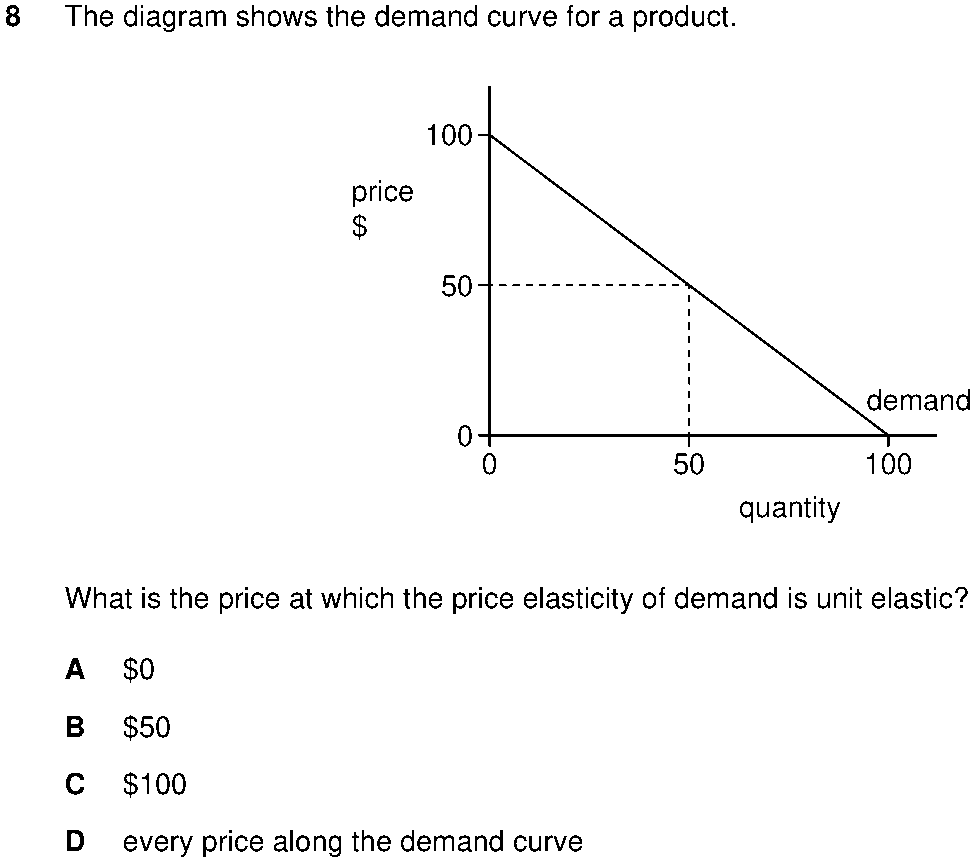
The price of a pizza has increased from $8 to $10. This leads to a decrease in quantity demanded of 12.5%.

What is the price elasticity of demand of pizza?

  • A0.5
  • B0.8
  • C1.6
  • D2.0
Show answer

ACorrect answer

Question 7June 20269708/131 mark

The price elasticity of demand for a good is highly elastic.

What is the impact on expenditure on this good when its price increases?

  • Adecreases
  • Bincreases by a large amount
  • Cincreases by a small amount
  • Dstays unchanged
Show answer

ACorrect answer

Question 6March 20269708/121 mark

What is cross elasticity of demand?

  • Athe responsiveness of price of good X to a change in demand of good Y
  • Bthe responsiveness of quantity demanded of a good to a change in its price
  • Cthe responsiveness of quantity demanded of good X to a change in quantity of good Y
  • Dthe responsiveness of quantity demanded of good X to a change in the price of good Y
Show answer

DCorrect answer

Question 10March 20269708/121 mark

An economy is experiencing a fall in real GDP. Also, deflation has caused the prices of four goods, A, B, C and D to each fall by 5%.

Which good is likely to enjoy the largest increase in its sales revenue?

income elasticity price elasticity of demand of demand

  • A+0.5 −1.5
  • B+1.5 −1.0
  • C−0.5 −1.0
  • D−1.5 −1.5
Show answer

DCorrect answer

Question 8November 20259708/111 mark

Which statement is true if the income elasticity of demand for a good has a value of –0.2?

  • AWhen income rises less of the good is bought.
  • BWhen income rises more of the good is bought.
  • CWhen price falls more of the good is bought.
  • DWhen price rises less of the good is bought.
Show answer

ACorrect answer

Question 9November 20259708/111 mark

The table shows the price of a good and total expenditure on the good during specific periods when the market is in equilibrium.

price total expenditure period ($) ($)

1 12 96000

2 5 40000

3 8 64000

4 10 80000

5 4 32000

What can be deduced from this data?

  • AThe good has constant opportunity cost.
  • BThe good is an inferior good.
  • CThe price elasticity of demand is equal to one.
  • DThe price elasticity of supply is equal to zero.
Show answer

DCorrect answer

Question 8November 20259708/121 mark
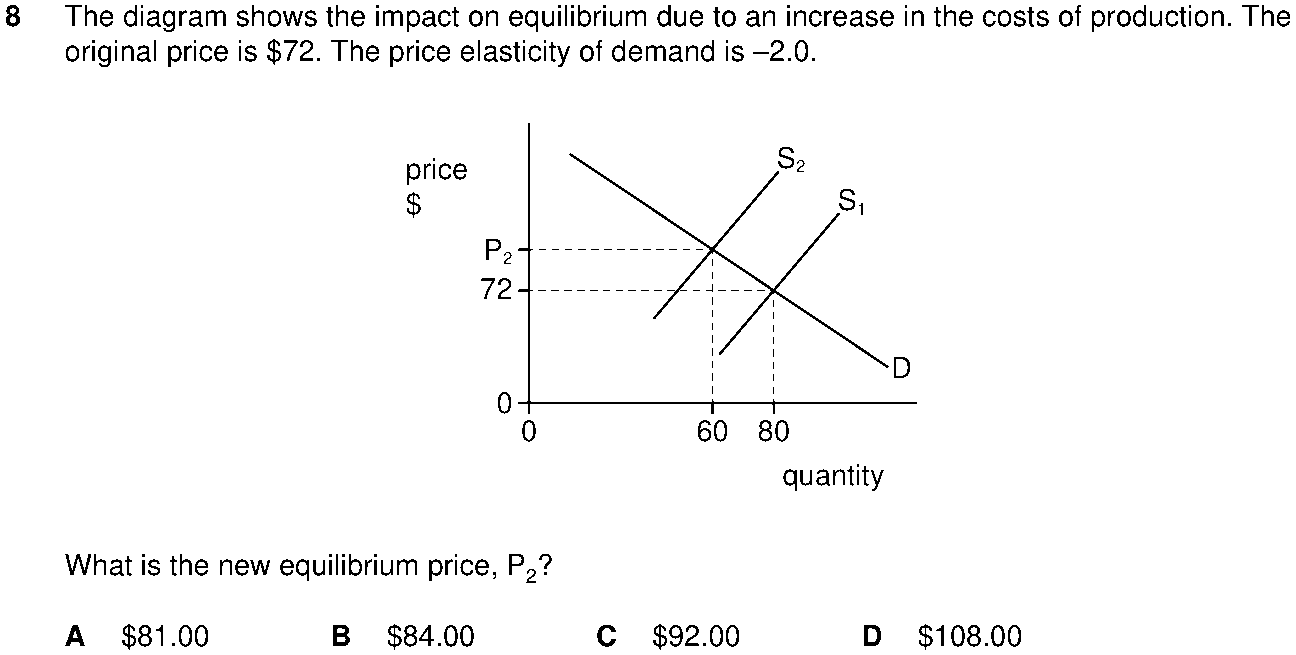
9708/12 November 2025 question 8
Show answer

BCorrect answer

Question 9November 20259708/121 mark

Public transport in an economy has an income elasticity of demand of –0.36.

What does this mean about public transport?

  • AIt is an inferior good.
  • BIt is a necessity.
  • CIt is a normal good.
  • DIt has close substitutes.
Show answer

ACorrect answer

Question 9November 20259708/131 mark

Good X has an income elasticity of demand (YED) value of −0.8. Its cross elasticity of demand (XED) with respect to good Y is also −0.8.

What are the characteristics of good X?

  • Aa normal good that is a complement to good Y
  • Ba normal good that is a substitute for good Y
  • Can inferior good that is a complement to good Y
  • Dan inferior good that is a substitute for good Y
Show answer

CCorrect answer

Question 13November 20259708/131 mark

Assuming demand is price elastic, what will rise the most if an indirect tax is removed?

  • Aconsumer expenditures
  • Bprice of the product
  • Cproducers’ revenues
  • Dtax receipts
Show answer

CCorrect answer

Question 15November 20259708/131 mark

A government provides a subsidy for a product with a perfectly price inelastic demand.

What prevents producers from benefiting from this subsidy?

The subsidy causes a large reduction in the price of the product as its price elasticity of demand

  • AThe subsidy causes a large reduction in the price of the product, as its price elasticity of demand is infinite. The subsidy causes a large reduction in the price of the product as its price elasticity of demand
  • BThe subsidy causes a large reduction in the price of the product, as its price elasticity of demand is zero. The subsidy causes a small reduction in the price of the product as its price elasticity of demand
  • CThe subsidy causes a small reduction in the price of the product, as its price elasticity of demand is relatively elastic. The subsidy causes a small reduction in the price of the product as its price elasticity of demand
  • DThe subsidy causes a small reduction in the price of the product, as its price elasticity of demand is relatively inelastic.
Show answer

BCorrect answer

Question 30November 20259708/131 mark

The main export of country X is oil. The world demand for oil is price inelastic. The world supply of oil is reduced by the major oil producing countries, including country X. Imports into country X are unchanged.

What are the effects of this action by the major oil producing countries on the terms of trade and the current account of the balance of payments in country X?

terms of trade current account

  • Aincreases increases
  • Bincreases decreases
  • Cdecreases increases
  • Ddecreases decreases
Show answer

ACorrect answer

Question 7November 20259708/141 mark

A firm sells 10 000 units of a product which has an estimated income elasticity of demand of –0.4.

If incomes have fallen by 10%, what is the new quantity demanded?

  • A9000
  • B9600
  • C10000
  • D10400
Show answer

DCorrect answer

Question 12November 20259708/141 mark

A government imposes a specific indirect tax on a product that has an inelastic demand curve.

What is the incidence of tax in this case?

  • AThe tax falls entirely on the consumer.
  • BThe tax falls entirely on the producer.
  • CThe tax falls to a greater extent on the consumer than on the producer.
  • DThe tax falls to a smaller extent on the consumer than on the producer.
Show answer

CCorrect answer

Question 7June 20259708/121 mark

When can a product be said to have a negative income elasticity of demand?

  • AWhen it is a luxury good.
  • BWhen it is a necessity good.
  • CWhen it is a normal good.
  • DWhen it is an inferior good.
Show answer

DCorrect answer

Question 11June 20259708/121 mark

An indirect tax is imposed on good X.

Which situation is most likely to result in producers bearing a higher burden of the tax?

  • Aprice elasticity of demand is elastic
  • Bprice elasticity of demand is inelastic
  • Cprice elasticity of supply is elastic
  • Dprice elasticity of supply is inelastic
Show answer

ACorrect answer

Question 9June 20259708/131 mark

What is true for income elasticity of demand but not for price elasticity of demand?

  • AIt helps firms differentiate between goods with elastic and inelastic demand.
  • BIt helps firms differentiate between normal and inferior goods.
  • CIt helps firms predict the changes in the quantity demanded.
  • DIt helps firms predict the changes in sales revenues.
Show answer

BCorrect answer

Question 8June 20259708/141 mark

, , 8 A survey into the market for good X found that it is an inferior good and a close substitute for good Y.

Which values for the income elasticity of demand for good X and its cross elasticity of demand with respect to the price of good Y would support this?

cross elasticity of demand income elasticity of for good X with respect to demand for good X the price of good Y

  • A–1.2 –0.9
  • B–1.2 +0.9
  • C+1.2 –0.9
  • D+1.2 +0.9
Show answer

BCorrect answer

Question 4March 20259708/121 mark

The price of a good rises by 5% and the quantity of it demanded rises by 3%. At the same time, the incomes of consumers of the good rise by 4%.

The law of demand appears not to be working in this case.

What is the most likely explanation?

  • AOther things did not remain equal.
  • BThe demand for the good was price inelastic.
  • CThe real price of the good fell.
  • DThe time period was the very short run.
Show answer

ACorrect answer

Question 8March 20259708/121 mark
9708/12 March 2025 question 8
Show answer

ACorrect answer

Question 11March 20259708/121 mark

A decrease in the quantity demanded of a product results in a proportionate decrease in sales revenues.

What is true about its price elasticity of demand?

  • AIt is between zero and one.
  • BIt is infinite.
  • CIt is unitary.
  • DIt is zero.
Show answer

BCorrect answer

Paper 2 · Data response and essays (15)

Case study: Should Australia support the production of nickel?
Case study: Should Australia support the production of nickel? (page 1 of 2)
Case study: Should Australia support the production of nickel? (page 2 of 2)
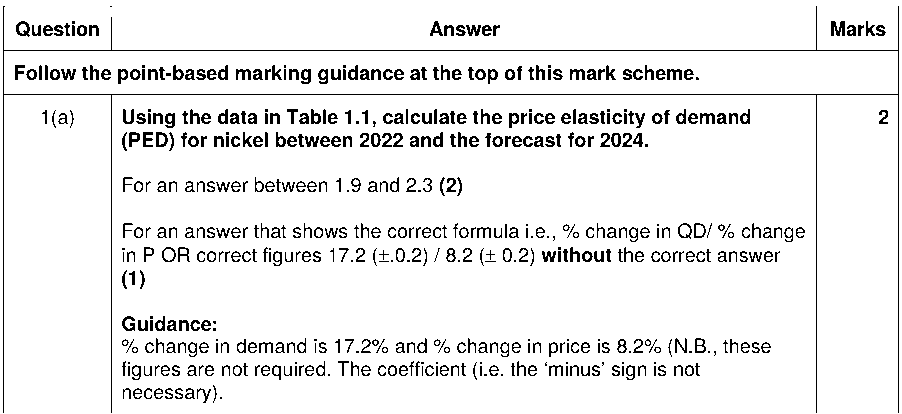
Question 1(a)June 20269708/222 marks

Using the data in Table 1.1, calculate the price elasticity of demand (PED) for nickel between 2022 and the forecast for 2024. [2]
Show mark scheme
Mark scheme, 9708/22 June 2026 question 1(a)
Question 1(b)June 20269708/222 marks

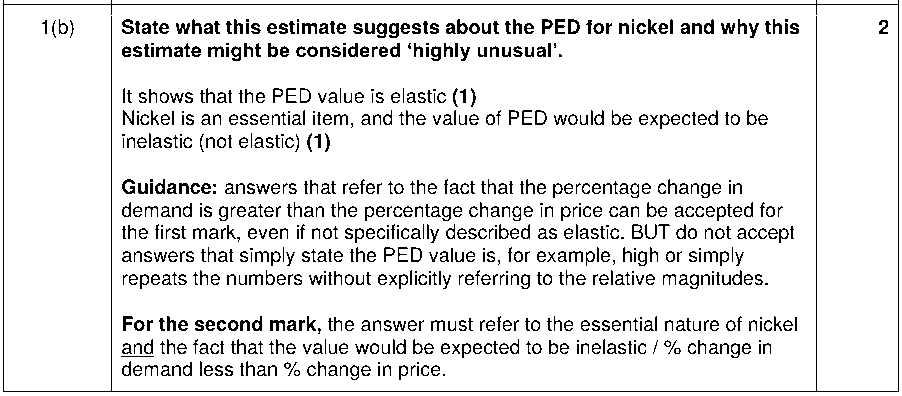
State what this estimate suggests about the PED for nickel and why this estimate might be considered ‘highly unusual’. [2]
Show mark scheme
Mark scheme, 9708/22 June 2026 question 1(b)
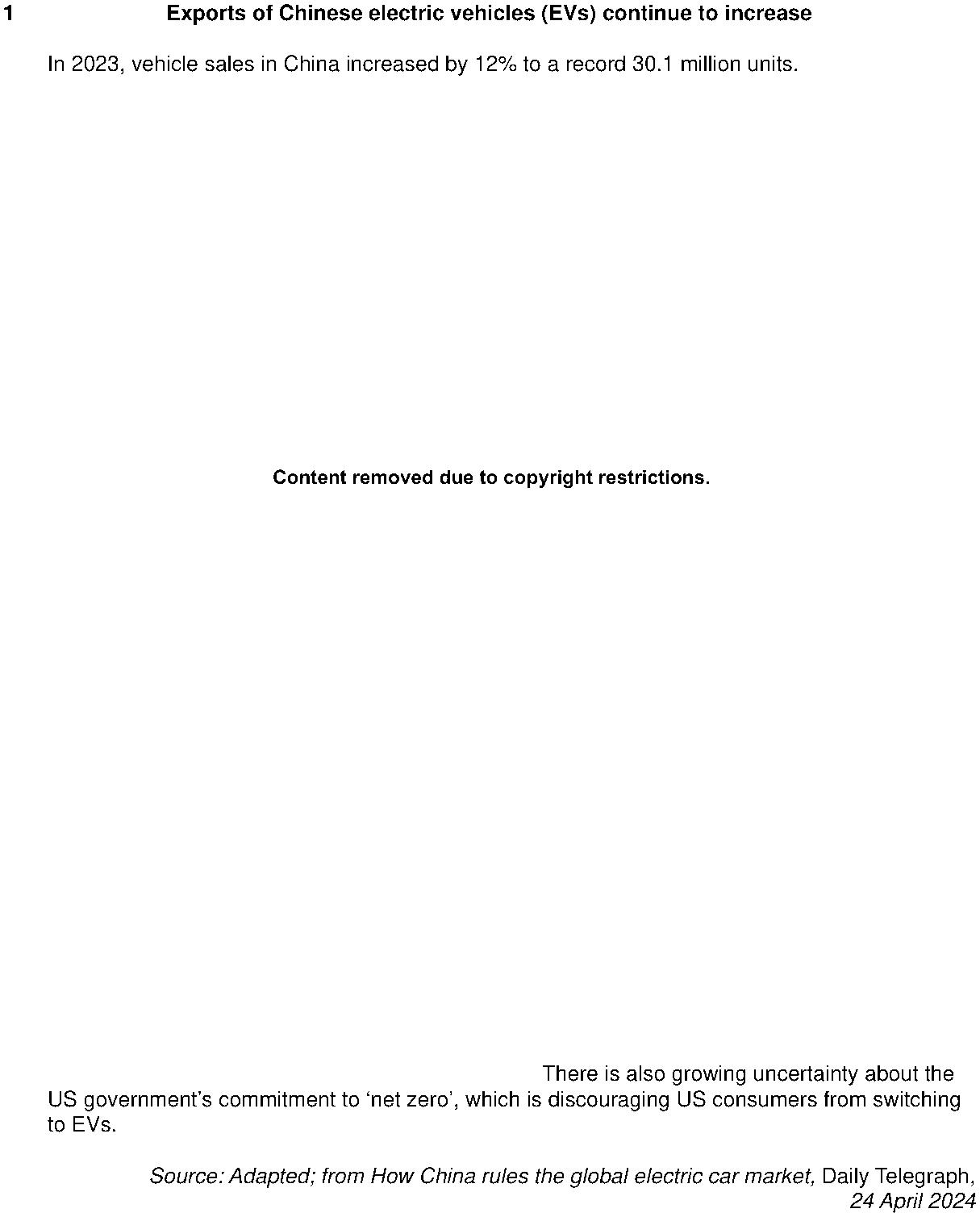
Case study: Exports of Chinese electric vehicles (EVs) continue to increase
Question 1(d)June 20269708/236 marks

A German car manufacturer is concerned about losing sales of EVs in the EU market to imports of EVs from China.

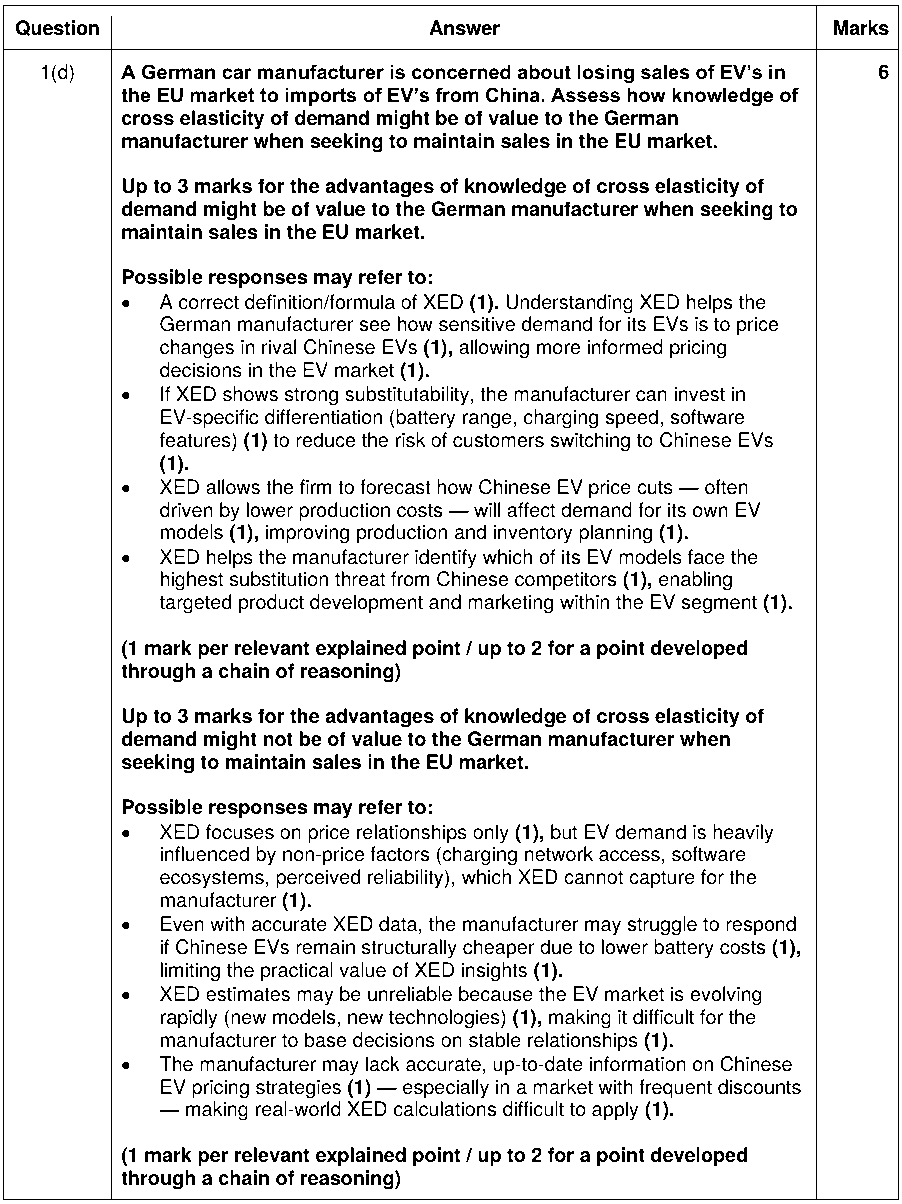
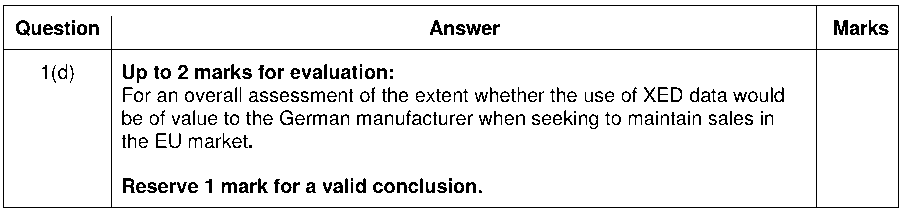
Assess the extent to which a knowledge of cross elasticity of demand (XED) might be of value to the German manufacturer when seeking to maintain sales in the EU market. [6]
Show mark scheme
Mark scheme, 9708/23 June 2026 question 1(d) (page 1 of 2)
Mark scheme, 9708/23 June 2026 question 1(d) (page 2 of 2)
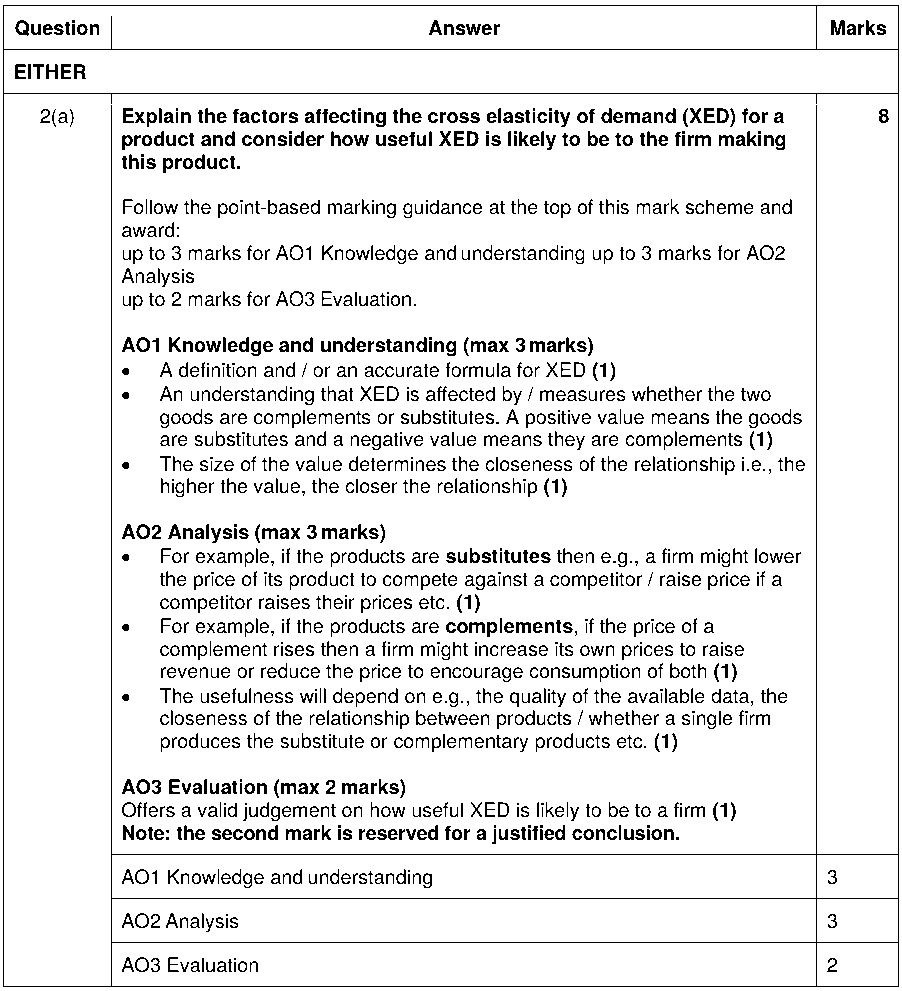
Question 2(a)June 20269708/248 marks

Explain the factors affecting the cross elasticity of demand (XED) for a product and consider how useful XED is likely to be to the firm making this product. [8]
Show mark scheme
Mark scheme, 9708/24 June 2026 question 2(a)
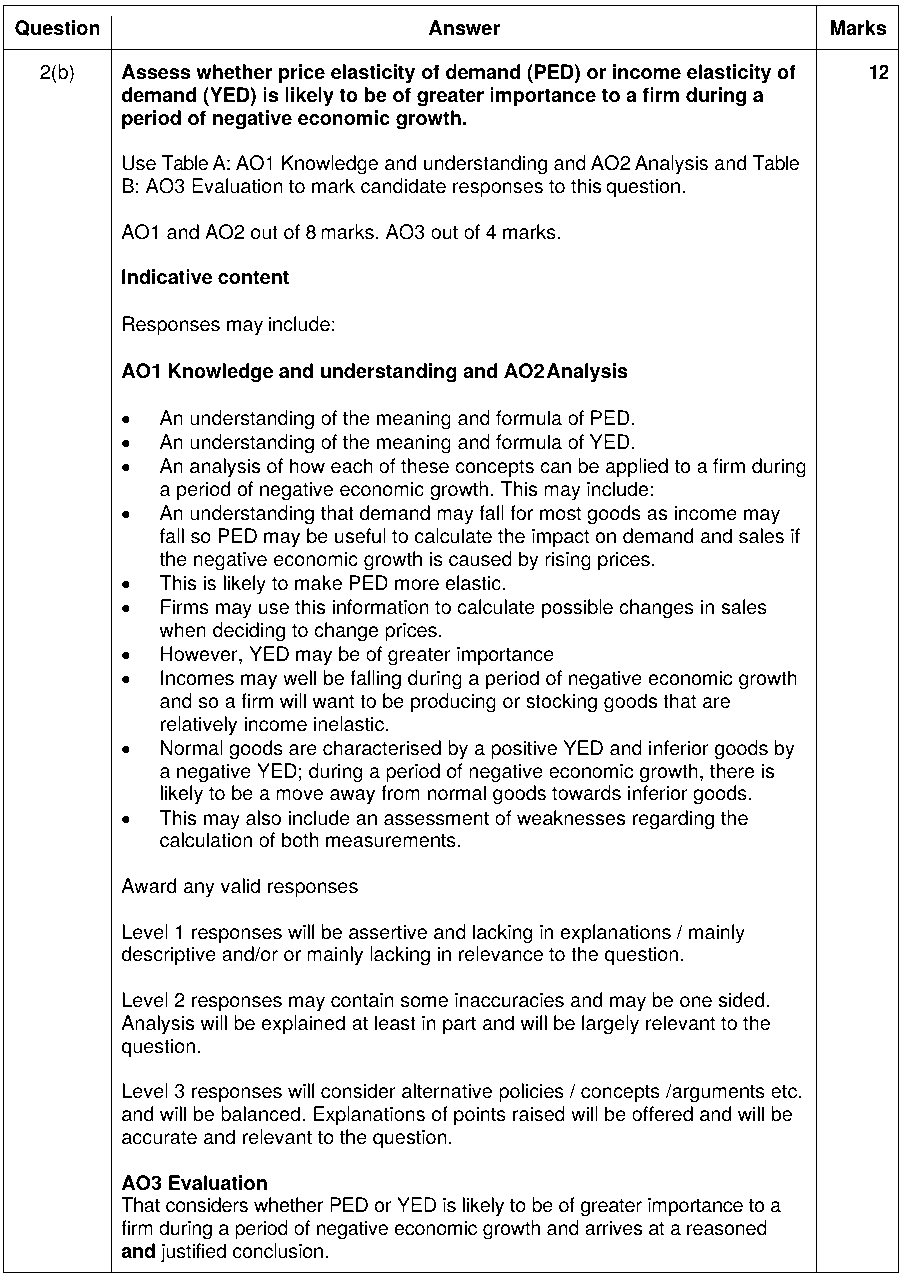
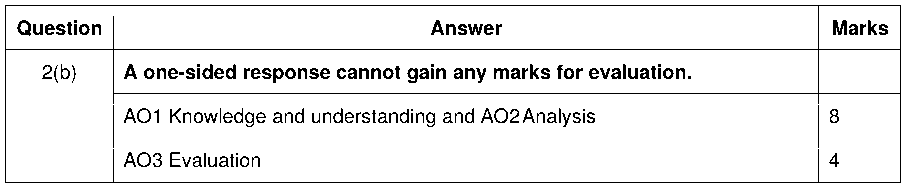
Question 2(b)June 20269708/2412 marks

Assess whether price elasticity of demand (PED) or income elasticity of demand (YED) is likely to be of greater importance to a firm during a period of negative economic growth. [12]
Show mark scheme
Mark scheme, 9708/24 June 2026 question 2(b) (page 1 of 2)
Mark scheme, 9708/24 June 2026 question 2(b) (page 2 of 2)
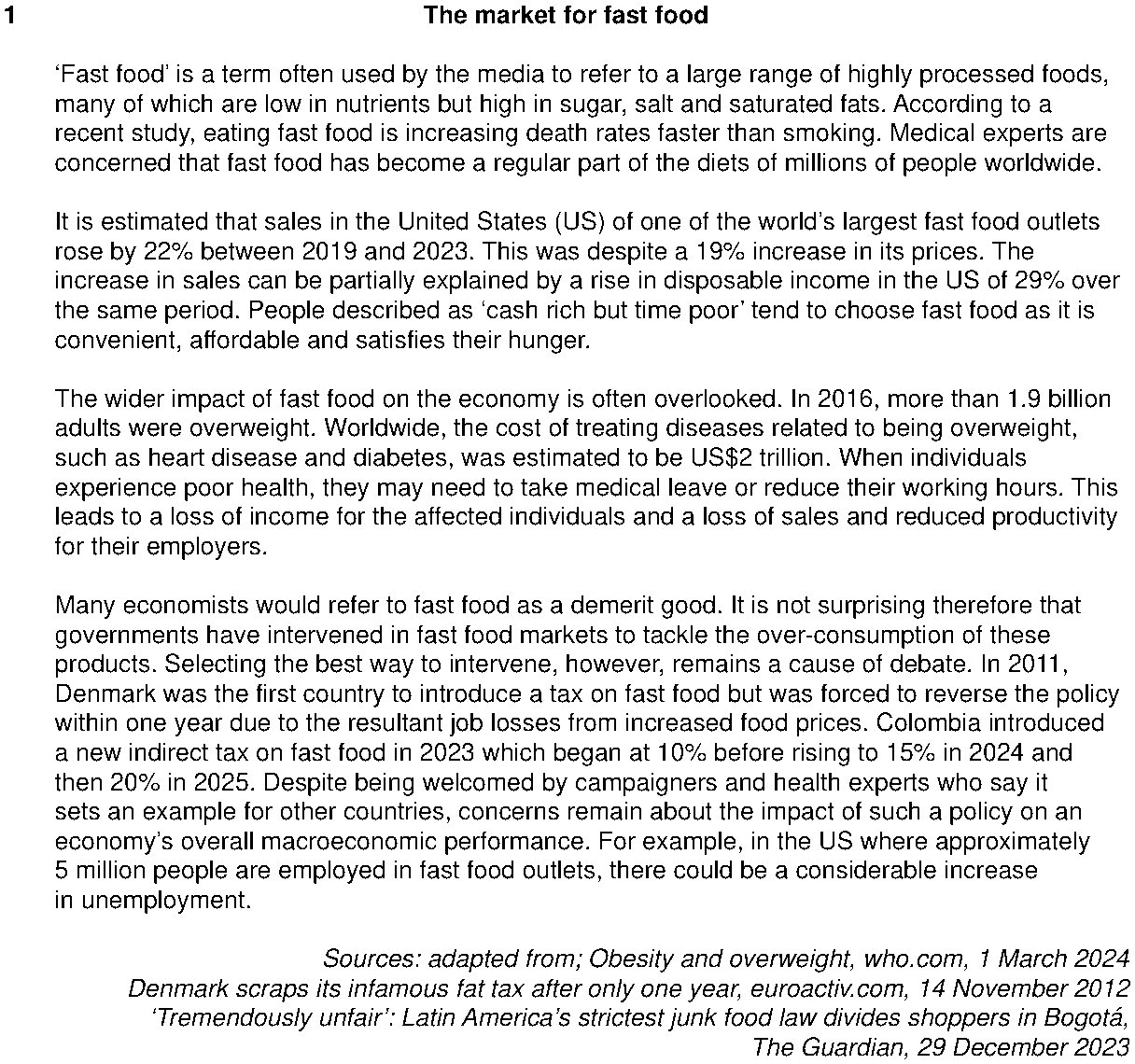
Case study: The market for fast food
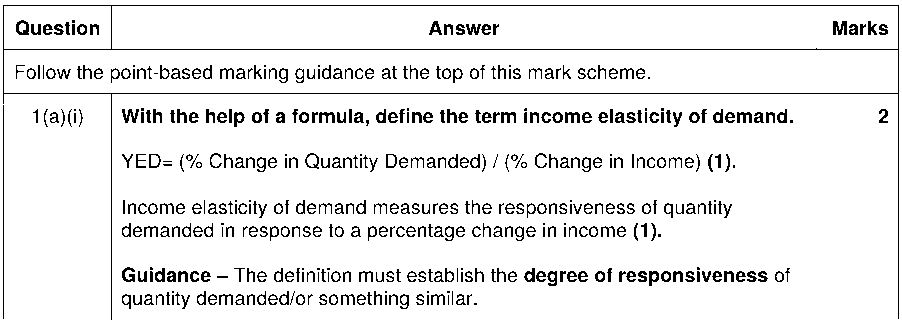
Question 1(a)March 20269708/224 marks

(i) With the help of a formula, define the term income elasticity of demand. [2]

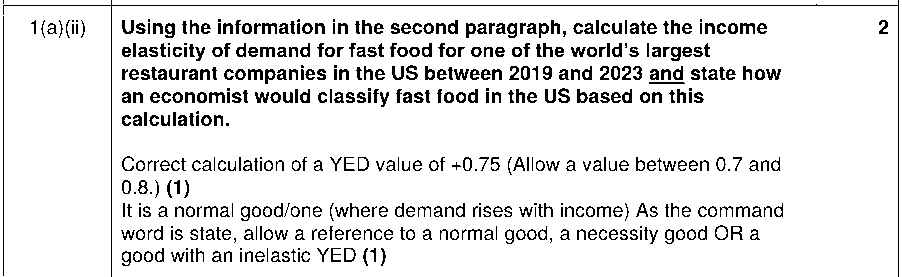
(ii) Using the information in the second paragraph, calculate the income elasticity of demand for fast food for one of the world’s largest restaurant companies in the US between 2019 and 2023 and state how an economist would classify fast food in the US based on this calculation. [2]
Show mark scheme
Mark scheme, 9708/22 March 2026 question 1(a) (page 1 of 2)
Mark scheme, 9708/22 March 2026 question 1(a) (page 2 of 2)
Question 2(a)November 20259708/218 marks

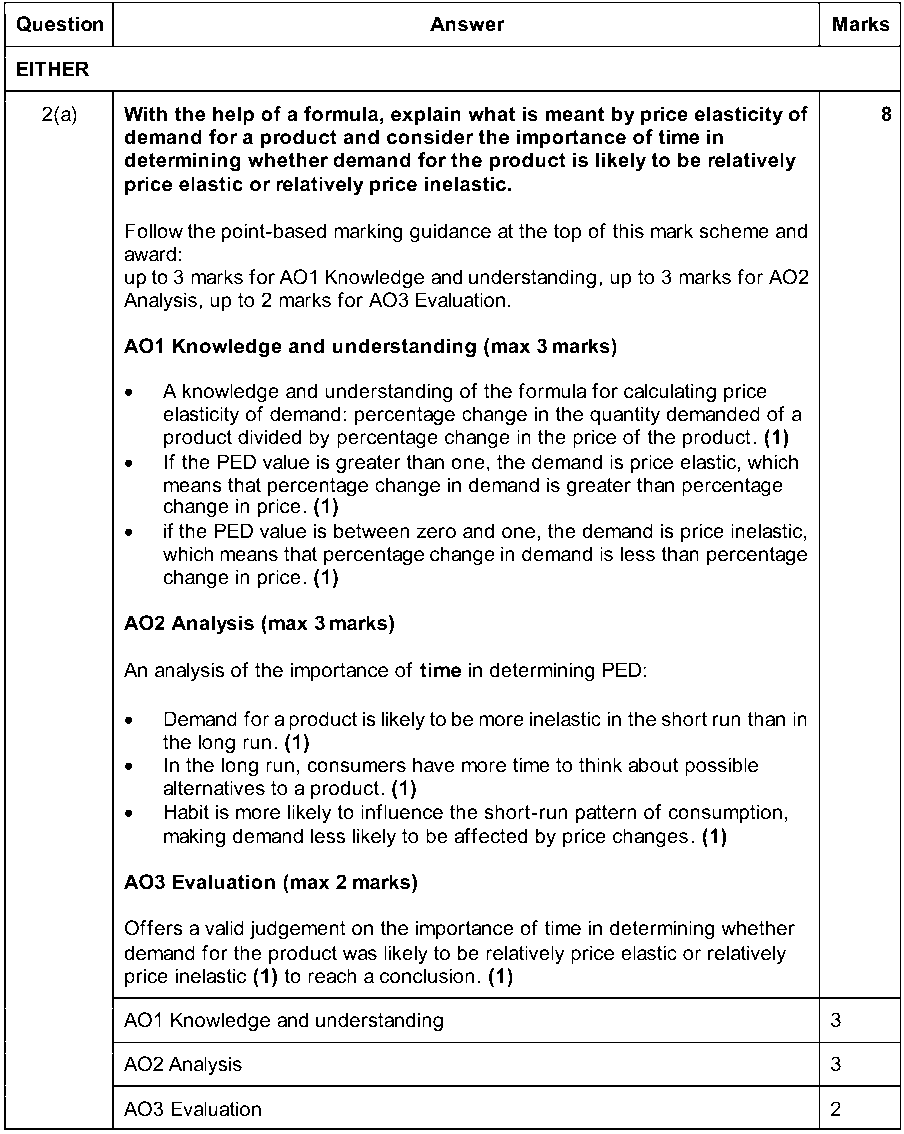
With the help of a formula, explain what is meant by price elasticity of demand for a product and consider the importance of time in determining whether demand for the product is likely to be relatively price elastic or relatively price inelastic. [8]
Show mark scheme
Mark scheme, 9708/21 November 2025 question 2(a)
Question 2(b)November 20259708/2112 marks

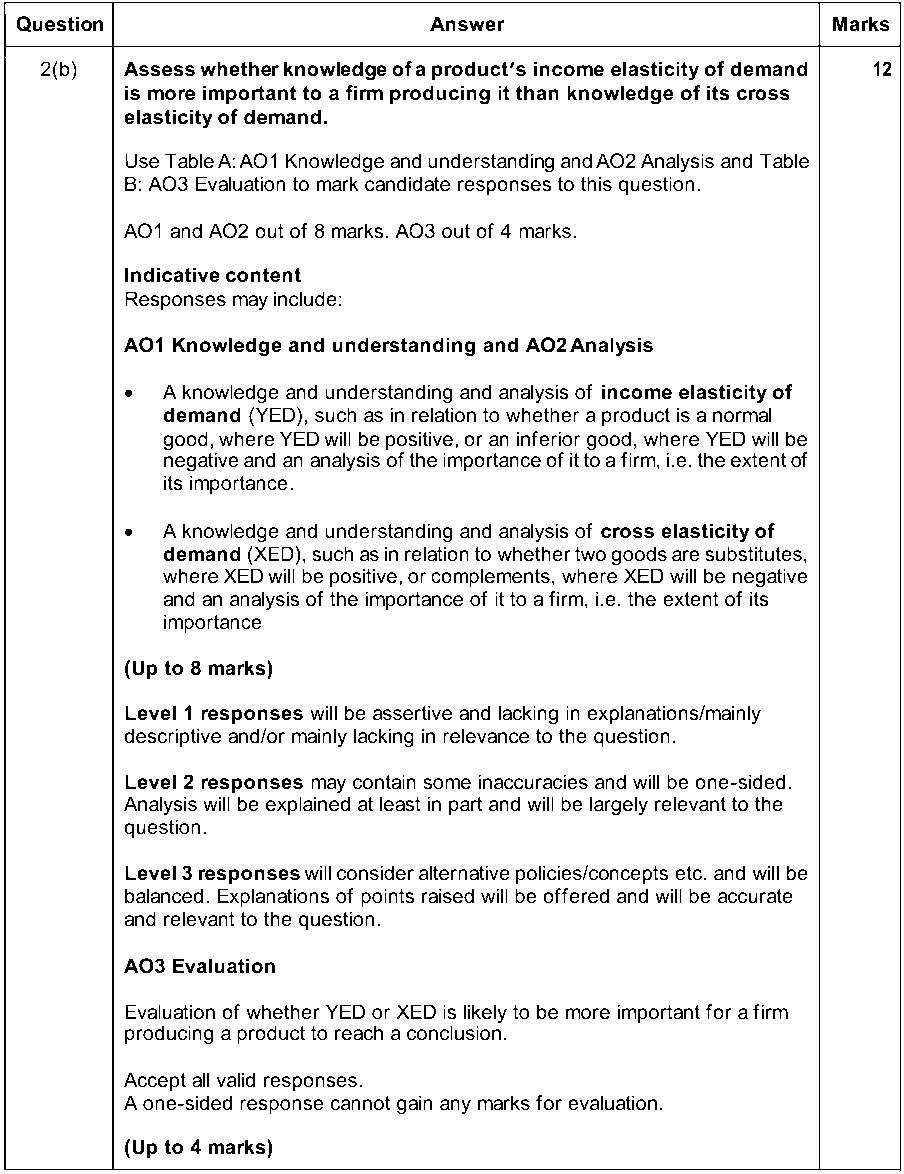
Assess whether knowledge of a product’s income elasticity of demand is more important to a firm producing it than knowledge of its cross elasticity of demand. [12]

Show mark scheme
Mark scheme, 9708/21 November 2025 question 2(b) (page 1 of 2)
Mark scheme, 9708/21 November 2025 question 2(b) (page 2 of 2)
Case study: How do we make sure cocoa bean farmers get paid a living wage?
Question 1(a)November 20259708/222 marks

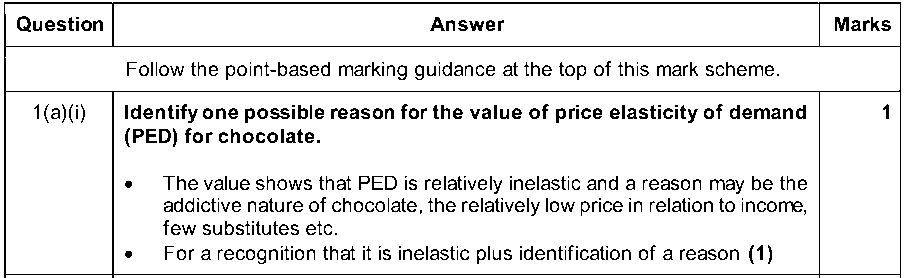
(i) Identify one possible reason for the value of price elasticity of demand (PED) for chocolate. [1]

(ii) Calculate the percentage change in the value of global sales of chocolate between 2017 and 2026, as shown in Table 1.1. [1]

Show mark scheme
Mark scheme, 9708/22 November 2025 question 1(a) (page 1 of 2)
Mark scheme, 9708/22 November 2025 question 1(a) (page 2 of 2)
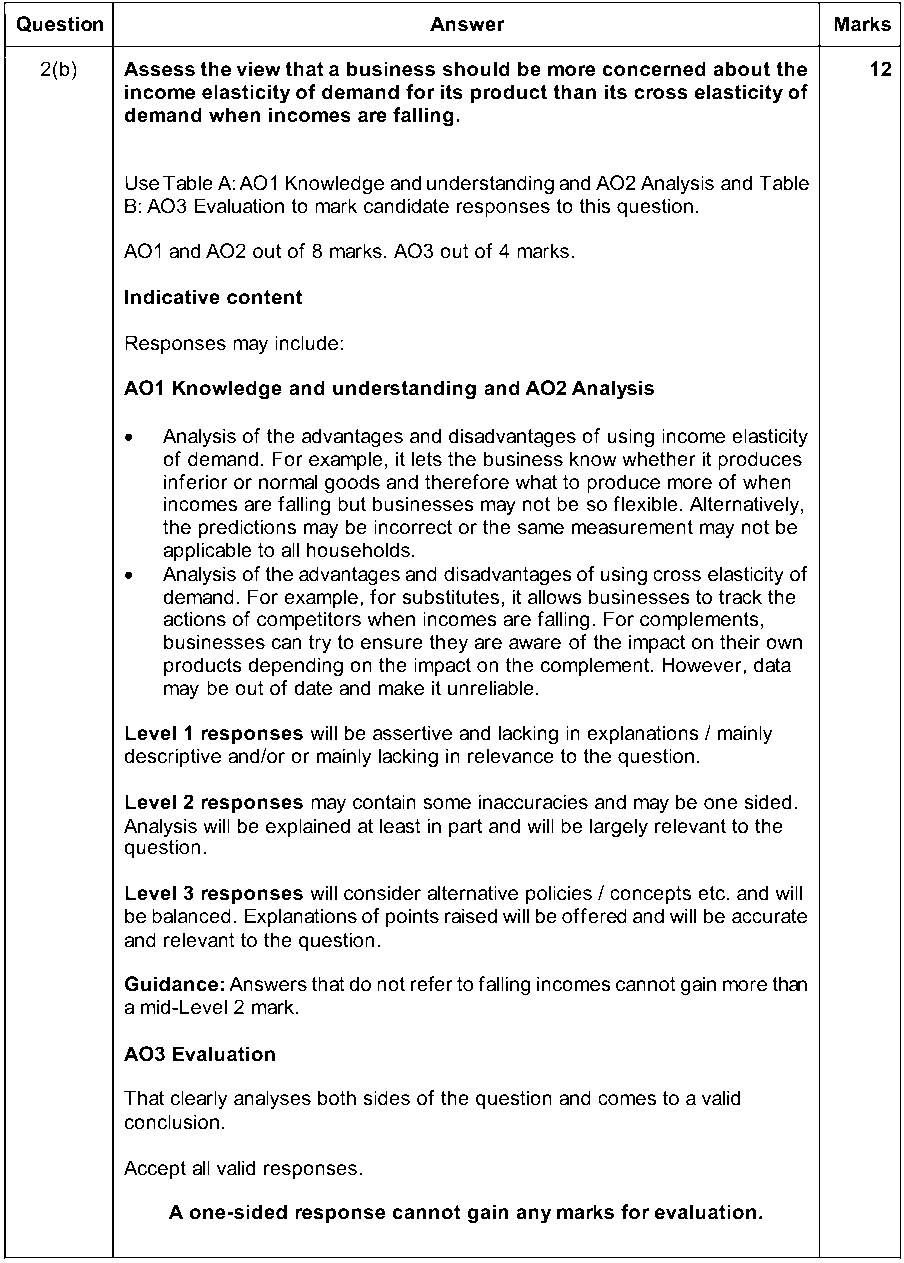
Question 2(b)November 20259708/2212 marks

Assess the view that a business should be more concerned about the income elasticity of demand for its product than its cross elasticity of demand when incomes are falling. [12]

Show mark scheme
Mark scheme, 9708/22 November 2025 question 2(b) (page 1 of 2)
Mark scheme, 9708/22 November 2025 question 2(b) (page 2 of 2)
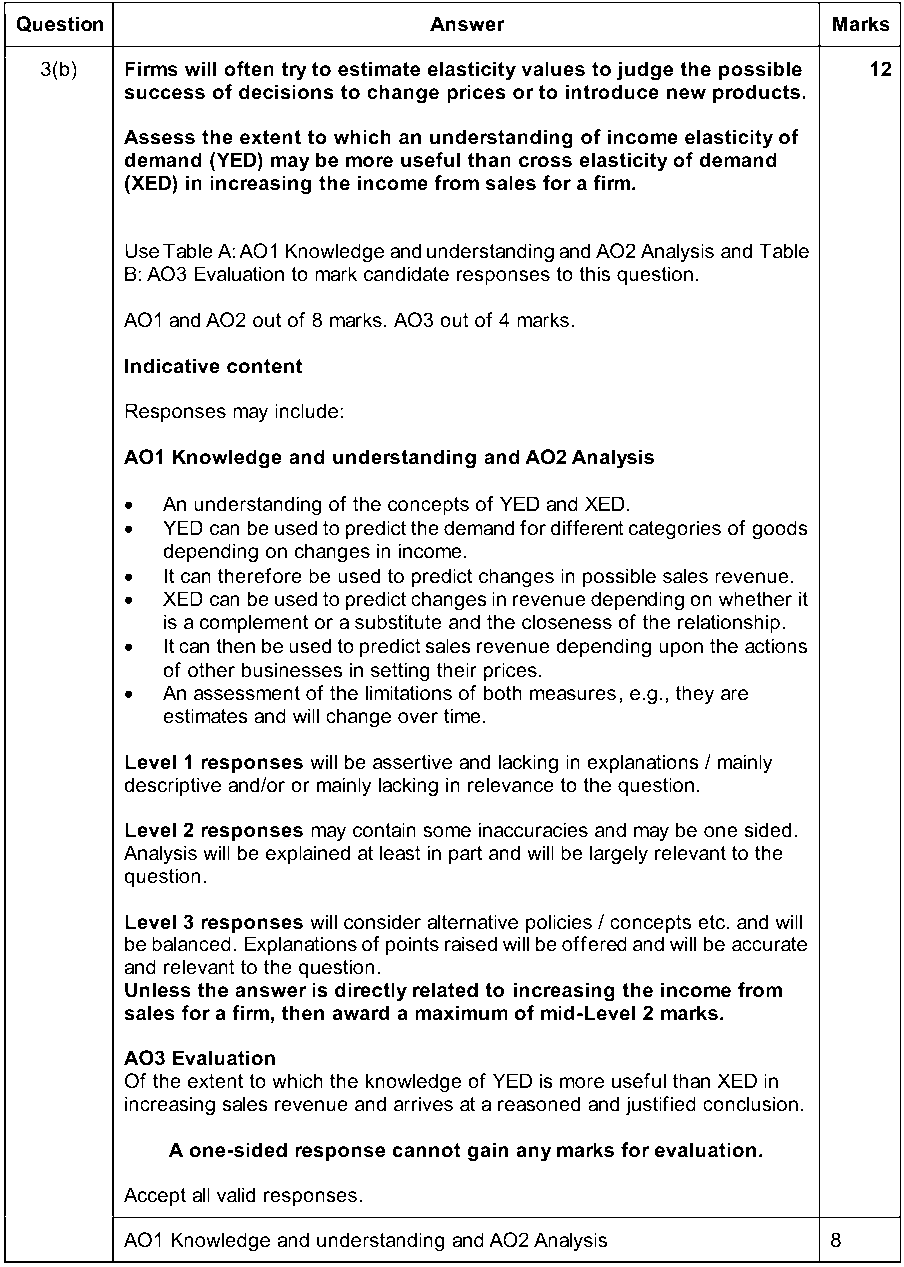
Question 3(b)November 20259708/2412 marks

Firms will often try to estimate elasticity values to judge the possible success of decisions to change prices or to introduce new products.

Assess the extent to which an understanding of income elasticity of demand (YED) may be more useful than cross elasticity of demand (XED) in increasing the income from sales for a firm. [12]

Show mark scheme
Mark scheme, 9708/24 November 2025 question 3(b) (page 1 of 2)
Mark scheme, 9708/24 November 2025 question 3(b) (page 2 of 2)
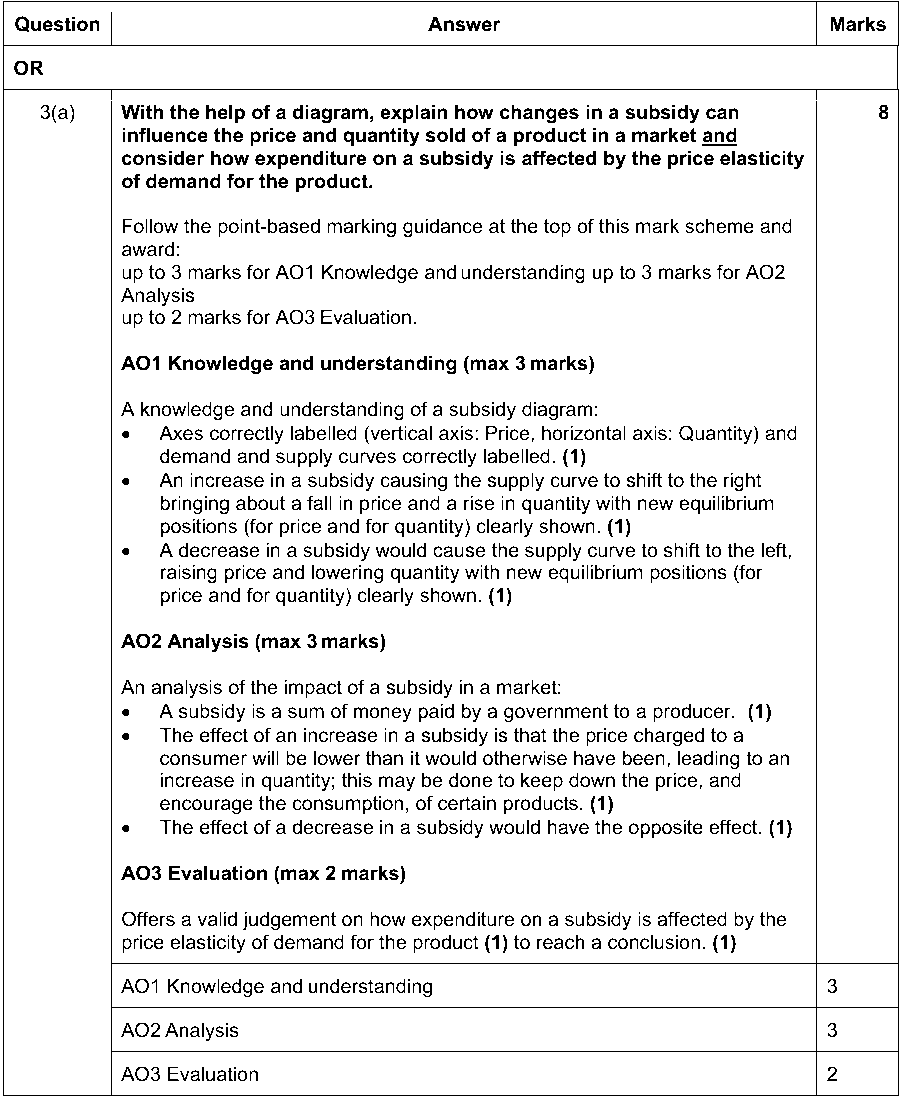
Question 3(a)June 20259708/218 marks

With the help of a diagram, explain how changes in a subsidy can influence the price and quantity sold of a product in a market and consider how expenditure on a subsidy is affected by the price elasticity of demand for the product. [8]
Show mark scheme
Mark scheme, 9708/21 June 2025 question 3(a)
Question 3(b)June 20259708/2212 marks

Assess the extent to which knowledge of a product’s price elasticity of supply is the most useful measure of elasticity to a firm needing to react quickly to changes in its market. [12]

Show mark scheme
Mark scheme, 9708/22 June 2025 question 3(b)
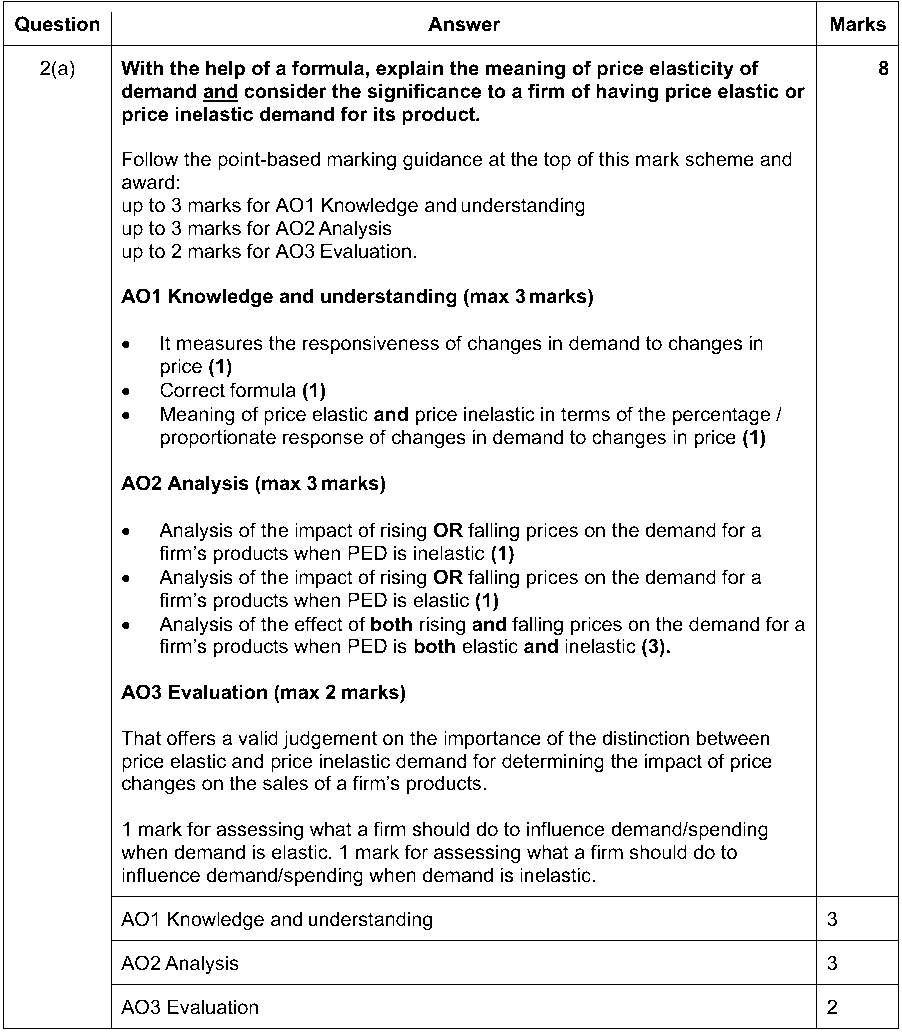
Question 2(a)June 20259708/248 marks

With the help of a formula, explain the meaning of price elasticity of demand and consider the significance to a firm of having price elastic or price inelastic demand for its product. [8]
Show mark scheme
Mark scheme, 9708/24 June 2025 question 2(a)
Case study: A global olive oil shortage
Case study: A global olive oil shortage (page 1 of 2)
Case study: A global olive oil shortage (page 2 of 2)
Question 1(b)March 20259708/222 marks

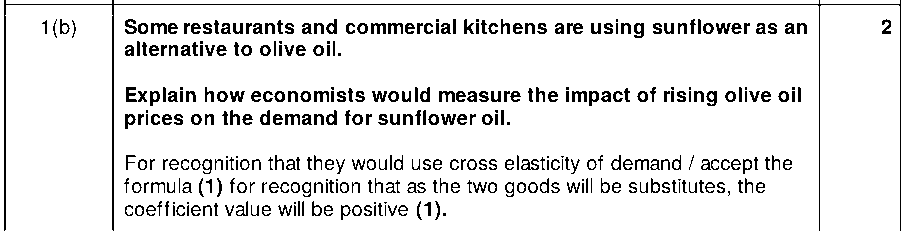
Some restaurants and commercial kitchens are using sunflower oil as an alternative to olive oil.

Explain how economists could measure the impact of rising olive oil prices on the demand for sunflower oil. [2]
Show mark scheme
Mark scheme, 9708/22 March 2025 question 1(b)

112 more questions from 2020–2024

🔒 Unlock every Price elasticity, income elasticity and cross elasticity of demand question from 2020–2024

All 112 come with their mark schemes, answers and case studies, and appear in the practice tool above once you’re signed in. It’s free.

Create a free accountSign in

A few of them

  • 9708/12 · November 2024 · Question 14A product with infinite elasticity of supply… 🔒
  • 9708/22 · November 2024 · Question 2(b)Assess whether knowledge of income elasticity of… 🔒
  • 9708/11 · June 2024 · Question 8Which statement… 🔒
  • 9708/12 · June 2024 · Question 8The tables show the different quantities of… 🔒
  • 9708/13 · June 2024 · Question 8A firm is charging a price of… 🔒
  • + 107 more, by year in the table above

Questions and mark schemes are from past Cambridge papers and are reproduced for revision. Topical Vault is an independent revision resource, not affiliated with or endorsed by Cambridge Assessment International Education.

AS Level Economics questions by topic

Each topic opens this practice tool with only that topic’s questions, plus how often it comes up and every question on it in one list.

  1. Unit 1Basic economic ideas and resource allocation
  2. Ch 1Scarcity, choice and opportunity cost
  3. Ch 2Economic methodology
  4. Ch 3Factors of production
  5. Ch 4Resource allocation in different economic systems
  6. Ch 5Production possibility curves
  7. Ch 6Classification of goods and services
  8. Unit 2The price system and the microeconomy
  9. Ch 7Demand and supply curves
  10. Ch 8Price elasticity, income elasticity and cross elasticity of demand
  11. Ch 9Price elasticity of supply
  12. Ch 10The interaction of demand and supply
  13. Ch 11Consumer and producer surplus
  14. Unit 3Government microeconomic intervention
  15. Ch 12Reasons for government intervention in markets
  16. Ch 13Methods and effects of government intervention in markets
  17. Ch 14Addressing income and wealth inequality
  18. Unit 4The macroeconomy
  19. Ch 15National income statistics
  20. Ch 16Introduction to the circular flow of income
  21. Ch 17Aggregate demand and aggregate supply analysis
  22. Ch 18Economic growth
  23. Ch 19Unemployment
  24. Ch 20Price stability
  25. Unit 5Government macroeconomic intervention
  26. Ch 21Government macroeconomic policy objectives
  27. Ch 22Fiscal policy
  28. Ch 23Monetary policy
  29. Ch 24Supply-side policy
  30. Unit 6International economic issues
  31. Ch 25The reasons for international trade
  32. Ch 26Protectionism
  33. Ch 27Current account of the balance of payments
  34. Ch 28Exchange rates
  35. Ch 29Policies to correct imbalances in the current account of the balance of payments