← Topical Vault

Exchange rates · AS Level Economics

Cambridge 9708, Paper 1 & 2. 2,092 questions, 2020 to 2026.

Topic
Year

Paper 1 multiple-choice questions and Paper 2 data-response/essay questions, from the original Cambridge material. Paper 2 mark schemes and case studies are reproduced as images of the official pages rather than retyped, so nothing is lost or paraphrased; a question tagged under more than one topic appears under each. Tick “Add to my paper” on any question to build a custom practice PDF from the tray in the corner.

About Exchange rates

Questions on exchange rates: floating, fixed and managed systems, what makes a currency appreciate or depreciate, and the effects of exchange rate changes.

114 past paper questions on this topic since 2020, across 20 exam sessions.

How often it comes up

YearPaper 1Paper 2TotalChart
20266410
20258513
202410313
20238513
202218523
202113417
202017825

Every 2025–2026 question on Exchange rates

The whole topic on one page, with answers and mark schemes. Printing this page prints just this list.

Paper 1 · Multiple choice (14)

Question 28June 20269708/111 mark

Why may a government introduce a floating exchange rate?

  • Ait allows government more independence in policy making
  • Bit eliminates the instability of free markets
  • Cit gives firms more confidence in future costs and prices
  • Dit increases foreign exchange reserves
Show answer

ACorrect answer

Question 26June 20269708/121 mark

The US dollar ($) has appreciated by 12% against an average of other major trading currencies.

What is likely to have caused this?

  • Aan increase in the US imports
  • Ban increase in the US interest rate
  • Can increase in the US money supply
  • Dan increase in the US employment rate
Show answer

BCorrect answer

Question 30June 20269708/121 mark
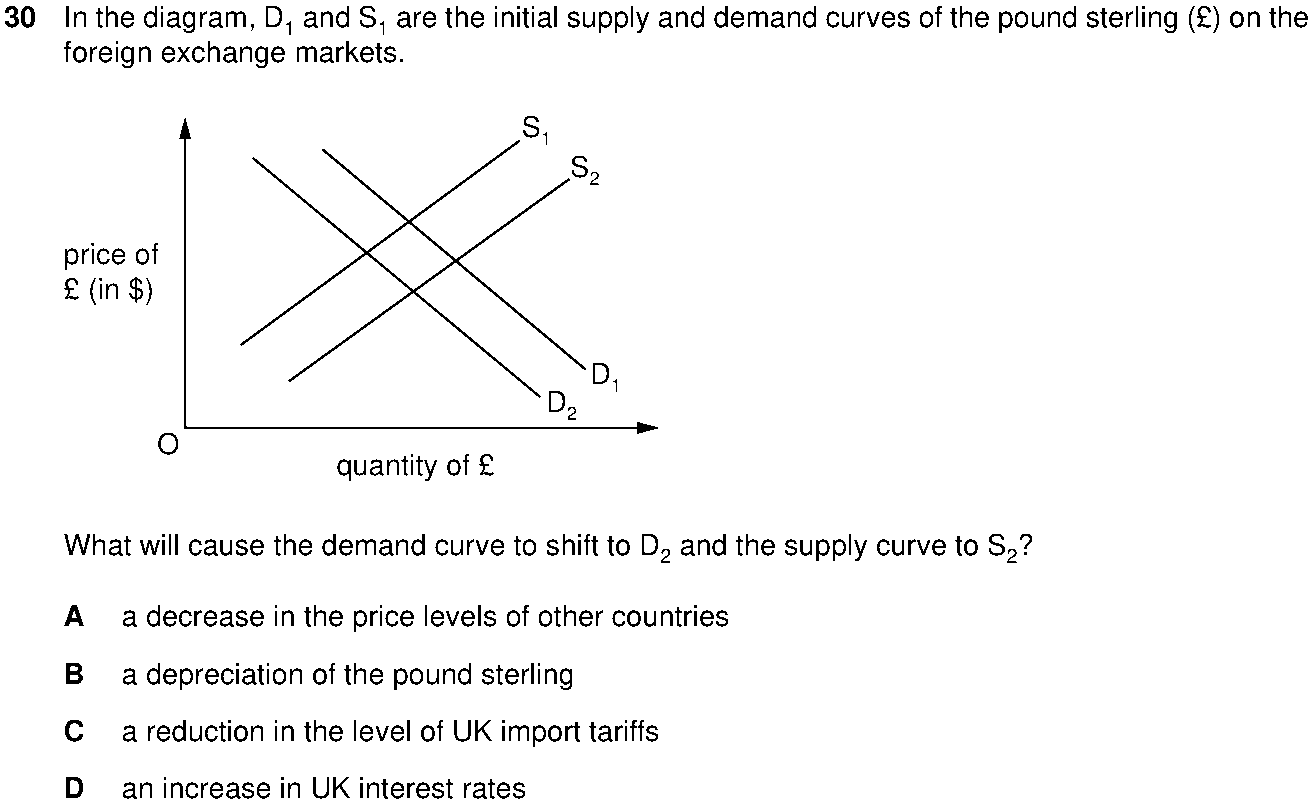
9708/12 June 2026 question 30
Show answer

ACorrect answer

Question 30June 20269708/131 mark

What is the consequence of an appreciation of the exchange rate on the current account of the balance of payments and the price level?

current account of the balance price level of payments

  • Aimproves decreases
  • Bimproves increases
  • Cworsens decreases
  • Dworsens increases
Show answer

CCorrect answer

Question 29June 20269708/141 mark

There is a floating exchange rate between country M and country N.

Which changes will definitely cause an appreciation of country M’s currency?

value of exports value of imports from M to N from N to M

  • Adecreases decreases
  • Bdecreases increases
  • Cincreases decreases
  • Dincreases increases
Show answer

CCorrect answer

Question 29March 20269708/121 mark

To what is a depreciation of a currency’s exchange rate most likely to lead?

  • Aa decrease in inflationary pressures
  • Ba decrease in the relative price of imports
  • Can increase in cyclical unemployment
  • Dan increase in real GDP
Show answer

DCorrect answer

Question 26November 20259708/111 mark

A country’s currency depreciates in terms of other currencies.

What would be a consequence of this depreciation?

  • AThere would be a decrease in structural unemployment.
  • BThere would be a decrease in the volume of exports.
  • CThere would be an increase in cost-push inflationary pressure.
  • DThere would be an increase in the budget deficit.
Show answer

CCorrect answer

Question 26November 20259708/121 mark

A country with a floating exchange rate has a large deficit on the current account of the balance of payments.

What is most likely to decrease as a consequence of this deficit?

  • Acompetitiveness of the country’s products
  • Blevel of employment in the country
  • Cprices of exports from the country
  • Drate of inflation in the country
Show answer

CCorrect answer

Question 28November 20259708/121 mark
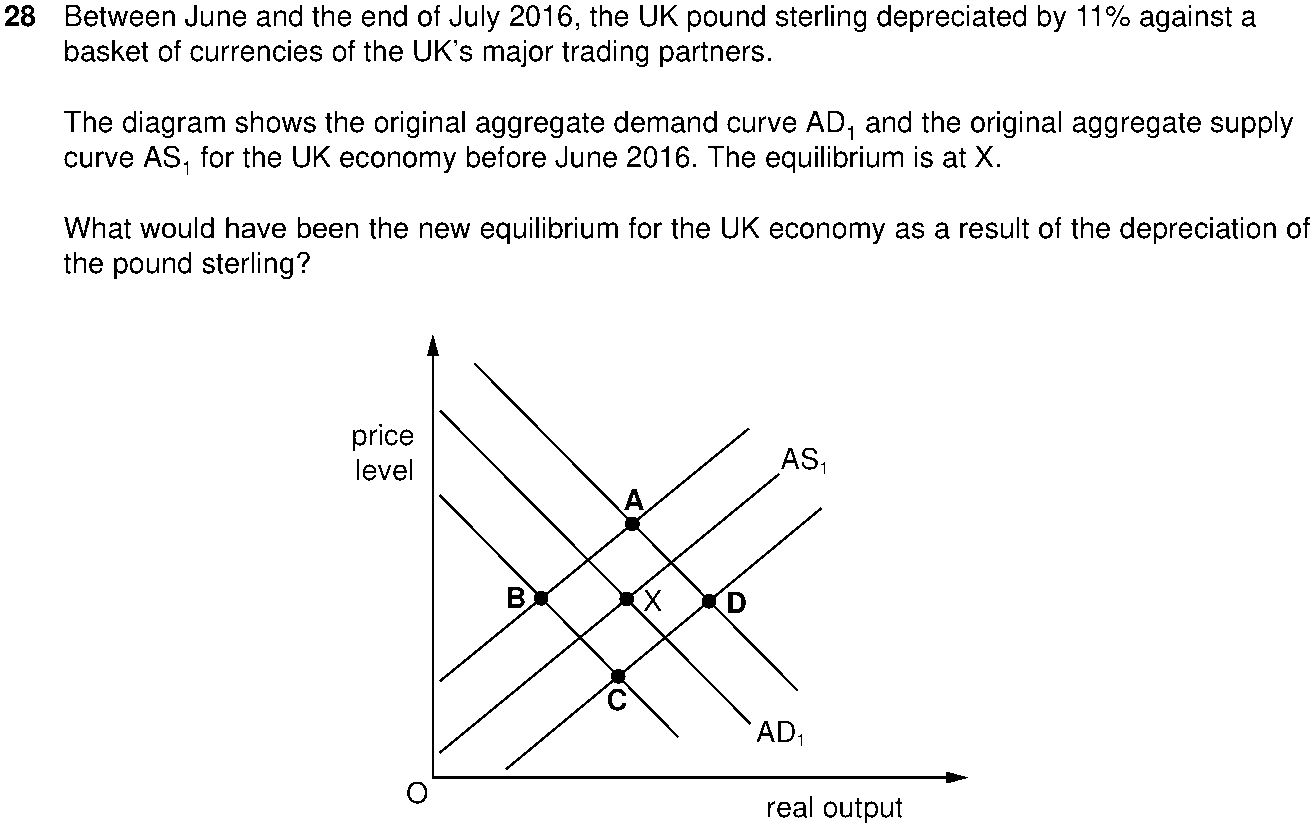
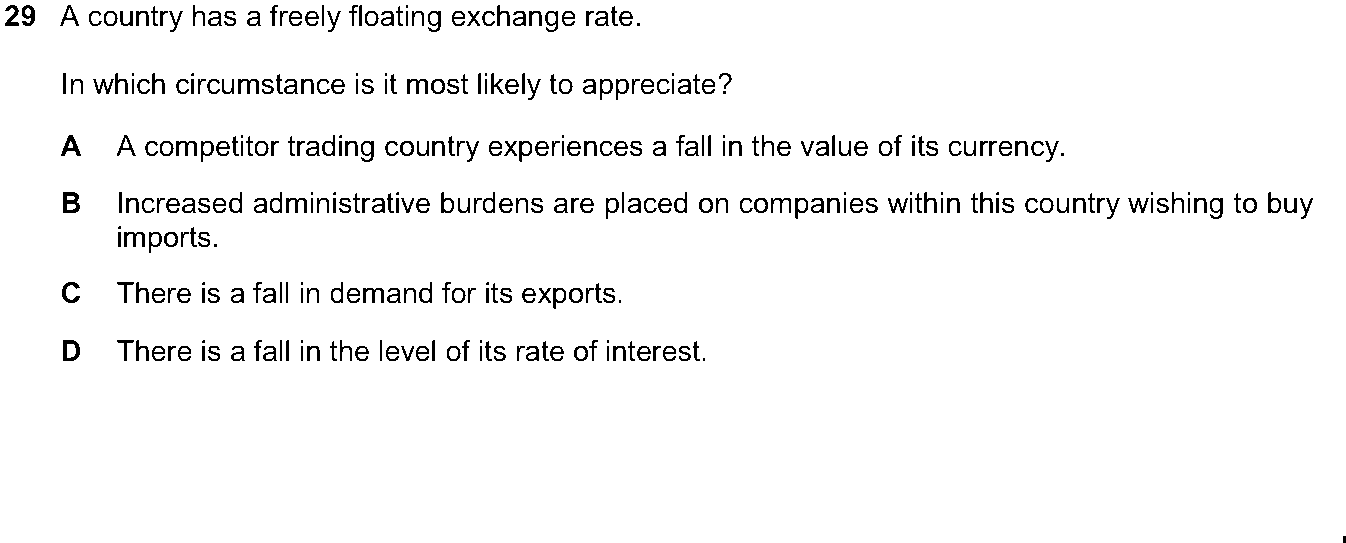
9708/12 November 2025 question 28
Show answer

ACorrect answer

Question 30November 20259708/141 mark
9708/14 November 2025 question 30
Show answer

ACorrect answer

Question 30June 20259708/111 mark

The table shows the change in the value of UK sterling over a three-month period.

June Sept

£1 = $1.38 £1 = $1.32

What is likely to be the short-term impact of the change in the value of UK sterling on the UK economy?

  • Aincreased disinflation
  • Bincrease in cost-push inflation
  • Cmore purchasing power of money
  • Dreduced demand-pull inflation
Show answer

BCorrect answer

Question 30June 20259708/121 mark
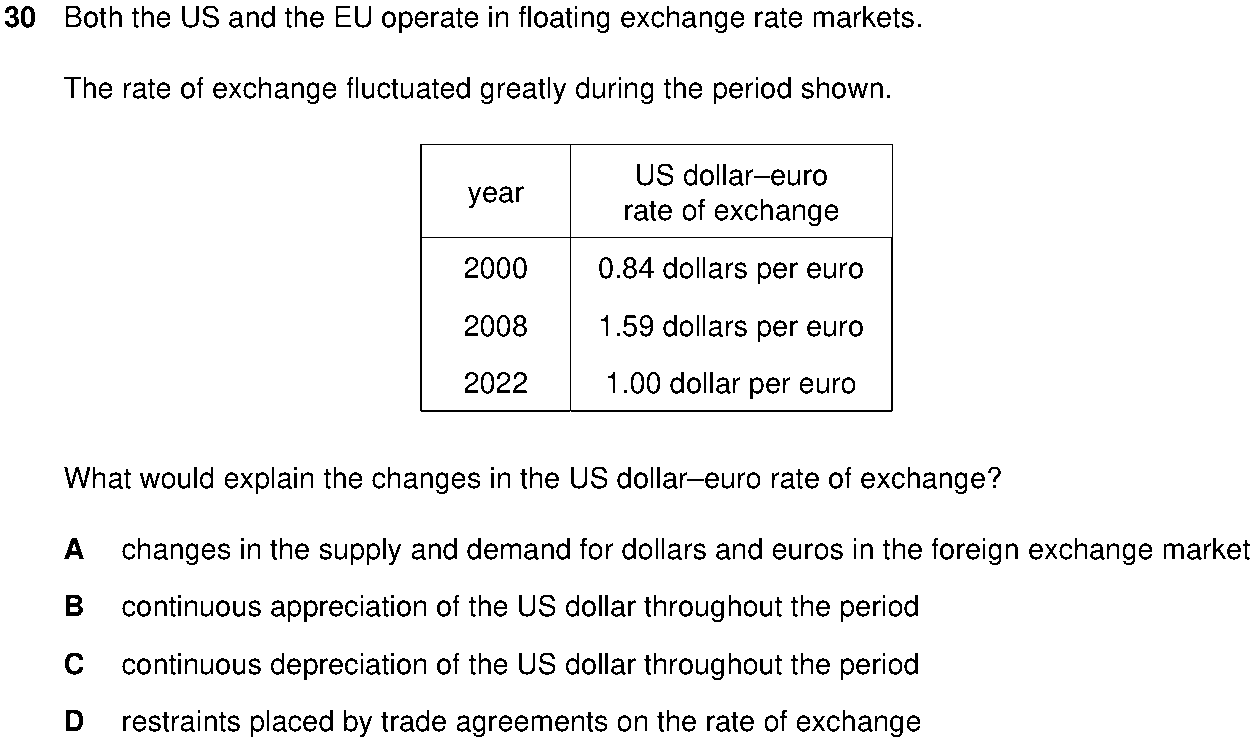
9708/12 June 2025 question 30
Show answer

CCorrect answer

Question 29June 20259708/141 mark
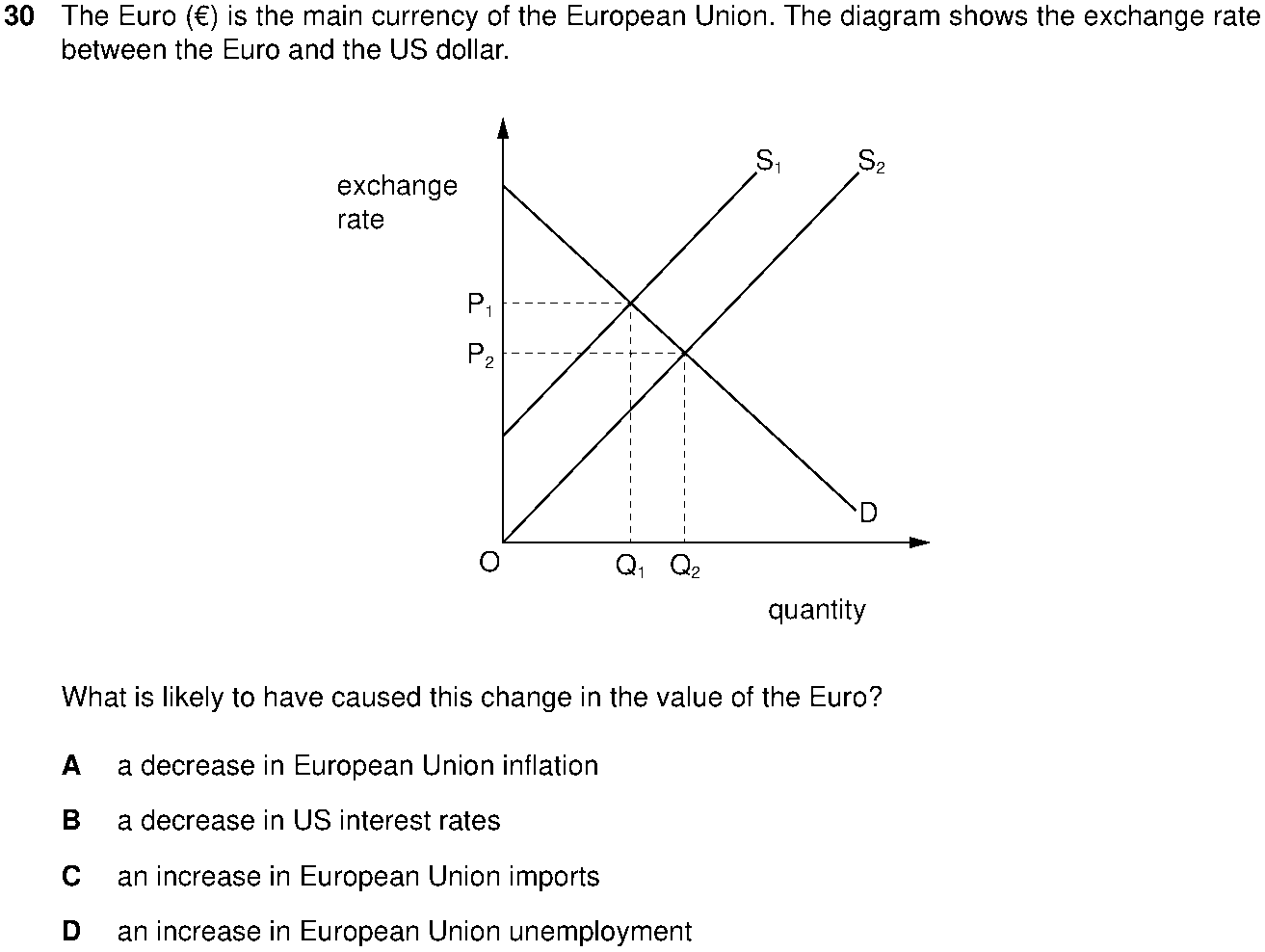
9708/14 June 2025 question 29
Show answer

BCorrect answer

Question 27March 20259708/121 mark

When is a country’s exchange rate most likely to fall?

  • AWhen its current account surplus exceeds that of its trading partners.
  • BWhen its inflation rate exceeds that of its trading partners.
  • CWhen its interest rate exceeds that of its trading partners.
  • DWhen its unemployment rate exceeds that of its trading partners.
Show answer

BCorrect answer

Paper 2 · Data response and essays (9)

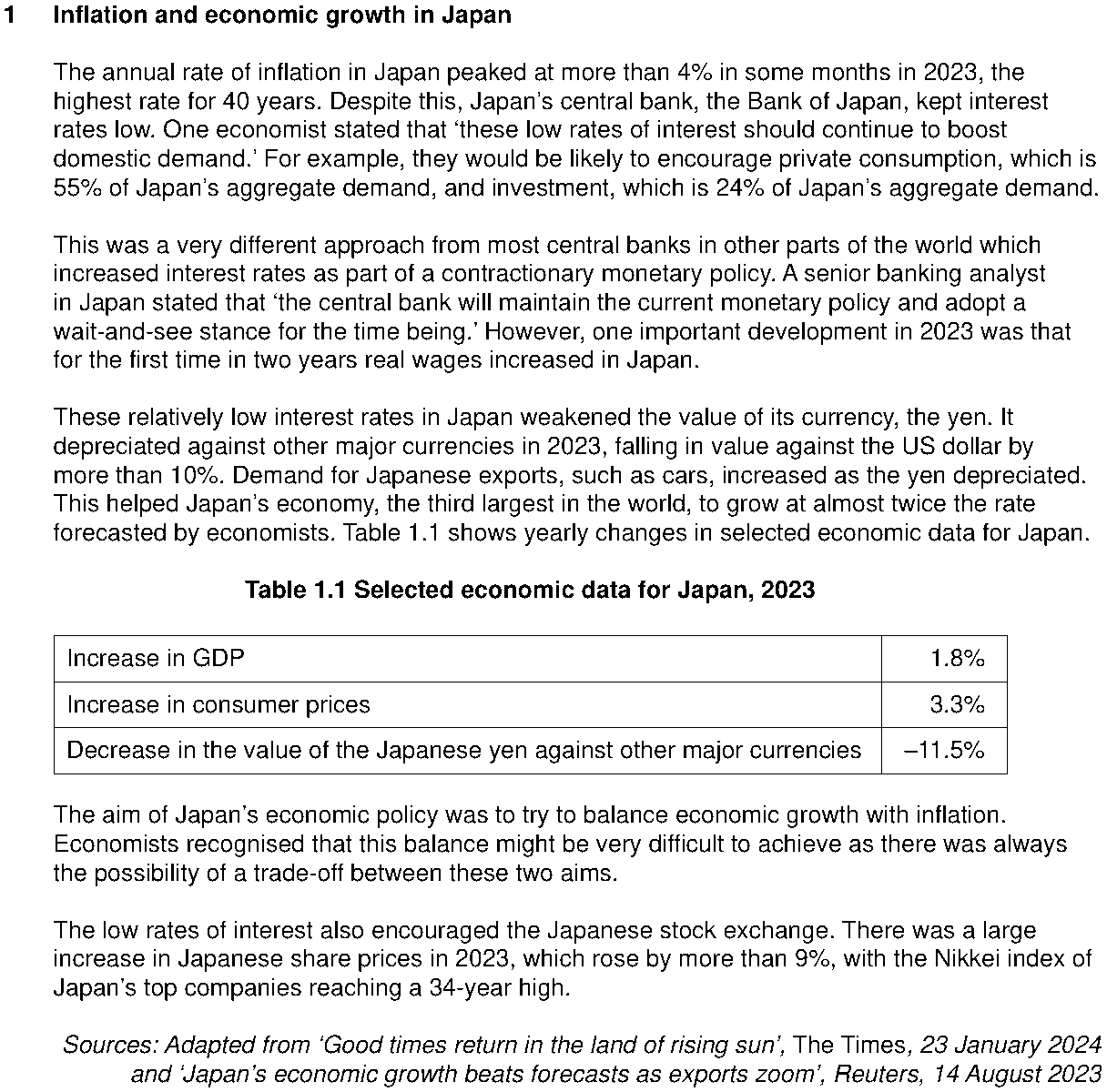
Case study: Inflation and economic growth in Japan
Question 1(c)June 20269708/214 marks

With the help of a diagram, explain how a decrease in the interest rate in Japan could lead to the depreciation in the value of the yen and consider whether only Japan’s interest rate determines the value of the yen. [4]

Show mark scheme
Mark scheme, 9708/21 June 2026 question 1(c)
Question 5(a)June 20269708/238 marks

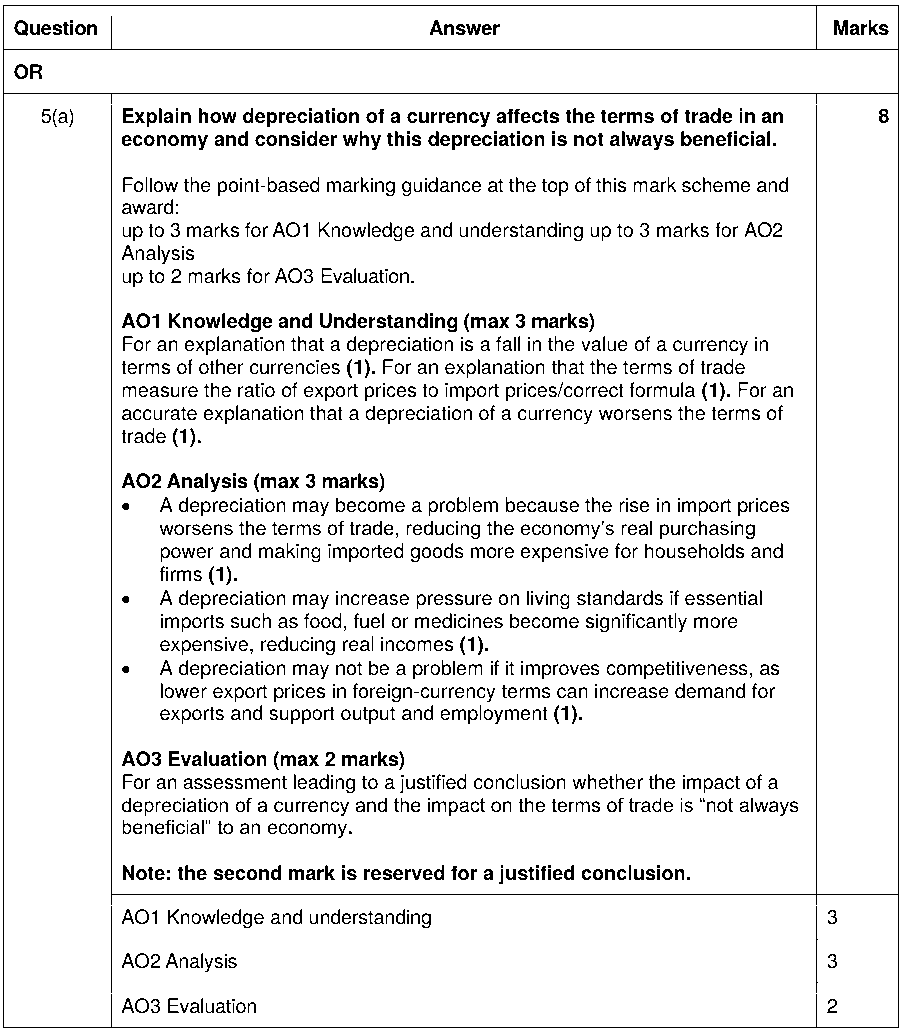
Explain how depreciation of a currency affects the terms of trade in an economy and consider why this depreciation is not always beneficial. [8]
Show mark scheme
Mark scheme, 9708/23 June 2026 question 5(a)
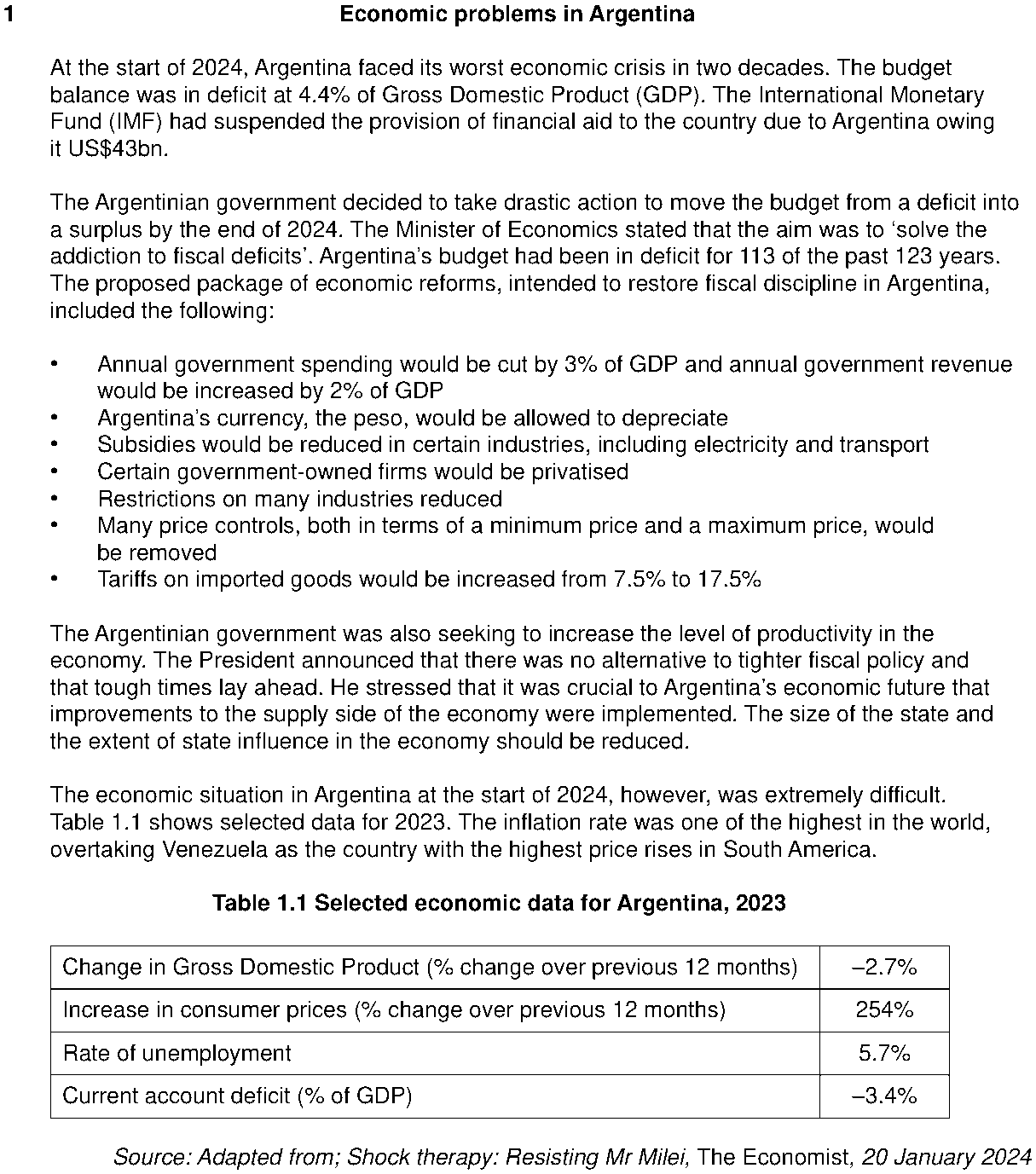
Case study: Economic problems in Argentina
Question 1(a)June 20269708/242 marks

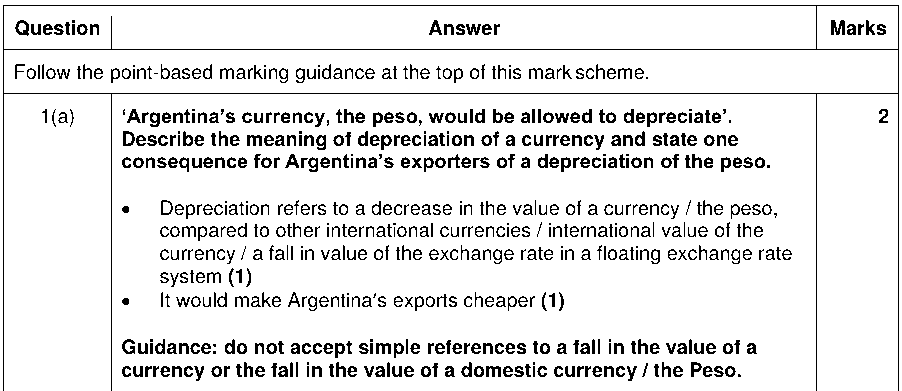
‘Argentina’s currency, the peso, would be allowed to depreciate’.

Describe the meaning of depreciation of a currency and state one consequence for Argentina’s exporters of a depreciation of the peso. [2]
Show mark scheme
Mark scheme, 9708/24 June 2026 question 1(a)
Question 5(a)March 20269708/228 marks

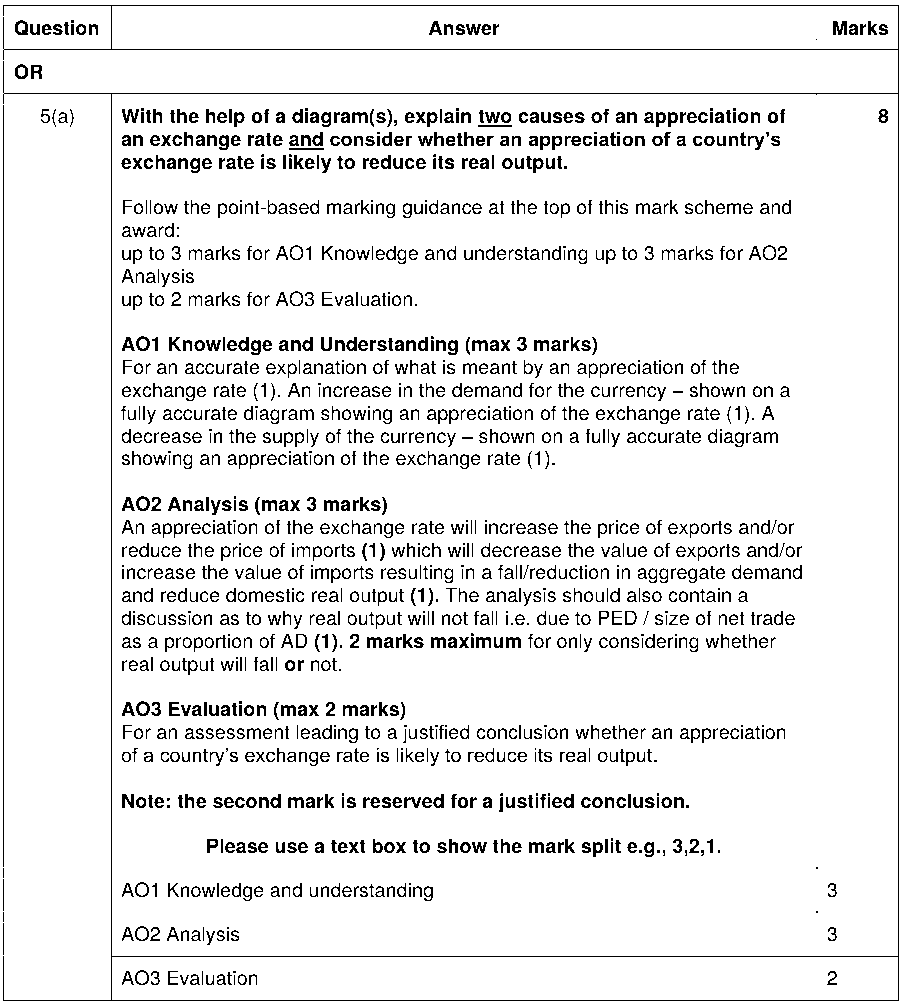
With the help of a diagram(s), explain two causes of an appreciation of an exchange rate and consider whether an appreciation of a country’s exchange rate is likely to reduce its real output. [8]
Show mark scheme
Mark scheme, 9708/22 March 2026 question 5(a)
Question 4(a)November 20259708/228 marks

Explain three components of the current account of the balance of payments and consider the extent to which a depreciation in the exchange rate will always lead to a surplus on the current account. [8]

Show mark scheme
Mark scheme, 9708/22 November 2025 question 4(a)
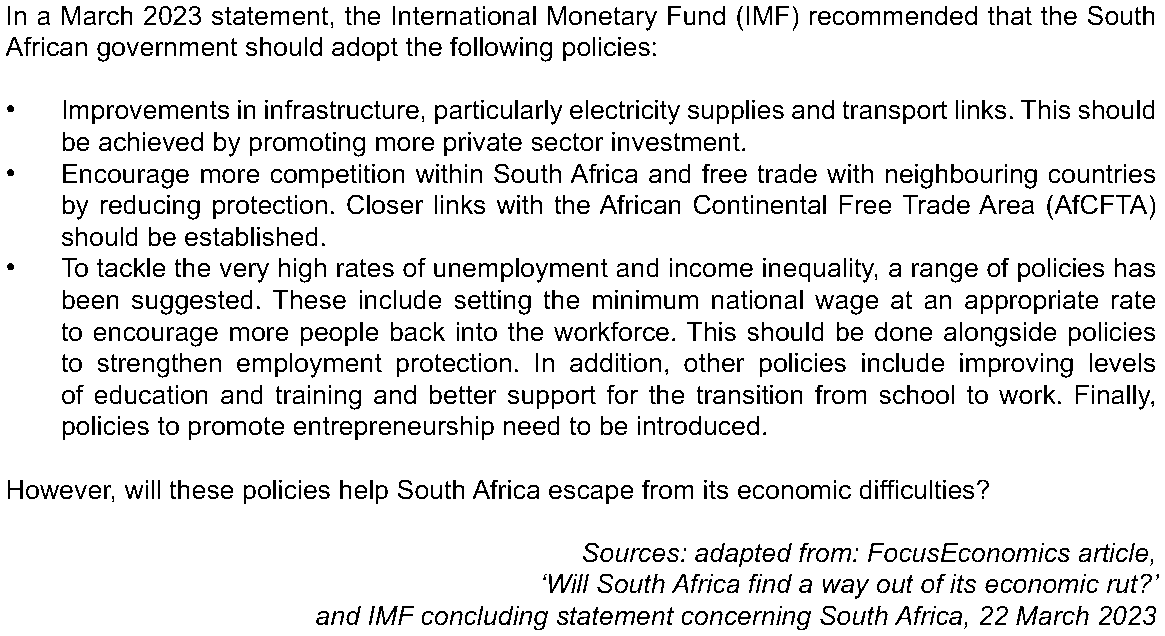
Case study: Can South Africa escape from its economic difficulties?
Case study: Can South Africa escape from its economic difficulties? (page 1 of 2)
Case study: Can South Africa escape from its economic difficulties? (page 2 of 2)
Question 1(c)June 20259708/224 marks

Consider whether continued falls in the value of the South African rand may lead to a reduction in the current account deficit of the balance of payments. [4]

Show mark scheme
Mark scheme, 9708/22 June 2025 question 1(c)
Question 5(a)June 20259708/228 marks

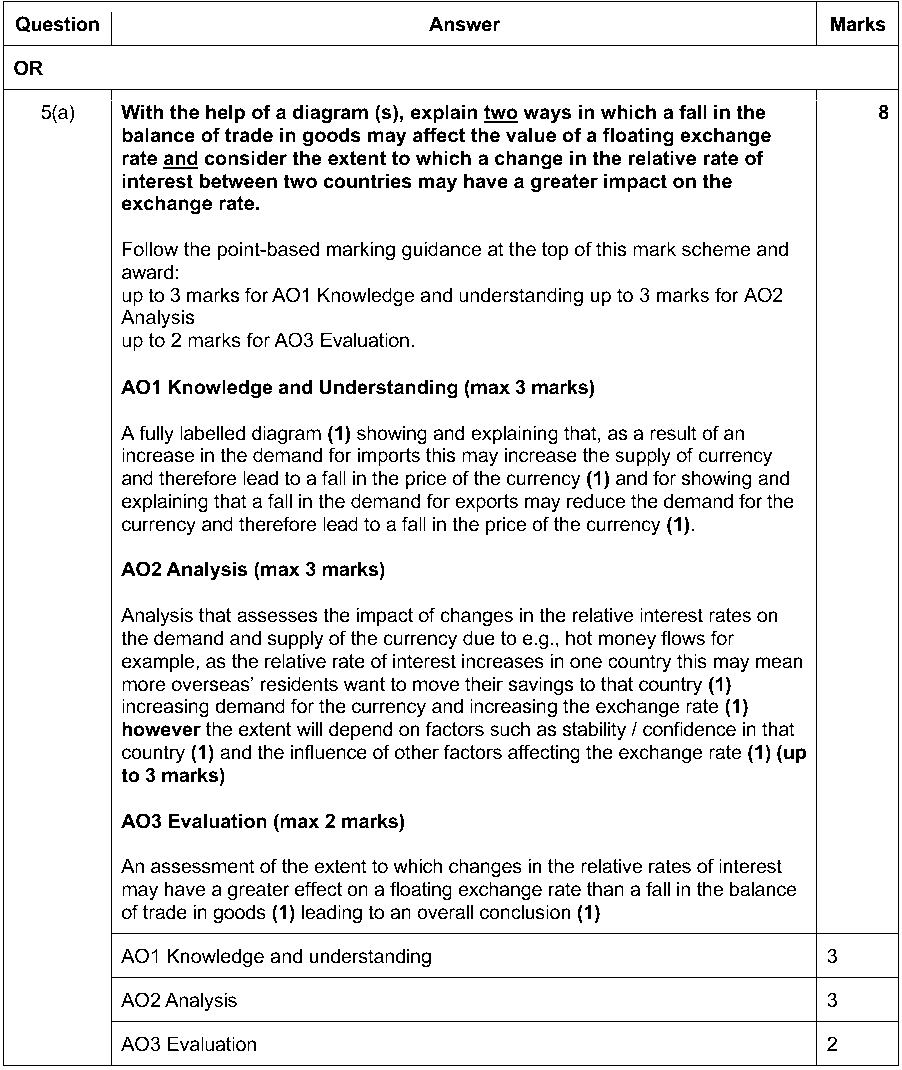
With the help of a diagram, explain two ways in which a fall in the balance of trade in goods may affect the value of a floating exchange rate and consider the extent to which a change in the relative rate of interest between two countries may have a greater impact on the exchange rate. [8]
Show mark scheme
Mark scheme, 9708/22 June 2025 question 5(a)
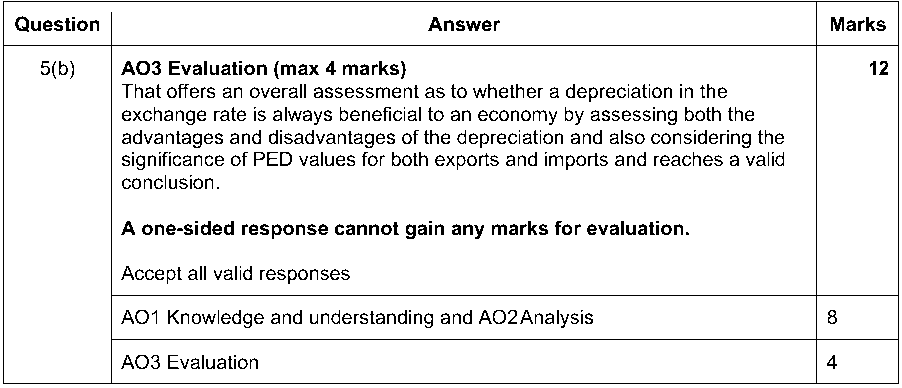
Question 5(b)June 20259708/2412 marks

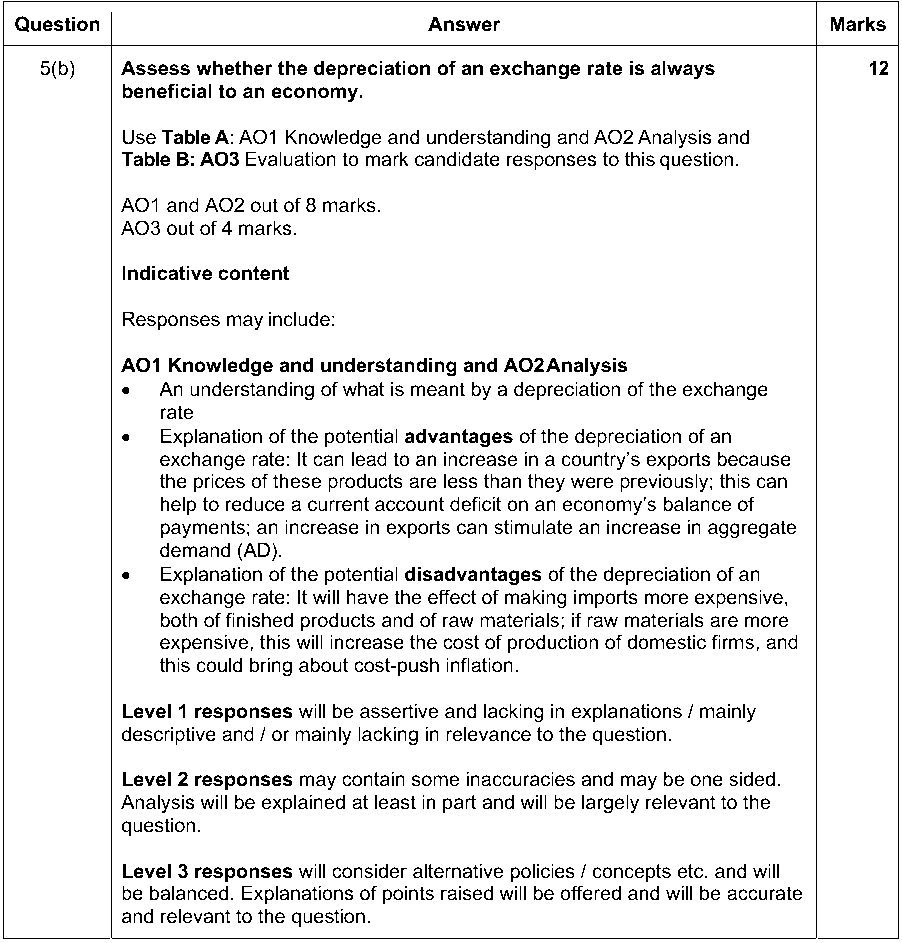
Assess whether the depreciation of an exchange rate is always beneficial to an economy. [12]
Show mark scheme
Mark scheme, 9708/24 June 2025 question 5(b) (page 1 of 2)
Mark scheme, 9708/24 June 2025 question 5(b) (page 2 of 2)
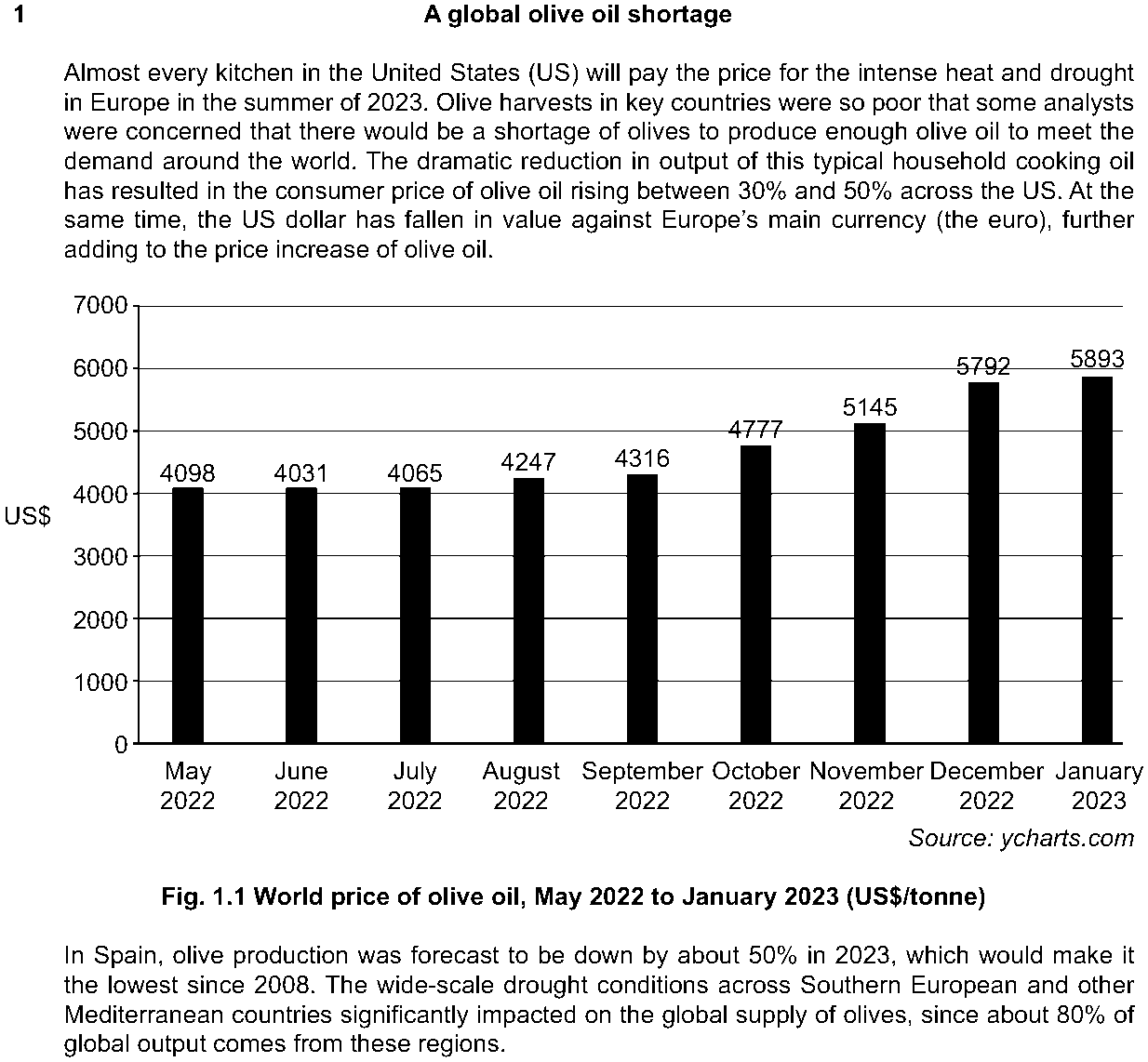
Case study: A global olive oil shortage
Case study: A global olive oil shortage (page 1 of 2)
Case study: A global olive oil shortage (page 2 of 2)
Question 1(e)March 20259708/226 marks

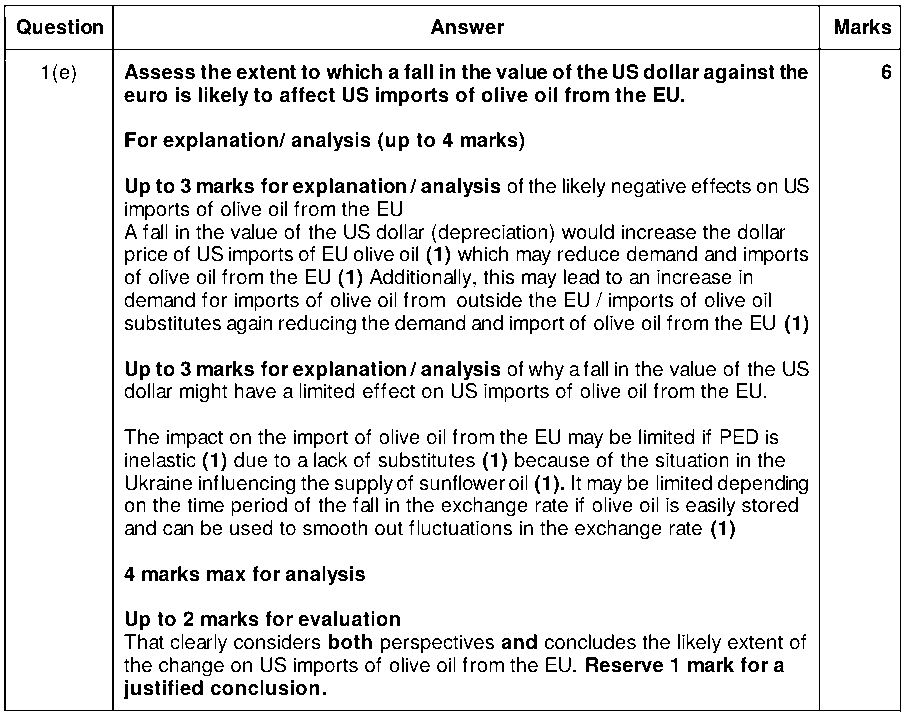
Assess the extent to which a fall in the value of the US dollar against the euro is likely to affect US imports of olive oil from the EU. [6]
Show mark scheme
Mark scheme, 9708/22 March 2025 question 1(e)

91 more questions from 2020–2024

🔒 Unlock every Exchange rates question from 2020–2024

All 91 come with their mark schemes, answers and case studies, and appear in the practice tool above once you’re signed in. It’s free.

Create a free accountSign in

A few of them

  • 9708/11 · November 2024 · Question 27Countries X and Y are… 🔒
  • 9708/12 · November 2024 · Question 24Which circumstances would most help a firm… 🔒
  • 9708/12 · November 2024 · Question 25A country has a floating… 🔒
  • 9708/12 · November 2024 · Question 30The table shows the exchange rate for… 🔒
  • 9708/13 · November 2024 · Question 30What is likely to happen if there… 🔒
  • + 86 more, by year in the table above

Questions and mark schemes are from past Cambridge papers and are reproduced for revision. Topical Vault is an independent revision resource, not affiliated with or endorsed by Cambridge Assessment International Education.

AS Level Economics questions by topic

Each topic opens this practice tool with only that topic’s questions, plus how often it comes up and every question on it in one list.

  1. Unit 1Basic economic ideas and resource allocation
  2. Ch 1Scarcity, choice and opportunity cost
  3. Ch 2Economic methodology
  4. Ch 3Factors of production
  5. Ch 4Resource allocation in different economic systems
  6. Ch 5Production possibility curves
  7. Ch 6Classification of goods and services
  8. Unit 2The price system and the microeconomy
  9. Ch 7Demand and supply curves
  10. Ch 8Price elasticity, income elasticity and cross elasticity of demand
  11. Ch 9Price elasticity of supply
  12. Ch 10The interaction of demand and supply
  13. Ch 11Consumer and producer surplus
  14. Unit 3Government microeconomic intervention
  15. Ch 12Reasons for government intervention in markets
  16. Ch 13Methods and effects of government intervention in markets
  17. Ch 14Addressing income and wealth inequality
  18. Unit 4The macroeconomy
  19. Ch 15National income statistics
  20. Ch 16Introduction to the circular flow of income
  21. Ch 17Aggregate demand and aggregate supply analysis
  22. Ch 18Economic growth
  23. Ch 19Unemployment
  24. Ch 20Price stability
  25. Unit 5Government macroeconomic intervention
  26. Ch 21Government macroeconomic policy objectives
  27. Ch 22Fiscal policy
  28. Ch 23Monetary policy
  29. Ch 24Supply-side policy
  30. Unit 6International economic issues
  31. Ch 25The reasons for international trade
  32. Ch 26Protectionism
  33. Ch 27Current account of the balance of payments
  34. Ch 28Exchange rates
  35. Ch 29Policies to correct imbalances in the current account of the balance of payments