← Topical Vault

Introduction to the circular flow of income · AS Level Economics

Cambridge 9708, Paper 1 & 2. 2,092 questions, 2020 to 2026.

Topic
Year

Paper 1 multiple-choice questions and Paper 2 data-response/essay questions, from the original Cambridge material. Paper 2 mark schemes and case studies are reproduced as images of the official pages rather than retyped, so nothing is lost or paraphrased; a question tagged under more than one topic appears under each. Tick “Add to my paper” on any question to build a custom practice PDF from the tray in the corner.

About Introduction to the circular flow of income

Questions on the circular flow of income: households, firms, government and the foreign sector, injections and withdrawals, and what makes national income rise or fall.

31 past paper questions on this topic since 2021, across 11 exam sessions.

How often it comes up

YearPaper 1Paper 2TotalChart
2026538
2025718
2024516
2023538
2021011

Every 2025–2026 question on Introduction to the circular flow of income

The whole topic on one page, with answers and mark schemes. Printing this page prints just this list.

Paper 1 · Multiple choice (12)

Question 18June 20269708/111 mark

What would be an injection into the circular flow of income?

  • Aan increase in imports
  • Ban increase in investment
  • Can increase in savings
  • Dan increase in taxation dge University Press & Assessment 2026 06 9708 11 2026 1 8
Show answer

BCorrect answer

Question 18June 20269708/121 mark

What are injections into the circular flow of income?

  • Agovernment spending, investment and exports
  • Bgovernment spending, savings and imports
  • Cinvestment, savings and exports
  • Dinvestment, taxes and imports
Show answer

ACorrect answer

Question 17June 20269708/131 mark

What represents a leakage from the circular flow of income in an economy?

  • Aa balance of trade surplus
  • Ba government budget surplus
  • Creduction in firm’s spending on research and development
  • Dreinvestment of a firm’s profits
Show answer

BCorrect answer

Question 18June 20269708/141 mark

Which row correctly identifies net injections into a country’s circular flow of income?

government expenditure savings exports > taxation > investment > imports

  • Ano no yes
  • Bno yes no
  • Cyes no yes
  • Dyes yes no
Show answer

CCorrect answer

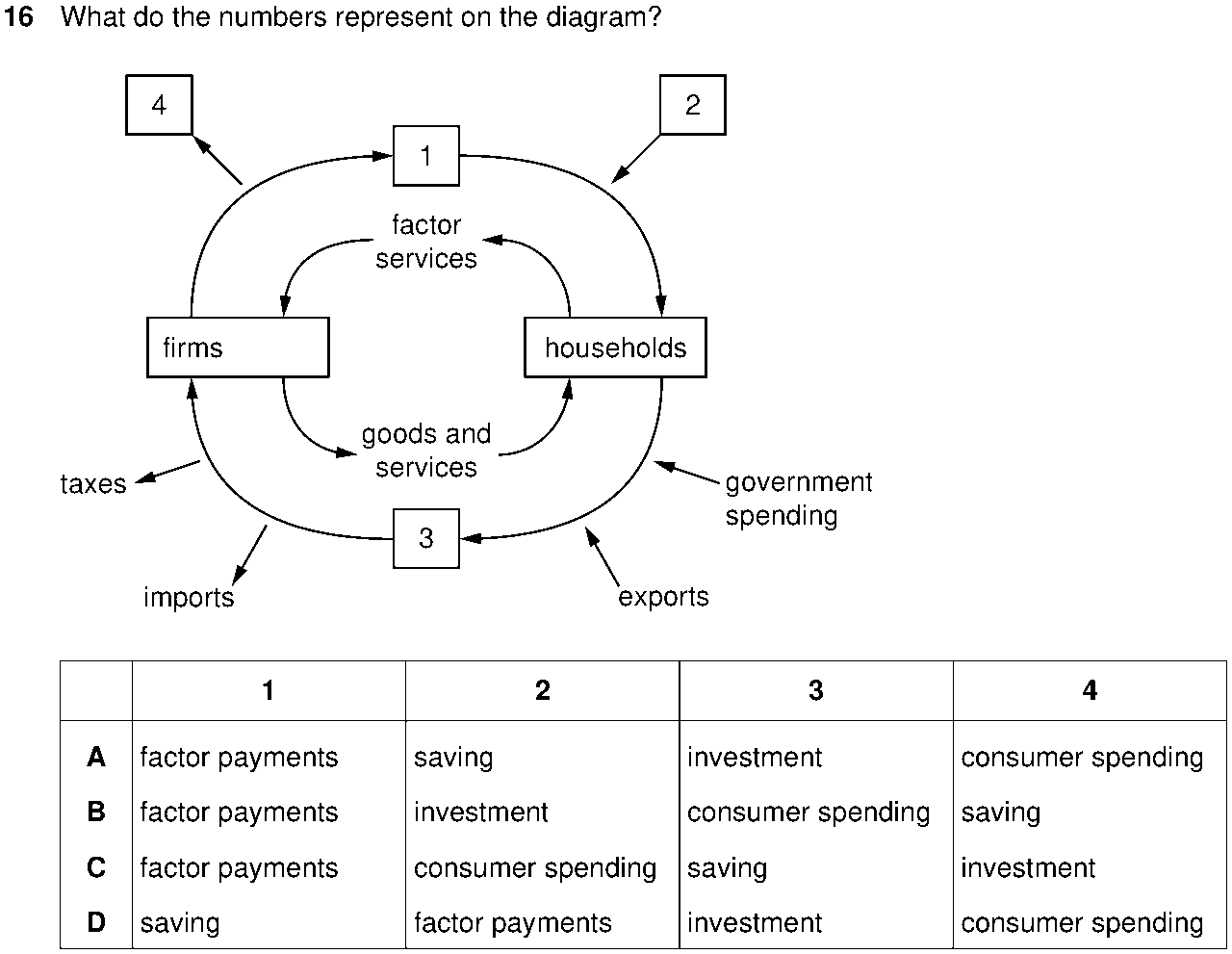
Question 16March 20269708/121 mark
9708/12 March 2026 question 16
Show answer

BCorrect answer

Question 15November 20259708/121 mark

What is an example of an injection into the circular flow of income in an open economy?

  • Aconsumer spending on goods
  • Bexpenditure on a government construction project
  • Cspending by households on holidays abroad
  • Drepayment of loans to commercial banks
Show answer

BCorrect answer

Question 19November 20259708/131 mark

A government is planning to increase its expenditure on defence. Half of this expenditure will be on equipment such as planes and weapons which it will have to import as it does not produce this equipment domestically.

What is the initial impact on injections and leakages from the circular flow of income?

  • AThe initial rise in injections is greater than the initial rise in leakages.
  • BThe initial rise in injections is greater than the initial fall in leakages.
  • CThe initial rise in injections is smaller than the initial rise in leakages.
  • DThe initial rise in injections is smaller than the initial fall in leakages.
Show answer

ACorrect answer

Question 18November 20259708/141 mark

An open economy with a government is in equilibrium at a national income of $900 million.

Households spend $700 million and save $50 million.

Firms spend $100 million on investment.

The government spends $150 million and has a balanced budget.

How much is spent on exports and imports?

export spending import spending ($ million) ($ million)

  • A100 100
  • B100 50
  • C50 100
  • D50 50
Show answer

CCorrect answer

Question 17June 20259708/111 mark

An open economy with a government sector is in equilibrium. Households in this economy save $100 million and firms spend $150 million on investment.

Which combination of the budget balance and the current account balance would lead to an equilibrium position on the circular flow of income?

budget balance current account balance

  • A$100m deficit $50m deficit
  • B$100m deficit $50m surplus
  • C$100m surplus $50m deficit
  • D$100m surplus $50m surplus
Show answer

DCorrect answer

Question 17June 20259708/121 mark

Based on the circular flow of income, which condition is necessary for an open economy to be in equilibrium?

  • AGovernment investment is equal to private investment.
  • BPlanned injections are equal to planned withdrawals.
  • CSpending by households is equal to taxes collected by government.
  • DValue of export earnings is equal to expenditure on imports.
Show answer

BCorrect answer

Question 16June 20259708/141 mark

, , 16 What is always regarded as a cause, rather than a consequence, of a change in the circular flow of income?

  • Aa decrease in government tax revenue
  • Ban increase in consumption spending
  • Can increase in savings
  • Dan increase in the value of exports
Show answer

DCorrect answer

Question 17June 20259708/141 mark

The table shows some data for an economy.

government national investment exports savings imports taxation expenditure income ($ million) ($ million) ($ million) ($ million) ($ million) ($ million) ($ million)

200 100 50 125 62.5 62.5 600

200 100 50 150 75 75 700

200 100 50 175 87.5 87.5 800

200 100 50 200 100 100 900

What is the equilibrium level of national income?

  • A$600 million
  • B$700 million
  • C$800 million
  • D$900 million
Show answer

CCorrect answer

Paper 2 · Data response and essays (4)

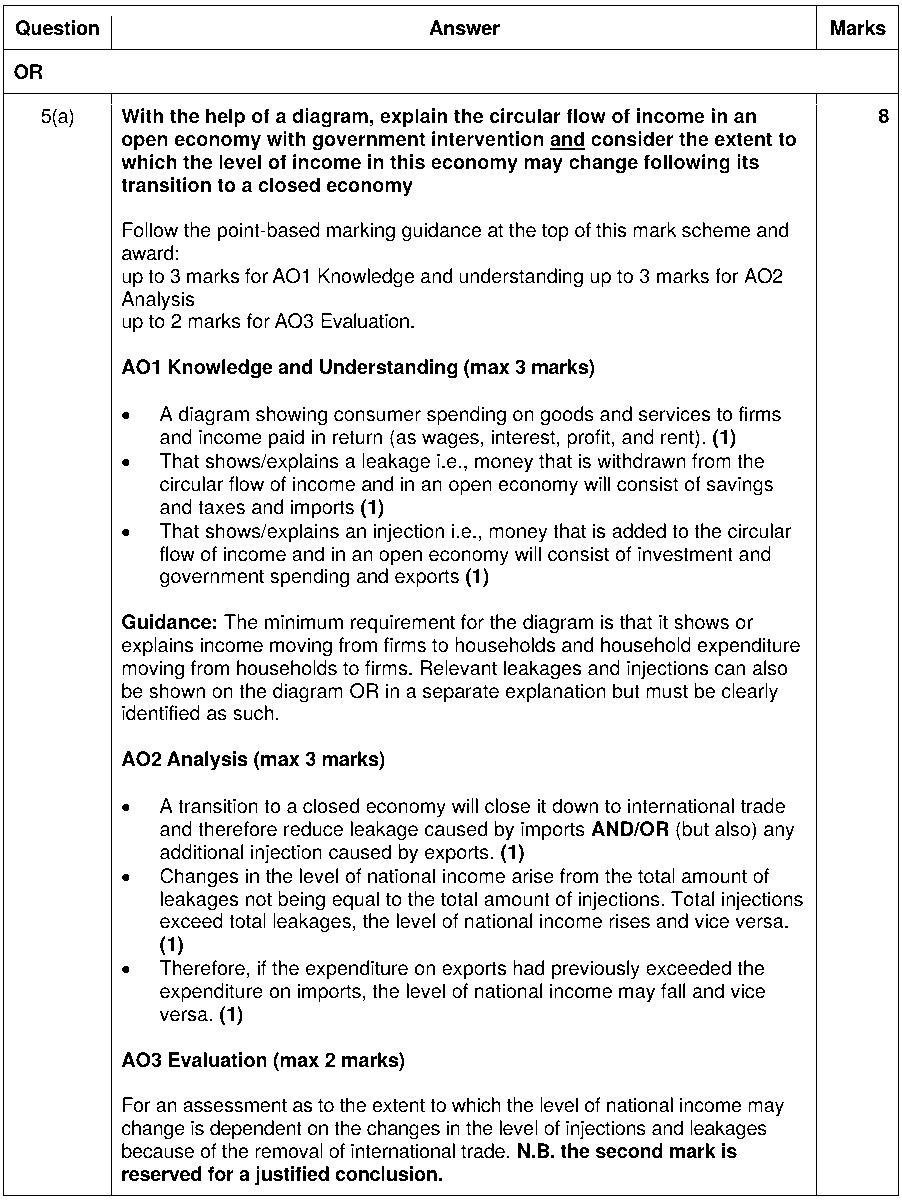
Question 5(a)June 20269708/228 marks

With the help of a diagram, explain the circular flow of income in an open economy with government intervention and consider the extent to which the level of income in this economy may change following its transition to a closed economy. [8]
Show mark scheme
Mark scheme, 9708/22 June 2026 question 5(a) (page 1 of 2)
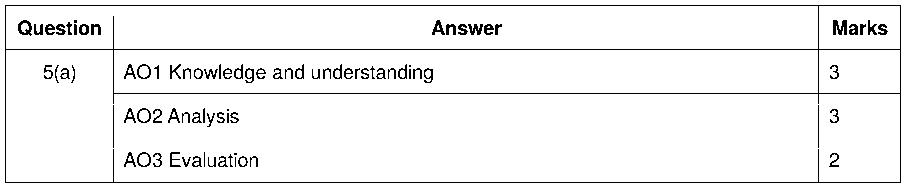
Mark scheme, 9708/22 June 2026 question 5(a) (page 2 of 2)
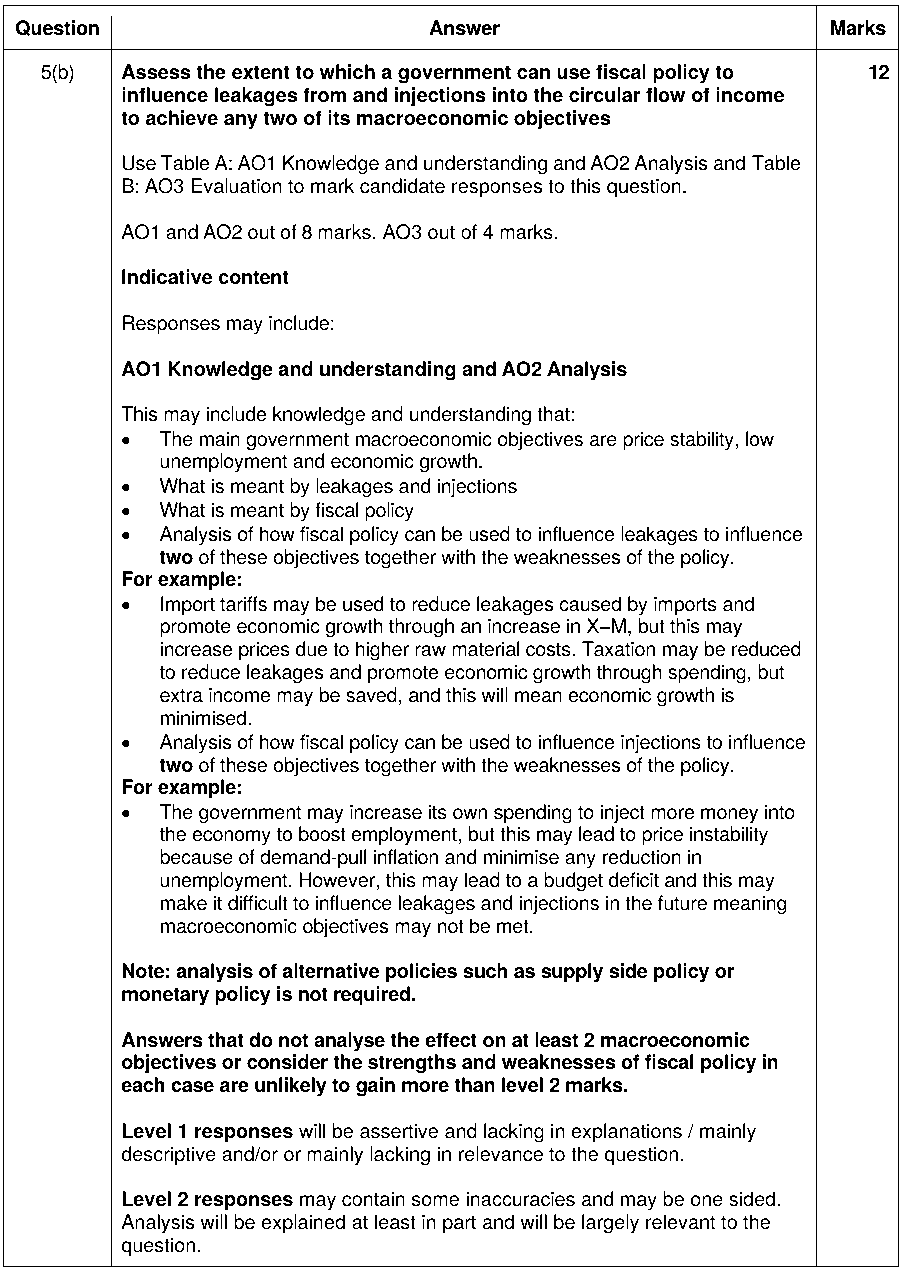
Question 5(b)June 20269708/2212 marks

Assess the extent to which a government can use fiscal policy to influence leakages from and injections into the circular flow of income to achieve any two of its macroeconomic objectives. [12]
Show mark scheme
Mark scheme, 9708/22 June 2026 question 5(b) (page 1 of 2)
Mark scheme, 9708/22 June 2026 question 5(b) (page 2 of 2)
Question 4(a)June 20269708/248 marks

Explain what is meant by the circular flow of income in a closed economy with a government sector and consider the impact of a move from a closed economy to an open economy on this circular flow. [8]
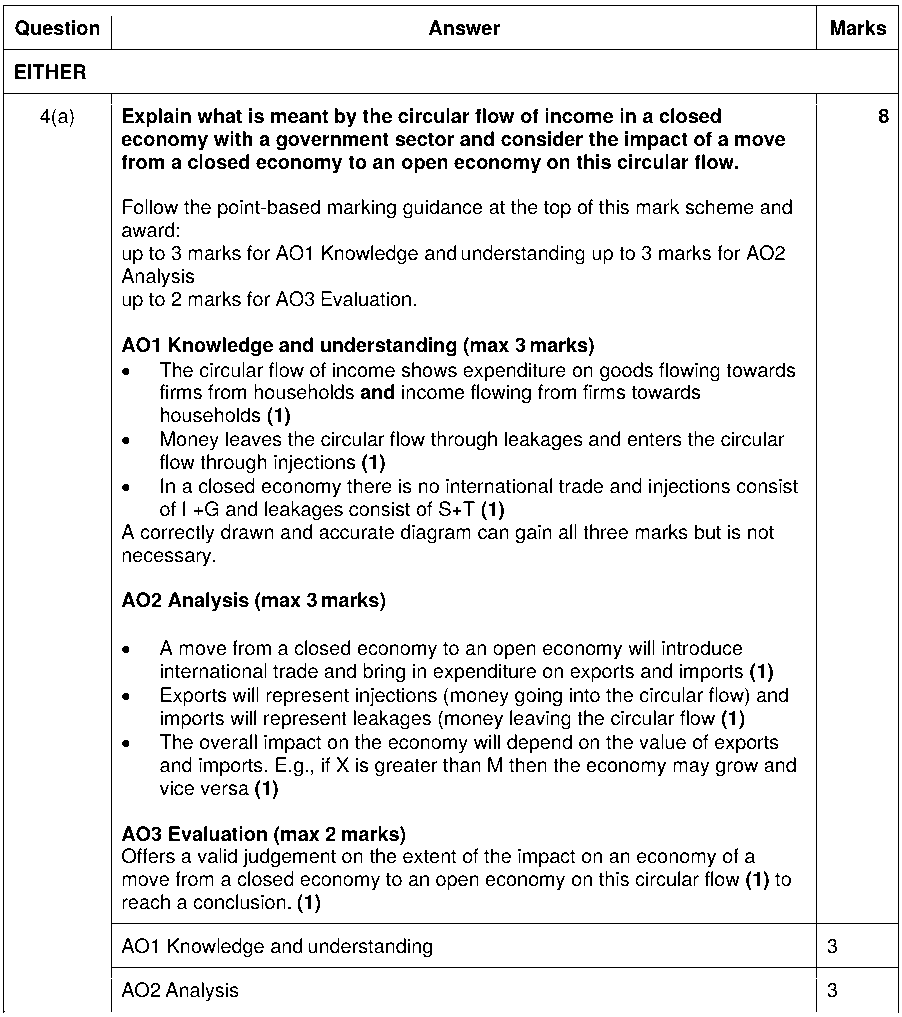
Show mark scheme
Mark scheme, 9708/24 June 2026 question 4(a)
Question 4(a)June 20259708/218 marks

Explain how the circular flow of income in an economy changes when that economy moves from a closed to an open economy and consider what determines the extent of the change. [8]
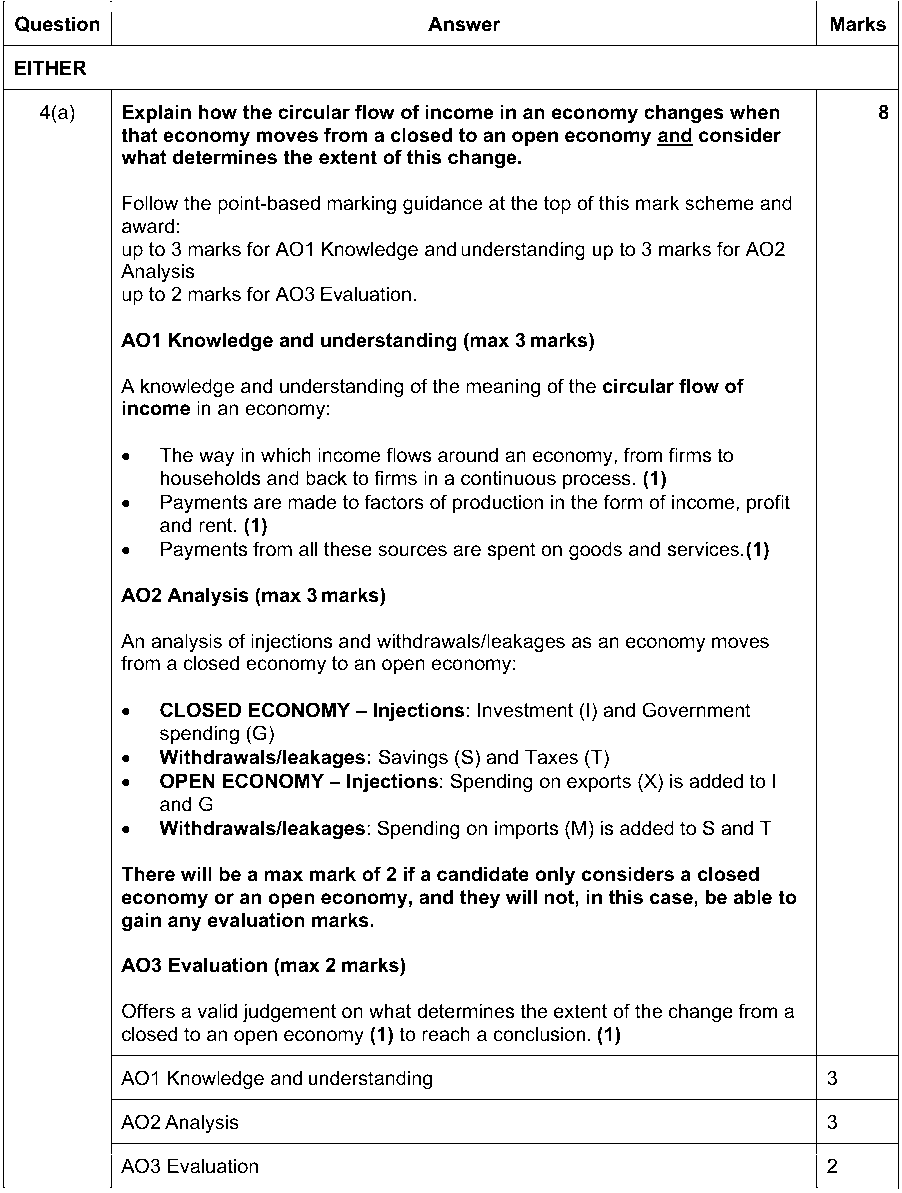
Show mark scheme
Mark scheme, 9708/21 June 2025 question 4(a)

15 more questions from 2021–2024

🔒 Unlock every Introduction to the circular flow of income question from 2021–2024

All 15 come with their mark schemes, answers and case studies, and appear in the practice tool above once you’re signed in. It’s free.

Create a free accountSign in

A few of them

  • 9708/11 · November 2024 · Question 17What is most likely to increase a… 🔒
  • 9708/13 · November 2024 · Question 16In the circular flow of income model… 🔒
  • 9708/11 · June 2024 · Question 15The table illustrates macroeconomic data for an… 🔒
  • 9708/13 · June 2024 · Question 17The table lists the values of the… 🔒
  • 9708/22 · June 2024 · Question 4(a)With the help of a diagram, explain… 🔒
  • + 10 more, by year in the table above

Questions and mark schemes are from past Cambridge papers and are reproduced for revision. Topical Vault is an independent revision resource, not affiliated with or endorsed by Cambridge Assessment International Education.

AS Level Economics questions by topic

Each topic opens this practice tool with only that topic’s questions, plus how often it comes up and every question on it in one list.

  1. Unit 1Basic economic ideas and resource allocation
  2. Ch 1Scarcity, choice and opportunity cost
  3. Ch 2Economic methodology
  4. Ch 3Factors of production
  5. Ch 4Resource allocation in different economic systems
  6. Ch 5Production possibility curves
  7. Ch 6Classification of goods and services
  8. Unit 2The price system and the microeconomy
  9. Ch 7Demand and supply curves
  10. Ch 8Price elasticity, income elasticity and cross elasticity of demand
  11. Ch 9Price elasticity of supply
  12. Ch 10The interaction of demand and supply
  13. Ch 11Consumer and producer surplus
  14. Unit 3Government microeconomic intervention
  15. Ch 12Reasons for government intervention in markets
  16. Ch 13Methods and effects of government intervention in markets
  17. Ch 14Addressing income and wealth inequality
  18. Unit 4The macroeconomy
  19. Ch 15National income statistics
  20. Ch 16Introduction to the circular flow of income
  21. Ch 17Aggregate demand and aggregate supply analysis
  22. Ch 18Economic growth
  23. Ch 19Unemployment
  24. Ch 20Price stability
  25. Unit 5Government macroeconomic intervention
  26. Ch 21Government macroeconomic policy objectives
  27. Ch 22Fiscal policy
  28. Ch 23Monetary policy
  29. Ch 24Supply-side policy
  30. Unit 6International economic issues
  31. Ch 25The reasons for international trade
  32. Ch 26Protectionism
  33. Ch 27Current account of the balance of payments
  34. Ch 28Exchange rates
  35. Ch 29Policies to correct imbalances in the current account of the balance of payments