Question 2May/June 20269708/311 mark
What is a characteristic of monopolistic competition?
Show answer
DCorrect answer
Cambridge 9708, Paper 3 & 4. 1,666 questions, 2020 to 2026.
Paper 3 multiple-choice questions and Paper 4 data-response/essay questions and case studies, retyped from the original Cambridge material; artwork and data tables are reproduced as images. Mark schemes show the official answer key and level-marked indicative content.
Questions on market structures: perfect competition, monopolistic competition, oligopoly and monopoly, contestable markets, price discrimination, collusion and game theory.
148 past paper questions on this topic since 2020, across 20 exam sessions.
| Year | Paper 3 | Paper 4 | Total | Chart |
|---|---|---|---|---|
| 2026 | 6 | 2 | 8 | |
| 2025 | 9 | 8 | 17 | |
| 2024 | 17 | 2 | 19 | |
| 2023 | 12 | 9 | 21 | |
| 2022 | 16 | 13 | 29 | |
| 2021 | 17 | 15 | 32 | |
| 2020 | 17 | 5 | 22 |
The whole topic on one page, with answers and mark schemes. Printing this page prints just this list.
What is a characteristic of monopolistic competition?
DCorrect answer
What must be found in two markets for price discrimination to be profitable?
ACorrect answer
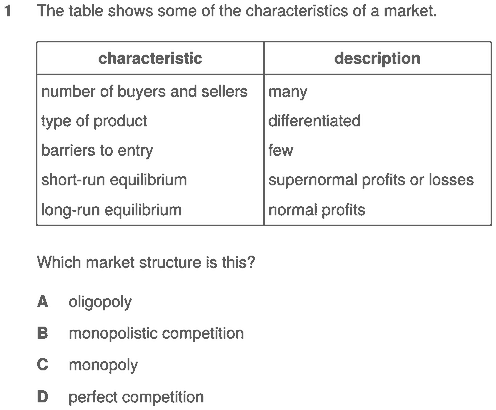
BCorrect answer
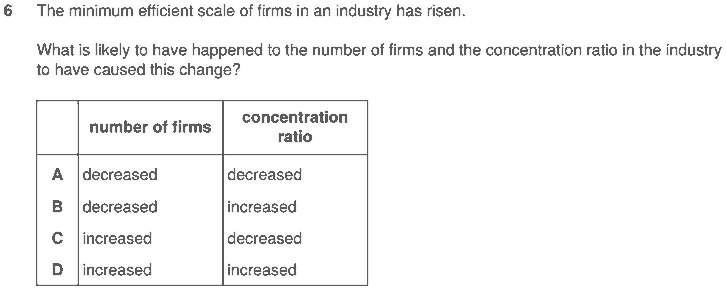
BCorrect answer
An oligopolist with a kinked demand curve decides to raise its price. Why might it do this?
ACorrect answer
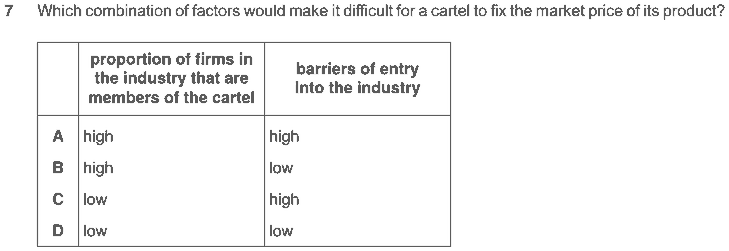
DCorrect answer
A firm has very high fixed costs but low marginal costs of production. It experiences continuous economies of scale so that the minimum efficient scale is not reached until the firm is very large in relation to total market demand. In which type of market structure would the firm operate?
CCorrect answer
What will act as a barrier to collusion between firms?
DCorrect answer
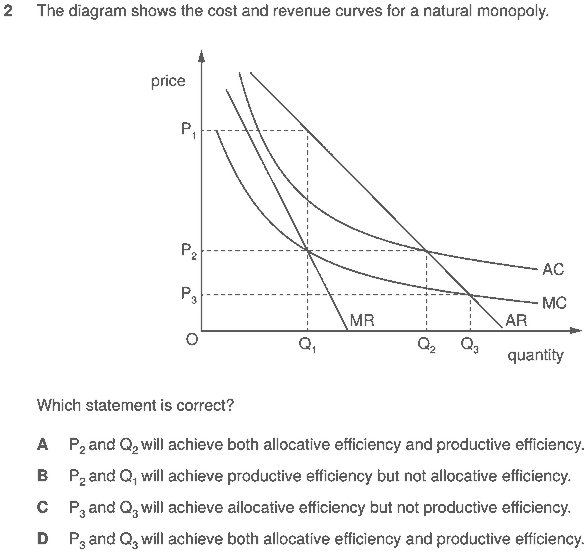
CCorrect answer

DCorrect answer
What would enable a firm to increase its market share in a monopolistically competitive market?
DCorrect answer
Which type of market structure enables price leadership to take place?
BCorrect answer
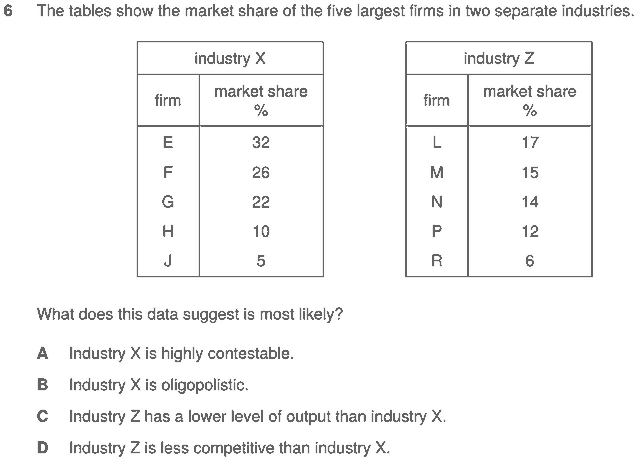
BCorrect answer
What is likely to prevent the development of an effective cartel in an industry?
DCorrect answer
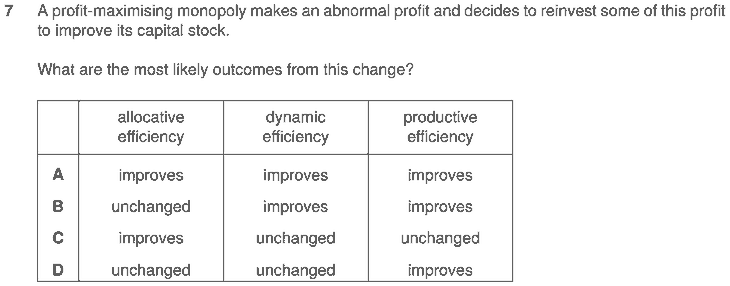
BCorrect answer
3 Third-degree price discrimination benefits the firm but not its customers.
With the help of a diagram, assess the consequences of third-degree price discrimination to both the firm and its customers. [20]
Third-degree price discrimination benefits the firm but not its customers. With the help of a diagram, assess the consequences of third-degree price discrimination to both the firm and its customers.
Use Table A: AO1 Knowledge and understanding and AO2 Analysis and Table B: AO3 Evaluation to mark candidate responses to this question.
AO1 and AO2 out of 8 marks. AO3 out of 4 marks.
Indicative content Responses may include:
AO1 Knowledge and understanding and AO2 Analysis
AO3 Evaluation
Accept all valid responses.
AO1 Knowledge and understanding and AO2 Analysis
AO3 Evaluation
3 Although firms in an oligopolistic market may be in competition with each other, they will find it advantageous to collude.
With the help of a diagram or a pay‑off matrix, evaluate this statement. [20]
Although firms in an oligopolistic market may be in competition with each other, they will find it advantageous to collude. With the help of a diagram or a pay-off matrix, evaluate this statement.
Use Table A: AO1 Knowledge and understanding and AO2 Analysis and Table B: AO3 Evaluation to mark candidate responses to this question.
AO1 and AO2 out of 14 marks. AO3 out of 6 marks.
Indicative content Responses may include:
AO1 Knowledge and understanding and AO2 Analysis
AO3 Evaluation
Accept all valid responses.
AO1 Knowledge and understanding and AO2 Analysis
AO3 Evaluation
3 The degree of competition that a firm experiences is determined only by the barriers to entry into its market.
With the help of a diagram(s), evaluate this statement. [20]
The degree of competition a firmexperiencesis determined only by the barriers to entry into its market. With the aid of diagrams, evaluate this statement. Use TableA:AO1 Knowledge and understanding andAO2 Analysis and Table B: AO3 Evaluation to mark candidate responses to this question.
AO1 and AO2 out of 14 marks. AO3 out of 6 marks.
Indicative content Responses may include:
AO1 Knowledge and understanding and AO2 Analysis
AO3 Evaluation
Accept all valid responses
Between 2000 and 2020, Brazilian GDP, measured in US dollars ($), rose from $1.19 trillion to $1.89 trillion at constant prices (2015). In the same period GDP per head rose from $6745 to $8204 at constant prices (2015).
The strength of the Brazilian economy lies in the variety and quantity of its natural resources. For example, Brazil is one of the world’s largest exporters of agricultural commodities, mainly soya and beef. There are also significant exports of minerals. Brazil is the second largest iron ore producer in the world and extracts 3.4% of the world’s crude oil.
World agricultural markets are dominated by four large commodity traders that buy and sell products such as grain and soya. They have grown through both horizontal integration and vertical integration. These traders own many large farms, they process farm produce and transport it to trade on international markets. In addition to buying and selling, the traders provide seed and fertiliser to farmers and supply storage for their products. They use agricultural by-products to produce items like biofuel. These traders also provide financial services to these markets.
Commodity traders are very important to the development of complex global food markets. Food prices, access to scarce resources such as land and water, climate change and food security are all affected by the activities of traders. In Brazil, the output of 15 000 farmers is purchased by a single trader.
In Brazil the development of agriculture, mining and oil extraction all contribute to environmental degradation. Both agriculture and mining have been accompanied by deforestation of the Amazon rainforest. Access roads to mining areas also lead to deforestation. Waste water from mining activity is frequently stored in reservoirs behind dams. On two occasions in the last 10 years these dams failed to hold back the water. This led to widespread flooding, the discharge of pollutants such as mercury into rivers, and deaths.
Sources: The Guardian, 23 August 2022
Cereal Secrets, Oxfam Research Report, August 2012 oec.world/en/profile, August 2023
(c) Describe how the market structure in which individual farmers operate is likely to differ from the market structure in which the commodity traders operate. [6]
Describe how the market structure in which individual farmers operate is likely to differ from the market structure in which the commodity traders operate. Farmers: monopolisticcompetition (1) many sellers (1), similar product (1), no barriers to entry (1), price maker (1) Max 3 Traders: oligopoly(1) and a few sellers (4) (1) and barriers to entry (1) price maker (1) product differentiation (1) Max 3 Market structure must be correct to gain explanation marks.
2 With the help of a diagram, evaluate the impact on consumers and producers of an increase in market contestability. [20]
With the help of a diagram, evaluate the impact on consumers and producers of an increase in market contestability.
Use Table A: AO1 Knowledge and understanding and AO2 Analysis and Table B: AO3 Evaluation to mark candidate responses to this question.
AO1 and AO2 out of 14 marks. AO3 out of 6 marks.
Indicative content Responses may include:
AO1 Knowledge and understanding and AO2 Analysis
AO3 Evaluation
Accept all valid responses. No diagram L2 Max
AO1 Knowledge and understanding and AO2 Analysis
AO3 Evaluation
From Adam Smith onwards, most economists have regarded competitive markets as the main mechanism of economic activity. They argue that the interaction between producers and consumers can lead to both allocative efficiency and productive efficiency.
It can, however, be questioned whether the market automatically produces the best solution. Sometimes there are significant reasons for governments to intervene in a market in order to produce a better outcome than market forces alone. These situations are market failures.
When producing goods and services firms consider the private costs they pay and private benefits they receive. For example, a steel producer accounts for the cost of iron ore, fuel, labour and administration. It offsets these costs against the revenue from selling the steel. However, those people who live near the steelworks suffer the consequences of the noise, dirt and polluted air generated as part of the production process. Similarly, in many areas the extraction of iron ore can lead to environmental destruction such as the degradation of ground water for domestic consumption and a reduction in the variety of wildlife and flowers.
Competitive markets as envisaged by economists, however, may not exist. Firms may integrate to gain the benefits of economies of scale, to realise their ambition to rule the market or to increase their market share. Such integration might lead to the development of a monopoly market structure. Many believe that a monopoly always operates against the interests of the consumer because of its lack of efficiency. As a result, governments often restrict the operation of monopolies.
(c) Consider whether ‘a monopoly always operates against the interests of the consumer’. [8]
Considerwhether‘a monopolyalways operates against the interests of the consumer’. In favour of monopoly :
Max 4 Against monopoly: Loss of productive efficiency 1 + explanation 1 Loss of allocative efficiency 1 + explanation 1 Lack of dynamic efficiency1 + explanation Or: A diagram showing the loss of allocative and productive efficiency Axes/Labels 1 correct costs and revenues 1 loss of AE 1 loss of PE 1
Max 4
Max 7 for argument Conclusion: 1 essay
3 Subnormal and supernormal profits are only experienced in the short run and only by firms in perfect competition.
With the help of diagrams, evaluate this statement. [20]
Subnormal and supernormal profits are only experienced in the short run and only by firms in perfect competition. With the help of diagrams, evaluate this statement.
Use Table A: AO1 Knowledge and understanding and AO2 Analysis and Table B: AO3 Evaluation to mark candidate responses to this question.
AO1 and AO2 out of 14 marks. AO3 out of 6 marks.
Indicative content Responses may include:
AO1 Knowledge and understanding and AO2 Analysis
AO3 Evaluation
Accept all valid responses.
AO1 Knowledge and understanding and AO2 Analysis
AO3 Evaluation
2 Monopolies restrict output to raise prices to exploit consumers.
With the help of a diagram, assess the extent to which a government should intervene in monopoly markets. [20]
Monopolies restrict output to raise prices and exploit consumers. With the help of a diagram, assess the extent to which a government should intervene in monopoly markets.
Use Table A: AO1 Knowledge and understanding and AO2 Analysis and Table B: AO3 Evaluation to mark candidate responses to this question.
AO1 and AO2 out of 14marks. AO3 out of 6 marks.
Indicative content Responses may include:
AO1 Knowledge and understanding and AO2Analysis
AO3 Evaluation
Accept all valid responses.
Accept all valid responses.
AO1 Knowledge and understanding and AO2Analysis
AO3 Evaluation
Since 1971 Bangladesh has experienced significant economic development, moving from the low-income to the lower-middle-income country classification. Gross National Income (GNI) per capita at constant 2017 prices in United States dollars ($) rose from $2342 to $5823 between 2000 and 2020. Over the same period, the country’s Human Development Index (HDI) rose from 0.49 to 0.66.
During this period, Bangladesh underwent changes in employment as it moved from the agricultural sector to the manufacturing and services sectors.
First, in agriculture, output increased by more than 100% whilst employment fell from 65% to 38% of the working population. This change was helped by innovation in crop irrigation, land preparation and harvesting, aided by the development of local industries to provide the capital equipment needed.
A second source of economic development was the growth in the clothing industry producing ready-made garments (RMG) that contributed about 11% of Bangladesh’s Gross Domestic Product (GDP) and employed 4.4 million workers of which 2.5 million were women (2020). The industry uses significant division of labour with production split into 10 or more processes, for example, cutting, sewing zips, assembly and packaging.
The value of raw materials imported for the RMG industry was about half of the value of the industry’s exports. Net exports from this sector stood at $23 billion. This enabled Bangladesh to both import a wider range of goods and services and reduce the deficit on its balance of trade in goods.
In 2020, there were more than 4000 RMG manufacturers in Bangladesh, differentiated by the quality of their products and the speed of their delivery. The RMG industry supplied more than 100 major US and European retailers.
However, the RMG industry has critics who point to air and water pollution from the chemicals used in cotton growing and manufacturing clothes. The industry is also accused of employing child labour and of having poorly constructed factories.
Sources: Bangladesh overview: World Bank, 11 April 2024 and Quarterly Review on Readymade Garments, Bangladesh Bank Research Department, 14 February 2023
(c) Identify the probable market structure of the RMG industry in Bangladesh and with the help of a diagram, consider the likely effect on the level of long-run profits of firms in this industry. [6]
Identify the probable market structure of the RMG industry in Bangladesh and with the help of a diagram, consider the likely effect on the level of long-run profits of firms in this industry. Identification of Monopolistic Competition 1
Diagram 3 marks: Labels and axes 1 Identification of MC=MR for profit maximisation 1 Average cost and revenue/marginal costs and revenue curves 1 Explanation of why Normal Profits 1 in long run equilibrium 1 If correct analysis but market mis-identified as monopolistically up to 5
2 Oligopolies are able to avoid price competition while maintaining supernormal profits in the long run.
Evaluate this statement. [20]
Oligopolies are able to avoid price competition while maintaining supernormal profits in the long run. Evaluate this statement. Use TableA:AO1 Knowledge and understanding andAO2 Analysis and Table B: AO3 Evaluation to mark candidate responses to this question.
AO1 and AO2 out of 14 marks. AO3 out of 6 marks.
Indicative content Responses may include:
AO1 Knowledge and understanding and AO2Analysis
AO3 Evaluation
Accept all valid responses.
AO1 Knowledge and understanding and AO2Analysis
AO3 Evaluation
🔒 Unlock every Different market structures question from 2020–2024
All 123 come with their mark schemes, answers and case studies, and appear in the practice tool above once you’re signed in. It’s free.
Questions and mark schemes are from past Cambridge papers and are reproduced for revision. Topical Vault is an independent revision resource, not affiliated with or endorsed by Cambridge Assessment International Education.
Each topic opens this practice tool with only that topic’s questions, plus how often it comes up and every question on it in one list.