About Labour market forces and government intervention
Questions on the labour market: the demand for labour and marginal revenue product, labour supply, wage differentials, trade unions, minimum wages, economic rent and transfer earnings.
135 past paper questions on this topic since 2020, across 19 exam sessions.
How often it comes up
| Year | Paper 3 | Paper 4 | Total | Chart |
|---|
| 2026 | 10 | 3 | 13 | |
|---|
| 2025 | 20 | 6 | 26 | |
|---|
| 2024 | 15 | 5 | 20 | |
|---|
| 2023 | 11 | 0 | 11 | |
|---|
| 2022 | 13 | 11 | 24 | |
|---|
| 2021 | 11 | 9 | 20 | |
|---|
| 2020 | 13 | 8 | 21 | |
|---|
Every 2025–2026 question on Labour market forces and government intervention
The whole topic on one page, with answers and mark schemes. Printing this page prints just this list.
Paper 3 · Multiple choice (30)
Question 9May/June 20269708/311 mark
The price of oil fell dramatically. As a result, 65 000 jobs were lost in the oil industry. How would this be represented on a diagram for the labour market for oil workers?
- Aa movement down the marginal revenue product curve
- Ba shift towards the horizontal axis of the marginal cost curve
- Ca shift towards the origin of the marginal revenue product curve
- Da shift towards the vertical axis of the average cost curve
Show answer
Question 10May/June 20269708/311 mark
What is the most likely effect of a change in a competitive labour market to a monopsony market?
- Adecrease in trade union membership
- Bhigher wage rates offered
- Cincreased economic rent
- Dless labour employed
Show answer
Question 8May/June 20269708/321 mark
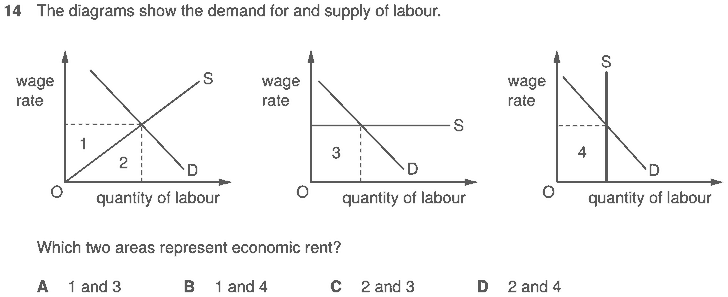
What is economic rent?
- AThe amount paid above the lowest wage that is needed to keep a worker in employment.
- BThe difference in pay between workers with comparable skills in different industries.
- CThe difference in pay between workers with different skills.
- DThe lowest wage that is needed to keep a worker in employment.
Show answer
Question 12May/June 20269708/321 mark
What would help a trade union to negotiate an increase in the wage rate of its members without causing a reduction in the numbers employed?
- Aif labour costs are a major proportion of total costs
- Bif the demand for the labour employed is elastic
- Cif the demand for the good produced is elastic
- Dif the demand for the good produced is increasing
Show answer
Question 11May/June 20269708/341 mark
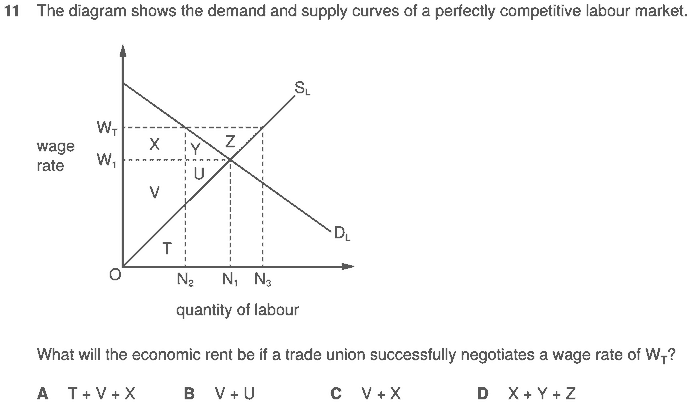
Show answer
Question 12May/June 20269708/341 mark
The market for farm workers is perfectly competitive. Which change is likely to increase the wage rate and employment of farm workers in the short run?
- Aa decrease in the demand for farm products
- Ba decrease in the number of farm workers retiring
- Can increase in the immigration of farm workers
- Dan increase in the price of farm products
Show answer
Question 13May/June 20269708/341 mark
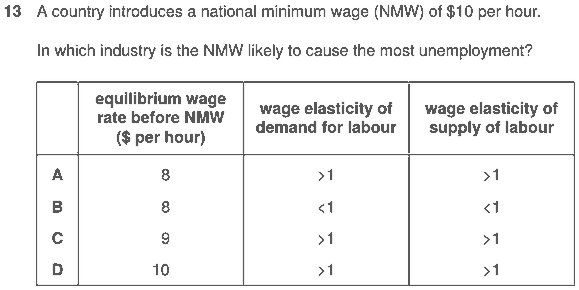
Show answer
Question 8Feb/March 20269708/321 mark
(Question image not available.)
Show answer
Question 11Feb/March 20269708/321 mark
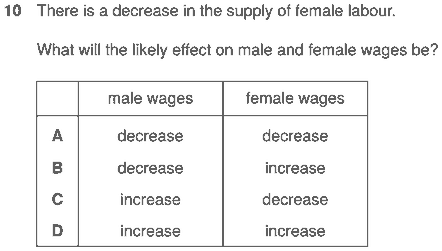
Show answer
Question 13Feb/March 20269708/321 mark
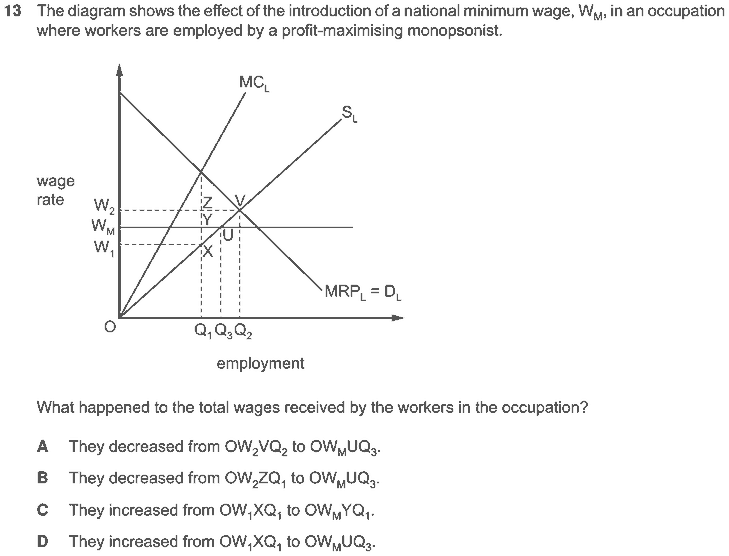
Show answer
Question 12Oct/Nov 20259708/311 mark
Show answer
Question 18Oct/Nov 20259708/311 mark
What is a likely consequence of an increase in government spending on education?
- Aincrease in the supply of unskilled labour
- Bincrease in occupational mobility
- Cincrease in the rate of unemployment
- Dincrease in trade union power
Show answer
Question 12Oct/Nov 20259708/321 mark
A government intervenes to raise the wages of a group of workers to prevent their exploitation. Where might such government intervention be justified?
- Ain an industry that is protected by tariffs on imports from abroad
- Bin an industry where a trade union negotiates wages for the workers
- Cin an industry where the output is produced by a single firm monopolist
- Din an industry where workers are employed by a monopsonist
Show answer
Question 9Oct/Nov 20259708/331 mark
Show answer
Question 10Oct/Nov 20259708/341 mark
Show answer
Question 11Oct/Nov 20259708/341 mark
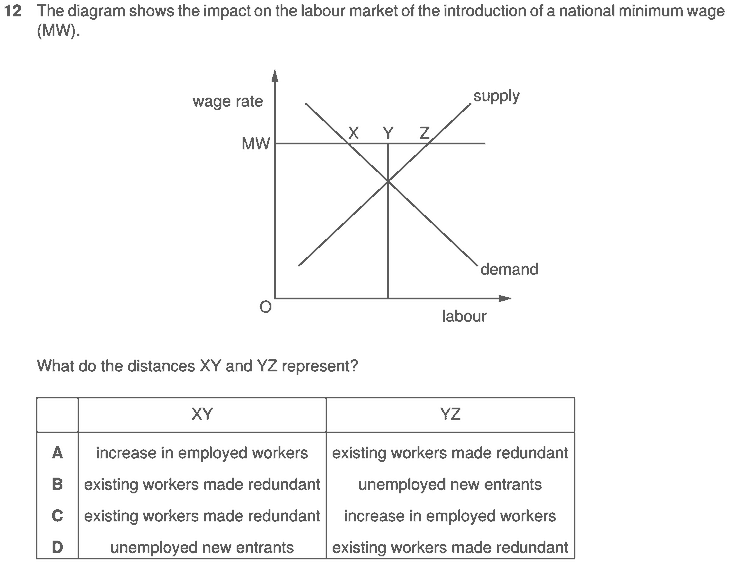
A government introduces a national minimum wage. What is not a benefit of this to the economy?
- AIt boosts the morale of workers and enhances labour productivity.
- BIt raises incomes of poorer workers.
- CIt reduces government spending on welfare payments.
- DIt reduces structural unemployment.
Show answer
Question 12Oct/Nov 20259708/341 mark
An increase in which variable would shift the supply curve for farm workers to the right?
- Ajob security
- Bthe hourly wage rate
- Cthe productivity of farm workers
- Dthe qualifications required
Show answer
Question 14Oct/Nov 20259708/341 mark
Show answer
Question 12May/June 20259708/311 mark
Show answer
Question 14May/June 20259708/311 mark
Show answer
Question 18May/June 20259708/311 mark
What is a factor affecting the occupational mobility of labour?
- Aeducation and training
- Bimmigration controls
- Cprice of housing
- Dtransport infrastructure
Show answer
Question 12May/June 20259708/321 mark
Show answer
Question 13May/June 20259708/321 mark
What is not a factor affecting the supply of labour?
- Aemigration rates
- Blabour participation rate
- Clabour productivity
- Dunemployment benefits
Show answer
Question 14May/June 20259708/321 mark
Show answer
Question 11May/June 20259708/341 mark
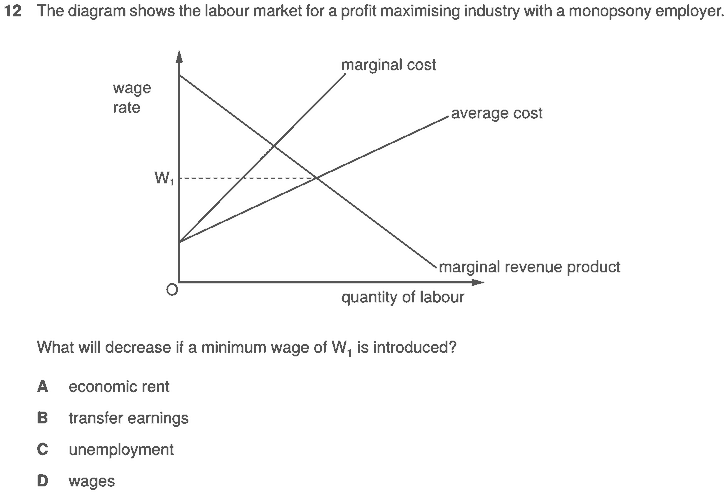
What determines the amount by which employment is reduced if a minimum wage is set 5% above the equilibrium market wage?
- Athe average revenue product curve
- Bthe marginal revenue product curve
- Cthe mobility of labour
- Dthe wage rate in other industries
Show answer
Question 12May/June 20259708/341 mark
What will increase the power of a trade union, allowing it to increase wages without reducing the employment of its members in a particular industry?
- AThe economy is experiencing a fall in the price of capital.
- BThe economy is experiencing rising employment.
- CThe price elasticity of demand for the industry’s goods is equal to 1.
- DThe price elasticity of demand for the industry’s goods is greater than 1.
Show answer
Question 12Feb/March 20259708/321 mark
A government’s aim is to reduce real wage rates. Which policy should be used to achieve this aim?
- AAward public sector workers pay increases below the rate of inflation.
- BEncourage private sector pay awards to be in line with company profits.
- CIntroduce a minimum hourly wage for non-unionised, low-paid workers.
- DRemove any restrictions on trade unions to bargain for wages.
Show answer
Question 13Feb/March 20259708/321 mark
How is marginal revenue product calculated?
- Amarginal physical product × marginal revenue
- Bmarginal physical product ÷ price
- Ctotal physical product × marginal cost
- Dtotal physical product ÷ marginal cost
Show answer
Question 14Feb/March 20259708/321 mark
A teacher currently earns $30 000. She would be willing to continue in that teaching job, provided she earned at least $25 000. Also, she would prefer to remain a teacher than change to her next best alternative employment as an accountant where she could earn $40 000. Which statement is correct?
- AHer economic rent as a teacher is $5000.
- BHer economic rent as an accountant is $10 000.
- CHer transfer earnings as a teacher are $30 000.
- DHer transfer earnings as an accountant are $15 000.
Show answer
Question 18Feb/March 20259708/321 mark
What is likely to improve the occupational mobility of labour?
- Aa decrease in income tax that increases aggregate demand
- Ba decrease in unemployment benefit
- Can increase in retraining schemes for the unemployed
- Dmore advertising of employment vacancies in the economy
Show answer
Paper 4 · Data response and essays (9)
Question 3May/June 20269708/4220 marks
3 Governments and trade unions should be excluded from taking part in wage negotiations as their intervention always causes higher levels of unemployment.
With the help of a diagram(s), evaluate this statement. [20]
Show mark scheme
Governments and trade unions should be excluded from taking part in wage negotiations as their intervention always causes higher levels of unemployment. With the help of a diagram(s), evaluate this statement. Use TableA: AO1 Knowledge and understanding and AO2 Analysis and Table B: AO3 Evaluation to mark candidate responses to thisquestion.
AO1 and AO2 out of 14marks. AO3 out of 6 marks.
Indicative content Responses may include:
AO1 Knowledge and understanding and AO2 Analysis
- Explanation and analysis of wage determination in perfect competition.
- Determination of marginal physical productivity of labour (MPP).
- Calculation of marginal revenue product (MRP) = MPP Price. (Demand for labour)
- Determination of supply of labour
- Wage determination by MRP and Supply of labour. Diagram to show industry/firm wages from supply and demand for labour
- Intervention of government/trade union to set minimum wage. Diagram to show demand falls and supply rises to create unemployment.
AO3 Evaluation
- Is the perfectly competitive market view of wage determination based on realistic assumptions of perfect knowledge, movement etc.
- Trade unions can negotiate productivity agreements which raise MPP and hence the demand for labour increases.
- Governments often act as monopsonistic employers and may exploit their employees, and higher wages may reflect MRP.
Accept all valid responses.
AO1 Knowledge and understanding and AO2Analysis
AO3 Evaluation
Question 2Feb/March 20269708/4220 marks
2 Training workers improves their human capital and increases productivity. This benefits the workers, their employers and the government.
Consider the extent to which training should be paid for only by workers. [20]
Show mark scheme
Training workers improves their human capital and increases productivity. This benefits the workers, their employers and government. Consider the extent to which training fees should be paid for only by workers. Use TableA: AO1 Knowledge and understanding and AO2 Analysis and Table B: AO3 Evaluation to mark candidate responses this question.
AO1 and AO2 out of 14marks. AO3 out of 6 marks.
Indicative Content: Responses may include:
AO1 Knowledge and Understanding and AO2 Analysis
- Differences between education and training might be explained.
- Trained workers are likely to have higher productivity and this will increase the demand for this labour
- For workers, higher demand for skilled labour is likely to lead to higher wages.
- MRP theory might be used in conjunction with a supply of and demand for labour diagram, to illustrate the impact on wages of an increase in productivity
- For workers, highly skilled labour is more likely to produce an inelastic supply and therefore increase wages.
- Employers might pay fees because they are likely to benefit through an increase in profits.
- Government’s might contribute towards fees because they are likely to benefit in the long run due to an increase in real GDP
AO3 Evaluation
- Wealthier families can afford to pay.
- Fear of significant debt for lower paid individuals.
- Government funding might lead to less well-off workers subsiding those benefiting from government financial support
- low paid workers may not be able to cover self-financing their fees.
- Workers may be subsequently employed by other firms who do not bear the initial costs.
- Government funding of fees for some groups at the expense of others may be politically unpopular.
Accept all valid responses.
AO1 Knowledge and understanding and AO2 Analysis
AO3 Evaluation
Question 3Feb/March 20269708/4220 marks
3 The fashion industry employs around 75 million workers, many of whom earn very low wages and work up to 16 hours a day. The industry contributes to 20% of global wastewater and 8% of all carbon emissions. 60% of clothes are made from plastics, 83 million tonnes of the 100 billion garments produced are sent to landfill, and only 20% are collected for recycling.
Consider to what extent an equitable solution can be found for market failures in the fashion industry. [20]
Show mark scheme
The fashion industry employs around 75 million workers, many of whom earn very low wages and work up to 16 hours a day. The industry contributes to 20% of global wastewater and 8% of all carbon emissions. 60% of clothes are made from plastics, 83 million tonnes of the 100 billion garments produced are sent to landfill, and only 20% are collected for recycling. Consider to what extent an equitable solution can be found for market failures in the fashion industry.
Use Table A: AO1 Knowledge and Understanding, AO2 Analysis, and Table B: AO3 Evaluation, to mark candidate responses to this question
AO1 and AO2 are out of 14 marks. AO3 is out of 6 marks.
Indicative Content Responses may include:
AO1 Knowledge and Understanding and AO2 Analysis
- definition of market failure/allocative inefficiency
- explanation and example of a negative externality of production
- might draw a diagram to illustrate the link between negative externality of production and market failure
- the use of indirect taxation could be used to reduce the output of fashion clothes/the subsequent cost of the tax would be shared between consumers and producers
- use of advertising and education to raise public awareness of the negative impact of the production of fashion clothes upon society
- the provision of subsidies to those producers who use less plastic
- increase the cost of using landfill sites
AO3 Evaluation
- the use of indirect taxation might lead to unemployment in the fashion industry
- the use of indirect taxation might have a negative effect upon the export of fashion goods
- subsidies are costly and will lead to a re-distribution of income within the economy
- the rising cost of using landfill sites might lead to illegal dumping of waste products
Accept all valid responses
AO1 Knowledge and understanding and AO2 Analysis
AO3 Evaluation
Case study: Working overseas
Many low-income countries have large proportions of the population below the World Bank’s absolute poverty level of $2.15 per day (United States dollars, 2022). One way in which these countries try to reduce their poverty is by the migration of workers to richer countries. The migrants send a portion of their incomes, known as remittances, back home to support their families.
These overseas workers are a link between migration and development. The flow of remittance money is greater than the foreign direct investment and official development aid received by middle-income and low-income countries. Total remittances received by those countries in 2022 was $650 billion, of which 45% ($293 billion) was received by only five countries.
About 50% of migrants from low-income countries went to high-income countries.
Migrants can find their incomes increase significantly. A nurse may make seven times more in Australia than in the Philippines, adjusted for purchasing power parity (PPP).
Unlike official aid, remittances flow directly to their receivers and are a stable source of income. They can buy extra food and they may provide savings for the receiver. They may reduce child labour in disadvantaged families and allow for higher spending on education through higher enrolments and more years of completed schooling.
Migration can reduce unemployment and raise wages in home countries. Migration may lead to larger benefits for the home country by increasing the rates of return on human capital caused by the creation of better, more productive, and higher paying jobs.
When the flow of migrants goes to a host country whose population is ageing, it may reduce the average age of the population. This can lead to an increase in the size of the labour force, reduce the age dependency ratio and make a positive tax contribution. The migrants increase the demand for host country output and may utilise housing in less popular areas. Those with a high level of education make an even more significant contribution to economic output.
Sources: The Guardian, 23 August 2023 asia.nikkei.com, 3 March 2023 imf.org, March 2020
Question 1(b)Oct/Nov 20259708/415 marks
(b) Explain, with the aid of a diagram, how the migration of workers from a low-income country is likely to affect wages in the low-income country. [5]
Show mark scheme
Explain, with theaid of a diagram, how the migration of workers from a low-income country is likelyto affect wages in the low-income country. Labels and axes Wages/labour (1) Initial S and D for labour (1) and equilibrium point (1) Reduction in the supply of labour (supply curve shift) (1) New equilibrium wage and quantity (1)
Maximum 3 marks if no diagram
Question 3Oct/Nov 20259708/4220 marks
3 The average wage of chief executives in large companies in a country is over 100 times greater than the average wage of their employees.
Assess how economic theory can account for this variation in average wages. [20]
Show mark scheme
The average wageof chiefexecutivesin large companies in a country is over 100 times greater than the average wage of their employees. Assess how economictheorycan account for this variation in average wages. Use TableA:AO1 Knowledge and understanding andAO2 Analysis and Table B: AO3 Evaluation to mark candidate responses to this question.
AO1 and AO2 out of 14 marks. AO3 out of 6 marks.
Indicative content Responses may include:
AO1 Knowledge and understanding and AO2 Analysis
- Explanation of wages determined by demand and supply of labour.
- Demand for labour determined by marginal physical product (MPP) and the price (P) of the good made to give marginal revenue product (MRP) = MPP P.
- Determinants of the supply of labour; skills education, training or ability, reference to elasticity of supply.
- Analysis of why wages differ depending on MRP and supply.
- Use of the concepts of economic rent.
- The application of the theory to the statement concerning chief executives’ pay relative to that of other workers.
- Difference based on labour market for chief executives and workers.
- A comparison of the labour markets for CE and workers.
AO3 Evaluation
- How to measure the MPP of a factor of production is difficult.
- Wages of chief executives (CE) are sometimes determinedby people in a similar position and so may inflate the wage level.
- Monopsony employer may underpay workers.
- Prejudice and discrimination leads to low wages for workers.
Accept all valid responses.
Question 3Oct/Nov 20259708/4320 marks
3 With the help of a diagram, assess the importance of the supply of labour in relation to the wage and employment levels for firms operating in perfectly competitive and monopsony labour markets. [20]
Show mark scheme
With the help of a diagram, assess the importance of the supply of labourin relation tothe wage andemployment levels forfirms operating in perfectly competitive and monopsony labour markets.
Use Table A: AO1 Knowledge and understanding and AO2 Analysis and Table B: AO3 Evaluation to mark candidate responses to this question.
AO1 and AO2 out of 14 marks. AO3 out of 6 marks.
Indicative content Responses may include:
AO1 Knowledge and understanding and AO2 Analysis
- Characteristics of a perfectly competitive labour market should be described.
- The assumptions which determine the shape of the supply of labour to a firm in a perfectly competitive labour market.
- A diagram should be provided which shows how wages are determined and employment will be determined within a firm operating in a perfectly competitive labour market.
- An explanation of how wages and employment might be determined in a monopsony labour market
- Analysis should refer to the perfectly competitive labour market and why firms operating in this market have a perfectly elastic supply of labour and how this relates to demand for labour and employment
- Analysis can be used to determined how an equilibrium wage would be determined in a monopsony labour market. The importance of an upward sloping supply of labour should be discussed.
- Analysis should then be used to show why workers are likely to receive lower wages and less employment opportunities primarily due to the supply of labour being influence by a monopsony buyer of labour.
AO3 Evaluation
- Although the supply of labour to a firm in a perfect labour market is perfectly elastic, this does not mean the wage rate is fixed. For example, an increase in labour productivity across the market will lead to an increase in the wage paid by each firmplus an increase in employment in each firm.
- It should also be recognized that ashortage of labour supply in a perfect labour market will also lead to higher wages paid by individual firms as well as an increase in unemployment.
- An increase in the marginal productivity in a perfect labour market within a firmwill not lead to an increase in wages paid by the firm, nevertheless it should still lead to an increase of employment of labour.
- A firm in a monopsony market will employ labour up to the point where the marginal cost of employing labour is equal to the marginal revenue product of labour. This will mean that employees will receive a wage lower than that determined by the interaction of the supply of and demand for labour.
- Sometimes, a government will intervene in a monopsony labour by establishing a minimum wage, this will produce a perfectly elastic supply of labour at that wage, while increasing wages and employing. Trade union intervention may achieve a similar outcome.
- A conclusion should attempt to evaluate the state in the using the preceding discussion. No diagram L2 Max Must refer to both markets for L3
Accept all valid responses.
AO1 Knowledge and understanding and AO2 Analysis
AO3 Evaluation
Question 3May/June 20259708/4220 marks
3 With the help of a diagram, assess whether the impact of an increase in labour productivity on the wages and employment of a firm is likely to be greater in a perfectly competitive labour market than in an imperfectly competitive labour market. [20]
Show mark scheme
With the help of a diagram, assess whether the impact of an increase in labour productivity on the wages and employment of a firm is likely to be greater in a perfectly competitive labour market than in an imperfectly competitive labour market.
Use Table A: AO1 Knowledge and understanding and AO2 Analysis and Table B: AO3 Evaluation to mark candidate responses to this question.
AO1 and AO2 out of 14marks. AO3 out of 6 marks.
Indicative content Responses may include:
AO1 Knowledge and understanding and AO2Analysis
- Characteristics of a perfectly competitive labour market should be described.
- An explanation should be provided of what is meant by an increase in labour productivity.
- A diagram and analysis should be provided which shows how wages are determined in a perfectly competitive labour market and how this impacts upon the wage and level of employment within each firm.
- Analysis should examine the potential impact of an increase in labour productivity on wages and employment in a perfectly competitive labour market.
- Comparative analysis to examine the effect of an increase in productivity on wages and employment in an imperfect market.
- An analysis of a monopsonistic labour market to show equilibrium for the imperfect labour market. No analysis of Increase in Productivity max L2 Max 10 marks.
Analysis of perfect or imperfect labour market only Max L2 8 marks. No diagram Max L2 8 marks.
AO3 Evaluation
- The model of perfect competition is based upon many assumptions such as; perfect mobility of labour, homogenous labour and perfect knowledge. It is unlikely that we can apply this to the real world.
- Labour productivity is sometimes very difficult to measure accurately, for example, the productivity of workers in service sectors such as health and education
- An increase in the productivity of the workforce through the provision of better training might increase wages and output in a perfect labour market but the cost of providing this training and the subsequent skill differentiation would challenge the basic assumptions of a perfect competitive market.
- An increase in productivity might also be produced by substituting capital for labour which might lead to an increase in unemployment.
- The impact of higher wages on employment will also depend upon how easy it is to substitute capital for labour and the existing proportion of capital to labour in the particular industry.
- In an imperfect market, although it is likely that some benefits of an increase in labour productivity might be passed on through higher wages, it is also likely that the costs incurred in increasing productivity in this type of market will be deducted from any benefits. Therefore, any increase in wage/job opportunities, is likely to be limited.
- A conclusion, based on the preceding analysis should discuss the relative impact of an increase in labour productivity in both types of market and consider which is likely to be the greatest, with reference to both wages and the level of employment.
Accept all valid responses
AO1 Knowledge and understanding and AO2Analysis
AO3 Evaluation
Question 3May/June 20259708/4420 marks
3 Evaluate whether the marginal revenue product theory (MRP) always explains the differences in wages. [20]
Show mark scheme
Evaluate whether the marginal revenue product theory (MRP) always explains the differences in wages.
Use Table A: AO1 Knowledge and understanding and AO2 Analysis and Table B: AO3 Evaluation to mark candidate responses to thisquestion.
AO1 and AO2 out of 14marks.
AO3 out of 6 marks.
Indicative content Responses may include:
AO1 Knowledge and understanding and AO2Analysis
- Definition and explanation of the MRP theory in terms of marginal physical product (MPP) and price equaling MRP which is the demand element in the demand and supply of labour.
- Explanations of what may affect the MPP.
- The effect of market structure on MRP.
- Explanations of factors affecting the supply of labour, for example population size, age structure, fertility, working conditions, education/experience migration etc.
- The combination of demand and supply factors to produce a wage rate.
AO3 Evaluation
- The theory is usually applied in a world of perfect competition which does not hold in real life.
- How do employers know MRP when labour is often collaborative.
- How to measure productivity e.g. health services/education?
- Trade union intervention in labour markets.
- Lack of market price for product e.g. health care outcomes
- Government intervention in labour markets e.g. minimum wage, staffing ratios (in childcare).
- Discussion of factors which account for differences which could include discrimination, market segmentation, capital equipment, monopsony.
Accept all valid responses
AO1 Knowledge and understanding and AO2Analysis
AO3 Evaluation
Question 3Feb/March 20259708/4220 marks
3 With the help of a diagram, evaluate the consequences of imposing an effective minimum wage on the employment level and the wage level in a monopsony labour market. [20]
Show mark scheme
With the help of a diagram, evaluate the consequences of imposing an effective minimumwage on the employment level and the wage level in a monopsony labour market. Use TableA:AO1 Knowledge and understanding andAO2 Analysis and Table B: AO3 Evaluation to mark candidate responses to this question.
AO1 and AO2 out of 14 marks. AO3 out of 6 marks.
Indicative content Responses may include:
AO1 Knowledge and understanding and AO2Analysis
- The key characteristics of a monopsony labour market should be provided
- An explanation of what is meant by a minimum wage should be provided.
- An accurate, clearly labelled diagram showing the effect of the introduction of aminimum wage in a monopsony labour market should be provided.
- The impact of the increase of the minimum wage on both the supply of and demand for labour in a monopsony labour market should be analysed.
- Analysis should be used to determine the potential impact on the level of employment and the new equilibrium wage rate
L2 Max if no relevant diagram provided.
AO3 Evaluation
- It should be recognized that the impact on wages and employment will be different depending upon the relative elasticities of demand for and supply of labour in a monopsony market.
- The extent of the increase will determine the significance of the impact upon the wage level and the level of employment.
- A minimum wage that increases the current wage might increase productivity, which would increase the MRP curve, increase the demand for labour and lead to even higher wage levels.
- A minimum wage may lead to the closure of smaller businesses that might already be struggling trying to make a profit thus decreasing employment.
- A minimum wage may raise costs which might make some businesses less competitive in global markets.
- The impact of a higher minimum wage on employment will also depend upon how easy it is to substitute capital for labour and the existing proportion of capital to labour in the particular industry.
- A conclusion should attempt to formulate ajudgement regarding the likely net effect on wages and employment in a monopsony labour market.
Accept all valid responses.
AO1 Knowledge and understanding and AO2Analysis
AO3 Evaluation
96 more questions from 2020–2024
🔒 Unlock every Labour market forces and government intervention question from 2020–2024
All 96 come with their mark schemes, answers and case studies, and appear in the practice tool above once you’re signed in. It’s free.
Create a free accountSign in
A few of them
- 9708/32 · Oct/Nov 2024 · Question 12In which situation is the introduction of… 🔒
- 9708/33 · Oct/Nov 2024 · Question 13A firm buys new machinery which increases… 🔒
- 9708/42 · Oct/Nov 2024 · Question 1(a)Identify the relationship between the variables shown… 🔒
- 9708/42 · Oct/Nov 2024 · Question 1(c)Using the information and labour market theory… 🔒
- 9708/43 · Oct/Nov 2024 · Question 33 Wages in a perfectly competitive labour… 🔒
- + 91 more, by year in the table above
Questions and mark schemes are from past Cambridge papers and are reproduced for revision. Topical Vault is an independent revision resource, not affiliated with or endorsed by Cambridge Assessment International Education.