← Topical Vault

Policies to correct disequilibrium in the balance of payments · A Level Economics

Cambridge 9708, Paper 3 & 4. 1,666 questions, 2020 to 2026.

Topic
Year

Paper 3 multiple-choice questions and Paper 4 data-response/essay questions and case studies, retyped from the original Cambridge material; artwork and data tables are reproduced as images. Mark schemes show the official answer key and level-marked indicative content.

About Policies to correct disequilibrium in the balance of payments

Questions on correcting disequilibrium in the balance of payments: expenditure-switching and expenditure-reducing policies, the Marshall-Lerner condition and the J-curve.

41 past paper questions on this topic since 2020, across 14 exam sessions.

How often it comes up

YearPaper 3Paper 4TotalChart
20267411
202513215
2024808
2023134
2021112
2020101

Every 2025–2026 question on Policies to correct disequilibrium in the balance of payments

The whole topic on one page, with answers and mark schemes. Printing this page prints just this list.

Paper 3 · Multiple choice (20)

Question 20May/June 20269708/311 mark

In the short run, which policy measure would tend to reduce a country’s current account of the balance of payments deficit but increase its inflation rate?

  • Aa decrease in the level of import tariffs
  • Ban appreciation of the country’s currency
  • Can increase in the level of import tariffs
  • Da reduction in government spending
Show answer

CCorrect answer

Question 25May/June 20269708/321 mark

Which action is open to a government to control the rate of decline in the value of the currency and improve the current account of the balance of payments?

  • Aallow the currency to float on the foreign exchange market
  • Bmove from a floating exchange rate to a fixed exchange rate lower than current value
  • Creduce government spending on subsidies to exporters
  • Drepay debts to foreigners from its exchange reserves
Show answer

BCorrect answer

Question 26May/June 20269708/321 mark

‘A depreciation of a country’s currency leads initially to a worsening of its trade balance.’ What helps to explain this?

  • AThe demand for domestic exports is price elastic.
  • BThe demand for domestic imports is price elastic.
  • CThe supply of domestic exports is price elastic.
  • DThe supply of domestic exports is price inelastic.
Show answer

DCorrect answer

Question 24May/June 20269708/341 mark
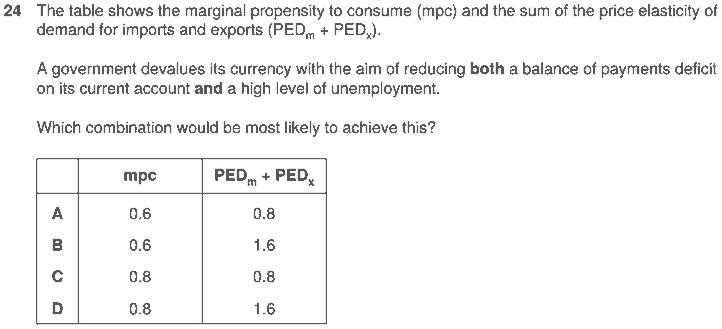
9708/34 May/June 2026 question 24
Show answer

DCorrect answer

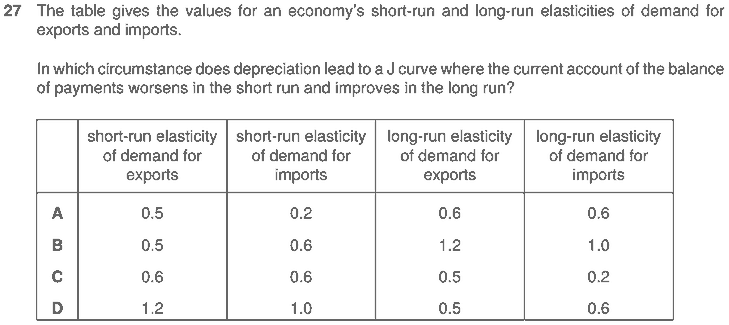
Question 27May/June 20269708/341 mark

A country devalues its currency on the foreign exchange market. Its current account balance on the balance of payments worsens in the short run, but improves in the long run. What does this illustrate?

  • Athe J curve
  • Bthe Kuznets curve
  • Cthe Laffer curve
  • Dthe Lorenz curve
Show answer

ACorrect answer

Question 22Feb/March 20269708/321 mark
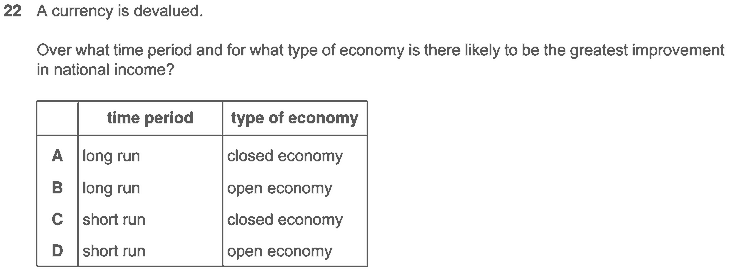
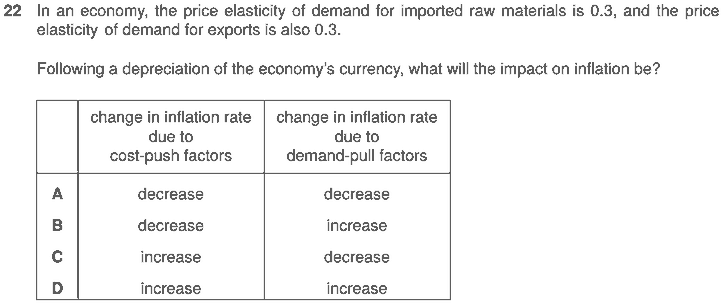
9708/32 Feb/March 2026 question 22
Show answer

BCorrect answer

Question 30Feb/March 20269708/321 mark

What is not a possible effect of using expenditure-switching policies to reduce a deficit on the current account of the balance of payments?

  • Aa reduction in the domestic demand for locally made goods and services
  • Ba retaliation from other countries
  • Can increase in demand-pull and cost-push inflation
  • Dthe generation of government revenues through customs duties
Show answer

ACorrect answer

Question 23Oct/Nov 20259708/311 mark
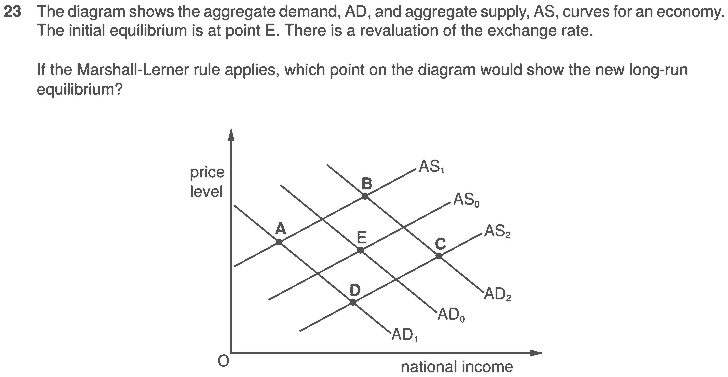
9708/31 Oct/Nov 2025 question 23
Show answer

DCorrect answer

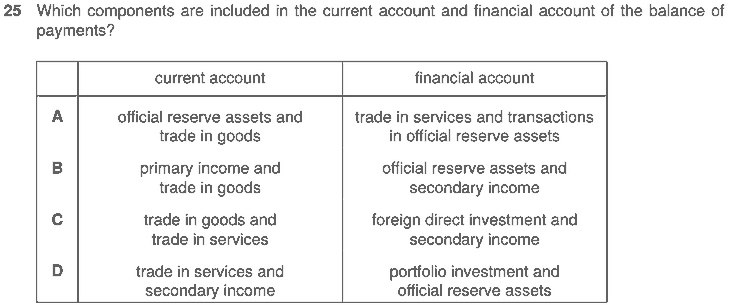
Question 25Oct/Nov 20259708/311 mark

Which statement about the components of the balance of payments is correct?

  • AThe current account consists of transactions in goods, services, investment income and remittances between countries.
  • BThe current account consists of transactions in goods, services, and portfolio investment between countries.
  • CThe financial account consists of transactions in financial assets, investment income and remittances between countries.
  • DThe financial account consists of transactions in fixed assets, investment income and the balancing item between countries.
Show answer

ACorrect answer

Question 29Oct/Nov 20259708/311 mark
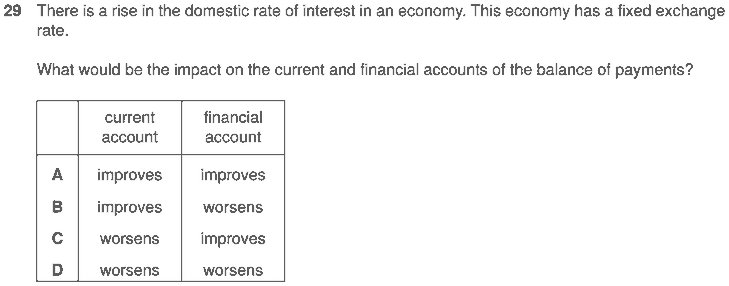
9708/31 Oct/Nov 2025 question 29
Show answer

ACorrect answer

Question 22Oct/Nov 20259708/321 mark
9708/32 Oct/Nov 2025 question 22
Show answer

CCorrect answer

Question 27Oct/Nov 20259708/321 mark

What is a protectionist policy a government may use to reduce the deficit on the balance of payments of the current account?

  • Arevaluation of the exchange rate
  • Bincrease in the rate of income tax
  • Cincrease in the rate of interest
  • Dintroduction of import quotas
Show answer

DCorrect answer

Question 29Oct/Nov 20259708/321 mark
9708/32 Oct/Nov 2025 question 29
Show answer

CCorrect answer

Question 27May/June 20259708/311 mark
9708/31 May/June 2025 question 27
Show answer

BCorrect answer

Question 27May/June 20259708/321 mark

Which policy will help to correct a deficit on the current account of the balance of payments?

  • Adecreasing direct taxes
  • Bdecreasing government regulations
  • Cincreasing exchange rates
  • Dincreasing government spending
Show answer

BCorrect answer

Question 25May/June 20259708/341 mark

What would be the most effective long-term solution to a persistent deficit on the current account of the balance of payments?

  • Ato increase borrowing from foreign financial institutions
  • Bto persuade foreign firms to increase direct investment in the economy
  • Cto revalue the currency to make it stronger on foreign exchange markets
  • Dto reduce the reserves of foreign exchange to zero
Show answer

BCorrect answer

Question 26May/June 20259708/341 mark
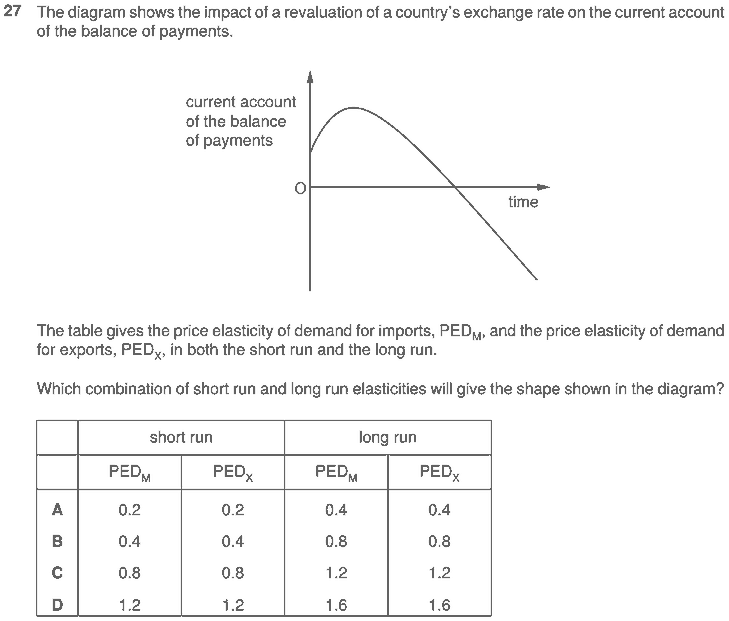
9708/34 May/June 2025 question 26
Show answer

BCorrect answer

Question 27May/June 20259708/341 mark
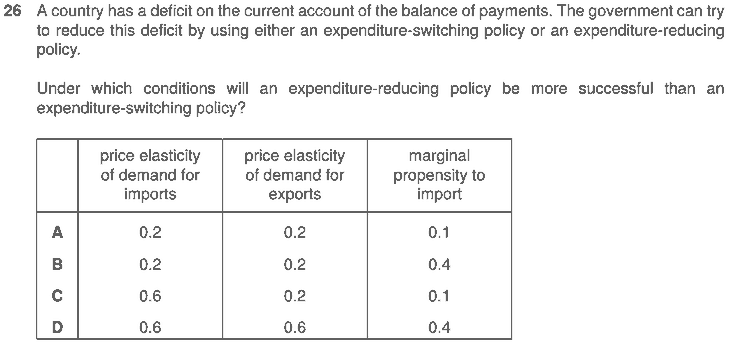
9708/34 May/June 2025 question 27
Show answer

ACorrect answer

Question 22Feb/March 20259708/321 mark

The current account on the balance of payments moves into deficit. What is a possible reason for this?

  • Aa decrease in tax revenue
  • Bexport-led growth
  • Crepayment of debts to other countries
  • Dthe import of new technology
Show answer

DCorrect answer

Question 25Feb/March 20259708/321 mark
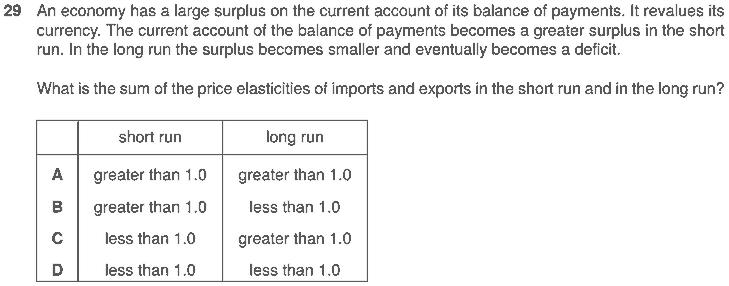
9708/32 Feb/March 2025 question 25
Show answer

DCorrect answer

Paper 4 · Data response and essays (6)

Case study: Interest Rates and Exchange Rates

Many commercial banks in Japan raised their interest rates on customer accounts in early 2024 for the first time in 17 years. Some banks also increased the interest rates on their housing loans (mortgages), which placed a heavier burden on borrowers.

The rise in interest rates followed the ending of a policy of negative interest rates used by the Bank of Japan (BOJ), the country’s central bank. Previously, the BOJ had set interest rates at –0.1% on some of the deposits made by commercial banks at the central bank.

The increase in interest rates coincided with a falling unemployment rate and expectations that Japan’s economy would grow further in the second half of 2024. This economic growth would be caused by higher wages, increased consumer spending and a depreciation of Japan’s currency, the yen.

The BOJ has a target inflation rate of 2%, but core inflation, which excludes fresh food prices, was last reported at 2.6% in March 2024. Core inflation was forecast to be above target for at least a year. This gave the central bank an opportunity to increase interest rates further. Higher interest rates, however, can reduce demand for loans and restrain economic growth.

Higher interest rates in Japan would usually lead to higher capital inflows from foreign savers causing an appreciation of the yen. Compared to other major economies, however, the interest rates in Japan were still very low. When the interest rate set by the BOJ was 0.1%, the equivalent rate was 5.25% in both the United States (US) and the United Kingdom (UK) and 4.5% in the Eurozone.

The value of the yen fell to a 34-year low in April 2024 as the chances of an expected cut in US interest rates diminished. Intervention by the BOJ to support the yen was seen as a possibility by the foreign exchange markets to restore confidence in the currency and reduce imported inflation.

On the other hand, the weak yen helped Japan’s balance of trade in goods and services. It encouraged export sales despite relatively low global economic growth. Export growth occurred across several products, particularly in transportation equipment. The number of foreign visitors to Japan also increased due to the weak yen.

Sources: Adapted from: japantimes.co.jp, 6 May 2024 morningstar.co.uk, 21 March 2024 kyodonews.net, 1 March 2024 deloitte.com, 18 October 2024

Question 1(c)May/June 20269708/416 marks

(c) Consider the extent to which a depreciation of the yen has been beneficial for Japan’s balance of trade in goods and services. [6]

Show mark scheme

Consider the extent to which a depreciation of the yen has been beneficial for Japan’s balance of trade in goods and services. Evidence from the article about its benefits:

  • It encourages export sales despite relatively low global economic growth

(1) due to lower prices of exports (1)

  • Lower global incomes could be offset by lower prices of Japanese products (1)
  • The number of foreign visitors to Japan has also increased due to the weak yen (1). Now cheaper for foreign tourists to visit and spend in Japan

(1)

  • In contrast, the article says:
  • the yen needed to be strengthened to restore investor confidence and reduce imported inflation (1). Explanation on how investor confidence could improve Japan’s balance of trade (1)
  • Credit reference to the price elasticity of demand (PED) for Imports and Exports (1) NOTE: Maximum 4 marks if no contrast
Case study: US Foreign Trade and Interest Rate Policy

The United States (US) balance of trade deficit increased to US$69.4 billion in March 2024. The deficit is considered to be undesirable and has caused discussion within the US on how to decrease it. Current and previous US governments have decided that import tariffs are their preferred solution.

Following the COVID-19 pandemic, there was a period in 2022 when the annual rate of inflation was over 10%. Intervention by the Federal Reserve (the US central bank) helped to reduce the annual rate of inflation to 2.9% by December 2023. This was still above its target rate of 2%. There was uncertainty about whether government policy objectives concerning inflation, economic growth and employment were all moving in the right direction. This uncertainty and above-target inflation meant the Federal Reserve decided to leave interest rates unchanged at 5.5%. It also decided to continue its policy of reversing quantitative easing by selling securities to remove money from money markets.

A secondary effect of this high-interest rate policy was that the US foreign exchange rate had appreciated by 6.25% during the previous 5 years. This meant that low-income countries (LICs) had to pay more for their imports priced in US$, such as raw materials, foodstuffs and oil.

These LICs often have an underdeveloped market economy with limited ability to raise tax revenue. They also have large external debts in US$, the repayment of which restricts their ability to increase economic development.

Sources: Adapted from; March 2024 Trade Gap is $69.4 Billion, bea.gov, 2 May 2024 Transcript of Chair Powell’s press conference, federalreserve.gov, 1 May 2024 Consumer prices up 2.9 percent, bls.gov, 21 August 2024

Question 1(a)May/June 20269708/422 marks

(a) Explain why a balance of trade deficit might be regarded as undesirable by the US government. [2]

Show mark scheme

Explain why a balance of trade deficit might be regarded as undesirable by the US government. Implies that (X-M) worsens and therefore Job losses 1 Reduction in gross domestic product (GDP) 1 Imported inflation 1 Fall in foreign exchange reserves. 1

Max 2

Question 1(b)May/June 20269708/424 marks

(b) Explain, with the aid of a diagram, how import tariffs lead to expenditure switching in the US economy. [4]

Show mark scheme

Explain, with the aid of a diagram, how import tariffs lead to expenditure switching in the US economy. Price US Demand US supply P1 B P2 F G World Supply+Tariff P3 world supply Q1 Q2 Qe Q3 Q4 Quantity

Diagram Axes and Labels 1 + 1 (Axes MUST show world supply)

Max 2 for diagram Comments based on diagram Max 2 Imports reduce (Q1 to Q4) to (Q2 to Q3) 1 Domestic output increases Q1 to Q2 1 World supply falls from Q4 to Q3 1 Explanation 1 developed point 1 + 1 2 points 1 and 1

Question 5May/June 20269708/4420 marks

5 Discuss whether expenditure‑reducing policies are preferable to expenditure‑switching policies in order to correct a persistent deficit on the current account of the balance of payments. [20]

Show mark scheme

Discuss whether expenditure-reducing policies are preferable to expenditure-switching policies in order to correct a persistent deficit on the current account of the balance of payments.

Use Table A: AO1 Knowledge and understanding andAO2 Analysis and Table B: AO3 Evaluation to mark candidate responses to this question.

AO1 and AO2 out of 14 marks. AO3 out of 6 marks.

Indicative content Responses may include:

AO1 Knowledge and understanding and AO2 Analysis

  • Explanation of how a persistent deficit on the current account of the balance of payments may occur, with reference to its components.
  • Explanation and analysis of how a contractionary fiscal/monetary policy ‘reduces expenditure’ by reducing aggregate demand/incomes and therefore imports.
  • An AD/AS diagram may be analysed.
  • An exchange rate diagram, to explain how a fixed/managed exchange rate can be devalued.
  • Explanation and analysis of how a devaluation of an exchange rate ‘switches expenditure’ from imports to exports.
  • Explanation and analysis of how protectionist policies e.g. tariffs, subsidies on exports, productivity increasing supply-side policy ‘switch expenditure’ from imports to domestically produced goods.

AO3 Evaluation

  • Expenditure-reducing policies will reduce real GDP and may cause a rise in unemployment.
  • Demand for imports may continue to be high if they are essential as inputs for manufacturing or necessities,
  • An analysis of how the deficit might widen after a devaluation if the Marshall-Lerner condition is not fulfilled. ‘J’ curve analysis.
  • Other economies may also devalue their exchange rates.
  • Effect of devaluation on the price of imports may raise costs of production and consumer prices, which may also lead to lower exports.
  • Protectionist policies e.g. tariffs may lead to retaliation/cause a trade war/ be against World Trade Organisation rules/Net welfare loss.
  • In the long run, supply side policies to improve exports may be preferable to both expenditure-switching and expenditure-reducing policies.

Accept all valid responses.

AO1 Knowledge and understanding and AO2 Analysis

AO3 Evaluation

Question 5Oct/Nov 20259708/4320 marks

5 ‘The use of tariffs is the most effective way to correct a balance of payments deficit.’

With the help of a diagram, evaluate this statement. [20]

Show mark scheme

The use of tariffs is the most effective way to correct a balance of payments deficit. With the help of a diagram, evaluate this statement

Use Table A: AO1 Knowledge and understanding and AO2 Analysis and Table B: AO3 Evaluation to mark candidate responses to this question.

AO1 and AO2 out of 14 marks. AO3 out of 6 marks.

Indicative content Responses may include:

AO1 Knowledge and understanding and AO2 Analysis

  • Tariffs should be clearly explained as a tax on selected imports and such taxes will act as a barrier to free trade
  • The key elements of the balance of payments accounts should be briefly outlined
  • A balance of payments deficit should be explained and linked to its potential effects on a country’s exchange rate.
  • An accurate, clearly labelled diagram should be provided which would form the basis for analysing the impact of a tariff on the balance of payments.
  • The focus of the analysis should be on the recognition that tariffs represent an expenditure switching policy which will rely significantly upon the response of the demand for imports in relation to a change in the price of imports.
  • Also, the analysis should recognize the overall impact of an increase in tariffs will be primarily upon the goods and services element of the balance of payments current account. No diagram Max L3–Micro diagram not acceptable

AO3 Evaluation

  • Tariffs often produce a retaliation response by those countries which have to pay the tariff. This might significantly reduce the positive impact upon the balance of payments.
  • The benefits of imposing a tariff regarding a balance of payments deficit will also be determined by the nature of the balance of payments deficit. Although tariffs might be suitable for a long-term, persistent deficit, alternative policies might be more effective for short-term, more temporary situations.
  • Alternative methods of addressing the balance of payments deficit may be more appropriate. For example, an economy experience high inflation might use a more effective expenditure reducing policy to correct this deficit.
  • The net effect on the current account will also be determined by the elasticity of demand for imports. Imports which are deemed inelastic will increase, rather than reduce total expenditure on imports when the price of imports rises.
  • Other potential negative effects on the economy also need to be considered. For example, the loss of producer and consumer surplus.
  • A conclusion might attempt to form an overall judgement on the short term and long-term impact on the balance of payments.

Accept all valid responses.

AO1 Knowledge and understanding and AO2 Analysis

AO3 Evaluation

Question 5Feb/March 20259708/4220 marks

5 With the help of a diagram, evaluate the effectiveness of the use of expenditure-switching policies to reduce a current account deficit on the balance of payments. [20]

Show mark scheme

With the help of a diagram, evaluate the effectiveness of the use of expenditure-switchingpolicies to reduce a currentaccount deficiton the balance of payments. Use TableA:AO1 Knowledge and understanding andAO2 Analysis and Table B: AO3 Evaluation to mark candidate responses to this question.

AO1 and AO2 out of 14 marks. AO3 out of 6 marks.

Indicative content Responses may include:

AO1 Knowledge and understanding and AO2Analysis

  • An explanation of the meaning of a current account balance of payments deficit should be provided.
  • Expenditure-switching policies should be explained by the relationship between changes in the market prices of imported and exported goods and services and changes in the balance of payments current account
  • Examples of expenditure-switching policies such as a decrease in tariffs or a devaluation of a currency in a fixed exchange rate system.
  • Analysis of the impact of the introduction of a tariff on the balance of payments current account. An accurately labelled diagram should be provided.
  • Analysis of the impact of tariffs on other key stakeholders, for example, domestic suppliers, consumers and firms should be considered.
  • Analysis of the use of an alternative expenditure switching policy should be provided. For example, the use of a devaluation in a fixed exchange rate system. Accept export subsidies/supply side policies.

L2 max if no relevant diagram provided.

AO3 Evaluation

  • It is important to establish the magnitude of the deficit and the how long this deficit has persisted before interfering in the import/export market.
  • Although tariffs might temporarily reduce the deficit,other countries might introduce their own tariffs in retaliation.
  • Tariffs might have a negative impact on other key macroeconomic variables. For example, tariffs might contribute to a growth in cost push inflation
  • Tariffs might lead to a net welfare loss for society as a whole. This can be shown on a clearly labelled diagram.
  • A devaluation of the currency will depend upon the relative price elasticities of supply/demand for imports and exports. The Marshall- Lerner condition should be explained.
  • A devaluation might also have a negative impact on other key macroeconomic variables. For example, a devaluation will stimulate the demand for exports, which might contribute to demand pull inflation. Or contribute to cost push inflation by raising the price of imported goods
  • A conclusion addressing the specific statement should be provided.

Accept all valid responses.

AO1 Knowledge and understanding and AO2Analysis

AO3 Evaluation

15 more questions from 2020–2024

🔒 Unlock every Policies to correct disequilibrium in the balance of payments question from 2020–2024

All 15 come with their mark schemes, answers and case studies, and appear in the practice tool above once you’re signed in. It’s free.

Create a free accountSign in

A few of them

  • 9708/31 · Oct/Nov 2024 · Question 25Which policy to reduce a current account… 🔒
  • 9708/32 · Oct/Nov 2024 · Question 26A US company receives a US$20 million… 🔒
  • 9708/33 · Oct/Nov 2024 · Question 26A government wants to reduce the current… 🔒
  • 9708/31 · May/June 2024 · Question 25What is not an example of an… 🔒
  • 9708/32 · May/June 2024 · Question 27The macroeconomic objective of a government is… 🔒
  • + 10 more, by year in the table above

Questions and mark schemes are from past Cambridge papers and are reproduced for revision. Topical Vault is an independent revision resource, not affiliated with or endorsed by Cambridge Assessment International Education.

A Level Economics questions by topic

Each topic opens this practice tool with only that topic’s questions, plus how often it comes up and every question on it in one list.

  1. Unit 7The price system and the microeconomy
  2. Ch 30Utility
  3. Ch 31Indifference curves and budget lines
  4. Ch 32Efficiency and market failure
  5. Ch 33Private costs and benefits, externalities and social costs and benefits
  6. Ch 34Types of cost, revenue and profit, short-run and long-run production
  7. Ch 35Different market structures
  8. Ch 36Growth and survival of firms
  9. Ch 37Differing objectives and policies of firms
  10. Unit 8Government microeconomic intervention
  11. Ch 38Government policies to achieve efficient resource allocation and correct market failure
  12. Ch 39Equity and redistribution of income and wealth
  13. Ch 40Labour market forces and government intervention
  14. Unit 9The macroeconomy
  15. Ch 41The circular flow of income
  16. Ch 42Economic growth and sustainability
  17. Ch 43Employment and unemployment
  18. Ch 44Money and banking
  19. Unit 10Government macroeconomic intervention
  20. Ch 45Government macroeconomic policy objectives
  21. Ch 46Links between macroeconomic problems and their interrelatedness
  22. Ch 47Effectiveness of policy options to meet all macroeconomic objectives
  23. Unit 11International economic issues
  24. Ch 48Policies to correct disequilibrium in the balance of payments
  25. Ch 49Exchange rates
  26. Ch 50Economic development
  27. Ch 51Characteristics of countries at different levels of development
  28. Ch 52Relationship between countries at different levels of development
  29. Ch 53Globalisation