Cambridge 9708, Paper 3 & 4. 1,666 questions, 2020 to 2026.
Topic
Year
Paper 3 multiple-choice questions and Paper 4 data-response/essay questions and case
studies, retyped from the original Cambridge material; artwork and data tables are reproduced as images.
Mark schemes show the official answer key and level-marked indicative content.
About Utility
A Level questions on utility: total and marginal utility, diminishing marginal utility, the equi-marginal principle, and how utility theory explains the demand curve.
47 past paper questions on this topic since 2020, across 18 exam sessions.
How often it comes up
Year
Paper 3
Paper 4
Total
Chart
2026
3
3
6
2025
4
1
5
2024
6
1
7
2023
4
0
4
2022
5
0
5
2021
7
2
9
2020
6
5
11
Every 2025–2026 question on Utility
The whole topic on one page, with answers and mark schemes. Printing this page prints just this list.
Paper 3 · Multiple choice (7)
Question 6May/June 20269708/311 mark
Marginal utility theory measures consumer satisfaction and concludes that the value of marginal utility a consumer places on a good will determine the price they are willing to pay for that good. The price of a bottle of water, which is vital for human survival, is less than the price of luxuries, such as designer clothing. Which statement is least likely to explain this?
Adifferent consumers have different marginal utilities for the same good
Bmoney does not measure utility accurately
Cprice is better at measuring the value of exchange than the value of satisfaction
Dprice is determined by both marginal utility and marginal cost
Show answer
ACorrect answer
Question 1May/June 20269708/321 mark
When do consumers maximise utility under the equi-marginal principle?
AWhen each additional unit of a product consumed decreases by equal amounts.
BWhen the average utility per dollar spent is the same for each product.
CWhen the marginal utility per dollar spent is the same for each product.
DWhen the total utility for each product consumed is the same.
Show answer
CCorrect answer
Question 5Feb/March 20269708/321 mark
What is it called when a consumer’s marginal utility is greater than the price paid for the good?
Aa Giffen good
Ban inferior good
Cconsumer surplus
Dproducer surplus
Show answer
CCorrect answer
Question 4Oct/Nov 20259708/311 mark
A consumer maximises his total utility by initially buying 10 units of good X and 10 units of good Y. Assuming both goods are normal, what would cause this utility-maximising consumer to purchase more of good Y and less of good X?
Aan increase in the marginal utility of good Y
Ban increase in the price of good Y
Can increase in the tax on the consumption of good Y
Dan increase in the tax on the income of consumers
Show answer
ACorrect answer
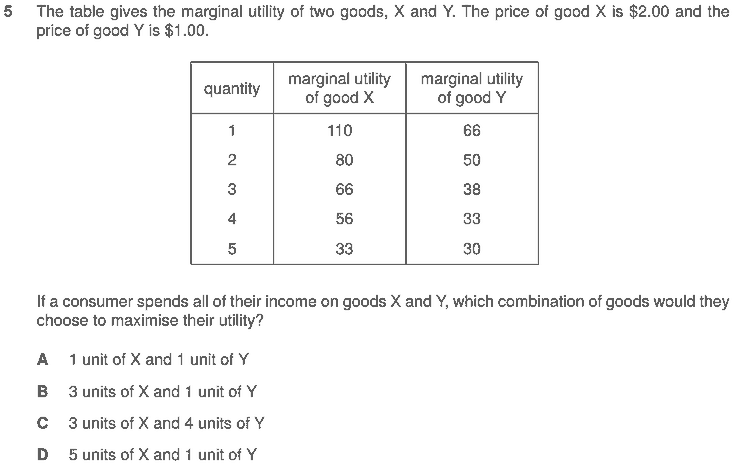
Question 5Oct/Nov 20259708/321 mark
Show answer
CCorrect answer
Question 1May/June 20259708/311 mark
What is the equi-marginal principle?
AAs consumption of a product increases, the satisfaction from consumption of the product decreases by an equal amount.
BConsumers maximise utility where their marginal valuation for each product consumed is the same.
CThe total satisfaction received by consumers from consumption of a product is constant.
DThe marginal utility derived by consumers from the consumption of one more unit of a product is constant.
Show answer
BCorrect answer
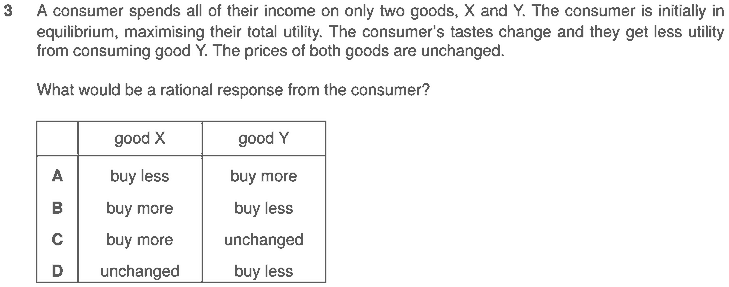
Question 3May/June 20259708/321 mark
Show answer
BCorrect answer
Paper 4 · Data response and essays (4)
Question 2May/June 20269708/4220 marks
2 Evaluate whether the marginal utility theory of demand provides an adequate explanation of market demand for both normal goods and inferior goods. [20]
Show mark scheme
Evaluate whether the marginal utility theory of demand provides an adequate explanation of market demand for both normal goods and inferior goods. Use TableA: AO1 Knowledge and understanding and AO2 Analysis and Table B: AO3 Evaluation to mark candidate responses to thisquestion.
AO1 and AO2 out of 14marks. AO3 out of 6 marks.
Indicative content Responses may include:
AO1 Knowledge and understanding and AO2 Analysis
Assumptions of marginal utility analysis including:
rational consumers who prefer more to less,
a two-good world,
the goods can be substituted for each other,
perfect knowledge of the market.
Definition of marginal and total utility.
Explanation of diminishing marginal utility.
The analysis of the change in the price of a good and the explanation of how much the consumer will purchase as the price changes.
The use of the equi-marginal principle to establish how consumers ‘balance’ their expenditure on goods as the price of one of them changes. MU /P = MU /P x x y y
The horizontal addition of individuals’ demand curves to achieve the market demand curve.
AO3 Evaluation
Consumer rationality: marginal utility theory assumes that consumers act rationally. They are of a calculating mind, carrying numerous combinations of different commodities in their heads, can substitute one for the other, compare their total utilities and make a rational choice between various combinations of goods.
Marginal utility theory has no provision for income and substitution effects so does not explain inferior goods.
It is difficult to compare the concept of changing the demand for expensive goods which are purchased infrequently with goods such as consumables. which are one-off indivisible purchases and the choice is between, for example, 1 fridge and 4 weeks’ food.
A consumer is faced with a much more complex world than the two-good world of the model because a consumer buys not just two but many commodities to satisfy their innumerable wants.
Accept all valid responses.
AO1 Knowledge and understanding and AO2Analysis
AO3 Evaluation
Case study: Environmental policies in Czechia
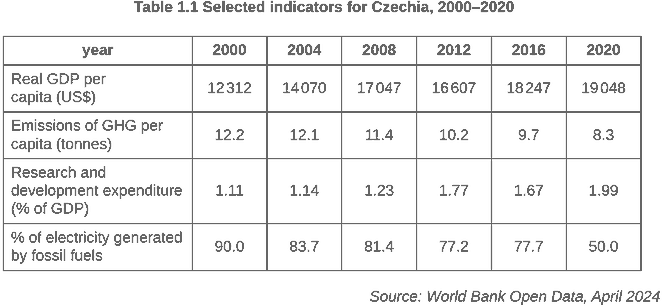
Czechia, a country in the European Union, is experiencing strong growth of its gross domestic product (GDP). Climate change, however, is affecting its agriculture and forestry sectors and people’s health. According to Table 1.1, Czechia currently generates 50% of its electricity using fossil fuels (coal, oil, and gas), which emit greenhouse gases (GHG) and other air pollutants. Nuclear power plants generate 32% and renewable sources generate 18%. Czechia also has coal‑fuelled heating systems, and industry that emits a lot of GHG, particularly in car production. Despite an increase in the use of renewables and energy efficiency measures, Czechia remains highly dependent on fossil fuels. If Czechia is to reach net zero carbon emissions by 2050, further measures are needed.
Czechia’s relatively low research and development (R&D) spending in the private sector is shown in Table 1.1. Combined with inadequate digital and transport infrastructure, this restricts innovation. However, energy efficiency regulations, such as setting energy efficiency standards for buildings, will incentivise private investment. Increased government spending on renewable energy projects and energy efficiency measures, such as modernising electricity grids, would act as a fiscal injection. There is not enough skilled labour at present to install new technologies in the renewable energy sector, but education and training can be improved.
The government needs to ensure that energy prices do not rise too much, which would add to firms’ costs. If Czechia fulfils its commitment to phase out the use of coal to generate electricity by 2033, the high levels of unemployment and poverty in Czechia’s coal‑producing region could increase.
Since 2000, transport’s use of energy has increased by 64%. As incomes have grown, the use of public transport, such as rail and buses, has decreased from 37% to 18% of all passenger kilometres travelled, while the use of private cars has increased from 63% to 82%. Therefore, policies to improve the quality and availability of public transport are needed. Increasing investment in public transport would also promote worker mobility and productivity growth.
Higher taxes on cars and electricity would raise revenues that could partly finance environmental projects. The structure of vehicle taxes in Czechia encourages the use of hybrid and electric cars, for example electric‑car owners are exempt from road tax and can park for free in cities. But further measures to facilitate the use of electric vehicles, such as providing charging infrastructure, are necessary.
Sources: International Monetary Fund : Enhancing the green transition in Czechia Odysee Mure: European Union: Czechia : Energy profile, March 2024
Question 1(b)May/June 20269708/444 marks
(b) Goods can be classified as either normal or inferior.
(i) Explain how public transport would be classified in Czechia. [2]
(ii) Explain how private cars would be classified in Czechia. [2]
Show mark scheme
Goods can be classified as either normal or inferior.
Explain how public transport would be classified in Czechia.
Use of bus and rail travel appears to be declining as incomes rise (1)
They are not normal goods/they are inferior goods (1) Explain how private cars would be classified in Czechia.
Use of private cars appears to be increasing as incomes rise (1)
They are normal goods/they are not inferior goods (1)
Question 2May/June 20269708/4420 marks
2 Assess the extent to which marginal utility theory explains the downward sloping market demand curve for a good. [20]
Show mark scheme
Assess the extent to which marginal utility theory explains the downward sloping market demand curve for a good.
Use Table A: AO1 Knowledge and understanding and AO2 Analysis and Table B: AO3 Evaluation to mark candidate responses to this question.
AO1 and AO2 out of 14 marks. AO3 out of 6 marks.
Indicative content Responses may include:
AO1 Knowledge and understanding and AO2 Analysis
Definition of marginal utility/total utility and their relationship.
Explanation of diminishing marginal utility.
Analysis of the equi-marginal principle to show how change in price affects the quantity demanded for an individual’s demand curve.
Explanation and analysis to show a market demand curve stating/showing the horizontal summation of the individuals demand curves.
AO3 Evaluation
Not possible to measure utility.
Assumes that consumers are rational, but there may be cases where expensive goods are consumed in order for the consumer to be conspicuous.
There may be Giffen goods.
Assumes perfect knowledge of prices for substitutes.
Many choices between two goods occur when they are not easily substitutable for each other.
Consumer preferences change over time.
The use of indifference curves to analyse demand may be more effective.
Collection of sets might mean utility increases as the sets near completion.
Accept all valid responses.
AO1 Knowledge and understanding and AO2 Analysis
AO3 Evaluation
Question 2Oct/Nov 20259708/4420 marks
2 Evaluate, with the aid of a diagram, whether the diminishing marginal utility theory of demand provides an adequate explanation of the market demand curve for all goods and services. [20]
Show mark scheme
Evaluate, with the aid of a diagram whether the diminishing marginal utilitytheoryof demand provides an adequate explanationof the market demand curve for all goods and services. Use TableA:AO1 Knowledge and understanding andAO2 Analysis and Table B: AO3 Evaluation to mark candidate responses to this question.
AO1 and AO2 out of 14 marks. AO3 out of 6 marks.
Indicative content Responses may include:
AO1 Knowledge and understanding and AO2 Analysis Assumptions of marginal utility analysis including:
rational consumers who prefer more to less, atwo-good world, the goods can be substituted for each other, perfect knowledge of the market.
Definition of marginal and total utility.
Explanation of diminishing marginal utility.
The analysis of the change in the price of a good and the explanation of how much the consumer will purchase as the price changes.
The use of the equi-marginal principle to establish how consumers ‘balance’ their expenditure on goods as the price of one of themchanges.
The horizontal addition of individuals’ demand curves to achieve the market demand curve.
AO3 Evaluation
Consumer rationality: marginal utility theory assumes that consumers act rationally. They are of a calculating mind, carrying numerous combinations of different commodities in their heads, can substitute one for the other, compare their total utilities and make a rational choice between various combinations of goods.
Marginal utility theory has no provision for income and substitution effects so does not explain inferior goods.
It is difficult to compare the concept of changing the demand for expensive goods which are purchased infrequently with goods such as consumables. which are one-off indivisible purchases and the choice is between, for example, 1 fridge and 4 weeks’ food.
A consumer is faced with a much more complex world than the two-good world of the model because a consumer buys not just two but a large number of commodities to satisfy their innumerable wants.
Accept all valid responses.
AO1 Knowledge and understanding and AO2 Analysis
AO3 Evaluation
36 more questions from 2020–2024
🔒 Unlock every Utility question from 2020–2024
All 36 come with their mark schemes, answers and case studies, and appear in the practice tool above once you’re signed in. It’s free.
9708/31 · May/June 2024 · Question 1Which statement about the concept of utility… 🔒
9708/32 · Feb/March 2024 · Question 1A person buys two pairs… 🔒
+ 31 more, by year in the table above
Questions and mark schemes are from past Cambridge papers and are reproduced for revision. Topical Vault is an independent revision resource, not affiliated with or endorsed by Cambridge Assessment International Education.
A Level Economics questions by topic
Each topic opens this practice tool with only that topic’s questions, plus how often it comes up and every question on it in one list.
Pick a paper, sub-topics and years to draw from (leave any blank for "all"), choose
how many questions you want, and we'll open a new worksheet page with a random set for you to review
and download.