← Topical Vault

Effectiveness of policy options to meet all macroeconomic objectives · A Level Economics

Cambridge 9708, Paper 3 & 4. 1,666 questions, 2020 to 2026.

Topic
Year

Paper 3 multiple-choice questions and Paper 4 data-response/essay questions and case studies, retyped from the original Cambridge material; artwork and data tables are reproduced as images. Mark schemes show the official answer key and level-marked indicative content.

About Effectiveness of policy options to meet all macroeconomic objectives

Questions on how well policies work: fiscal, monetary and supply-side policy compared, Keynesian and monetarist views, the Laffer curve, and policy conflicts and time lags.

151 past paper questions on this topic since 2020, across 20 exam sessions.

How often it comes up

YearPaper 3Paper 4TotalChart
20265712
2025171027
202413417
20237815
2022141024
202118725
2020171431

Every 2025–2026 question on Effectiveness of policy options to meet all macroeconomic objectives

The whole topic on one page, with answers and mark schemes. Printing this page prints just this list.

Paper 3 · Multiple choice (22)

Question 20May/June 20269708/321 mark
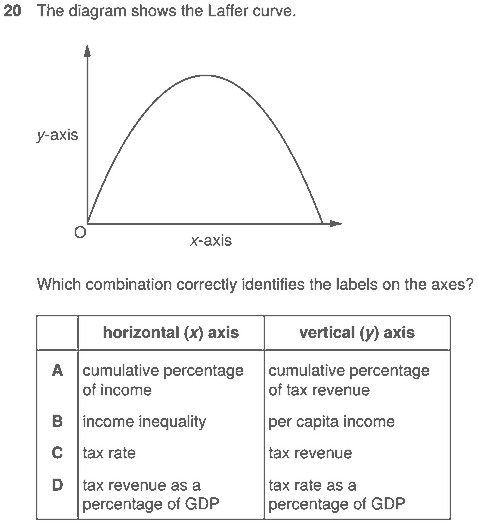
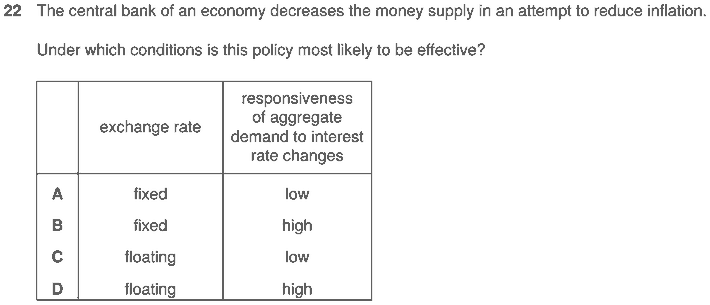
9708/32 May/June 2026 question 20
Show answer

CCorrect answer

Question 22May/June 20269708/321 mark

Other things being equal, what is likely to result from a reduction in interest rates in a country?

  • Aan appreciation of the country’s currency
  • Ba decrease in consumption
  • Ca decrease in investment
  • Dan outflow of short-term capital
Show answer

DCorrect answer

Question 28May/June 20269708/321 mark

One year, the World Bank gave a loan of $650 million to Angola to help stabilise the economy. The Bank said Angola needed to have a fiscal policy that would encourage the diversification of its economy. Which policy would be consistent with this requirement?

  • Athe lowering of interest rates to encourage investment in solar power
  • Bthe relaxing of regulations to allow the development of a new hydropower project
  • Cthe spending of the loan supporting its existing oil industry after oil prices collapsed
  • Dthe subsidising of a partnership with a French company to establish a chain of tourist hotels
Show answer

DCorrect answer

Question 22May/June 20269708/341 mark

Which policy pursued by a central bank represents a contractionary monetary policy?

  • Aa reduction in the interest rate at which it will lend to banks
  • Ba reduction in the minimum cash to deposit ratios of banks
  • Cthe purchase of foreign currency to influence the country’s exchange rate
  • Dthe sale of government bonds in the open market
Show answer

DCorrect answer

Question 21Feb/March 20269708/321 mark

What is a reason for a central bank to decrease the interest rate?

  • Ato attract hot money inflows to prevent a decrease in the exchange rate
  • Bto discourage private sector borrowing for investment
  • Cto increase aggregate demand and aggregate supply in the economy
  • Dto slow the rate of increase of domestic prices
Show answer

CCorrect answer

Question 16Oct/Nov 20259708/311 mark

What describes a Keynesian measure to reduce cyclical unemployment?

  • Aadopting a supply-side policy to retrain unskilled workers
  • Ballowing the private sector to take over the supply of merit goods
  • Cincreasing the ratio of capital equipment to manual labour in production
  • Dusing fiscal policy to increase effective demand
Show answer

DCorrect answer

Question 22Oct/Nov 20259708/311 mark

To overcome deflation in an economy the government increases the size of its budget deficit and funds this by increasing the money supply. What is most likely to reduce the effectiveness of these measures?

  • Aa high marginal propensity to save
  • Ba rise in business confidence
  • Can inelastic demand for money
  • Dlow cash deposit ratios for commercial banks
Show answer

ACorrect answer

Question 15Oct/Nov 20259708/321 mark

In which situation is expansionary fiscal policy least likely to be effective?

  • Ainflation is below its target rate
  • Black of confidence in the economy
  • Cthere is a negative output gap
  • Dunemployment is high
Show answer

BCorrect answer

Question 20Oct/Nov 20259708/331 mark

Which macroeconomic policy is most likely to be used as a long-run means of reducing inflationary pressures?

  • Aexchange rate policy
  • Bfiscal policy
  • Csupply-side policy
  • Dmonetary policy
Show answer

CCorrect answer

Question 22Oct/Nov 20259708/331 mark
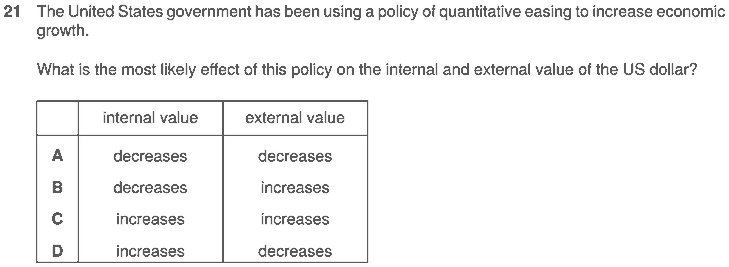
9708/33 Oct/Nov 2025 question 22
Show answer

DCorrect answer

Question 19Oct/Nov 20259708/341 mark

What is an example of a demand-side macroeconomic policy that would reduce cyclical unemployment?

  • Aan increase in government spending on new infrastructure such as roads
  • Ban increase in government spending on retraining workers
  • Ca reduction in the rate of tax on imports
  • Dan increase in the rate of tax on goods and services
Show answer

ACorrect answer

Question 24Oct/Nov 20259708/341 mark

A political party proposed a policy of quantitative easing (the creation of money by the central bank). When would such a policy be least likely to destabilise the macroeconomy in the short run?

  • Awhen the economy was experiencing a high level of inflation
  • Bwhen the economy had price stability but there was full employment of the labour force
  • Cwhen there was a deep recession with high levels of unemployment
  • Dwhen there was full employment and a current account balance of payments deficit
Show answer

CCorrect answer

Question 25Oct/Nov 20259708/341 mark

What does the Laffer curve show?

  • Athe amount of tax revenue received at each tax rate
  • Bthe impact on the distribution of income after tax rates rise
  • Cthe rise in inflation following a fall in unemployment due to a cut in income tax
  • Dthe rise in poverty due to a rise in the basic rate of income tax
Show answer

ACorrect answer

Question 19May/June 20259708/311 mark

A country’s government decides to set artificially low interest rates. What describes a negative consequence to this country of this policy?

  • Aa higher rate of consumer price inflation
  • Ba rapid growth in gross domestic product
  • Can increase in investment by manufacturers and real estate developers
  • Da reduction in borrowing by consumers
Show answer

ACorrect answer

Question 23May/June 20259708/311 mark

An economy is at its natural rate of unemployment. Under which circumstances will an increase in government spending aimed at reducing unemployment be most likely to conflict with a government’s objective of low inflation?

  • Aif inflationary expectations are unchanged
  • Bif inflationary expectations fall
  • Cif labour productivity increases
  • Dif labour supply increases
Show answer

ACorrect answer

Question 17May/June 20259708/321 mark
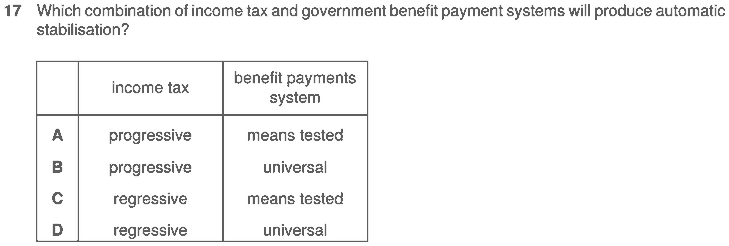
9708/32 May/June 2025 question 17
Show answer

ACorrect answer

Question 19May/June 20259708/321 mark
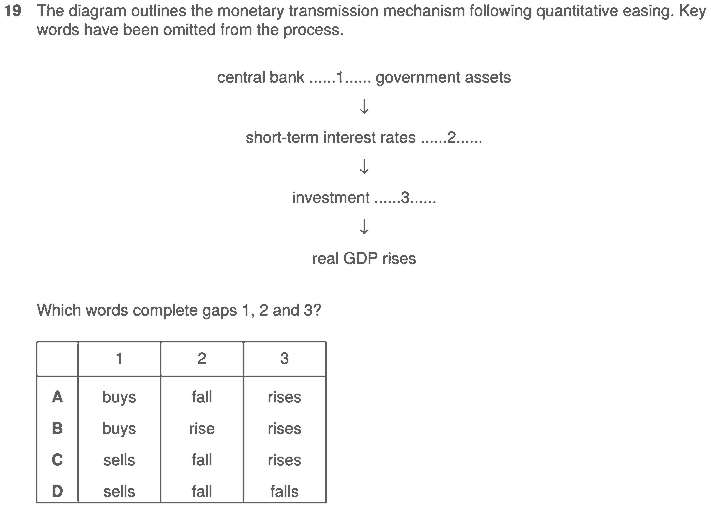
9708/32 May/June 2025 question 19
Show answer

ACorrect answer

Question 22May/June 20259708/321 mark

A government sets a target for the annual rate of inflation to be no more than 3%. Which circumstances would make it difficult to achieve the target?

  • Aif devaluation of the currency leads to a trade surplus
  • Bif interest rates are increased to control effective demand
  • Cif the government increases its tax revenue
  • Dif wage increases are kept in line with productivity
Show answer

ACorrect answer

Question 24May/June 20259708/321 mark

What is the most likely consequence when there is an increase in the national debt?

  • Athe creation of additional money
  • Ba current account deficit on the balance of payments
  • Ca surplus in the government’s budget
  • Dthe crowding out of private sector investment
Show answer

DCorrect answer

Question 20May/June 20259708/341 mark

A country is experiencing high unemployment, high inflation and a trade deficit. Which policy is most likely to solve all of these problems?

  • Adevaluation of the currency
  • Bexport subsidies
  • Clower interest rates
  • Dtariffs on imports
Show answer

BCorrect answer

Question 21May/June 20259708/341 mark
9708/34 May/June 2025 question 21
Show answer

ACorrect answer

Question 21Feb/March 20259708/321 mark

Which policy may increase economic growth without causing inflation?

  • Agiving subsidies to producers
  • Bincreasing government spending
  • Clowering direct taxes
  • Dlowering interest rates
Show answer

ACorrect answer

Paper 4 · Data response and essays (17)

Question 4May/June 20269708/4120 marks

4 Due to the multiplier process, governments conducting an expansionary fiscal policy do not need to increase spending by the full amount of the negative output gap to bring the output of the economy to its full employment level.

Evaluate this statement. [20]

Show mark scheme

Due to the multiplier process, governments conducting an expansionary fiscal policy do not need to increase spending by the full amount of the negative output gap to bring the output of the economy to its full employment level. Evaluate this statement.

Use Table A: AO1 Knowledge and understanding and AO2 Analysis and Table B: AO3 Evaluation to mark candidate responses to this question.

AO1 and AO2 out of 8 marks. AO3 out of 4 marks.

Indicative content Responses may include:

AO1 Knowledge and understanding and AO2 Analysis

  • Negative output gap as the condition where actual output is less than potential output.
  • The concept of full employment where all available resources in the economy are fully and efficiently used, where there is no cyclical unemployment.
  • Aggregate demand is a determinant of the output of an economy.
  • Expansionary fiscal policy is when the government decreases taxes and increases government spending, incurring a budget deficit.
  • Government spending is an injection into the circular flow of income and is a component of aggregate demand.
  • Multiplier = 1 / (1-MPC) = 1/ MPW = 1/ (MPS + MTR + MPM) = Change in National Income/ Change in Injection
  • Multiplier process leads to multiple rounds of spending due to an injection
  • The increase in income leads to induced consumption and investment spending by households and businesses.
  • As households have more disposable income, they increase their consumption of goods and services.
  • Similarly, businesses may invest in new capital equipment or expand production capacity to meet the growing demand.
  • The initial injection of spending sets off a chain reaction of additional rounds of spending, as the increase in income from one round leads to further increases in consumption and investment, creating a multiplier effect on aggregate demand.
  • An injection of government spending leading to a more than proportionate increase in national income.
  • Examples of what the government can spend on and the additional rounds of spending that it creates.
  • AD/AS diagram showing more than one shift in AD (or 1 shift with written explanation that the amount of increase is more than the amount the government spent)

AO3 Evaluation

  • The uncertainty of the existence of the multiplier may lead to government spending being insufficient.
  • Uncertainty could also lead to overshooting, leading to higher inflation.
  • Government spending is a small part of the aggregate demand of the economy and therefore may have an insignificant impact on the national output levels, even with the multiplier.
  • Expansionary fiscal policy could lead to the crowding out effect.
  • National debt issues could emerge such as high debt servicing ratio, lower investor confidence, debt crises.
  • MPM in the economy might be very large /MPC in the economy might be very small, leading to small multiplier.

Accept all valid responses.

AO1 Knowledge and understanding and AO2 Analysis

AO3 Evaluation

Case study: US Foreign Trade and Interest Rate Policy

The United States (US) balance of trade deficit increased to US$69.4 billion in March 2024. The deficit is considered to be undesirable and has caused discussion within the US on how to decrease it. Current and previous US governments have decided that import tariffs are their preferred solution.

Following the COVID-19 pandemic, there was a period in 2022 when the annual rate of inflation was over 10%. Intervention by the Federal Reserve (the US central bank) helped to reduce the annual rate of inflation to 2.9% by December 2023. This was still above its target rate of 2%. There was uncertainty about whether government policy objectives concerning inflation, economic growth and employment were all moving in the right direction. This uncertainty and above-target inflation meant the Federal Reserve decided to leave interest rates unchanged at 5.5%. It also decided to continue its policy of reversing quantitative easing by selling securities to remove money from money markets.

A secondary effect of this high-interest rate policy was that the US foreign exchange rate had appreciated by 6.25% during the previous 5 years. This meant that low-income countries (LICs) had to pay more for their imports priced in US$, such as raw materials, foodstuffs and oil.

These LICs often have an underdeveloped market economy with limited ability to raise tax revenue. They also have large external debts in US$, the repayment of which restricts their ability to increase economic development.

Sources: Adapted from; March 2024 Trade Gap is $69.4 Billion, bea.gov, 2 May 2024 Transcript of Chair Powell’s press conference, federalreserve.gov, 1 May 2024 Consumer prices up 2.9 percent, bls.gov, 21 August 2024

Question 1(c)May/June 20269708/427 marks

(c) Consider whether a high interest rate would ensure that ‘inflation, job creation and economic growth were all moving in the right direction’ in the US economy. [7]

Show mark scheme

Consider whether a high interest rate will ensure that ‘inflation, job creation and economic growth are all moving in the right direction’ in the US economy.

  • High interest rates will reduce investment and lower employment (job creation)t 1 and lower growth rate 1
  • Increases the exchange rate (hot money inflows) 1 reduces import cost and inflationary effects 1
  • Reduce consumer demand 1 and reduces growth rate/inflation 1 3  (1 + 1)

Max 6 Conclusion: Not all the stated aims are likely to be achieved at the same time.1

Question 4May/June 20269708/4420 marks

4 Knowledge of both the multiplier and the accelerator enable a government to implement effective fiscal policies to close a deflationary gap.

Evaluate this statement. [20]

Show mark scheme

Knowledge of both the multiplier and the accelerator enable a government to implement effective fiscal policies to close a deflationary gap. Evaluate this statement.

Use Table A: AO1 Knowledge and understanding and AO2 Analysis and Table B: AO3 Evaluation to mark candidate responses to this question.

AO1 and AO2 out of 14 marks. AO3 out of 6 marks.

Indicative content

AO1 Knowledge and understanding and AO2 Analysis Responses may include:

  • Explanation of a deflationary gap in terms of the full employment level of income and the equilibrium level of income.
  • Explanation of multiplier, accelerator and fiscal policies
  • Formula for the multiplier and accelerator.
  • Explanation of the multiplier mechanism after an increase in government spending and/or a decrease in taxation.
  • Explanation of the accelerator mechanism after an increase in real gross domestic product leading to an increase in induced investment.
  • Analysis of the effects of expansionary fiscal policy on equilibrium level of national income and the level of real output, the price level and employment. Use of AD/AS diagram, showing a deflationary gap, with shifts in AD/AS (and LRAS).

AO3 Evaluation

  • Effectiveness depends on accurate calculations of marginal propensity to consume, the potential level (full employment level) of national income, and the present level of national income.
  • Government failure can occur if variables change/forecasts are wrong.
  • Time lags in implementation.
  • Other influences on consumption and investment, such as confidence and interest rates.
  • Supply shocks will change planned outcomes
  • Effectiveness of an expansionary fiscal policy may be reduced if government needs to borrow funds to finance a budget deficit.
  • Marginal propensity to consume may change in the long run.

Accept all valid responses.

AO1 Knowledge and understanding and AO2 Analysis

AO3 Evaluation

Case study: Widening levels of inequality resulting from the COVID-19 pandemic

The COVID-19 pandemic led to a global economic crisis, causing an increase in inequality within and between countries. Whilst economic policy responses helped reduce infection rates in the short run, increases in public and private debt resulted in significantly greater levels of inequality.

During 2020, it became apparent that many households and firms could not cope with the income shock caused by the pandemic. Globally, earned income fell by US$3.5 trillion in the first nine months of 2020, a fall of 10.7% compared with the same period the year before. Studies have shown that before the pandemic more than half of all households in emerging and advanced economies had savings equivalent to 90 days of income. Firms, on average, had 55 days of cash reserves. Many of those households and firms were already struggling with their debt repayments and, once public lockdowns were established, their incomes and revenues fell.

For the first time in a generation global poverty increased. In 2020 unemployment grew in most low-income countries (LICs). Income losses were greatest amongst young people, the self-employed and casual workers. Women were particularly affected because they tended to work in sectors which were more sensitive to lockdowns and social distancing, for example, the hospitality, retail and personal services sectors.

Small, and medium-sized firms were vulnerable because they were also likely to operate within those sensitive sectors. Because smaller firms had limited access to credit, they suffered from revenue losses more than larger firms.

A sector that does appear to have done well out of lockdowns is the digital sector. One US company, which provides logistics, communications, social media and financial technology services saw its revenue increase from US$233 bn in 2018 to US$514 bn in 2022. Similarly, a Chinese company involved in video games, social media and investment, saw its revenues rise from US$47 bn to US$84 bn over the same time period.

To try and ease pressures on their economies, governments adopted various fiscal and monetary policy tools including direct income support, writing off debt, and asset purchase programmes by their central banks. Direct income support took the form of transfer payments to workers and firms unable to earn due to lockdowns.

High-income countries (HICs) could offer more of these resources than LICs which had limited access to credit markets and high levels of international debt. In middle-income countries (MICs) assistance varied according to the ability and the willingness of governments to spend on such packages.
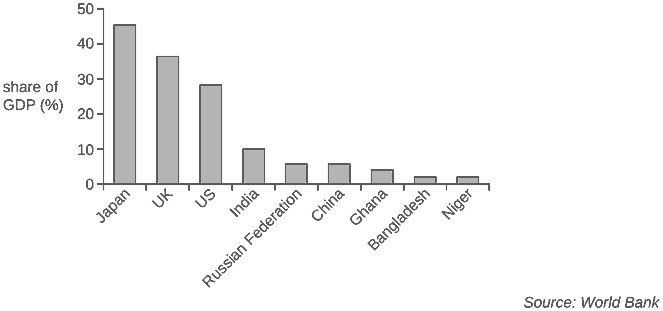
Case study: Widening levels of inequality resulting from the COVID-19 pandemic

Figure 1 Additional government spending in response to the COVID-19 pandemic as a percentage of gross domestic product (GDP), selected countries

Question 1(a)Feb/March 20269708/424 marks

(a) Using the information:

(i) Compare the additional government spending in Japan and Ghana in response to the COVID-19 pandemic. [2]

(ii) Explain one possible reason for the difference between their responses. [2]

Show mark scheme

Compare the additional government spending in Japan and Ghana in response to the COVID-19 pandemic. Japan’s government’s fiscal response was 45% GDP. (1) Ghana’s government’s fiscal response was 2% GDP. (1) Japan’s response was approximately 20+ times the size of Ghana’s response.

(1)

Max 2 marks Explain one possible reason for the difference between their responses. Japan will have had greater ability to access to credit markets to increase its debt levels. (1) Therefore, Japan may have been more willing to spend on COVID-19 responses. (1) Ghana’s government may not have had the ability to spend on COVID-19 responses. (1) This might be due to Ghana’s being a relatively low-income country. (1)

Max 2 marks for one developed point.

Accept any valid alternative response.

Question 1(b)Feb/March 20269708/424 marks

(b) With the help of an aggregate demand and aggregate supply diagram, explain the impact of an increase in ‘direct income support’ on real output and the price level. [4]

Show mark scheme

With the help of an aggregate demand and aggregate supply diagram, explain the impact of an increase in ‘direct income support’ on real output and the price level. Correct labelling of axes and correct labelling of curves (1) Changes in co-ordinates correctly labelled and correct identification of shift in AD curve (1) (Max 2 marks) An increase in government spending will shift AD to the right because G is a component of AD. (1) This will cause an increase in real GDP/ real income/output. (1) Price level is likely to increase (1) The effect on the price level will depend upon initial the equilibrium position.

(1) (Max 2 marks)

Question 1(d)Feb/March 20269708/427 marks

(d) Using the information regarding government policy tools, assess the advantages and disadvantages of two policies used by governments during the COVID-19 pandemic to protect their economies. [7]

Show mark scheme

Using the information regarding government policy tools, assess the advantages and disadvantages of two policies used by governments during the COVID-19 pandemic to protect their economies. The policies: Direct income support (grants, ‘furlough’ money) Debt write-offs (lender forgives all/some outstanding debt) Asset purchases (quantitative easing) (Max 1 mark for identifying at least 2 policies) Advantages

  • Government provides support for any fall in income and allows families to survive drop in income.
  • Reduces costs to allow firms to avoid bankruptcy helps to maintain employment.
  • Reduce interest rates so that families/firms can reduce size of debt obligations
  • Reduces costs of government borrowing
  • Promotes the growth of the circular flow of income. up to 2 marks for each developed point – Max 3 marks Disadvantages)
  • Income support is a significant cost to the government and, in the long run, the taxpayer.
  • Will have a significant long-term negative impact on government debt.
  • Potential for exploitation/fraud regarding the use of government financial support
  • Debt write-offs might have a negative impact on the government’s borrowing requirement, in the long run.
  • Quantitative Easing might have a potentially negative effect on the rate of inflation in the long run up to 2 marks for each developed point – Max 3 marks
Question 4Feb/March 20269708/4220 marks

4 The Bank of China has a target inflation rate of around 3%, the Bank of India has a target inflation rate of 4% and the Federal Reserve, the European Central Bank and the Bank of England all have a 2% target inflation rate.

Consider whether central banks should have a target inflation rate of 0%. [20]

Show mark scheme

The Bank of China has a target inflation rate of around 3%, the Bank of India has a target inflation rate of 4%, the Federal Reserve, the European Central Bank and the Bank of England all have a 2% target inflation rate. Consider whether central banks should have a target inflation rate of 0%?

Use Table A: AO1 Knowledge and Understanding, AO2 Analysis, and Table B: AO3 Evaluation, to mark candidate responses to this question

AO1 and AO2 are out of 14 marks. AO3 is out of 6 marks.

Indicative Content Responses may include:

AO1 Knowledge and Understanding and AO2 Analysis

  • definition of a target inflation rate
  • explanation of the process by which a central bank attempts to meet a target inflation rate – including changes in central bank lending rate/open market operations/quantitative easing
  • explanation why central banks state target inflation rates – main reasons would include the aim to achieve price stability and to support sustainable growth
  • a 0% inflation target might help businesses and household to make long term spending plans
  • very low rates of inflation will allow real wages to adjust without cutting nominal wages
  • very low rates of inflation will help a government to reduce its expenditure on debt repayment/help to reduce a public sector fiscal deficit
  • a very low target rate of inflation might eventually lead to a reduction in menu/shoe leather costs.

AO3 Evaluation

  • if the inflation target set i.e. 0% is too low, consumer spending might fall due to expectations of further price falls
  • a very low inflation target will reduce profit expectations and a subsequent fall in the level of investment is likely
  • a 0% inflationary target based on low interest rates, might result in an outflow of short-term capital and a negative effect on the overall balance of payments
  • 0% inflationary targets will remove the ability of a central bank to use interest cuts to stimulate the economy/ liquidity trap
  • due to index linking, a very low inflationary target is likely to lead to a re- distribution of income from savers to borrowers
  • a 0% inflationary target might trigger falling prices and cause a deflationary outcome/ ultimately linked to lower economic growth and higher levels of unemployment
  • a conclusion should be attempted based on the statement in the question

Accept all valid responses.

AO1 Knowledge and understanding and AO2 Analysis

AO3 Evaluation

Question 4Oct/Nov 20259708/4120 marks

4 Evaluate the effect of a rise in the exchange rate on the achievement of the macroeconomic aims of a country. [20]

Show mark scheme

Evaluate the effect ofa rise in the exchange rate on the achievement of the macroeconomic aims of a country.

AO1 Knowledge and understanding and AO2 Analysis

  • Explanation of the effect of a rise of the $US on the US’s exports and imports OR any other currency
  • Analysis of exchange rate rise on the price of exports (X) and imports (M) and the consequences fortheir demand, links to aggregate demand (AD) through the balance of payments effect (X–M). A decrease in exports and an increase in imports, potentially worsening the trade balance
  • Candidates may refer to this change in terms of injections and leakages and their effect on AD.
  • The use of AD and AS diagram to show this effect on the level of national income and economic growth.
  • Alternatively, the analysis of the increased injection may be through the multiplier effect and/or the 45° diagram.
  • A clear link should be made between the effect of the rise in exchange rate and economic growth, reference to the type of economic growth: actual or potential should be made.
  • Ignore $US on the US’s exports
  • Minimum of 2 aims developed for L3

AO3 Evaluation

  • Why the US$ rate rose and how that might have affected economic growth.
  • The nature of exports fromthe USto the rest of the world: oil, agricultural produce etc. and the price elasticity of demand for that produce.
  • Extent the effects of a rise in ER on employment and inflation.
  • The effect of the $US being a reserve currency.
  • The size of the marginal propensity to export/import on the multiplier and its affect on the change in AD
  • The impact of inflow of capital in terms of MNC and the effect on US output and growth.
  • The percentage of US GDP represented by (X–M)
  • Accept all valid responses

AO1 Knowledge and understanding and AO2 Analysis

AO3 Evaluation

Question 4Oct/Nov 20259708/4220 marks

4 Evaluate the effect of a fall in the exchange rate on the achievement of the macroeconomic aims of a country. [20]

Show mark scheme

Evaluate the effect ofa fall in the exchange rate on the achievement of the macroeconomic aims of a country.

AO1 Knowledge and understanding and AO2 Analysis

  • Knowledge and understanding of the effectof depreciation/devaluation on the exchange rate (ER), and economic growth.
  • Analysis of Ex R fall on the price of exports (X) and imports (M) and the consequences for their demand, links to aggregate demand (AD) through the balance of payments effect (X–M).
  • Candidates may refer to this change in terms of injections and leakages and their effect on AD.
  • The use of AD and AS diagram to show this effect on the level of national income and economic growth.
  • Alternatively, the analysis of the increased injection may be through the multiplier effect and/or the 45° diagram.
  • Identification of at least two macroeconomic aims of a country: e.g. balance of payments, economic growth, inflation, employment.
  • Analysis of the impact of the change in ER on at least 2 macroeconomic aims to comment on their likely achievement.

AO3 Evaluation

  • The ability of supply capacity in the country to react to the effectof the fall in the exchange rate.
  • The nature of exports from many countries where exports of agricultural commodities are price inelastic in supply.
  • The short run effect on employment (positive) and inflation (negative), reference to the Phillips curve.
  • Effect on a country’s ability to service international debt positive if denominated in domestic currency but negative if borrowings are in a foreign currency.
  • The impact of the inflow of capital in terms of FDI/MNC and the effect on output, employment and growth.
  • The proportion of international trade in relation to GDP.

Accept all valid responses.

Question 4Oct/Nov 20259708/4320 marks

4 With the help of a diagram, evaluate the effectiveness of using monetary policy to increase the rate of economic growth in a country. [20]

Show mark scheme

With the help of a diagram, evaluate the effectiveness of usingmonetary policy to increase the rate of economic growth in an economy.

Use Table A: AO1 Knowledge and understanding and AO2 Analysis and Table B: AO3 Evaluation to mark candidate responses to this question.

AO1 and AO2 out of 14 marks. AO3 out of 6 marks.

Indicative content Responses may include:

AO1 Knowledge and understanding and AO2 Analysis

  • A clear outline of different types of monetary policy, including changes to the money supply, changes in interest rates and exchange rate policy.
  • A detailed explanation of what is meant by ‘economic growth’ and why it is important.
  • An accurate, clearly labelled diagram indicating the link between an increase in aggregate monetary demand and an increase in real GDP/output.
  • Analysis can be used to show how a government will be able to increase the money supply, which in turn might reduce interest rates, increase investment and ultimately increase aggregate demand and GDP, thus achieving economic growth.
  • Central banks might directly reduce interest rates which would be expected to increase borrowing and consumer expenditure and ultimately lead to an increase in real GDP.
  • Alternative analysis might focus upon the impact of changes in the exchange rate and how a devaluation of the currency might lead to an export led growth of income, employment and real GDP. No diagram Max L3

AO3 Evaluation

  • The immediate impact of monetary policy on income, output and growth will depend upon the existing state of the economy when the policy is introduced. The policy will have a greater impact when the economy has significant spare capacity.
  • An increase of the money supply might be relatively ineffective due to the existence of the liquidity trap or due to a low elasticity of the MEC curve.
  • Negative expectations would also determine the extent to which a decrease in interest rates is likely to increase consumer expenditure, which will then reduce the impact on output.
  • Currency devaluation will only be effective if this results in a net increase in trade. This will be determined to some extent by the Marshall-Lerner condition.
  • Increase in money supply might cause high inflation.
  • In a situation of ‘stagflation’ when unemployment is high and prices are high the use of monetary policy might solve one problem at the expense of the other. A more appropriate long-term policy might be supply-side based. For example, investment in skills training/education
  • A conclusion should attempt to assess the relative effectiveness of each type of policy approach and consider which approach is likely to be the most effective in the short run and then compare this with possible outcomes that might be achieved in the long run.

Accept all valid responses.

AO1 Knowledge and understanding and AO2 Analysis

AO3 Evaluation

Question 4Oct/Nov 20259708/4420 marks

4 A country imposes a tariff of 20% on imported goods and restricts the number of immigrants entering the country.

Evaluate, with the aid of a diagram(s), the impact of these two policies on the rate of inflation in that country. [20]

Show mark scheme

A countryimposes a tariff of 20% on imported goods and restricts the number of immigrants entering the country. Evaluate, with the aid of a diagram(s), the impact of these two policies on the rate of inflation in that country. Use TableA:AO1 Knowledge and understanding andAO2 Analysis and Table B: AO3 Evaluation to mark candidate responses to this question.

AO1 and AO2 out of 14 marks. AO3 out of 6 marks.

Indicative content Responses may include:

AO1 Knowledge and understanding and AO2 Analysis

  • Definition of a tariff and analysis of the effect of a tariff on the price of goods and a development of this in terms of the direct effect on the price of goods bought by consumers.
  • The analysis may also be in terms of the cost of imported raw materials and cost push inflation.
  • Analysis of impact on macroeconomy in terms of leftwards shift of aggregate supply (AS) promoting cost push inflation.
  • A similar analysis of the effect of restricting the supply of labour and reducing any potential decrease in the general wage rate.
  • A relevant diagram to show either the effect of a tariff on cost/prices, the restriction of immigrants and the effect on wages and the impact on AS

AO3 Evaluation

  • The elasticity of supply of domestically produced goods subject to the tariff.
  • The availability of domestic labour force prepared to do jobs.
  • The rate of inflation will also depend on the level of aggregate demand (AD). The restriction on immigrants will reduce the level of demand and hence demand pull inflation.
  • Limited migration may allow domestic workers to claim higher wages and contribute to cost push inflation.

Accept all valid responses.

AO1 Knowledge and understanding and AO2 Analysis

AO3 Evaluation

Question 5Oct/Nov 20259708/4420 marks

5 Evaluate whether an increase in a government’s budget deficit will always lead to economic growth. [20]

Show mark scheme

Evaluate whether an increase in a government’s budget deficit will always lead to economic growth. Use TableA:AO1 Knowledge and understanding andAO2 Analysis and Table B: AO3 Evaluation to mark candidate responses to this question.

AO1 and AO2 out of 14 marks. AO3 out of 6 marks.

AO1 Knowledge and understanding and AO2 Analysis

  • Definitions of budget deficit, economic growth.
  • Use of AD/AS models or 45o model to analyse government budget deficit.
  • Use of the circular flow of income to explain the effect of an increase in government spendingincreases the level of aggregate demand within the economy.
  • Reference to the short run and long run economic growth.
  • Reference can be made to employment, inflation, the balance of payments
  • Impact of supply side expenditure of budget deficit on education/investment

AO3 Evaluation

Evaluation may be by individual measure or by comparing the measures.

  • Closeness of economy to full employment.
  • Use of Phillips’ Curve to reflect inflationary impact.
  • Commentary on the size of marginal propensity to consume and its effects on the size of the multiplier.
  • The role of expectations in determining the reactions to expansionary fiscal policy
  • Reference to the multiplier being an analysis of the trade cycle which exists for only a short run and that the accelerator effect is needed to increase investment and an outwards shift in the production possibility curve for the long run effects.

Accept all valid responses

AO1 Knowledge and understanding and AO2 Analysis

AO3 Evaluation

Case study: The influence of governments

People often talk as if governments can easily control economic outcomes.

Content removed due to copyright restrictions.

High-income countries decided to focus on economic growth realising that it was essential to generate revenues and taxes needed to pay for costly investments, for example, the storage of renewable energy, required to reduce the use of fossil fuels.

Sources: Irwin Stelzer, The Sunday Times, 29 January 2023 Ray Bourne, The Times, 9 February 2023

Question 1(b)May/June 20259708/416 marks

(b) To keep unemployment low, one government used fiscal policy. Analyse how this policy can affect unemployment rates. [6]

Show mark scheme

To keep unemployment low, one government used fiscal policy. Analyse how this policy can affect unemployment rates. Explanation of meaning of fiscal policy (Government spending and Taxation).

(2).

Up to 4 marks for a correct diagram explained. Comment on how it could affect output and unemployment – up to 2 for comment on each example. Fully developed point up to 4 marks.

Question 1(d)May/June 20259708/418 marks

(d) Assess whether the article provides sufficient evidence to justify its conclusion that the intervention of governments has little effect on economic outcomes. [8]

Show mark scheme

Assess whether the article provides sufficient evidence to justify its conclusion that the intervention of governments has little effect on economic outcomes. Evidence. – War in Ukraine disrupted supplies, but the Russian government was responsible for the war and they stopped the flow of natural gas. So, some evidence against the conclusion that governments have little effect on outcomes.

  • banks raised interest rates to stop rise in inflation.(1) Some evidence against the conclusion. (1)
  • governments decided to concentrate on growth and did not direct finances to encourage ‘green energy’. (1) This is some evidence against the conclusion as this did affect the economic outcome. (1)
  • article mentions billions of private transactions. (1) Not clear whether this supports or contradicts the conclusion. (1)
  • Article does not give evidence that supply-side policies were the reason for low unemployment in Germany. (1) Some evidence supports the conclusion. (1)
  • evidence about link between unemployment and fiscal policy does support the conclusion. (1)
  • No clear conclusion (1)

Up to 2 marks for explanation of any of above points, maximum 7 Reserve a mark for conclusion.

Question 4May/June 20259708/4120 marks

4 A country is experiencing stagflation, when there is a high rate of inflation at the same time as a negative output gap.

With the help of a diagram, evaluate the effectiveness of using fiscal policy to solve this problem. [20]

Show mark scheme

A country is experiencing stagflation, when there is a high rate of inflation at the same time as a negative output gap. With the help of a diagram, evaluate the effectiveness of using fiscal policy to solve this problem.

Use Table A: AO1 Knowledge and understanding and AO2 Analysis and Table B: AO3 Evaluation to mark candidate responses to this question.

AO1 and AO2 out of 14 marks. AO3 out of 6 marks.

Indicative content Responses may include:

AO1 Knowledge and understanding and AO2 Analysis

  • A clear definition of inflation and why inflation might cause problems.
  • A detailed explanation of what is meant by a ‘negative output gap’.
  • An accurate, clearly labelled aggregate supply and aggregate demand diagram to identify a ‘negative output gap’.
  • An explanation of what is meant by fiscal policy and how it is used to control inflation or close an output gap.
  • Analysis might use a diagram to indicate how fiscal policy might be used to close a negative output gap.
  • Analysis might use a diagram to indicate how fiscal policy might be used to reduce the level of inflation.
  • Analysis using aggregate demand and aggregate supply curves could be used to show why it is possible to have high inflation and a negative output gap at the same time.

Accept Keynesian Cross diagram

Maximum 8 marks if no relevant diagram

AO3 Evaluation

  • The use of fiscal policy to reduce aggregate demand might help to reduce the level of inflation, it will simultaneously increase the negative output gap and vice versa.
  • An alternative approach to fiscal might be the use of supply side measures which would increase aggregate supply, reduce the rate of inflation and help to close the negative output gap in the long run.
  • Long run supply-side policies are likely to focus on attempts to increase productivity. This frequently involves significant investment in new technology which might lead to a rise in unemployment in the short run.
  • Fiscal policy may be inappropriate or ineffective unless paired with supply-side reforms. More suitable policies might include reducing regulation, cutting production costs, or encouraging productivity.
  • May lead to crowding out A conclusion should attempt to assess the relative effectiveness of each type of policy approach and consider which approach is likely to be the most effective in the short run and then compare this with possible outcomes that might be achieved in the long run.

AO1 Knowledge and understanding and AO2 Analysis

AO3 Evaluation

Question 4May/June 20259708/4420 marks

4 A country with an open economy has falling demand for exports.

Consider the view that monetary policy alone will solve this problem. [20]

Show mark scheme

A country with an open economy has falling demand for exports. Consider the view that monetary policy alone will solve this problem.

Use Table A: AO1 Knowledge and understanding and AO2 Analysis and Table B: AO3 Evaluation to mark candidate responses to this question.

AO1 and AO2 out of 14 marks.

AO3 out of 6 marks.

Indicative content Responses may include:

AO1 Knowledge and understanding and AO2 Analysis

  • A definition of an open economy in terms of its foreign trade sector in the aggregate demand equation.
  • The effects of the falling exports on the level of aggregate demand.
  • The candidate should show the intended effect of monetary policy on the demand for exports – A choice is made of reducing the exchange rate to boost exports through increasing external demand and the effect of this on aggregate demand.
  • Governments can directly devalue the exchange rate.
  • Government can indirectly reduce the exchange rate by increasing the money supply/decreasing interest rates.

AO3 Evaluation

  • The elasticity of demand for exports and the short-run, long run implications.
  • An explanation of whether the aims can be achieved in the short run or long run.
  • Governments might use supply-side policies e.g. subsidies.
  • Comments on other aims of the government which may be affected and how they may be affected by the policy/policies suggested.
  • The government impact through directly reducing the rate of interest and the effects of this through the monetary transmission mechanism can be traced.
  • Comments on the negative impact on other government aims e.g. Inflation.

Accept all valid responses

AO1 Knowledge and understanding and AO2Analysis

AO3 Evaluation

Question 4Feb/March 20259708/4220 marks

4 With the help of a diagram, assess the effectiveness of government policies that might be used to reduce demand-pull inflation. [20]

Show mark scheme

With the help of a diagram, assess the effectiveness of government policies that might be used to reduce demand-pull inflation. Use TableA:AO1 Knowledge and understanding andAO2 Analysis and Table B: AO3 Evaluation to mark candidate responses to this question.

AO1 and AO2 out of 14 marks. AO3 out of 6 marks.

Indicative content Responses may include:

AO1 Knowledge and understanding and AO2Analysis

  • A clear outline of different causes of demand-pull inflation and why inflation might cause problems.
  • A more detailed analysis of the causes of demand-pull inflation, can use either a monetarist or Keynesian approach, supported by an accurately labelled diagram
  • A description of alternative policies that a government might use to reduce demand-pull inflation, can focus upon either a Keynesian or monetarist perspective
  • Analysis can be used to show how a government will be able decrease aggregate demand, by appropriate fiscal policy. For example, by increasing direct taxation. This analysis might also be supported by a relevant diagram
  • Alternatively, a government might focus on the use of different types of monetary policy. For example, increasing interest rates, re-valuing the currency or open market operations. Accept alternative supply side policies.

L2 Max if no relevant diagram provided

AO3 Evaluation

  • Increasing the use of direct taxation might have a negative impact on long term economic growth and/or unemployment
  • Decreasing government expenditure might mean key sectors such as education and health care having a long-term negative impact on social welfare
  • The overall impact of contractionary fiscal policy will depend upon the state of the economy when the new policies were introduced.
  • Exchange rate policies which promote a re-valuation of the currency might have a negative impact on an economy’s balance of payments, depending upon the Marshall-Lerner condition. This might also cause unemployment in the export producing sector.
  • The use of high interest rates might lead to lower levels of investment which, in turn, will have a negative impact on economic growth in the long term
  • A contractionary monetary might also produce additional economic outcomes. For example, a rapid fall in house prices due to the high cost of borrowing for house purchase.
  • A conclusion should attempt to assess the relative effectiveness of each type of policy approach and consider which approach is likely to be the most effective in the short run and then compare this with possible outcomes that might be achieved in the long run.

Accept all valid responses.

AO1 Knowledge and understanding and AO2Analysis

AO3 Evaluation

112 more questions from 2020–2024

🔒 Unlock every Effectiveness of policy options to meet all macroeconomic objectives question from 2020–2024

All 112 come with their mark schemes, answers and case studies, and appear in the practice tool above once you’re signed in. It’s free.

Create a free accountSign in

A few of them

  • 9708/32 · Oct/Nov 2024 · Question 22Which argument for lowering income tax rates… 🔒
  • 9708/33 · Oct/Nov 2024 · Question 18A government decides to cut the rate… 🔒
  • 9708/33 · Oct/Nov 2024 · Question 20How would decreasing interest rates be most… 🔒
  • 9708/33 · Oct/Nov 2024 · Question 23An economy experiences falling incomes and rising… 🔒
  • 9708/33 · Oct/Nov 2024 · Question 24Monetary policy does not usually… 🔒
  • + 107 more, by year in the table above

Questions and mark schemes are from past Cambridge papers and are reproduced for revision. Topical Vault is an independent revision resource, not affiliated with or endorsed by Cambridge Assessment International Education.

A Level Economics questions by topic

Each topic opens this practice tool with only that topic’s questions, plus how often it comes up and every question on it in one list.

  1. Unit 7The price system and the microeconomy
  2. Ch 30Utility
  3. Ch 31Indifference curves and budget lines
  4. Ch 32Efficiency and market failure
  5. Ch 33Private costs and benefits, externalities and social costs and benefits
  6. Ch 34Types of cost, revenue and profit, short-run and long-run production
  7. Ch 35Different market structures
  8. Ch 36Growth and survival of firms
  9. Ch 37Differing objectives and policies of firms
  10. Unit 8Government microeconomic intervention
  11. Ch 38Government policies to achieve efficient resource allocation and correct market failure
  12. Ch 39Equity and redistribution of income and wealth
  13. Ch 40Labour market forces and government intervention
  14. Unit 9The macroeconomy
  15. Ch 41The circular flow of income
  16. Ch 42Economic growth and sustainability
  17. Ch 43Employment and unemployment
  18. Ch 44Money and banking
  19. Unit 10Government macroeconomic intervention
  20. Ch 45Government macroeconomic policy objectives
  21. Ch 46Links between macroeconomic problems and their interrelatedness
  22. Ch 47Effectiveness of policy options to meet all macroeconomic objectives
  23. Unit 11International economic issues
  24. Ch 48Policies to correct disequilibrium in the balance of payments
  25. Ch 49Exchange rates
  26. Ch 50Economic development
  27. Ch 51Characteristics of countries at different levels of development
  28. Ch 52Relationship between countries at different levels of development
  29. Ch 53Globalisation