Question 29May/June 20269708/311 mark
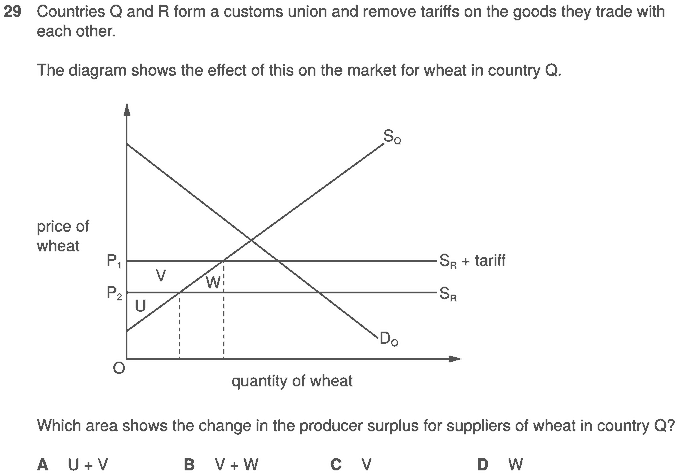
Show answer
CCorrect answer
Cambridge 9708, Paper 3 & 4. 1,666 questions, 2020 to 2026.
Paper 3 multiple-choice questions and Paper 4 data-response/essay questions and case studies, retyped from the original Cambridge material; artwork and data tables are reproduced as images. Mark schemes show the official answer key and level-marked indicative content.
Questions on globalisation: its causes and effects, trading blocs and free-trade areas, the World Trade Organization, and the costs and benefits for different countries.
32 past paper questions on this topic since 2020, across 11 exam sessions.
| Year | Paper 3 | Paper 4 | Total | Chart |
|---|---|---|---|---|
| 2026 | 3 | 0 | 3 | |
| 2025 | 7 | 4 | 11 | |
| 2024 | 5 | 4 | 9 | |
| 2023 | 3 | 2 | 5 | |
| 2021 | 1 | 1 | 2 | |
| 2020 | 2 | 0 | 2 |
The whole topic on one page, with answers and mark schemes. Printing this page prints just this list.
CCorrect answer
The African Union (AU) consists of 55 countries of Africa, but only 18% of total trade of the AU is between countries in Africa. If the AU decides to co-operate on trade policy, what would make the greatest change to this situation?
DCorrect answer
What is likely to be found in a free trade area?
ACorrect answer
What occurs in a monetary union?
ACorrect answer
As a member of the European Union, Greece must trade at the same exchange rate, tied to the euro, as stronger economies such as Germany. Greece has a persistent balance of payments deficit. How would changing to a floating exchange rate help Greece?
CCorrect answer
What is not a likely feature of a customs union?
DCorrect answer
A country’s government imposes a tariff on steel imports. What is the likely impact of this tariff on this country’s economy?
BCorrect answer

DCorrect answer

DCorrect answer
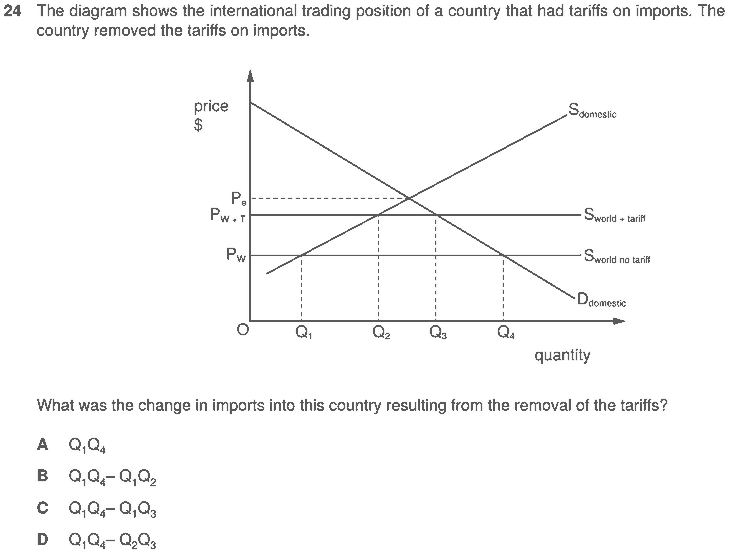
DCorrect answer
Many low-income countries have large proportions of the population below the World Bank’s absolute poverty level of $2.15 per day (United States dollars, 2022). One way in which these countries try to reduce their poverty is by the migration of workers to richer countries. The migrants send a portion of their incomes, known as remittances, back home to support their families.
These overseas workers are a link between migration and development. The flow of remittance money is greater than the foreign direct investment and official development aid received by middle-income and low-income countries. Total remittances received by those countries in 2022 was $650 billion, of which 45% ($293 billion) was received by only five countries.
About 50% of migrants from low-income countries went to high-income countries.
Migrants can find their incomes increase significantly. A nurse may make seven times more in Australia than in the Philippines, adjusted for purchasing power parity (PPP).
Unlike official aid, remittances flow directly to their receivers and are a stable source of income. They can buy extra food and they may provide savings for the receiver. They may reduce child labour in disadvantaged families and allow for higher spending on education through higher enrolments and more years of completed schooling.
Migration can reduce unemployment and raise wages in home countries. Migration may lead to larger benefits for the home country by increasing the rates of return on human capital caused by the creation of better, more productive, and higher paying jobs.
When the flow of migrants goes to a host country whose population is ageing, it may reduce the average age of the population. This can lead to an increase in the size of the labour force, reduce the age dependency ratio and make a positive tax contribution. The migrants increase the demand for host country output and may utilise housing in less popular areas. Those with a high level of education make an even more significant contribution to economic output.
Sources: The Guardian, 23 August 2023 asia.nikkei.com, 3 March 2023 imf.org, March 2020
(d) Consider if the article contains sufficient information to support the view that migrants have only a beneficial economic impact on the host country. [7]
Considerif the article contains sufficient informationto support the view that migrants have only a beneficial economic impact on the host country. Beneficial to host country: Higher labour force(1), pay taxes (1) allows pay- as you-go pension system (1), increases demand (1), Increased productivity and economic growth (1)Entrepreneurship e.g.new business startups Max 3. Disadvantages: The effects of higher demand for housing (1),health services
(1), education services (1). cultural differences (1) are not mentioned, Other considerations-wage suppression in some sectors, short term unemployment effects, integration/training costs, regional disparities Max 3. Justified Conclusion (1)
A government commission published a report saying that global poverty and inequality were worsening and there was a risk that the gap between the rich and the poor would increase.
But, according to a newspaper, a lot of what is said about inequality is wrong. It overlooks the fact that the past 50 years saw a period of dramatic reduction in global inequality. The normal measurement of relative inequality is the Gini coefficient. The figure for global inequality in 1975 was 0.75, in 2020 it was 0.72 and in 2022 it was 0.67.
It is important to understand this trend rather than make the mistake of the commission.
The fall in global inequality should not come as a surprise. For about two hundred years the benefits of industrialisation went mainly to countries in Europe and North America. Income inequality between these countries and poorer countries worsened. The spread of globalisation in recent decades has meant this difference has lessened. Countries such as China and India have benefited from large increases in per capita (average) income, as shown in Table 1.1.
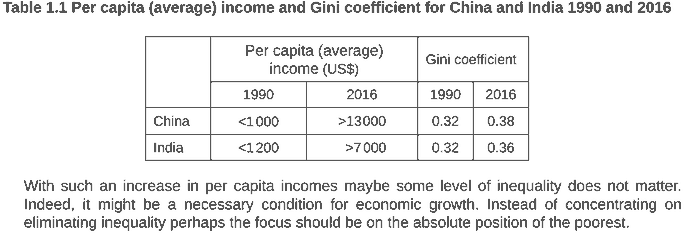
If the attention is on the relief of poverty rather than the wealth of the richest, improvements can be seen. Life expectancy has increased, most noticeably by ten years in the past two decades in the poorest region of sub-Saharan Africa. Literacy rates have also increased. Those in absolute poverty across the world have fallen from more than a third to under a tenth of the world’s population. And all this while the world’s population has increased.
Critics of globalisation and foreign direct investment (FDI) by multinational companies point to the possible negative environmental effects, the weakening of individual cultures and the reliance on international financial institutions that can fail. They also claim there can be exploitation of workers leading to greater wage inequality and possible increases in domestic unemployment as cheaper goods are imported.
Source: The Times, 23 August 2021
(c) With reference to the article, explain the idea of globalisation and assess whether there is enough evidence to conclude that globalisation has a net benefit for everyone. [8]
With reference to the article, explainthe idea of globalisationand assess whetherthere is enoughevidence to conclude that globalisation has a net benefit for everyone. Globalisation means the growing interdependence of the world's economies, cultures, and populations, brought about by cross-border trade in goods and services, technology, and flows of investment, people, and information. (2) Benefits mentioned include increases in incomes, life expectancy (10 years in sub-Saharan Africa) and literacy rates. A fall in absolute poverty. A fall in inequality (2) Drawbacks mentioned environmental issues, exploitation of workers, domestic unemployment, increasing dependence on other countries. (2) The benefits have occurred while the population has increased so are probably substantial. However, there is no statistical information to compare the benefits with the drawbacks. Also it depends on what ‘net benefit’ means– does it mean an increase in quantity of goods, higher profits, or does it mean wider choice, better quality. It is difficult to make an overall assessment. (2)
5 A free trade area gains all the benefits associated with being a member of a customs union while avoiding all the costs associated with being a member of a customs union.
Evaluate this statement. [20]
A free trade area gains all the benefits associated with joining a customs union while avoiding all the costs associated with being a member of a customs union. Evaluate this statement.
Use Table A: AO1 Knowledge and understanding and AO2 Analysis and Table B: AO3 Evaluation to mark candidate responses to this question.
AO1 and AO2 out of 14 marks. AO3 out of 6 marks.
Indicative content Responses may include:
AO1 Knowledge and understanding and AO2 Analysis
AO3 Evaluation
Accept all valid responses.
AO1 Knowledge and understanding and AO2 Analysis
AO3 Evaluation
5 Globalisation will have an equally beneficial effect on the standard of living in both high-income and low-income countries.
Evaluate this statement. [20]
Globalisation will have an equally beneficial effect on the standard of living in both high-income and low-income countries Evaluate this statement
Use Table A: AO1 Knowledge and understanding and AO2 Analysis and Table B: AO3 Evaluation to mark candidate responses to this question.
AO1 and AO2 out of 14marks. AO3 out of 6 marks.
Indicative content Responses may include:
AO1 Knowledge and understanding and AO2Analysis
AO3 Evaluation
Accept all valid responses.
🔒 Unlock every Globalisation question from 2020–2024
All 18 come with their mark schemes, answers and case studies, and appear in the practice tool above once you’re signed in. It’s free.
Questions and mark schemes are from past Cambridge papers and are reproduced for revision. Topical Vault is an independent revision resource, not affiliated with or endorsed by Cambridge Assessment International Education.
Each topic opens this practice tool with only that topic’s questions, plus how often it comes up and every question on it in one list.