Question 3May/June 20269708/311 mark
During a recession, two holiday companies agree to join together and become a single company to improve their chances of survival. How would this be described?
Show answer
CCorrect answer
Cambridge 9708, Paper 3 & 4. 1,666 questions, 2020 to 2026.
Paper 3 multiple-choice questions and Paper 4 data-response/essay questions and case studies, retyped from the original Cambridge material; artwork and data tables are reproduced as images. Mark schemes show the official answer key and level-marked indicative content.
Questions on how firms grow and survive: internal growth, horizontal, vertical and conglomerate integration, and why small firms survive alongside large ones.
55 past paper questions on this topic since 2020, across 17 exam sessions.
| Year | Paper 3 | Paper 4 | Total | Chart |
|---|---|---|---|---|
| 2026 | 3 | 0 | 3 | |
| 2025 | 4 | 2 | 6 | |
| 2024 | 10 | 2 | 12 | |
| 2023 | 5 | 1 | 6 | |
| 2022 | 7 | 1 | 8 | |
| 2021 | 8 | 3 | 11 | |
| 2020 | 5 | 4 | 9 |
The whole topic on one page, with answers and mark schemes. Printing this page prints just this list.
During a recession, two holiday companies agree to join together and become a single company to improve their chances of survival. How would this be described?
CCorrect answer
What is a likely reason for a firm to remain small?
DCorrect answer
Two US chemical production firms merged. What is the likely benefit to the US chemical industry of this merger?
CCorrect answer
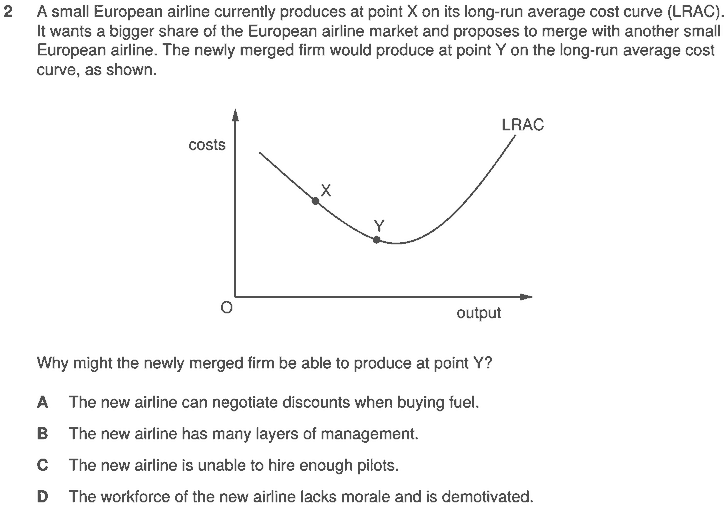
ACorrect answer
What is an example of forward vertical integration?
CCorrect answer
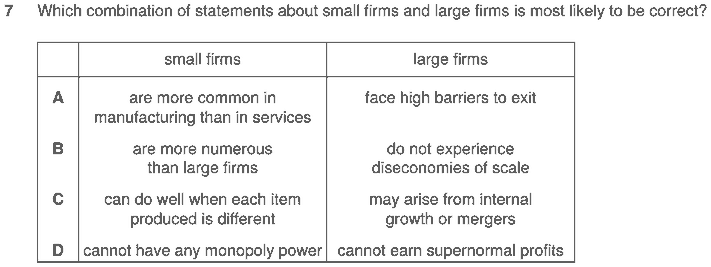
CCorrect answer
Two manufacturing firms in the same industry, producing similar products, are considering merging together. What would be the least convincing reason for merging?
DCorrect answer
Between 2000 and 2020, Brazilian GDP, measured in US dollars ($), rose from $1.19 trillion to $1.89 trillion at constant prices (2015). In the same period GDP per head rose from $6745 to $8204 at constant prices (2015).
The strength of the Brazilian economy lies in the variety and quantity of its natural resources. For example, Brazil is one of the world’s largest exporters of agricultural commodities, mainly soya and beef. There are also significant exports of minerals. Brazil is the second largest iron ore producer in the world and extracts 3.4% of the world’s crude oil.
World agricultural markets are dominated by four large commodity traders that buy and sell products such as grain and soya. They have grown through both horizontal integration and vertical integration. These traders own many large farms, they process farm produce and transport it to trade on international markets. In addition to buying and selling, the traders provide seed and fertiliser to farmers and supply storage for their products. They use agricultural by-products to produce items like biofuel. These traders also provide financial services to these markets.
Commodity traders are very important to the development of complex global food markets. Food prices, access to scarce resources such as land and water, climate change and food security are all affected by the activities of traders. In Brazil, the output of 15 000 farmers is purchased by a single trader.
In Brazil the development of agriculture, mining and oil extraction all contribute to environmental degradation. Both agriculture and mining have been accompanied by deforestation of the Amazon rainforest. Access roads to mining areas also lead to deforestation. Waste water from mining activity is frequently stored in reservoirs behind dams. On two occasions in the last 10 years these dams failed to hold back the water. This led to widespread flooding, the discharge of pollutants such as mercury into rivers, and deaths.
Sources: The Guardian, 23 August 2022
Cereal Secrets, Oxfam Research Report, August 2012 oec.world/en/profile, August 2023
(b) Explain one possible benefit of horizontal integration and one possible benefit of vertical integration. [4]
Explain one possible benefit ofhorizontal integration and one possible benefit of vertical integration. Horizontal integration definition (1) + Benefit (1) Vertical integration definition (1) + Benefit (1)
3 The growth of a firm using a takeover is desirable because it enables consumers to benefit from lower prices and the firm to gain additional profits.
Evaluate this statement. [20]
The growth of a firm using a takeover is desirable because it enables consumers to benefit from lower prices and the firm to gain additional profits. Evaluate this statement.
Use Table A: AO1 Knowledge and understanding and AO2 Analysis and Table B: AO3 Evaluation to mark candidate responses to this question.
AO1 and AO2 out of 14 marks. AO3 out of 6 marks.
Indicative content Responses may include:
AO1 Knowledge and understanding and AO2 Analysis
AO3 Evaluation
Accept all valid responses.
AO1 Knowledge and understanding and AO2Analysis
AO3 Evaluation essay
🔒 Unlock every Growth and survival of firms question from 2020–2024
All 46 come with their mark schemes, answers and case studies, and appear in the practice tool above once you’re signed in. It’s free.
Questions and mark schemes are from past Cambridge papers and are reproduced for revision. Topical Vault is an independent revision resource, not affiliated with or endorsed by Cambridge Assessment International Education.
Each topic opens this practice tool with only that topic’s questions, plus how often it comes up and every question on it in one list.