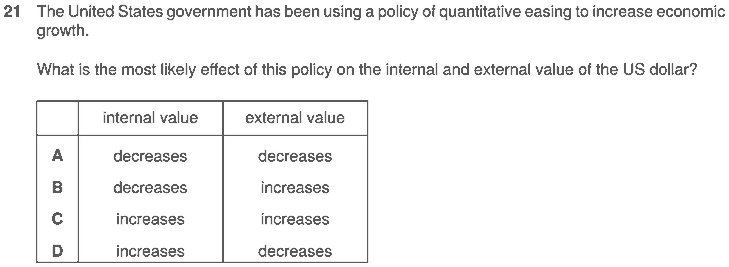
A central bank seeks to prevent a country’s currency from appreciating in value against the US dollar by intervening in the foreign exchange market. What is likely to be a consequence of this action?
Show answer
BCorrect answer
Cambridge 9708, Paper 3 & 4. 1,666 questions, 2020 to 2026.
Paper 3 multiple-choice questions and Paper 4 data-response/essay questions and case studies, retyped from the original Cambridge material; artwork and data tables are reproduced as images. Mark schemes show the official answer key and level-marked indicative content.
Questions on exchange rates at A Level: floating, fixed and managed systems, purchasing power parity, and how exchange rate changes affect the domestic economy.
31 past paper questions on this topic since 2020, across 13 exam sessions.
| Year | Paper 3 | Paper 4 | Total | Chart |
|---|---|---|---|---|
| 2026 | 2 | 2 | 4 | |
| 2025 | 10 | 2 | 12 | |
| 2024 | 5 | 0 | 5 | |
| 2023 | 2 | 1 | 3 | |
| 2022 | 1 | 4 | 5 | |
| 2020 | 2 | 0 | 2 |
The whole topic on one page, with answers and mark schemes. Printing this page prints just this list.
A central bank seeks to prevent a country’s currency from appreciating in value against the US dollar by intervening in the foreign exchange market. What is likely to be a consequence of this action?
BCorrect answer
Which action is open to a government to control the rate of decline in the value of the currency and improve the current account of the balance of payments?
BCorrect answer

DCorrect answer
As a member of the European Union, Greece must trade at the same exchange rate, tied to the euro, as stronger economies such as Germany. Greece has a persistent balance of payments deficit. How would changing to a floating exchange rate help Greece?
CCorrect answer
What is a trade-weighted exchange rate?
ACorrect answer
A central bank officially lowers the price of its currency relative to an agreed rate in terms of other currencies. What type of central bank policy is this?
CCorrect answer
A country with fixed exchange rates faces a surplus on its current account. Which policy is most desirable to maintain the fixed exchange rate?
DCorrect answer

DCorrect answer

ACorrect answer
The value of the currency of an open economy with a fixed exchange rate is significantly below its purchasing power parity value. If the economy decides to adopt a floating exchange rate, which of its macroeconomic policy aims is most likely to benefit?
ACorrect answer

ACorrect answer
Which policy would not lead to an increase in the value of a country’s currency?
ACorrect answer
Many commercial banks in Japan raised their interest rates on customer accounts in early 2024 for the first time in 17 years. Some banks also increased the interest rates on their housing loans (mortgages), which placed a heavier burden on borrowers.
The rise in interest rates followed the ending of a policy of negative interest rates used by the Bank of Japan (BOJ), the country’s central bank. Previously, the BOJ had set interest rates at –0.1% on some of the deposits made by commercial banks at the central bank.
The increase in interest rates coincided with a falling unemployment rate and expectations that Japan’s economy would grow further in the second half of 2024. This economic growth would be caused by higher wages, increased consumer spending and a depreciation of Japan’s currency, the yen.
The BOJ has a target inflation rate of 2%, but core inflation, which excludes fresh food prices, was last reported at 2.6% in March 2024. Core inflation was forecast to be above target for at least a year. This gave the central bank an opportunity to increase interest rates further. Higher interest rates, however, can reduce demand for loans and restrain economic growth.
Higher interest rates in Japan would usually lead to higher capital inflows from foreign savers causing an appreciation of the yen. Compared to other major economies, however, the interest rates in Japan were still very low. When the interest rate set by the BOJ was 0.1%, the equivalent rate was 5.25% in both the United States (US) and the United Kingdom (UK) and 4.5% in the Eurozone.
The value of the yen fell to a 34-year low in April 2024 as the chances of an expected cut in US interest rates diminished. Intervention by the BOJ to support the yen was seen as a possibility by the foreign exchange markets to restore confidence in the currency and reduce imported inflation.
On the other hand, the weak yen helped Japan’s balance of trade in goods and services. It encouraged export sales despite relatively low global economic growth. Export growth occurred across several products, particularly in transportation equipment. The number of foreign visitors to Japan also increased due to the weak yen.
Sources: Adapted from: japantimes.co.jp, 6 May 2024 morningstar.co.uk, 21 March 2024 kyodonews.net, 1 March 2024 deloitte.com, 18 October 2024
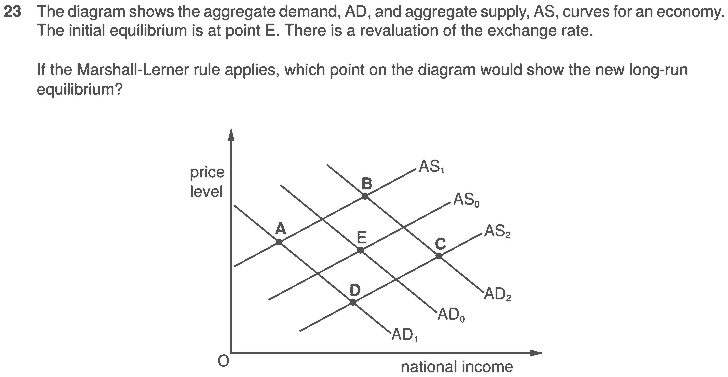
(c) Consider the extent to which a depreciation of the yen has been beneficial for Japan’s balance of trade in goods and services. [6]
Consider the extent to which a depreciation of the yen has been beneficial for Japan’s balance of trade in goods and services. Evidence from the article about its benefits:
(1) due to lower prices of exports (1)
(1)
(d) Assess how diminished chances of a US interest rate cut pushed the yen to a 34-year low in April 2024. [6]
Assess how diminished chances of a US interest rate cut pushed the yen to a 34-year low in April 2024. Economic theory states that:
(1).
(1).
Max 4 for general description of how interest rates affect exchange rates, without clear application to the US and Japan.
4 Evaluate the effect of a rise in the exchange rate on the achievement of the macroeconomic aims of a country. [20]
Evaluate the effect ofa rise in the exchange rate on the achievement of the macroeconomic aims of a country.
AO1 Knowledge and understanding and AO2 Analysis
AO3 Evaluation
AO1 Knowledge and understanding and AO2 Analysis
AO3 Evaluation
4 Evaluate the effect of a fall in the exchange rate on the achievement of the macroeconomic aims of a country. [20]
Evaluate the effect ofa fall in the exchange rate on the achievement of the macroeconomic aims of a country.
AO1 Knowledge and understanding and AO2 Analysis
AO3 Evaluation
Accept all valid responses.
🔒 Unlock every Exchange rates question from 2020–2024
All 15 come with their mark schemes, answers and case studies, and appear in the practice tool above once you’re signed in. It’s free.
Questions and mark schemes are from past Cambridge papers and are reproduced for revision. Topical Vault is an independent revision resource, not affiliated with or endorsed by Cambridge Assessment International Education.
Each topic opens this practice tool with only that topic’s questions, plus how often it comes up and every question on it in one list.